Why YouTube Channels Fail and How Successful Creators Grow
Most creators never make it past their first 20 videos. They post, see minimal views, assume the algorithm is rigged against them or they're just not cut out for this, and quit. What they don't realize is that they're experiencing the most common failure mode in YouTube—and it has almost nothing to do with talent or luck. It has everything to do with what they're measuring and when they're measuring it.
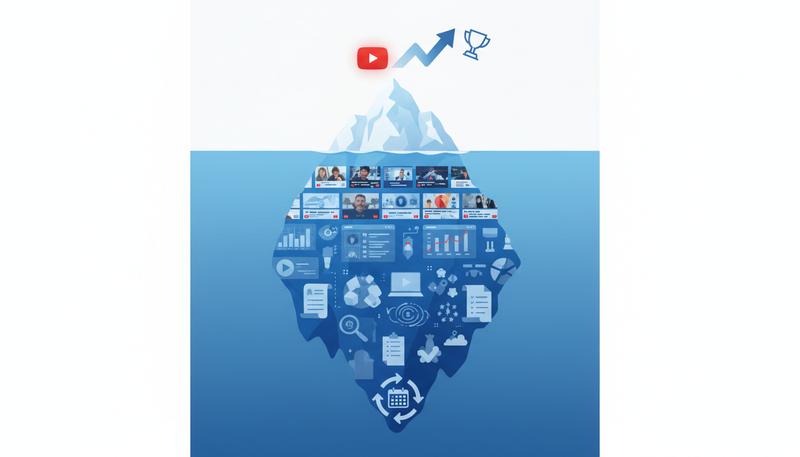
The channels you actually admire didn't start by going viral. They started by going invisible. Marques Brownlee—MKBHD, now one of the most-watched tech creators on the platform—spent his first few years making videos in his parents' basement that barely cracked a few hundred views. Ali Abdaal started with music covers featuring him playing guitar and singing with friends that went largely unnoticed. Every successful creator has a graveyard of content that underperformed—but here's the critical difference: they didn't look at those early failures and think "I'm not good at this." They looked at the data. They figured out what their specific audience actually wanted, how to structure their hooks, exactly where people were dropping off. Each video that flopped was just one more lever they could adjust for next time.
This section pulls back the curtain on survivorship bias, that thing that keeps creators stuck watching highlight reels. You've definitely seen the YouTube success story that starts with "I made this one video and it blew up." What's almost always buried in that story is the 18 months of foundational work underneath—the niche clarity, the thumbnail testing, the retention patterns they'd already figured out. That's not luck showing up early. That's a system so solid that when opportunity finally arrived, they were actually ready to capitalize on it.
YouTube Is Not a Social Network—But It's Also Not Just a Search Engine
Before we go any further, here's something that trips up nearly every new creator.
Instagram is a social network. TikTok, despite all its algorithmic distribution, functions socially at its core—it rewards trends, participation, and cultural moments. Twitter/X is fundamentally a conversation platform. These platforms reward following and social capital. If you're not already someone with an existing audience, they're genuinely tough to break into.
YouTube operates on completely different rules—but understanding those rules requires getting two distinct things right at once.
Yes, YouTube is the world's second largest search engine, handling more than 3 billion searches per month, with viewers consuming over a billion hours of content daily. Search matters. Keyword strategy matters. There's a real audience arriving with explicit intent—searching "how to fix a leaky faucet" or "best mirrorless camera under $1000"—and serving that intent well is a legitimate growth path, especially early in a channel's life.
But if you stop there, you'll build the wrong kind of channel for the wrong reasons. Because here's what the data from successful channels consistently shows: for most established creators, the homepage and browse feed—not search—drives the majority of their views. YouTube's recommendation engine is increasingly the dominant force. Viewers open the app without a specific destination in mind, and YouTube surfaces content it predicts they'll enjoy based on their watch history, session behavior, and engagement patterns. This is passive discovery—the algorithm finding your audience for you, rather than your audience finding you through a search query.
These are two fundamentally different mechanisms, and they reward different things:
Search Intent rewards specificity. Someone searching "how to start a sourdough starter" wants a clear, direct answer. Titles need to match the query. Structure needs to be efficient. These videos can generate steady, predictable traffic for years because the search demand persists.
Browse Curiosity rewards novelty and emotional pull. Someone scrolling their homepage isn't looking for anything specific—they're waiting to be surprised, intrigued, or entertained. A compelling thumbnail and an irresistible title hook them before they've consciously decided to watch. These videos can reach far larger audiences because they're not limited to people who happen to type a specific query.
The implication: a complete YouTube strategy uses both. Early in a channel's life, search-optimized content is your friend—it's predictable, findable, and builds a foundation of watch time and audience data. As your channel earns algorithmic trust, browse-friendly content that's designed to generate curiosity and broad appeal becomes what actually scales your reach.
Here's what this means for creators starting from scratch. Unlike a social network, your follower count doesn't set your ceiling. A brand new channel with zero subscribers can reach substantial audiences if it produces content that either satisfies a clear search intent or generates the kind of engagement signals (strong CTR, high retention) that prompt the algorithm to surface it more broadly. What sets your ceiling is understanding how the system works—specifically whether your content:
- Targets things people are actively searching for, or creates enough curiosity to earn clicks in the browse feed
- Gets clicked when it appears (your thumbnail and title handle this)
- Makes people stay and watch once they've clicked (retention drives this)
- Signals to the algorithm that it's valuable enough to show to more people
None of that is luck. That's all engineering. And every single variable is learnable.
graph TD
    A[Viewer opens YouTube] --> B{Mode?}
    B --> C[Search Intent: types a query]
    B --> D[Browse Curiosity: scrolls homepage]
    C --> E[Your video appears in results]
    D --> F[Your video appears in recommendations]
    E --> G[Viewer clicks - or doesn't]
    F --> G
    G --> H[Viewer watches - or leaves]
    H --> I[Algorithm grades the experience]
    I --> J[Recommend to more - or fewer - viewers]
    J --> A
The Five Core Levers Every Successful Channel Pulls
Boil down every successful YouTube strategy you've ever heard of and you're left with five fundamental variables. These aren't random categories—they directly map to how YouTube's system actually operates, and they line up with the chapters that follow in this course. Learn to control all five levers and growth compounds. Ignore one of them and you've created a ceiling that nothing else can break through.
Lever 1: Niche
Your niche determines who you're actually talking to, what problems or desires you're solving, and how much real competition you're facing. Choose poorly and you end up in one of two traps: either a topic so crowded you can't stand out, or something so narrow there's barely an audience there. Getting this right isn't just about doing what you love—it's about finding where what you can deliver meets what people actually want and where you can realistically compete.
Garrett Yamasaki's WeLoveDoodles channel is a perfect example: instead of making generic dog content or "pets" broadly, he focused exclusively on Doodles. That specificity meant a smaller channel could build real loyalty fast because he wasn't trying to appeal to everyone.
Lever 2: Discoverability
Discoverability is what determines whether anyone finds your content in the first place. This covers YouTube SEO—keyword research, title structure, tags, descriptions, chapter markers—all the signals that tell YouTube what your video is actually about and who should see it. It also includes how you set up your channel itself—your description, your playlists, your channel art—which all send signals about what you make and who you're making it for.
A genuinely great video that nobody discovers is basically invisible. Discoverability is the front door.
Lever 3: Click Appeal
When YouTube shows your video to someone—in search results, the browse feed, or as a recommendation—you've got maybe half a second to convince them to click. Your thumbnail and title do all that work. Together they function like an ad for your content, and the metric that measures how well they're working is Click-Through Rate (CTR): the percentage of people who see your video and actually click.
Most new creators treat this lever like an afterthought. They slap whatever screenshot looks okay onto their video and move on. But YouTube's algorithm is watching CTR closely. If your content is being shown to people and they're not clicking, the algorithm reads that as a signal to show it to fewer people next time. Get it right and you create a flywheel. Get it wrong and you build something invisible.
Lever 4: Retention
Getting the click is one thing. What matters more is what happens next: do people actually stay and watch, or do they bounce immediately? Average View Duration and Audience Retention percentage are what YouTube uses to decide if your content is genuinely valuable or just had a lucky thumbnail.
Retention comes down to how you structure your content—specifically how you hook viewers in those first 30 seconds, how you pace the rest, and how you use pattern interrupts to keep attention from start to finish. These are skills you can learn and improve, not something you either have or don't.
Lever 5: Community
The fifth lever is the one most growth frameworks completely skip, and honestly it's the most important one if you want something that actually lasts. Community isn't just about counting comments and likes—it's about creating content that makes viewers feel genuinely seen, building the kind of trust that makes people come back without being reminded, and developing a subscriber base that actively helps amplify your videos when you publish.
Channels with real community benefit from something powerful: early engagement signals (comments, likes, shares in the first 24-48 hours) that dramatically improve how the algorithm distributes your videos. They also keep their viewers—subscribers who feel connected don't disappear just because one video underperforms.
These five levers don't sit in isolation. They work together as a self-reinforcing system. Strong niche clarity makes your keywords more specific and your content easier to surface. Strong click appeal improves effective retention because viewers who clicked already self-selected based on what your thumbnail promised. Strong community generates early engagement signals that feed back into the algorithm's willingness to distribute your next video more broadly. The whole thing compounds—and the diagram below shows how that flywheel actually turns.
graph LR
    A[Niche Clarity] --> B[Discoverability]
    B --> C[Click Appeal / CTR]
    C --> D[Retention]
    D --> E[Community & Engagement]
    E --> F[Algorithm Trust & Distribution]
    F --> B
    style A fill:#f0f4ff
    style B fill:#f0f4ff
    style C fill:#f0f4ff
    style D fill:#f0f4ff
    style E fill:#f0f4ff
    style F fill:#e8f5e9
This is the system this course builds. Each section strengthens a different part of the flywheel—and once all five components are working together, growth stops feeling like luck and starts feeling like physics.
What "Doable Without Luck" Actually Means
Let's be clear about what we're actually saying here, because we're definitely not claiming YouTube is easy.
What we're claiming is that YouTube channel growth follows patterns—there are identifiable causes for identifiable effects, and a creator who understands those patterns and acts on them consistently will outperform one who just uploads randomly, hopes for virality, and treats every underperforming video as evidence that the system is broken.
Think about compound interest for a second. A small advantage in any one of the five levers, applied consistently over time, produces wildly different results than sporadic effort bursts. A channel with a 5% better CTR doesn't just get 5% more views—it gets shown more often, which generates more data, which helps the algorithm find its audience more effectively, which improves CTR even further. Small edges compound into big differences.
Here's something else this means: the single worst thing you can do is publish inconsistently. Every upload is data. Every data point teaches you something. Creators who upload once every two months aren't just missing views—they're missing the feedback loop that makes every next video better. Consistency isn't motivational poster stuff. It's how you generate the data you need to improve. Publishing on a predictable schedule is honestly one of the most concrete levers you can pull to accelerate your learning.
What does "doable without luck" actually look like in the real world?
- A creator who researches their niche before making content will outperform one who guesses.
- A creator who studies which thumbnails actually get clicked in their niche will outperform one who uses whatever screenshot looks decent.
- A creator who actually looks at their retention graphs and figures out where viewers are bailing will write better hooks next time.
- A creator who responds to comments and genuinely builds community will get better early-engagement signals, which improves distribution.
None of that requires luck. All of it requires knowing what you're doing and why. This course provides exactly that.
How to Use This Course: The Order of Operations
One quick thing before you jump in—the sequence actually matters.
This course is deliberately structured so that each section makes the next one more powerful. Niche comes before discoverability for a reason. Discoverability comes before thumbnails for a reason. Thumbnails come before analytics for a reason. These aren't random choices—they reflect the actual order in which YouTube's system works.
Start with your niche (Section 2), because everything downstream flows from this choice—your channel name, your keywords, your thumbnail style, your entire content approach. Get niche wrong and you're optimizing everything else in the wrong direction.
Set up your channel architecture (Section 3) before you worry about SEO or thumbnails. Your channel sends trust signals, and a poorly set up channel undermines even solid content.
Understand how the algorithm actually works (Section 4) before you start optimizing for it (Sections 5–7). Tactics without understanding produce random results. Tactics built on a clear mental model of why they work produce real leverage.
Get your retention skills solid (Section 7) before you start scaling your output (Section 9). There's no point publishing twice a week if people are leaving your videos after 90 seconds.
Dive into analytics (Section 10) after you've been publishing long enough to have real data. Analytics only become useful when you have enough information to actually draw conclusions.
Section 11 pulls everything together into a sequenced 90-day action plan—so if you ever feel overwhelmed, you can jump there to see exactly what to do and when, then come back to whichever sections you need for deeper understanding.
One last thing: don't skip ahead to the tactics. The creators who struggle hardest are the ones who jumped straight to "how do I make better thumbnails" without first nailing down their niche or understanding what their specific audience actually responds to. Tactics without strategy produce noise. Work through this course in order and each section will genuinely make the next one land harder.
YouTube success isn't a lottery. It never was. The creators you respect most almost certainly understand, at some intuitive or deliberate level, the mechanics we've outlined here—even if they learned them through trial and error rather than a structured framework. This course is that framework.
The rest is execution. Let's build.
Only visible to you
Sign in to take notes.