How to Use Spaced Practice to Remember Information
You just closed that page and retrieved everything you could remember — uncomfortable, incomplete, and exactly what your brain needs. But there's another layer to this: when you practice retrieval matters as much as that you do it. In fact, retrieval and spacing are so intertwined in the research that they're almost inseparable. You can't build lasting memory through retrieval alone if you do all the retrieving in one marathon session.
There's a famous study that should have permanently ended the practice of cramming. Researchers took two groups of students and gave them identical study time on the same material. Group One massed all their studying into a single session — classic cramming. Group Two spread the same total time across multiple sessions separated by gaps. Then they tested both groups. The results weren't close. Distributed practice won decisively. Not by a little — by margins that, in memory research terms, are almost embarrassingly large.
And this wasn't some isolated finding. The spacing effect, as it's called, is one of the most replicated findings in the entire history of memory research, reproduced across different ages, different subjects, different languages, and different types of material for well over a century.
So why are you still cramming? Why is everyone still cramming? The uncomfortable answer is this: because cramming feels like it's working. And understanding why it feels that way — while actually failing — is the key to finally changing the habit. This is the same illusion we saw with re-reading and recognition in the previous section: the comfort of fluency masquerading as the reality of retention.
Think of memory consolidation like a muscle: the stress of retrieval creates a small amount of damage, and the recovery process makes the structure stronger. When a memory is fresh and easily accessible, retrieval takes little effort. The cognitive "stress" is minimal, and so the reconsolidation benefit is minimal. But when a memory has faded somewhat — when you have to work to pull it back — the retrieval is harder, the reconsolidation is more substantial, and the resulting memory trace is significantly stronger.
This is why spacing and retrieval practice are so deeply intertwined. We dug into retrieval practice in the previous section, and they're complementary in ways worth revisiting. Spacing creates the forgetting that makes retrieval practice maximally effective. Together they're like a compound interest machine for your memory.
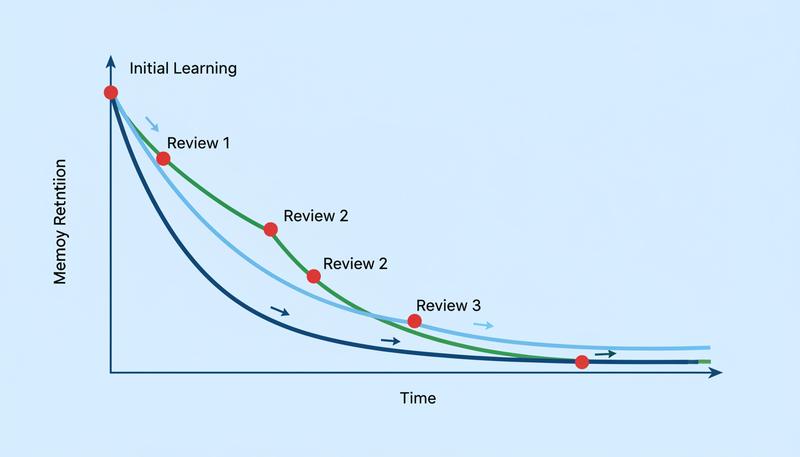
How Each Review Changes the Game
Here's a concrete way to think about what spaced reviews actually do to your memory:
Without any review, you might retain approximately 33% of material after 24 hours, 25% after a week, and 21% after a month. The exact numbers vary by person and material, but the shape is consistent.
Now add a single review session at the 24-hour mark. Something remarkable happens: the forgetting curve resets — but not to the same steep trajectory. The new curve is flatter. Forgetting still happens, but more slowly. Add a second review session, and the curve flattens more. A third, and you're approaching the territory where the material feels genuinely durable — not just temporarily accessible.
Each review session is essentially extending the lifetime of that memory. Not by a constant amount, but by an increasing one. This is why the optimal spacing intervals get longer over time: once a memory is strong, you don't need to review it as frequently to keep it alive.
The practical implication is that the first few reviews are the most critical. Reviewing 24 hours after initial learning, then a week later, provides disproportionately large returns compared to that same time spent in a single massed session.
graph LR
    A[Initial Learning] --> B[Review at 24 hours]
    B --> C[Review at 1 week]
    C --> D[Review at 1 month]
    D --> E[Review at 3 months]
    E --> F[Long-term Memory]
    A --> G[No Review]
    G --> H[Largely Forgotten in 2 weeks]
The Numbers: What Research Says About Optimal Intervals
Let's get specific, because "spread it out" isn't a study schedule.
The research on optimal spacing intervals is surprisingly nuanced. The key finding, synthesized across multiple studies: the ideal gap between reviews depends on how far in the future you need to remember the material.
A useful rule of thumb from researcher Piotr Wozniak (the developer of the SuperMemo algorithm, which is the grandfather of modern spaced repetition software): the optimal spacing interval is roughly 10-20% of the period over which you want to remember something.
- Need to remember something for a week? Review it after about a day.
- Need to remember it for a month? Review it after about a week.
- Need to remember it for a year? Review it about once a month.
For most students and professionals, a simpler version of this works beautifully in practice. Here's a practical starter schedule based on the research:
| Review Number | When to Review |
|---|---|
| 1 (initial learning) | Day 1 |
| 2 | Day 2 (next day) |
| 3 | Day 7 (one week later) |
| 4 | Day 21 (three weeks later) |
| 5 | Day 60 (two months later) |
After five spaced reviews of the same material using active retrieval, most people have pushed that knowledge into something resembling long-term storage. Not ironclad — you'll still benefit from occasional refreshers — but genuinely durable rather than evaporating after the exam.
Remember: The goal of spacing isn't to review as many times as possible. It's to review at the right times — specifically, just before you'd otherwise forget. More reviews at the wrong intervals doesn't beat fewer reviews at the right ones.
Same Time, Wildly Different Outcomes
Here's a thought experiment worth sitting with. Imagine you have six hours to spend studying before an important exam in two weeks.
Option A (cramming): Six hours in a single weekend session.
Option B (spaced): Three 2-hour sessions — one now, one in five days, one in three days before the exam.
The total study time is identical. But the research consistently shows that Option B produces dramatically better retention, not just on exam day, but months later. The Dunlosky et al. review in Psychological Science in the Public Interest rated distributed practice as having high utility — one of only two techniques in the entire review to earn that designation — precisely because of this consistency across ages, ability levels, and subject areas.
The cramming student in Option A will probably perform similarly on the immediate exam. But ask both students the same questions a month later, and you'll see the divergence clearly. The spaced student will remember significantly more. The crammer will have retained very little.
What makes this especially striking is that students consistently predict the opposite. Research on how we judge our own learning shows that students rate massed practice as more effective than distributed practice, even after experiencing both. They feel like cramming works better. The subjective experience of fluency after a marathon session reads as genuine mastery. It's not.
Spaced Repetition Systems: Let the Algorithm Do the Math
Once you understand the basic principle, you face an immediate practical problem: tracking review schedules manually is a pain. If you're learning 500 vocabulary words, or 200 historical dates, or the drug interactions for 300 pharmaceuticals, you can't realistically maintain a hand-crafted review calendar in your head.
Enter spaced repetition software (SRS) — and specifically, the app called Anki, which has become something close to a cult object among medical students, language learners, and self-directed learners of all kinds.
Here's how it works: You create flashcards (or download shared decks for common subjects). When you review a card, you rate how well you remembered it — typically on a scale from "complete blank" to "perfect recall." The algorithm uses your rating to calculate the optimal next review date. Cards you struggle with come back soon. Cards you nail get pushed out to increasingly distant intervals.
The result is a self-optimizing review queue. Every morning, Anki shows you only the cards that are due — the ones that have hit their optimal review point based on your personal memory data. You're never wasting time reviewing things you know solidly, and you're never letting things slip past their forgetting threshold.
For medical students, this is close to transformative. The material volume in medical education is so enormous that without systematic spaced repetition, retention simply collapses. Anki has become essentially standard practice in many medical schools. Premade decks like "Anki-King" or "Brosencephalon" are passed down like sacred texts among students learning pharmacology and pathology.
But Anki isn't only for students. Language learners use it for vocabulary — it's arguably the single most efficient way to build a large vocabulary in a new language. Professionals use it to maintain technical knowledge. Programmers use it to retain syntax and algorithms. The principle transfers to anything that requires durable recall.
Tip: If you're new to Anki, don't start by downloading a giant pre-made deck and trying to work through it. Start by making cards for things you actually need to learn right now, in your own words. The act of making a good flashcard is itself a form of encoding.
Building a Spacing Schedule Without Software
Maybe you're not a flashcard person. Maybe the subject you're learning doesn't fit neatly into discrete Q&A pairs — you're learning to write code, or play guitar, or understand calculus, not memorize isolated facts. That's fine. You don't need an app to implement spacing. You need a calendar and a modest amount of planning discipline.
Here's the simplest version that actually works:
The Three-Session Rule for New Material
When you learn something new — a concept, a chapter, a skill module — plan three future touchpoints before you're done with the initial session:
- Tomorrow (brief, maybe 15-20 minutes): Review from memory. What can you recall without looking? What's already fuzzy?
- One week later (30-45 minutes): A more thorough review, including the things that were fuzzy yesterday.
- Three to four weeks later (20-30 minutes): A final solidification pass.
For skills rather than facts, the reviews take a different form: you're not reviewing notes, you're practicing. A guitarist implements spacing by playing a new chord progression today, returning to it for 10 minutes tomorrow, touching it again next week. The spacing principle is the same; only the format changes.
The Weekly Setup
For people managing multiple subjects — which is most students and many professionals — a simple weekly planning ritual works well:
Every Sunday evening (or whatever your week-start looks like), spend 10 minutes doing three things:
- List what you learned this past week that needs a 1-week review.
- List what you learned three weeks ago that needs a 1-month review.
- Block time in your calendar for those reviews.
It sounds trivial. It is also genuinely not done by the vast majority of learners, which is why the vast majority of learners retain much less than they could.
Warning: Don't confuse re-reading notes with a review session. Passive re-exposure is one of the least effective forms of review. A real review session means trying to recall the material first — closing your notes, writing down what you remember, testing yourself — and then checking. This is where spacing and retrieval practice fuse into something genuinely powerful.
The Interplay Between Spacing and Retrieval Practice
We talked about retrieval practice in the previous section: the practice of actively pulling information from memory rather than passively re-exposing yourself to it. Spacing and retrieval practice are theoretically distinct, but in practice they work best as a single system.
Think of it this way:
- Spacing tells you when to review.
- Retrieval practice tells you how to review.
Spacing without retrieval practice means you sit down at the right moment but then re-read your notes — which wastes the opportunity that spacing creates. Retrieval practice without spacing means you test yourself repeatedly in a single session — which is useful, but doesn't produce the reconsolidation benefits of a review after forgetting.
Put them together — space your sessions, and make every review session an active retrieval attempt — and you get something that research consistently identifies as the most powerful combination available to ordinary learners. Not "pretty effective." Not "marginally better." Qualitatively, game-changingly better.
This is the key insight that separates someone who uses these techniques superficially from someone who genuinely transforms their learning: the strategies aren't a menu to pick from. They're a system that amplifies each other.
The Emotional Difficulty of Letting Things Get Fuzzy
Here's the part nobody in the productivity literature wants to talk about, because it doesn't fit neatly into a how-to framework.
Spacing feels bad.
Not in some abstract, intellectual sense. It feels bad emotionally. When you sit down a week after studying something and realize you've forgotten more than you expected, it triggers a very human response: anxiety, self-doubt, the sense that you're bad at this, maybe the feeling that you've wasted your time. Students who understand the theory of spacing still often abandon it in practice, because the experience of partial forgetting is uncomfortable.
This is important to acknowledge, because if you don't expect this feeling, you'll interpret it as a signal that the system isn't working. You'll go back to cramming because at least that feels productive. And then you'll be back to starting over.
The reframe that actually helps: partial forgetting is not failure. It is the mechanism. The cognitive effort of retrieving something that has partially faded is precisely what makes the subsequent memory stronger. When you sit down to review next week and have to work to remember things, that discomfort is the sensation of your memory being strengthened. You are doing it right.
A helpful analogy: physical training. Nobody interprets muscle soreness after a workout as evidence that exercise doesn't work. We understand it as a sign that we've created useful stress, and that recovery will make us stronger. Memory works the same way. The retrieval difficulty during a spaced review session is your cognitive muscle soreness. It means the training is working.
Common Pitfalls and What Counts as a Real Review
After years of working through this material, a few failure modes come up again and again among well-intentioned learners:
Pitfall 1: Passive re-reading dressed up as review. You open your notes, read through them nodding, feel the warm glow of recognition, and call it a review. But recognition is not recall. Testing yourself and failing, then checking, is a review. Re-reading is not.
Pitfall 2: Spacing reviews of low-quality initial learning. Spacing is powerful, but it can't rescue material you didn't encode well in the first place. If your initial study session consisted of passive highlighting, the spaced reviews are spreading a thin foundation, not a solid one. Strong initial encoding — using active engagement, questions, connections — is what gives spacing something to work with.
Pitfall 3: Abandoning the system during high-stress periods. Counterintuitively, spaced review schedules are most critical precisely when students abandon them — right before exams, during crunch periods, when life gets chaotic. A crammed emergency review session right before a test is far less valuable than maintaining your spaced schedule and taking a night off before the exam.
Pitfall 4: Using app streaks as a proxy for learning. Anki and similar apps can become gamified in unhealthy ways. The metric that matters is not your daily streak or your review count — it's whether you're actually retrieving material with real effort, or mindlessly tapping "Good" to keep your numbers up.
Pitfall 5: Spacing without adding retrieval. As discussed, this is the most common way to do spacing incorrectly. You show up at the right time but don't test yourself. You get points for attendance but not the actual benefit.
Practical Scheduling for Different Kinds of Learners
For students taking classes: Your review schedule can be anchored to class meetings. Initial learning happens during or right after class. Schedule a 20-minute review the next day. Mark your calendar with "Chapter 4 review" one week later and three weeks later. Before final exams, you won't be cramming — you'll be doing a fifth or sixth light review of material you already know pretty well.
For professionals learning on the job: New skills and information often arrive in a less structured way, so you have to create structure yourself. A simple practice: at the end of every work week, spend 15 minutes writing down three to five things you learned or were exposed to this week that you want to actually retain. Then schedule a review of each on your work calendar — first one in 7 days, second in 30 days. It takes maybe 20 minutes a week to set up and pays enormous dividends in actually retaining the professional knowledge you're accumulating.
For self-directed learners and hobbyists: You don't have anyone else setting your curriculum, which is liberating and also means you have to supply your own structure. The simplest durable system: keep a learning journal with dated entries. When you review something, date that entry too. If an entry hasn't been reviewed in more than three weeks, it goes on your list for this week. The journal doubles as a review schedule without any extra infrastructure.
The spacing effect has been known to science for over 130 years. It is arguably the most robustly replicated finding in all of memory research. And virtually no one uses it deliberately.
This is the course's central argument made concrete: the gap between what we know about learning and what most people actually do is enormous. Not because the research is inaccessible, or because the techniques are difficult. Because studying the right way feels worse in the short term, and human psychology naturally gravitates toward what feels like progress rather than what actually produces it.
Once you've internalized why spacing works — the reconsolidation mechanism, the way each review flattens the forgetting curve, the power of retrieving something that's partially faded — you're not just following a rule. You understand the underlying logic. And that understanding is what lets you apply it flexibly, troubleshoot when it isn't working, and build it into a system that survives contact with your actual life.
Next, we'll look at interleaving — a practice that feels even more uncomfortable than spacing, and works for equally counterintuitive reasons.
Only visible to you
Sign in to take notes.