How to Write a Documentary Short Film Script
You've now completed the full fiction writing pipeline — from scenario to locked script. You understand how constraint fuels creativity, how conflict drives structure, and how discipline in the writing process leads to finished work. But what if your story doesn't come from your imagination? What if it comes from the world?
Documentary filmmaking operates on an entirely different axis than fiction, yet most screenwriting courses treat it as an afterthought — a sidebar, a chapter titled "Other Forms," and then done. This course isn't doing that. Documentary short filmmaking is a complete, rigorous, and deeply demanding scriptwriting practice. It shares the fundamental principles you've just learned — structure, conflict, economy of form — while operating under entirely different rules of engagement. The central difference is this: in fiction, you invent the world. In documentary, the world invents itself, and your job is to find, shape, and honor what's already there. That's not easier. In many ways, it's harder. Your characters don't say the lines you need them to say. Your story doesn't end on schedule. The conflict you thought would drive the film evaporates two weeks before your shoot date, replaced by something richer and stranger that you never planned for.
You are not the author of reality. You are its editor — its interpreter, its advocate, its honest witness. And within the short form, these pressures intensify. A ten-minute documentary short has almost no room for scene-setting, throat-clearing, or exploratory tangents. Every interview answer has to carry weight. Every piece of archival footage has to advance the argument or the emotion. Every narration line has to earn its place. If the short film's brevity is a creative engine — and this course argues that it is — then the documentary short is that engine running at full throttle with no manual override.
The sections that follow walk you through the documentary short process in the order you'll actually live it: finding a subject and its conflict, scoping the film correctly, doing the research that reshapes your premise, thinking through the ethics before you shoot, choosing your mode, building your pre-script documents, outlining and scripting, and finally writing documents flexible enough to survive contact with reality.
Finding Your Documentary Subject: Passion, Access, and the 'Why Now' Question
The three-part test for a documentary short subject is simple to state and surprisingly difficult to pass: you need a subject you're passionate about, a subject you can actually access, and a subject with a 'why now' that makes the film urgent.
Passion sounds obvious, but it's worth unpacking. Documentary filmmaking is slow, expensive, emotionally demanding, and full of setbacks. You will spend far more time on a documentary short than you expect to, and there will be moments when you wonder why you started. The only thing that gets you through those moments is genuine investment in the subject — not just intellectual interest, but something closer to moral urgency. You're making this film because you believe the story matters, because you believe the world will be slightly better for having seen it, because you can't let the story go.
The flip side of passion is the danger of advocacy disguised as inquiry. There's nothing wrong with having a point of view — the greatest documentaries all do. But if your passion hardens into propaganda, if you've already decided what the film will say before you've done the research, you're not making a documentary anymore. You're making an illustrated argument. That can be a legitimate form, but call it what it is, and understand that it forecloses the discovery process that makes documentary storytelling vital.
Access is the great practical filter. You may be passionately interested in a story about the inner workings of a secretive political organization or the private grief of a family that wants nothing to do with cameras. Your passion doesn't open doors that are closed to you. Before you commit to a documentary subject, honestly assess: do you have access, or a realistic path to access, for the story you want to tell?
Access has several layers. There's physical access to locations, events, and situations. There's interpersonal access — the trust of the people whose stories you want to tell. And there's institutional access — permission to film in controlled spaces, use archival materials, or interview official spokespersons. You need to map all three before you begin.
A useful reframe: proximity is a form of access. Some of the most powerful documentary short films come from filmmakers who turned their cameras on their own lives, families, communities, or backyards. Not because those are easier subjects (they're often harder), but because the access is real and the knowledge is deep. Don't dismiss what you can reach for what you can merely imagine.
The 'why now' question is the one that separates a story from a timely story. Almost any subject can be made into a documentary in theory. The question is why this film, about this subject, should be made now. Is there an event happening — a trial, an election, a demolition, a reunion, a dying — that gives the story urgency and a natural end point? Is there a cultural moment that makes the subject newly visible or newly relevant? Is there something about right now that makes this story resonate in ways it wouldn't have five years ago?
For documentary shorts in particular, the 'why now' question often points to a concrete event or situation with a deadline built in. A community facing eviction. A tradition being performed for potentially the last time. A person at a turning point in their life. These are stories with natural narrative pressure — the clock is running, something is at stake, the outcome is uncertain. That structure is a gift.

How Documentary Short Films Find Conflict: The Real Tension in Real Stories
Finding your subject is step one. Finding the conflict inside your subject is what turns a subject into a film. These are not the same thing, and collapsing the distinction is how you end up with a beautiful, inert portrait that gives the audience nothing to follow.
We've established throughout this course that conflict is the engine of dramatic storytelling. In fiction, you engineer conflict. In documentary, you recognize and frame it. But the principle is the same: without genuine tension — something at stake, someone wanting something, an obstacle in the way — you don't have a film, you have a report.
Person versus circumstance. A person facing a situation they didn't choose and must navigate — illness, displacement, economic pressure, social change. This is the most common form of documentary conflict, and it's powerful because it's universally relatable. We all know what it is to face circumstances we didn't ask for.
Person versus person. Competing interests, opposing viewpoints, or actual human conflict between subjects the film has access to. Town hall meetings where community members argue. Families where members hold irreconcilable positions. Labor disputes, custody battles, political contests. This kind of conflict is inherently dramatic and relatively straightforward to capture on camera.
Person versus system. An individual in conflict with an institution, a policy, a bureaucracy, or a social structure. Much of the most powerful documentary journalism operates in this mode — a person trying to navigate or challenge a system that seems designed to defeat them.
The internal conflict of the subject. The most interesting documentary subjects are often people who are in conflict with themselves — who want contradictory things, who hold beliefs that their actions undermine, who are changing in ways they don't fully understand or control. The external situation your subject faces (circumstance, person, system) is most powerful when it triggers or reveals an internal struggle.
The conflict of competing truths. Documentaries that examine events where different participants have genuinely different accounts of what happened — where memory, interest, and perspective produce irreconcilable versions of the truth — are engaging a particular kind of conflict that's unique to nonfiction. Errol Morris built an entire career on this mode.
For documentary short writers, the practical discipline is learning to identify which form of conflict is actually present in your material, and then structuring the film to make that conflict visible and legible. Don't bury the conflict in context. Don't diffuse the tension by presenting too many equally weighted perspectives. Choose the conflict that is real, central, and dramatically viable, and build your film around it.
The short form's great advantage here is that it forces you to commit. You can't hedge by presenting five different forms of conflict and hoping one of them lands. You pick the one that matters most, and you follow it to its honest conclusion.
Do this work before you write a word of your blueprint. If you can't name the conflict in one clear sentence — whose desire is blocked by what obstacle, with what at stake — you're not ready to write the film yet. Go back to your subject and keep looking.
The Documentary Short Versus the Feature Documentary: Scope, Focus, and What You Must Leave Out
With your subject and its central conflict identified, the next discipline is scope. The difference between a short documentary and a feature documentary is not merely a question of length. It's a question of scope, and more importantly, of ruthless editorial priority.
A feature documentary can hold multiple threads, develop several characters across time, explore contradictions and counterfactuals, and give its subject the full panoramic treatment. A documentary short cannot. A documentary short is, almost by definition, a film about one thing — one person at one moment, one community facing one crisis, one argument made with precision and conviction.
The discipline of the documentary short is the discipline of selection. Not "what should I include in this film?" but "what is this film actually about, and what does that mean I must leave out?"
Consider the difference between a feature and a short on the same subject. Imagine you're making a film about a retiring school principal who has spent forty years in the same community. A feature documentary might follow them through their final year of work, explore their childhood and early career, interview dozens of former students and teachers, examine the changing landscape of public education around them, and end with a portrait of a life in full. A short documentary on the same subject might focus on a single afternoon: the last faculty meeting, a conversation with one student, the drive home. The scope is radically narrower, but the emotional resonance doesn't have to be.
What you're always looking for in a documentary short is the synecdoche — the specific, concrete, well-observed detail that stands in for something much larger. The retiring principal's empty coffee mug left on a desk tells you something about forty years of occupation that no amount of interview footage can quite replicate.
The ruthless editorial question at every stage of the documentary short process is: does this belong in this film, or does it belong in a longer film, or a different film, or no film at all? Your subject may have ten compelling angles. Your job is to pick one and go deep.
Research as Story Development: How Deep Investigation Reshapes Your Premise
Research in documentary filmmaking is not a preliminary step that you complete before the "real work" begins. Research is the real work, or at least the first and most important part of it. Your research doesn't just inform your script — it produces your script.
The process typically moves through three phases:
Phase one: broad exploration. At the outset, you're mapping the terrain. Read everything you can find on your subject — journalism, academic papers, personal accounts, historical records, related films. Talk to people at the edges of your subject before you approach the center. If you're making a film about a specific neighborhood's response to gentrification, spend time reading local papers, attending community meetings, and talking to people on the periphery before you approach your central subjects. This phase is about building context and, crucially, discovering what you didn't know you didn't know.
Phase two: subject development. Once you've mapped the terrain, you start identifying specific people and situations that could carry the film. You're conducting preliminary conversations — not necessarily on camera — to find out who has a story worth following and who has the willingness and capacity to tell it. This is also where you start testing your hypothesis. Does the story you thought you were going to tell actually exist? Is there genuine conflict and movement, or did you just have an interesting idea?
Phase three: story development. The research from phases one and two reshapes your premise into a working story. You now know enough about your subject to identify the specific dramatic engine of your film — what is at stake, who has a stake in it, and what the tension is that will carry the film from beginning to end. Your blueprint document (more on this shortly) emerges from this phase.
The practitioner's truth about this process is that it's iterative and recursive, not linear. You'll cycle back through earlier phases as new information changes your understanding. You'll discover in phase three that you need to go back to phase one for a piece of context you missed. Treat the research process as a spiral, not a straight line.
One specific research discipline that transforms documentary writing: triangulate every significant claim through at least two independent sources. Not because you're writing a legal brief, but because the most dramatically interesting thing in documentary is usually the gap between different people's accounts of the same events. That gap — the place where memories diverge, where interests conflict, where the "official" story and the lived experience part ways — is often where your film's real subject lives.
The research process is supposed to challenge and reshape your initial premise. If your premise survives your research unchanged, you probably didn't dig deep enough.
Fact-Checking, Accuracy, and the Writer's Ethical Responsibilities in Nonfiction
Before you write your first pre-script document, you need to reckon with a set of obligations that fiction writers simply don't carry. This section is not optional, and it's not just about avoiding legal liability. It's about the fundamental contract between a documentary filmmaker and their audience: the implicit promise that what you're presenting as true is, to the best of your knowledge and ability, actually true.
Documentary writers carry ethical responsibilities that fiction writers don't. When you put a person's image on screen in a nonfiction context, you're making a claim about their character, their actions, and their place in a story that will be seen by strangers who have no reason to doubt your account. When you make a factual assertion in narration — about history, about policy, about cause and effect — you're asking the viewer to update their understanding of the world based on your word. That's a significant responsibility. Establish your ethical framework now, in pre-production, not in the edit bay under deadline pressure.
Factual accuracy starts in research. Every factual claim in your script should be sourced. Not just "I read somewhere that..." but a specific, credible source that you can identify if challenged. In journalism, this is standard practice; in documentary filmmaking, it's honored more in the breach than the observance, which is how filmmakers end up with lawsuits, retracted films, and damaged reputations.
Be especially careful about implication. The most dangerous inaccuracies in documentary aren't false statements — they're true statements arranged in ways that create false impressions. Cutting from an interview clip of Person A saying one thing to a clip of Person B saying something apparently contradictory can imply a conflict that doesn't actually exist. Juxtaposing footage of an event with interview commentary that was recorded years earlier can imply a relationship between them that isn't real. These are editorial choices with ethical implications, and they need to be made consciously.
Subjects' consent matters. The people who appear in your documentary have a right to know, in broad terms, what kind of film you're making and how their appearance will be used. This doesn't mean showing them a cut before release (that can compromise editorial independence), but it does mean being honest with them about your intentions, your perspective, and the kind of film you're making. People who agree to participate in what they think is a sympathetic portrait and then discover they've appeared in an exposé have been deceived, and that deception has human consequences.
Know the difference between POV and distortion. Documentary filmmakers have points of view. They make arguments. They take sides. That's not a violation of nonfiction ethics — it's a legitimate and often essential part of the form. The line that matters is between advocating for a position you honestly hold based on evidence you've genuinely gathered, versus misrepresenting evidence to support a conclusion you decided before you began. The former is journalism with a camera. The latter is propaganda.
The 'harm' question. Before you include a scene, an interview excerpt, or a factual claim, ask: could this cause harm to someone — reputational, professional, physical, psychological — and if so, is that harm proportionate to the public value of the disclosure? This is not a reason to avoid controversy or to soft-pedal difficult truths. It's a reason to be intentional about the human cost of your editorial choices and to be certain those choices are serving the story and the public interest, not just your narrative convenience.
The Four Paths to Nonfiction: Documentary Modes
With your subject, conflict, scope, research, and ethical framework in place, you face a fundamental creative decision that shapes every document you'll write from here: what kind of documentary are you making?
Documentary scholar Bill Nichols identified a taxonomy of documentary modes that has become foundational to how filmmakers and writers think about nonfiction. For a writer approaching a documentary short, understanding these modes is practical, not academic — it helps you make informed decisions about how to structure your film and what kinds of footage you'll need to gather.
graph TD
    A[Documentary Modes] --> B[Observational]
    A --> C[Participatory]
    A --> D[Expository]
    A --> E[Poetic]
    B --> F["'Fly on the wall' — filmmaker observes without intervening"]
    C --> G["Filmmaker is on screen — interview-driven or participatory"]
    D --> H["Direct address to viewer — argument-forward narration"]
    E --> I["Prioritizes mood, rhythm, association over argument"]
Observational documentary — sometimes called "fly on the wall" filmmaking — places the camera as a witness to events as they unfold without directorial intervention. The filmmaker observes; they don't ask questions, provide narration, or shape situations. The work of Frederick Wiseman is the canonical example at feature length: long, unnarrated films that drop you inside institutions and let you draw your own conclusions. At short film length, observational filmmaking requires identifying a self-contained situation with inherent dramatic structure — a rehearsal, a medical procedure, a family dinner — and trusting the camera to find the story in it.
The challenge for writers working in an observational mode is that the "script" is more of a shooting plan: a description of the situation you'll observe, a list of anticipated moments, and a strong editorial instinct for what you're looking for. You're not writing what will happen. You're articulating what you believe will be there to find.
Participatory documentary acknowledges the filmmaker's presence and makes it a feature rather than a problem. The director appears on screen — conducting interviews, responding to subjects, being affected by what they encounter. Errol Morris's The Thin Blue Line is typically classified as reflexive or investigative documentary, not participatory. Michael Moore's work is a better example of participatory documentary, where the filmmaker is visible and actively engaged in the investigation. Participatory documentary is enormously flexible, but it demands that the filmmaker be a compelling screen presence and that their own perspective add something to the film.
For documentary short writers, participatory mode offers a crucial structural tool: the interview. When you can put a person on camera and draw out their account of their experience, you have a dramatic monologue with all the raw material of a scene. The writer's job is to construct the questions (or at least the conversational territory) that will produce moments worth using, and then to edit those moments into a coherent structure.
Expository documentary is the mode most audiences are most familiar with: a film that makes an argument, supports it with evidence (interviews, archival footage, data), and addresses the viewer directly, often through narration. Most television documentary — National Geographic, PBS Frontline, BBC Horizon — operates in expository mode. The voice-of-God narrator is the purest expression of this form, though expository films can also use on-screen experts and title cards to make their arguments.
For documentary short writers, expository mode is both the most accessible and the most dangerous. It's accessible because the structure is logical and familiar — thesis, evidence, conclusion. It's dangerous because it can flatten the human texture of your subject into a series of illustrated points, turning complex people into talking heads and complex situations into infographics. The best expository documentary shorts retain a sense of discovery even while advancing a clear argument.
Poetic documentary prioritizes rhythm, imagery, and emotional association over linear argument or character-driven narrative. These films are closer to essay films or experimental work — they might juxtapose images and sounds in ways that create meaning through association rather than logical sequence. Early films like Dziga Vertov's Man with a Movie Camera or Chris Marker's Sans Soleil are touchstones. At short film length, poetic mode can be extraordinarily powerful because a ten-minute poetic film can achieve emotional states that no amount of talking-head interviews could reach.
The writing challenge in poetic mode is that traditional script formats barely apply. You're writing something closer to a visual poem — sequences of images, sounds, and rhythms that create an experience rather than make an argument. This requires a different kind of script document, which we'll discuss below.
Most documentary shorts are not pure expressions of a single mode — they mix elements. A film might be primarily observational but include a few direct-to-camera interviews (participatory), accompanied by brief title cards that provide context (expository), and built around a recurring visual motif (poetic). Your job as a writer is to be intentional about which modes you're using and why, rather than defaulting to whatever feels easiest. The mode you choose shapes every pre-script document you'll write next.
Writing the Pre-Script Documents: Blueprint and Scenario
You've identified your subject, located its conflict, scoped the film, done enough research to know the terrain, worked through your ethical obligations, and chosen your primary mode. Now you write. But not the script — not yet. First you write the documents that test whether you actually have a film and communicate your vision to collaborators and funders.
There are two key pre-script documents in documentary short development, and they serve different audiences. The blueprint is an internal working document — a tool for your own clarity and for communicating with your production team. The scenario (or treatment, in professional contexts) is an external pitch document — what you hand to funders, festival curators, or potential subjects to demonstrate that you have a genuine, grounded project.
The Documentary Blueprint
The documentary blueprint is the documentary writer's equivalent of the fiction outline — but it's a richer, more flexible document. Writing it forces you to test whether you have a film or just an interesting subject.
A strong documentary short blueprint typically contains:
The premise statement. One to three sentences that describe what your film is about, what it reveals or argues, and why it matters. Not a synopsis — a statement of purpose. "This film follows a Haitian American chef in Miami's Little Haiti during the week of a neighborhood celebration, exploring how food and ritual become forms of cultural memory in a community navigating rapid change." That's a premise. "This film is about a chef" is not.
The dramatic question. Every documentary short needs a single central question that the film exists to explore. Not to answer definitively, but to explore honestly. "Will this neighborhood survive its own reinvention?" "Can one woman's story of addiction and recovery challenge how an entire city thinks about its drug policies?" "What is lost when a language dies?" The dramatic question gives the film its spine and gives the viewer a reason to keep watching.
Character profiles. For a participatory or observational film, who are your subjects? Describe them in terms of their stake in the film's central question — what they want, what they fear, what they represent, why they're the right people to carry this story. For an expository film, who are your experts and voices, and what does each one contribute that the others can't?
The anticipated story arc. Not a scene-by-scene outline — you probably can't write that yet — but a sense of the emotional and argumentative journey of the film. Where does the film begin (what's the situation)? What complicates it (what disrupts or challenges the opening situation)? Where does it land (what has the film revealed, argued, or shown that it couldn't have shown at the start)?
Key scenes and sequences. Even before you shoot, you can often identify the scenes and situations that will be central to your film. A community meeting where competing interests clash. An interview with a person who has unique insight into the question. An annual event that provides a natural climax. List these with enough description that your collaborators understand what you're trying to capture and why.
Visual and tonal approach. How will this film look and sound? Handheld and intimate, or observational and formal? A mix of archival and contemporary footage? Music-forward or sound-design-driven? These decisions belong in the blueprint because they shape how you shoot and what you look for in the edit.
Research needs. What do you still need to find out? What access has not yet been secured? What are the open questions that research and pre-production need to answer before you can commit to a shooting plan?
The blueprint is a living document. You'll revise it as your research deepens and your access develops. But writing it forces you to test whether you have a film or just an interesting subject — which is the most valuable thing a pre-script document can do.
The Documentary Scenario (Treatment)
A documentary short scenario is typically two to five pages and serves a specific external purpose: it allows you to pitch your film to funders, distributors, festival curators, or potential collaborators before you've shot a frame. It needs to demonstrate that you have a genuine story, not just a subject; real access, not just good intentions; and a clear vision for how the film will work, not just an interesting question.
A strong documentary short treatment contains:
Opening hook. A vivid, specific scene or moment that drops the reader into the world of the film. Not a general description of your subject — a particular image or moment that makes the film's world feel real and urgent. "On the third floor of a building that's scheduled for demolition next month, a 78-year-old woman is repainting the walls of an apartment she's lived in for sixty years." That's a hook.
The story. Written in present tense, as if describing a film the reader is watching. Walk through the film's major sequences in their anticipated order, using specific details — real people's names, real places, real situations — to demonstrate that this is a researched, grounded project, not a speculative idea.
The people. Who are your subjects, and why should the reader care about them? Brief character descriptions that convey why these particular people are the right vessels for this story.
Your perspective. Why you? Why are you the right filmmaker for this story? What's your relationship to the subject, and what does that relationship give you — in terms of access, understanding, emotional investment — that another filmmaker wouldn't have?
The visual approach. A brief description of how the film will look and sound, establishing the mode (observational, participatory, expository, or hybrid) and any distinctive aesthetic choices.
Production status. What have you shot already? What's secured (locations, subjects, archive licenses)? What's still to be arranged? Funders and collaborators want to know the project's current state of development.
The treatment is a piece of writing, and it should be compelling on the page in its own right — not just a functional document but an evocative one. Funders and programmers read hundreds of treatments. The ones that get funded are the ones that make the reader feel the film before they've seen a frame of it.
Outlining and Scripting: Sequence Outline, A/V Format, and Narration
Once your blueprint is solid and your research is deep enough to see the shape of the film, you move into the scripting phase. This happens in two stages: first the sequence outline, then the full script in documentary format.
The Sequence Outline
The sequence outline is where the documentary writer starts to think and write like an editor. It divides the film not into individual scenes but into sequences — units of meaning that group related material, move the story forward, and serve a specific dramatic purpose. A sequence might be three minutes long and contain one long observational take, or it might intercut between an interview, archival footage, and a present-day scene. The point is that the sequence functions as a unified beat in the film's structure.
For a ten-minute documentary short, you might have five to seven sequences. Each one should do something the previous one couldn't, and each one should create a reason to keep watching the next one.
Here's a rough sequence template for a documentary short built around a single central character and dramatic question:
Sequence 1 — The World and the Person. Establish the situation and introduce your central character or question. This is the documentary's opening argument: here is the world, here is who matters in it, here is what's at stake.
Sequence 2 — The Complication. Introduce the conflict or tension that the film will explore. Something is wrong, something is at risk, something is being contested.
Sequence 3 — The First Response. How do the characters (or the subject situation) respond to the complication? This might be an attempt to solve the problem, a deepening of the conflict, or a revelation that the situation is more complex than it first appeared.
Sequence 4 — The Deepening. The film goes deeper — into history, into personal stakes, into the contradiction or tension at the heart of the subject. This is often where archival material, second-perspective interviews, or contextual information appears.
Sequence 5 — The Crisis or Revelation. Something happens that forces a confrontation with the central question. This might be a real event captured on camera, a dramatic interview moment, or an editorial juxtaposition that crystallizes what the film has been building toward.
Sequence 6 — The Resolution (or Deliberate Irresolution). The film lands somewhere. Not necessarily with an answer, but with a feeling, a judgment, an image, or a moment that satisfies the emotional and intellectual journey the viewer has been on. Some of the best documentary shorts end with a question that is deeper and more honest than the one they started with.
The sequence outline is not a rigid structure — it's a planning tool. The actual film may reorganize sequences in the edit, collapse or expand them, or discover that one sequence needs to become three. But writing it forces you to think about the film's rhythm and momentum before you shoot, which is where those decisions should be made.
Documentary Script Formats: The Two-Column A/V Script
If you try to write a documentary short in standard screenplay format, you'll immediately run into a problem: standard screenplay format is designed to describe fiction scenes in the form of action lines, character names, and dialogue. Documentary footage often doesn't have dialogue — it has sound, ambient audio, interview excerpts, narration, music. And the visual content of a documentary shot is often a description of what the camera should look for, not a description of a scene that has been constructed to be filmed.
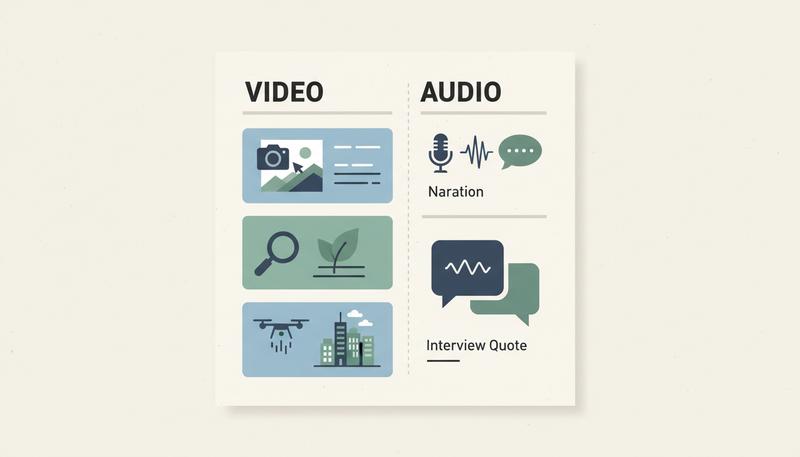
The industry-standard format for documentary scripts is the two-column script — also called the A/V script (Audio/Visual). The left column describes the visual content; the right column describes the audio. This format reflects the documentary production reality: video and audio are planned and assembled as parallel tracks that are then synchronized in the edit.
Here's a simplified example of the format in action:
VIDEO                               AUDIO

WIDE SHOT — community garden         NARRATION (V.O.):
at dusk. People moving between       "In the last five years, this
raised beds. Children.               neighborhood has lost twelve
                                     grocery stores and gained one
                                     community garden."

CU — hands sorting vegetables.       [Sound of ambient conversation,
Different ages, different skin.      children laughing, distant traffic]

INTERVIEW — MARIA SANTOS, 58,        MARIA: "My grandmother had a
Community Garden Founder.            garden in Porto. I used to think
Medium shot. Garden visible          gardens were for old women.
in background.                       Now I understand what she knew."
The left column uses visual shorthand: WIDE SHOT, CU (close-up), MEDIUM SHOT, ARCHIVAL FOOTAGE, TITLE CARD, ANIMATION. These aren't production directions in the fiction sense — they're descriptions of the type of image that will appear, giving the director and editor a visual plan to work from.
The right column contains narration text in full, interview excerpts in summary form (with the understanding that actual usable quotes will be confirmed in the edit), music cues, and sound design descriptions. The narration text is often the most fully developed element in a pre-production documentary script, because narration is one of the few elements fully under the writer's control.
For a poetic or observational documentary short, the two-column format may be even more stripped down — less prescription, more description of intention. "We want images that convey the texture of waiting" is a legitimate visual direction in a poetic documentary script, even if it makes a fiction script supervisor's head spin.
Some documentary writers use a modified version of this format that adds a center column for notes — source of footage, interview questions, research context. This production script format is particularly useful when presenting the documentary to funders or collaborators who need to understand not just what the film will look like, but how the filmmaker intends to get there.
Writing Narration and Voice-Over: When It Helps and When It Undermines Visual Storytelling
Narration is the documentary writer's most powerful and most dangerous tool. Use it well, and it provides context, emotional resonance, and argumentative clarity that images alone can't achieve. Use it badly, and it does the visual work for the viewer — telling them what to think instead of allowing them to experience and conclude.
The first question to ask about narration is not "what should I say?" but "does this need to be said at all?" Many things that beginning documentary writers put in narration are already present in the images, the interviews, or the ambient sound. If your shot of an overcrowded classroom already conveys the reality of underfunded public education, you don't need a narrator to say "this classroom is overcrowded due to underfunding." Trust the image.
Narration earns its place when it does things images cannot:
Provides factual context. Dates, statistics, historical background, geographical orientation — information that grounds the viewer in a situation they couldn't understand from images alone. "In 1968, the federal government acquired this land by eminent domain. The family has been fighting for its return ever since." That sentence does work no image can do.
Creates temporal movement. Narration can compress time, jump between periods, or orient the viewer in a complex chronology. "Three months later, everything had changed" is a transition that would take minutes of footage to accomplish without narration.
Provides the filmmaker's perspective. In participatory or essay-mode documentaries, narration can be the filmmaker's voice — their reflection, their doubt, their moral positioning relative to the subject. This is one of the most interesting uses of narration, because it acknowledges the filmmaker's presence and subjectivity rather than pretending to an impossible objectivity.
Connects disparate elements. When you're cutting between archival footage, contemporary interviews, and observational footage, narration can provide the connective tissue that explains why these things belong together.
What narration should almost never do is explain or editorialize what images make self-evident. "She looked sad" over a shot of someone clearly weeping. "The community was divided" over a shot of a contentious public meeting. This kind of narration doesn't add information — it closes down interpretation, treating the viewer as incapable of reading images for themselves.
The test for every narration line: remove it from the script and read through the adjacent material without it. If you lose nothing — no context, no clarity, no emotional intelligence — cut it. If something essential disappears, keep it, but keep tightening it.
A note on voice: narration voice matters enormously, and it's a decision that belongs in the writing stage. The same text delivered in a warm first-person voice, a distant institutional voice, or the filmmaker's own voice creates completely different films. Write your narration in the voice you intend it to be heard in, and specify that voice in your script.
The Flexible Documentary Script: Writing Documents That Survive Contact with Reality
Here's a hard-won practitioner truth: your first documentary script will be wrong. Not wrong because you're a bad writer or a careless researcher, but wrong because reality doesn't cooperate with scripts. Your central subject cancels their interview the day before you were going to shoot it. The event you planned to film as your climax gets rained out. The archive footage you counted on turns out to be licensed in ways that make it prohibitively expensive. The interview that was going to be your film's emotional center turns out to be flat and generic, while the fifteen-minute conversation you had in a parking lot with someone you barely knew turns out to be the most alive thing you've shot.
Documentary script writing is, in part, the practice of writing documents that can absorb this kind of disruption without collapsing.
The key principle: write intention, not prediction. Don't write "we will film Maria Santos describing her early life in Porto" — that's a prediction, and it assumes Maria Santos will agree, will be available, will say what you need, and will be filmable in a way that works for your visual plan. Instead, write "we're looking for interview content that illuminates the connection between immigrant food culture and memory — Maria Santos is a strong candidate for this." That intention survives the cancellation of Maria's interview. The prediction doesn't.
In practical terms, this means:
Build redundancy into your shot plan. For every key visual, have a backup approach. If you planned to capture the neighborhood's transformation through a before-and-after tour with your central subject, what do you do if they're unavailable that day? Have an alternative plan — archival photographs, testimony from a different community member, present-day observational footage — that can serve the same sequence purpose.
Leave space for discovery. The best thing that can happen on a documentary shoot is finding something you didn't expect — a moment, a person, a detail that's better than anything you planned. If your shooting plan is so rigid that you can't deviate to follow that discovery, you'll miss it. Write documents that create room for serendipity.
Write the edit you want, not the shoot you plan. Experienced documentary writers think backward from the edit — they write the film they want to watch, then figure out how to get the footage that makes that film possible. This approach reveals gaps in your coverage plan (what would you need to shoot to make this sequence work?) and keeps the creative vision clear through the chaos of production.
Version your documents. Maintain a running updated version of your script that reflects what you've actually shot, what's changed, and what needs to be reconsidered. The distance between your pre-production script and your final cut script is a record of the documentary process — and often, the most interesting material in a documentary comes from the gap between those two documents.
This is perhaps the deepest difference between fiction and documentary writing. A fiction screenplay is a blueprint that production executes. A documentary script is a hypothesis that production tests. Your job throughout is to stay attached to the intention — the conflict you identified, the dramatic question you're exploring, the emotional journey you're building — while remaining genuinely open to how reality wants to answer you.
Bringing It Together: The Documentary Short as Complete Practice
Documentary short filmmaking is not a lesser form of documentary. It is, as we said at the outset, a complete and demanding creative practice with its own disciplines, its own craft challenges, and its own aesthetic possibilities. The workflow you've just moved through — subject, conflict, scope, research, ethics, mode, pre-script documents, outline, script, production flexibility — is not a checklist to tick off and forget. It's a way of thinking that you'll cycle through on every project, each pass deepening your understanding of what the film is actually about.
The brevity of the short form is not a limitation — it's a creative engine. The constraint of ten or fifteen minutes forces you to be certain about what your film is actually about, to commit to a single dramatic question, and to trust that a well-observed, carefully structured story told in concentrated form can do everything a longer film can do, and sometimes things a longer film cannot.
Characters are discovered, not invented. In a fiction short, you design your protagonist from the ground up. Their desires, contradictions, wounds, and behavior patterns are all yours to construct. In documentary, you find people who already contain those things — and your job is to recognize them, earn their trust, and draw them out. The best documentary subjects are rarely the most obvious or quotable people. They're the people whose complexity reveals something essential about your subject.
Conflict is found, not manufactured. A fiction writer manufactures conflict by placing characters in opposition, raising stakes, and engineering obstacles. A documentary writer locates conflict that already exists in the world — between people, between a person and their circumstances, between what is and what should be, between competing claims about the truth. The craft lies in recognizing genuine dramatic tension when you see it, and then structuring the film so that tension can build, complicate, and resolve (or deliberately, meaningfully fail to resolve).
The story changes during production. Almost every fiction film is shot from a locked script. Almost no documentary unfolds exactly as written. Plans change, subjects become unavailable, better stories emerge from unexpected places, reality throws you curveballs. The documentary writer's job is to write documents that are rigorous enough to provide direction but flexible enough to survive contact with the real world — and to stay close enough to your original intention that you recognize the real story when it arrives.
The writers who thrive in this form are the ones who bring to their work a genuine commitment to the people and situations they're documenting — an honest reckoning with the ethical responsibilities of nonfiction storytelling that keeps their ambition in appropriate relationship to the real human lives they're representing on screen. Format a two-column script with the same care a fiction writer brings to a scene. Write narration with the same discipline you'd bring to a line of dialogue. Build a sequence outline with the same structural rigor you'd bring to a three-act beat sheet. The tools are different. The seriousness of craft is identical.
That's the practice. It's harder than it looks, it's more rewarding than it sounds, and it produces films that the world genuinely needs.
Only visible to you
Sign in to take notes.