Mead History: Why It's the World's Oldest Fermented Drink
Mead: The World's Oldest Drink
Let's talk about mead properly, because it deserves the attention.
The word "mead" comes from Proto-Germanic meduz, related to Sanskrit madhu and Greek methu, all meaning "honey" or "honey drink." The linguistic lineage alone is a hint of how old this stuff really is — these root words predate written history by thousands of years, inherited across languages as cultures split apart and migrated in different directions. When the same word for "honey wine" shows up in Sanskrit, Greek, Germanic, and Celtic languages that stopped being mutually intelligible millennia ago, you're looking at something genuinely ancient — a drink that was probably already established folklore when these proto-languages were still recognizable to each other.
The Archaeological Record: How Old Is Mead, Really?
The oldest hard evidence of mead comes from pottery shards at the Jiahu site in Henan province, China, dated to 7000 BC. Dr. Patrick McGovern at the University of Pennsylvania ran chemical analysis on the residues and found traces consistent with a fermented mixture of honey, rice, and fruit — a mead-beer-wine hybrid that's arguably the world's oldest known alcoholic beverage. This matters because we're not dealing with stories or legends here. These are actual chemical traces in ancient pottery, which means someone 9,000 years ago deliberately made fermented honey drinks.
But as Sky River Mead points out, mead's real origins probably stretch back much further — maybe 20,000 to 40,000 years before present — as something that just happened naturally, and early humans eventually figured out how to make it happen on purpose. Honey stored in natural containers (hollowed logs, animal bladders, caves where water collected) could ferment all by itself if moisture got in. Wild yeast was already living on honeycomb and floating in the air. Maybe mead wasn't invented at all — just observed, recognized as interesting, and deliberately repeated.
Think about the timeline here: agriculture — farming, permanent settlements, the whole civilization project — didn't start until around 10,000 BC in the Fertile Crescent. But honey hunting, actually going out and finding wild bees and taking their honey, is vastly older. Paleolithic humans, the ones with sophisticated tools and complex social structures, were almost certainly harvesting honey for 100,000 years or more before anyone planted the first grain. The chemistry of fermentation works the same today as it did then. An early human discovering a sealed container of honey that somehow got wet, fermented into something mildly alcoholic and fizzy and psychoactive, might have figured they'd stumbled onto something divine.
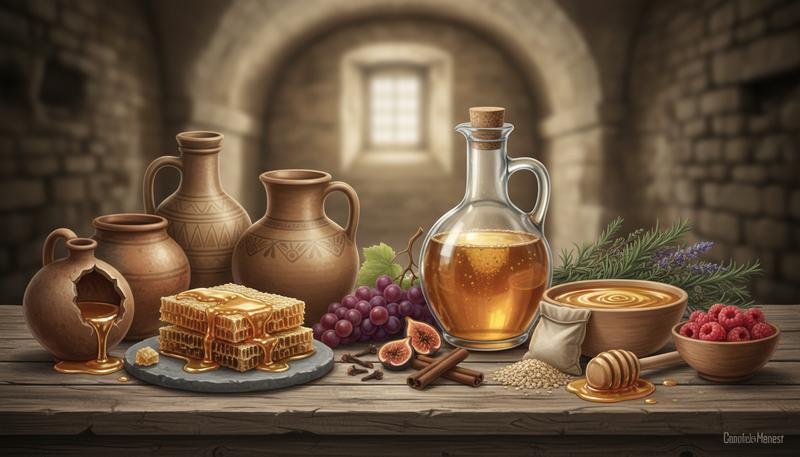
Mead in Myth and Culture: The Divine Drink
Every culture that had access to honey seems to have discovered mead independently, and nearly all of them treated it like something sacred.
Norse mythology and the Mead of Poetry. In Norse mythology, the "Mead of Poetry" (Skaldskaparminni) wasn't just a nice drink — it was magical. Made from the blood of the wise giant Kvasir mixed with honey, and anyone who drank it gained wisdom and poetic inspiration. Odin himself steals it from the giant Suttungr through elaborate trickery and shapeshifting, and this story mattered enough to survive in the Prose Edda, written down approximately 154 years after the Viking Age ended. The myth itself is older still, passed down by word of mouth for centuries before that. The implication is unmistakable: mead isn't casual drinking. It's the drink of poets, gods, and profound knowledge.
Ancient Greece and the nectar of gods. In ancient Greece, ambrosia — the food of the gods, sometimes described as a drink — gets interpreted as a form of mead often enough. The word itself connects etymologically to Sanskrit amṛta ("immortality") and the Indo-Iranian amr — which points to something interesting: the divine associations of honey wine go back to the proto-Indo-European cultures that were the ancestors of both Greeks and Sanskrit speakers.
Anglo-Saxon England and the mead hall. Anglo-Saxon England built mead halls — these great communal drinking spaces where warriors gathered to eat, drink, and take loyalty oaths. The Old English epic Beowulf opens inside Heorot, a mead hall, where the hero first meets King Hrothgar. These weren't just bars. They were the social and political engine of early medieval society. A loyalty oath sworn over mead was a binding contract. A dispute settled over mead carried weight. The hall itself, with its mead, symbolized the king's power and generosity. Building a great mead hall announced to everyone that you had wealth, connections, and the ability to summon warriors. Mead wasn't a luxury — it was an instrument of government.
Why Mead Disappeared (and Why It's Coming Back)
Here's the historical twist: in medieval Europe, as beer production became centralized and industrial (brewers' guilds, standardized recipes, hops adopted as a preservative), mead just... faded. Beer was cheaper to make at scale — grain grows faster and more reliably than bees produce honey. Wine, imported from warmer regions, became fashionable among people with money. By the 18th century, mead had turned into a curiosity. A historical footnote.
Today, though, it's having a real renaissance. Home brewers, historical reenactors, fermentation enthusiasts — they're rediscovering what medieval brewers understood: that honey can produce something of extraordinary complexity and delicacy and aging potential. A well-made mead can be bone-dry and elegant, or lush and dessert-like, or anything in between. It ages beautifully too. Unlike beer, which peaks in a couple of years, mead can improve over decades.
Types of Mead: A Taxonomy
The mead world has developed a rich vocabulary for different styles, drawn partly from medieval tradition and partly from modern homebrewing experimentation:
Traditional mead: Just honey, water, and yeast. The pure expression of what the honey itself tastes like. The most instructive starting point because there's nowhere to hide — every mistake in technique is audible. A traditional mead that's clean and balanced is a genuine achievement. You'll taste the terroir of the honey: traditional mead from local wildflower honey tastes different from orange blossom honey, which tastes different from blueberry-blossom honey. This is what makes traditional meads so useful for understanding what your yeast is actually doing.
Melomel: Mead made with fruit. The most popular category overall. Strawberry, raspberry, blueberry, blackberry, cherry, plum — nearly any fruit works and produces beautiful results. Within melomels, there's a whole set of subcategories:
- Cyser: Mead made with apple juice or cider. Two ancient fermented traditions merged together. A cyser can be dry and complex (like an extended apple wine) or semi-sweet and light (like a fruit beer).
- Pyment: Mead made with grape juice or wine. Chemically close to wine, but with honey adding depth and fullness.
- Morat: Mead made with mulberries. Less common in modern homebrewing, but historically significant.
Metheglin: Mead made with spices and/or herbs. Some of the oldest mead recipes are metheglins — medieval and ancient brewers used whatever they had on hand, from lavender and ginger to yarrow and meadowsweet. Medieval apothecaries made medicated metheglins, using specific herbs for specific purposes: ginger for digestion, St. John's Wort for mood, meadowsweet for inflammation. A metheglin exists in that space between beverage and medicine. Modern metheglins often mix honey with warming spices (cinnamon, nutmeg, clove) or floral elements (rose, hibiscus).
Braggot: A hybrid of mead and beer — made with both honey and malt. Historically, the distinction between mead and ale was fuzzy. Many medieval brewing records show brewers using both honey and grain, and the Welsh word bragawd is where we get "braggot." A braggot combines beer's fermentation character (usually cleaner and faster) with mead's body and sweetness potential. From a nutrition standpoint, malt brings amino acids and B vitamins that honey alone doesn't provide.
Session mead / short mead: A rapidly fermented mead designed to be ready in weeks instead of months, usually lower in alcohol (6-8% ABV), slightly sweet, and often carbonated. More like a honey beer in practice. Beginner-friendly because you get results quickly, and the lower alcohol makes the whole fermentation process more forgiving.
Only visible to you
Sign in to take notes.