Why Film Editing Works When It Shouldn't
The First Decade Without Cuts
To really appreciate how wild it is that we accept editing at all, you have to go back to the beginning. When the Lumière brothers screened their first films in Paris in 1895, there were no cuts. L'Arrivée d'un train en gare de La Ciotat is 50 seconds of a single unbroken shot: a train approaches the camera, passengers disembark, the film ends. That's it. And it was more than enough. Audiences panicked. They dove out of the way of the approaching locomotive. Some reportedly fled the theater. The moving image itself was so novelty that it didn't need narrative to captivate anyone.
But novelty wears off. By the early 1900s, something became obvious: audiences wanted more. Not just the world as a camera saw it, but the world as a story demanded it be seen. That hunger—that appetite for something editing could provide—would eventually make the cut feel natural. But here's the thing: that naturalness wasn't inevitable. It had to be invented.
For cinema's first decade, the assumption was straightforward. Films were records of events, not constructions of narrative. The camera stayed in one place, the action unfolded, the film ended. This wasn't a lack of imagination. It was a reasonable assumption about what the medium was for. Photography was a record. Why would you want to break reality into pieces?
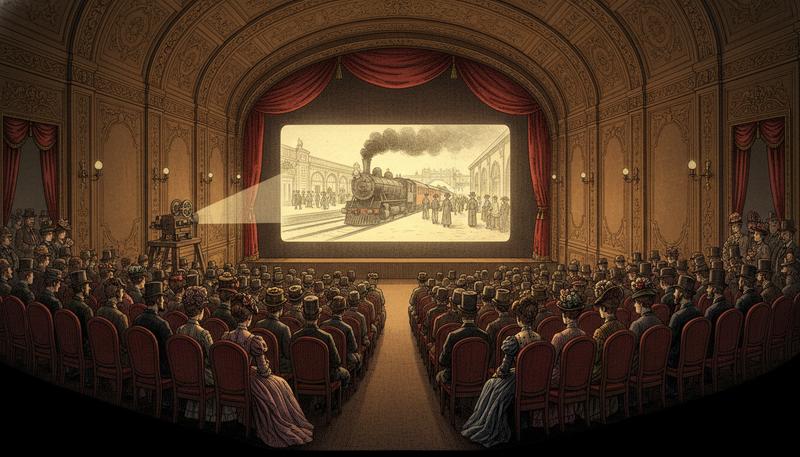
Then something remarkable happened. Sometime between 1900 and 1915, filmmakers—Edwin Porter in America, Robert Paul in England, eventually D.W. Griffith doing it at a scale no one had attempted—started discovering that you could cut between different shots and audiences would not only understand what was happening, they'd find it more absorbing than a continuous record. Griffith's The Birth of a Nation (1915), for all its moral horrors, proved something crucial: the cut could be the primary unit of cinematic language. Cross-cutting between simultaneous actions. Close-ups isolating emotional detail. Angle changes redirecting attention. Within twenty years of cinema's invention, editing had gone from nonexistent to indispensable.
Nobody had to teach audiences how to parse this. There was no manual. No narrator explaining "we are now looking at the same scene from a different angle." People just... understood it. Immediately. Intuitively. Across cultures, across languages, across wildly different levels of formal education. When researchers showed edited films to people in remote communities in Kenya who'd never seen cinema, they grasped the basic grammar of cutting almost instantly. Event boundaries in film—the transitions from one shot to another—activate the same neural mechanisms that our brains use to chunk ordinary experience into meaningful pieces. We didn't learn to understand cuts. We were already built for them.
The Question That Organizes Everything
This observation opens up the question that will organize everything that follows: Why doesn't editing confuse us, and what does that tell us about how the brain works?
These two parts deserve separate attention, because they have different answers that feed into each other in interesting ways.
The first part—why doesn't it confuse us—is trickier than it sounds. The easy answer is "cultural conditioning." But the cross-cultural evidence kills that. So does the developmental evidence: infants as young as 9-11 months show early signs of event cognition, with evidence of neural segmentation even in younger infants though at more basic, sensory-driven levels, long before they've had any real exposure to film. Cultural conditioning may refine how we respond to editing, but it doesn't seem to create the response from scratch. Something more fundamental is at work.
The second part—what this tells us about the brain—is where things get genuinely exciting. Because the answer isn't simply "editing is fine, the brain ignores it." The brain does not ignore cuts. It responds to them vigorously, measurably, consistently. The real question is what kind of response that is, and whether it reaches conscious awareness.
This distinction—between a neural response and a conscious experience—is the conceptual hinge on which everything else in this course turns.
Two Systems, One Cinema Experience
To understand why editing works, we need a framework that will come back again and again throughout this course: the idea that your brain isn't a single unified processor but a collection of semi-independent systems running at different speeds, with different access to consciousness, and different relationships to the flow of sensory experience.
Sometimes this is described informally as a "two-system" model, borrowing language from Daniel Kahneman's Thinking, Fast and Slow—though the application here is more specific than Kahneman's original framing. For our purposes:
System 1 (perceptual, automatic, unconscious) is the part of your brain constantly monitoring incoming sensory information, detecting changes, flagging threats, updating your model of what's happening around you—all without consulting your conscious mind. It operates at the speed of milliseconds. It doesn't wait for your attention. And crucially, it always notices cuts.
System 2 (conscious, deliberate, narrative) is the part following the story, tracking characters, experiencing emotions, predicting what comes next. This is the system you point to when you say "I was completely absorbed in that film." And this system can be kept from caring about cuts—provided the right conditions are met.
graph TD
    A[Film Cut Occurs] --> B[System 1: Perceptual Detection]
    B --> C{Prediction Violated?}
    C -->|No — cut is narratively coherent| D[System 2 remains absorbed in story]
    C -->|Yes — cut breaks narrative logic| E[System 2 is disrupted]
    D --> F[Cut feels 'invisible']
    E --> G[Cut feels jarring or confusing]
    B --> H[Neural response in temporal-parietal regions]
    H --> D
    H --> E
Here's the profound part: these two systems can process the same input and reach different conclusions simultaneously. Jeffrey Zacks, a neuroscientist at Washington University in St. Louis who's spent much of his career studying exactly this problem, puts it plainly: "It's amazing that film editing works, because it's so disruptive to the visual information coming into the brain." He knows this because he can measure System 1's response directly—in brain scanners, every significant cut produces a measurable neural event. The brain registers the cut. System 1 isn't fooled.
But System 2 is doing something different. When you're genuinely engaged in a film—when you care about the characters, when a chase scene has you on edge, when you're holding your breath through a confrontation—your conscious attention is being consumed by narrative. The cut happens. System 1 notes it. And System 2, busy with more pressing concerns, just incorporates it and moves on. No disruption. No confusion. The story continues.
This is why analyzing a well-edited film later can feel paradoxical: you didn't notice the cuts, but you also didn't not notice them. What actually happened is more precise. You noticed them in the System 1 sense—your brain registered every single one—but you weren't consciously aware of them in a way that would interrupt narrative immersion. And you certainly didn't feel disrupted by them, which requires yet another condition to fail.
Three Distinct Things We Mean by "Noticing"
This three-way distinction—noticing (perceptual), awareness (conscious), disruption (emotional/narrative)—deserves to be spelled out explicitly, because most discussions of film editing blur it together. But the whole vocabulary of "invisible editing" and "breaking the fourth wall" depends on this distinction.
Noticing a cut is occurring is what System 1 does automatically. Your visual cortex detects one image abruptly replacing another. Your temporal-parietal junction registers an event boundary. This happens with every cut, in every film, for every viewer. There are no truly invisible cuts at this level—only cuts that vary in how strongly they activate this detection mechanism.
Being consciously aware a cut occurred is something else entirely. This is System 2 acknowledging the medium's mechanics. When you think "that was a nice cut" or "that cut was jarring," you're operating here. Skilled filmmakers have developed an entire toolkit of techniques (matched action, consistent screen direction, audio continuity) specifically designed to keep System 1's response from bubbling up to conscious awareness.
Feeling disrupted by a cut is the third level, and it's the one editors care about most. A cut can reach conscious awareness without being disruptive—film students and critics notice cuts constantly without being thrown out of the story. Disruption happens when a cut violates narrative expectations so severely that it breaks emotional continuity. The story logic collapses. You stop caring about what happens next because you're busy figuring out what just happened.
Great editing keeps most cuts at level one (noticed but not consciously acknowledged), occasionally elevates cuts to level two (consciously recognized as good editing), and almost never descends to level three (disruption) except as a deliberate creative choice. The jump cut—which we'll examine later—is a deliberate descent to level three, used by directors from Jean-Luc Godard to Darren Aronofsky to create a specific kind of conscious unease.
What the Brain Does at a Cut
Before we move forward, let's preview the neuroscience that will run through this entire course, because it fundamentally reframes what film editors have been doing intuitively for a century.
Zacks's research has revealed something counterintuitive about how cuts are processed: film cuts and "event boundaries"—the points where one distinct meaningful action ends and another begins—are not the same thing, even though editors behave as if they should be. When people watch mundane footage of everyday activities—someone washing dishes, say—they spontaneously and consistently identify the same transition points as "event boundaries," moments where one meaningful chunk of activity ends and another begins. They agree on these boundaries far above chance, which tells us event segmentation is a genuine, consistent cognitive operation, not just subjective interpretation.
But most cuts in films are continuity cuts—camera angle changes within a single continuous event. The camera cuts from a wide shot of a dinner party to a close-up of one guest's face, and the brain is asked to integrate these as parts of the same event. This asks something quite specific of the visual system: maintain the event model, update the spatial perspective, hold the narrative thread. And the brain—perpetually astonishing perception researchers—does this effortlessly, across viewer after viewer, across culture after culture.
The brain regions that activate at event boundaries include areas at the intersection of the temporal, parietal, and occipital lobes—regions integrating visual information across time and space—and parts of the right prefrontal cortex, involved in predictive modeling and updating mental representations. These aren't "movie-watching" circuits. They're the same circuits you use navigating everyday life, predicting what comes next, updating your model of the world when something unexpected happens. Film editing plugs directly into your reality-construction machinery.
This is the central insight animating everything else in this course: film editing works not despite violating continuous perception, but because it exploits the brain's pre-existing machinery for segmenting experience, inferring causality, and constructing meaning. Every cut is, at its core, an act of applied neuroscience, even when the editor making it has never read a neuroscience paper.
The Five Insights That Organize This Course
Let's map where we're going, because the territory is large and the connections between ideas matter as much as the ideas themselves.
First: your brain already edits. Before we understand why film editing works, we need to understand that your visual experience of reality is itself heavily edited—by saccadic suppression, event segmentation, and predictive filling. The cut isn't foreign to your visual system. It's a formalized version of something your brain does thousands of times a day. Section 3 explores this in depth.
Second: editing language was invented, not discovered. The grammar of film editing that feels natural today—the eyeline match, the cut on action, cross-cutting—was developed through extraordinary experimentation in cinema's first two decades. Understanding this history (Sections 4 through 7) reveals that "naturalness" in editing is a learned response, layered on top of deeper perceptual mechanisms. The rules were designed to exploit the hardware; knowing the history helps you understand which rules matter most.
Third: juxtaposition creates meaning that neither image contains alone. The Kuleshov effect—the most important discovery in film editing, and among the most important in all of cognitive science—demonstrates that the brain compulsively constructs causal and emotional relationships between sequentially presented images. This isn't a bug in cognition. It's the fundamental feature that makes narrative cinema possible. Section 5 is devoted to this.
Fourth: the cut has temporal and emotional dimensions beyond the visual. Sound editing, rhythm, pacing, the relationship between cut timing and musical structure—these represent an entire second editing system operating in parallel with the visual one, often dominating it. Sections 10 and 11 explore the temporal architecture of editing.
Fifth: neuroscience is beginning to give empirical data about what editors have known intuitively. Brain imaging studies of film viewing are early, but they're already producing surprising results—including the discovery that well-edited films can synchronize the neural activity of different viewers watching the same scene. Section 12 explores what this emerging science reveals and what it might eventually change about how we understand the craft.
Why This Matters
Before we go further, a question worth addressing: why does understanding the neuroscience of editing matter to anyone who actually wants to make films, or to anyone who simply loves watching them?
For editors and directors, the answer is practical. Intuition is remarkable, and many great editors work largely from it. But intuition without understanding is fragile—it works until it doesn't, and when it stops working, you don't know why. Understanding the cognitive mechanisms behind editorial choices gives you a principled basis for deciding under uncertainty, for diagnosing why something isn't working, and for making deliberate rule-breaking choices that produce specific effects rather than accidental ones.
For viewers, the answer is about the quality of attention. There's a particular pleasure—richer than passive absorption—in watching a film while understanding why it's working on you. This isn't cold analysis that kills enjoyment. It's closer to what a musician feels hearing a chord progression they recognize: the intellectual pleasure of understanding compounds the emotional pleasure of experiencing. You feel the cut and you understand why it felt that way, and somehow both are richer for the combination.
And for anyone interested in consciousness, perception, or how we experience reality, the deeper answer is this: film editing is an extraordinarily precise instrument for probing how the brain constructs reality. Cinema developed editing so rapidly—cutting became the default language of film almost immediately—because editing is, in a fundamental sense, how the mind already works. The Lumière brothers' single-shot films were documentaries of events. But the brain doesn't experience reality as a documentary. It experiences reality as an edited film.
The paradox in this course's title—that editing works despite violating continuous perception—begins to dissolve the moment you realize that continuous perception itself is the illusion. What we're really asking is not why a disruption is accepted, but why a particular form of the mind's native language, imposed on external reality, feels so much like home.
That's where we're going. Let's start by going inside the machinery.
Only visible to you
Sign in to take notes.