How Buildings Reflect Power, Identity, and Social Control
The Politics of Buildings: Power, Identity, and Control
Here's something you probably don't think about: architecture has never been neutral. Buildings are expensive. They last forever. That means they're built by people with power — states, churches, corporations, empires — and everyone in power has always understood that buildings are basically a loudspeaker for broadcasting how important you are.
The connection between buildings and power is so fundamental that it's almost invisible once you stop looking. Every major shift in political power announces itself first in stone, steel, and glass. A revolution, the rise of an empire, a religious takeover, the emergence of corporate dominance — you see it all coming before you read about it in history books. Buildings are the most durable form of propaganda we have. A television ad lasts thirty seconds. A building lasts centuries.
Monumental Architecture and the State
The most obvious way buildings express politics is through sheer scale — using massive size and severe formality to communicate state power. This isn't some modern invention. The Egyptian pyramids, the Persian palace at Persepolis, the Roman Forum — all of these are exercises in making people feel small.
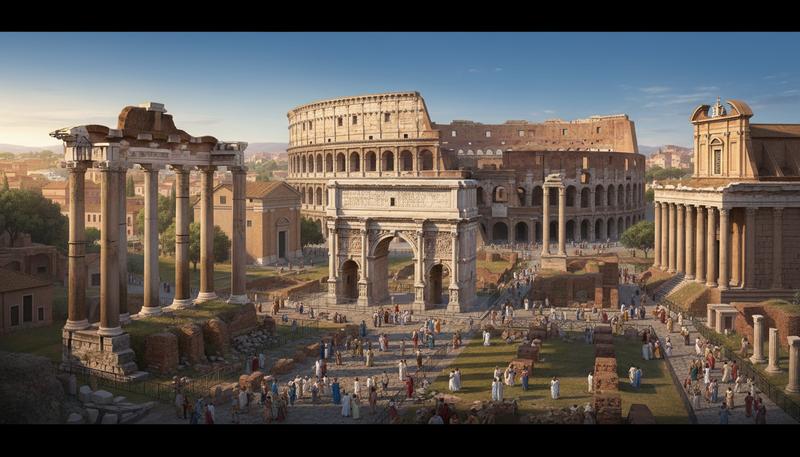
What's wild is how consistent the vocabulary has been across different cultures and centuries. Heavy stone. Symmetry. Elevated platforms. Enormous scale that dwarfs the human body. Wide axial approaches that lead somewhere important. These design moves show up in Egyptian temples, Roman civic buildings, Baroque palaces, Fascist government buildings, and Stalinist civic architecture. They keep appearing because they work — and not just on your intellect. They work on your body first.
Why Scale Commands Authority: The Psychology of Monumentality
When you stand at the base of a monumental building, something happens to you physically. Your entire visual field fills with stone. You can't see the sky, can't see the horizon, can't see anything beyond this structure. Your body becomes aware of itself — and of how small you are relative to what's around you. If the building is symmetrical, your eye gets pulled toward a center point, an axis. Maybe it leads to a throne room, a sacred altar, a command center. Walking forward along that axis starts to feel like submission — like something is directing you, orchestrating your movement.
Egyptian temples are the textbook case. The temple of Karnak, built to honor Amun-Ra, got rebuilt over more than a thousand years. Each pharaoh added courtyards, pylons, obelisks. But the real trick was the procession path — a route lined with colossal statues that gets progressively narrower the deeper you go, and the ceiling gets progressively lower. The space closes in on you. Those statues are carved at waist height, so you're walking past the bodies of gods. You feel tiny. The world of the gods feels vast beyond comprehension. And the pharaoh who paid for all this? He's the guy who speaks their language. This is architecture arguing for power in the most direct way possible.
The Roman Forum worked similarly, but for a secular audience. Instead of one organizing axis, the Forum packed multiple temples and civic buildings into dense proximity — no particular order, just the overwhelming weight of Roman institutional presence. Citizens could experience Roman power from every angle. The Forum wasn't designed for comfort. It was designed to overwhelm you with the scope and scale of empire.
The Theory of Ruin Value and Architectural Ambition
One of the most revealing documents of twentieth-century architecture is Albert Speer's "Inside the Third Reich," where he describes what he called the "theory of ruin value" (Ruinenwerttheorie). Speer was Hitler's architect, and here's the unsettling part: he explicitly designed Nazi government buildings not to function well in the present, but to look impressive as ruins a thousand years from now.
The logic was: Rome still impresses us not through its intact buildings but through its ruins — the Colosseum, the Forum, the aqueducts. Even in decay, the grandeur is obvious. So if you design a building with ruin value, if you use massive stone blocks and simple structural forms that would retain dignity even as they fall apart, you're announcing the permanence of your civilization to future ages. You're building not for your contemporaries but for history itself. It's architecture as a claim to immortality.
This reveals something deeply unsettling about monumental architecture: it often reflects not the needs of the people living under it, but the ambitions of the people building it to transcend time itself. The building becomes a monument to its own power rather than a service to its inhabitants. When this is done in the service of a totalitarian state, it's a form of violence — announcing not just power, but the permanence of power, the futility of resistance.
Colonial Architecture and Cultural Domination
Colonialism left an architectural record as clear as any written document. When European powers moved into Africa, Asia, and the Americas, they brought their own building traditions. And they deployed those traditions deliberately to communicate the cultural superiority of the colonizer and the subordination of the colonized.
The Hybrid Style as Conquest
The British Raj built its government buildings in India in a hybrid style called "Indo-Saracenic" — a mix of Victorian Gothic engineering with Mughal and Hindu ornamental elements. On the surface, this looks like respectful cultural synthesis. In context, it was something darker: a demonstration that the British could absorb and improve upon Indian culture, the same way they claimed to be absorbing and improving upon India itself.
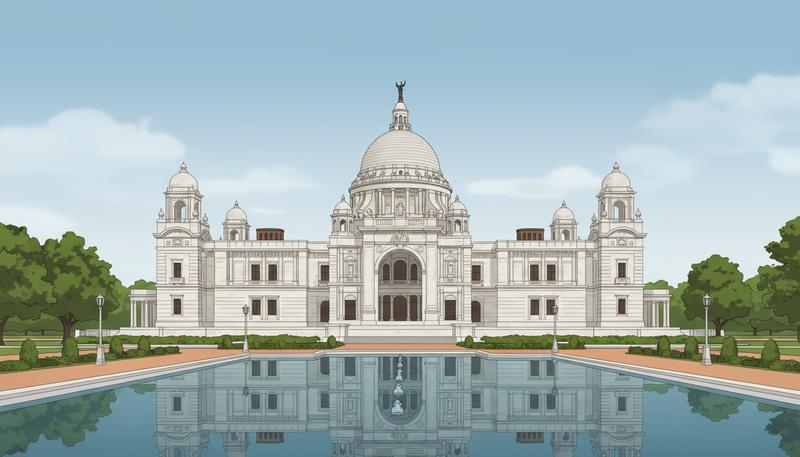
Take the Victoria Memorial in Kolkata, finished in 1921. It's a vast marble building with a central dome that borrows freely from Mughal palace architecture — the same architectural language used by the Emperors who ruled India for centuries before the British arrived. But it's made of white Italian marble, uses European engineering, and sits in a European-style formal garden. The message cuts clear: we have taken the best of your architecture, combined it with our superior engineering and materials, and created something more magnificent than you could ever make. We're not outsiders. We've become the true inheritors of Indian civilization. Your own architectural heritage now belongs to us.
You see this same logic in colonial capitals worldwide. In New Delhi, designed by British architects as a new capital, palaces and government buildings mixed European Baroque planning with simplified Indian ornamental motifs. In Africa, British colonial stations adapted Mediterranean Baroque and Gothic elements to tropical climates, creating buildings that were simultaneously "modern" (meaning European) and "adapted" (to local conditions), which implicitly suggested that modernity and Europeanness were equivalent.
The Aftermath: Inheritance and Discomfort
The history of colonial architecture raises questions that haven't been neatly resolved: What do you do with buildings that are genuinely beautiful by any standard but whose construction involved the exploitation or erasure of colonized peoples? Who do great public buildings belong to when the public that built them no longer holds power?
In India and across the postcolonial world, these buildings remain in use — as government offices, museums, cultural institutions. They're heritage sites and also symbols of occupation. The Victoria Memorial, built as a monument to the Queen-Empress, now serves as a museum and a public space for Indian citizens. Its architectural magnificence is undeniable. Its historical associations are fraught. Both things are true simultaneously, and that tension can't be cleanly resolved. The building contains both truths, and that discomfort is part of what it means.
Some postcolonial cities have chosen to supplement rather than erase colonial architecture. New Delhi has hosted numerous new monuments and government buildings designed by Indian architects working in explicitly modern vocabularies, a way of reclaiming the cityscape while acknowledging what came before. Other cities have renamed streets, added contextual plaques, or integrated colonial buildings into larger narratives that center indigenous agency. These aren't solutions so much as ongoing negotiations with the past.
Corporate Architecture and the Glass Fortress
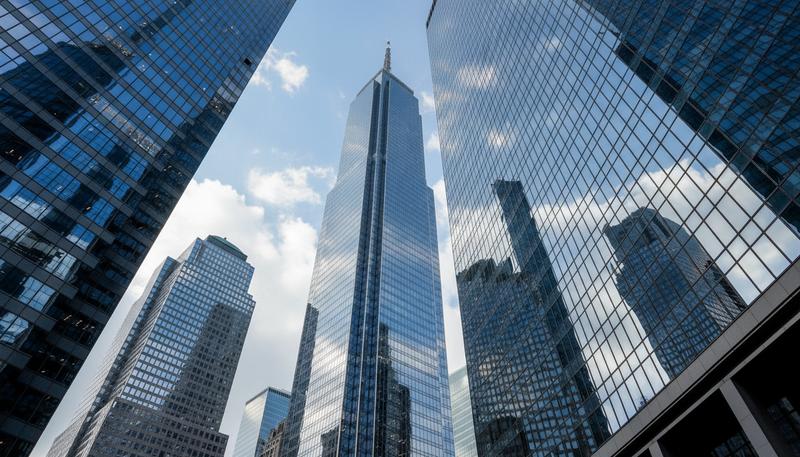
The glass curtain wall skyscraper is the dominant corporate building type of the late twentieth and early twenty-first centuries. And whether its builders intended it or not, it's a political argument about transparency, efficiency, and where power resides.
The Rhetoric of Transparency
Glass suggests transparency: we have nothing to hide, come look at us work. It suggests modernity: we're not weighed down by historical baggage. It suggests efficiency and rationality: we've stripped the building to its functional minimum, maximized the floor-to-window ratio, eliminated ornament and pretense. Glass towers rose to dominance after World War II, particularly in American corporate culture, as a deliberate rejection of what came before — heavy masonry buildings with historical references were associated with the past, with tradition, with old money. Glass was the future.
The irony is sharp: pursuing transparency through architecture produced some of the most opaque institutional cultures. A glass office building is fundamentally theatrical, staging corporate life for external viewing. These buildings are designed to be seen from the outside — from the street, from other buildings, from the highway. They perform corporate power and modernity for the public.
The Experience of Opacity
But here's the catch: the floor plates of typical glass towers are deep — often 150 feet or more — which means only a narrow band of employees, maybe 25-30 feet from the facade, actually get natural light. Everyone else works under fluorescent light. The glass itself is often tinted, reflective, or coated to reduce heat gain and glare, so the view out is compromised. From outside, you can't see clearly into most glass buildings because of reflection and angle — you see the city reflected back, or the sky, or other buildings. The transparency is mostly an illusion.
The interior is controlled by a centralized HVAC system that disconnects workers from any relationship with weather, time of day, or the natural world outside. Someone on the 40th floor of a glass tower in Houston can't feel the temperature shift at noon, can't experience the transition from morning to afternoon, can't sense whether it's raining. The building has been engineered to eliminate variability, to create a perfectly controlled environment. This is comfortable in one sense. In another sense, it's disconnection by design.
Surveillance and the Panopticon
The surveillance implications of glass offices are worth sitting with. Jeremy Bentham designed a prison called the panopticon in the eighteenth century — a central guard tower that allows surveillance of all prisoners without them knowing when they're being watched. Michel Foucault used it as a metaphor for modern power structures more broadly: the possibility of being watched gets internalized, so you self-regulate even when no one's actually observing.
Open-plan offices with glass walls aren't panopticons exactly, but they share the same structural logic: worker visibility correlates with productivity. The worker who can be seen works harder. The architecture of the contemporary office — open floor plates, glass walls, the elimination of private space — is an architecture of managed visibility. It expresses a particular theory of human motivation: we work harder when we might be observed, and our work is most valuable when it's transparent and observable.
This is different from monumental state architecture, but it's political in the same way: it embodies assumptions about how power operates, how control is maintained, what productivity means. And it reflects a shift in where power actually lives. Medieval architecture expressed the power of the church; Baroque expressed absolute monarchy; Fascist architecture expressed the state; glass towers express the power of capital and the surveillance that capital deploys. Each architecture is an argument about who's in charge and how they stay there.
Vernacular Resistance: Architecture from Below
graph TD
    A["Vernacular Architecture"] --> B["Evolved over Generations"]
    A --> C["No Professional Architects"]
    A --> D["Local Materials & Climate"]

    B --> E["Tested by Time"]
    B --> F["Modified by Experience"]

    C --> G["Collective Knowledge"]
    C --> H["Community Participation"]

    D --> I["Climate Adaptation"]
    D --> J["Resource Efficiency"]

    E --> K["Proven Solutions"]
    F --> K
    G --> K
    I --> K
    J --> K

    K --> L["The Courtyard House:<br/>Global Solution"]

    style A fill:#e1f5ff
    style L fill:#fff3e0
Not all architecture is made by the powerful. Vernacular architecture — the building traditions of ordinary people, developed without professional architects over generations — represents a different kind of knowledge and a different set of priorities. Vernacular buildings are precisely adapted to their climate, their local materials, and the social patterns of their communities. They work because they've been tested by time, refined through accumulated experience, and evolved in conversation with the people actually living in them.
Why Vernacular Architecture Resists Power
Vernacular architecture is, in a sense, a form of resistance. Not through explicit political action, but through the assertion of a different kind of knowledge — one rooted in place, in community, in practical intelligence rather than professional authority. When ordinary people build their own houses, they do so based on what has worked before in their specific location. A thick-walled adobe house in the American Southwest uses thick walls because they moderate temperature extremes. A Vietnamese stilt house is elevated to protect from floods and allow air to circulate below. A Scottish stone cottage is low and compact because stone is locally available and wind resistance is critical.
None of this required an architect. It required observation, trial and error over centuries, and the transmission of knowledge from one generation to the next. Once you understand why a building is designed the way it is — why the walls are that thickness, why the roof has that pitch, why the windows are that size — you understand that vernacular architecture is not primitive. It's sophisticated in a different register. It privileges adaptation over innovation, community knowledge over expert authority, longevity over novelty.
The Courtyard House: A Global Solution
The courtyard house type appears across cultures that had no contact with each other: Morocco, China, Mexico, ancient Rome. This is architecture that was independently invented by dozens of separate cultures because the solution is genuinely optimal.
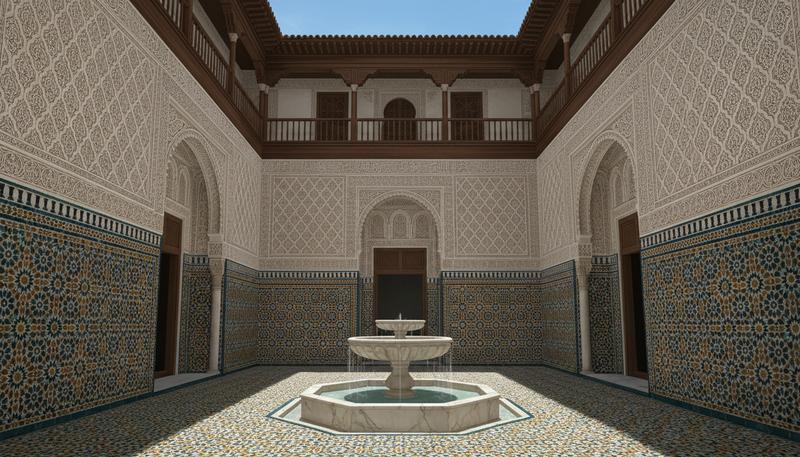
The inward-facing courtyard solves multiple problems all at once:
-
Climate control: The courtyard acts as a thermal buffer. In hot, arid climates like North Africa or the Mediterranean, the courtyard shades the interior rooms and allows the thick exterior walls to absorb daytime heat and release it at night. The courtyard also acts as a solar chimney — as the sun heats the courtyard floor during the day, warm air rises and draws cooler air through the rooms, creating natural ventilation without mechanical systems.
-
Privacy: The inward focus creates a private realm that belongs to the household rather than the street. In cultures where family privacy or women's seclusion is valued, the courtyard allows domestic life to happen outside while remaining screened from public view. The boundary between private and public is clearly marked — no street-facing windows, no interaction with passersby, your intimate life stays internal.
-
Social space: The courtyard is a gathering space that belongs to the household. Unlike a public square, which belongs to no one in particular, the courtyard is a semi-public space where family gatherings, markets, and celebrations can happen. Life happens in the middle, not at the edges.
-
Water and garden: In arid climates, the courtyard can hold a central fountain or well, making water a focal point and a cooling device (evaporative cooling does the work of air conditioning). Gardens flourish in this protected, irrigated space, providing food, fragrance, and beauty.
This house type appears across cultures that never contacted each other: Persian courtyards, Moroccan riads, Chinese siheyuan, Roman domus, traditional Mexican colonial haciendas. The reason isn't cultural diffusion but convergent evolution. Given the same constraints — hot climate, need for privacy, access to water, the economics of thick masonry construction — the courtyard solution is simply the right answer. Multiple independent solutions to the same problem constitute evidence of genuine architectural wisdom.
Vernacular Knowledge in the Contemporary World
In the modern era, vernacular architecture has often been dismissed as unsophisticated or backward — something to be replaced by modern construction and design. But there's growing recognition that vernacular buildings contain embedded knowledge about climate, culture, and sustainability that modern architecture has often discarded at considerable cost.
A contemporary example: the cooling strategies used in traditional Middle Eastern buildings — thick walls, small windows, wind towers (badgirs), courtyards — are now recognized as far more energy-efficient than the glass boxes that replaced them. A government building in Qatar designed in international modernist style might require air conditioning running 24/7 in summer, consuming enormous amounts of energy. The same building in a traditional courtyard configuration with appropriate wind towers could operate with far less mechanical cooling. The traditional solution wasn't inferior. It was designed for different values (community, privacy, connection to place) than the modern building (transparency, efficiency, international style).
This represents a shift in how we value knowledge: away from the assumption that expert, professional, scientifically-justified knowledge is inherently superior to the accumulated wisdom of communities and generations, and toward recognition that different kinds of knowledge are valuable for different purposes. Vernacular architecture is not primitive. It's a different way of knowing the world — one that's increasingly recognized as containing wisdom we discarded too quickly.
Only visible to you
Sign in to take notes.