How to Research the National Archives (NARA)
The National Archives (NARA): America's Documentary Backbone
In the Cleveland factory example we just walked through, we identified materials at the National Archives through the National Archives Catalog — and then we had to navigate its finding aids just like we would anywhere else. But NARA deserves its own focused attention. Not because the skills you've learned are different there, but because the scale changes everything. The organization is different. And understanding NARA's particular logic will multiply what you can actually find.
Here's the thing: if you want to understand what the United States federal government has documented about itself — about its own activities, its decisions, the lives of the people it governed — there is no better starting point than the National Archives and Records Administration. NARA is not a library. It's not a museum. It is, functionally, the institutional memory of the American state. More practically for you: it's one of the most powerful research tools available to anyone doing serious historical work. And it requires you to understand some specific organizational logic that doesn't work the same way as state and local archives.
This section is your practical orientation. We'll cover what NARA actually holds, how it organizes that material, where the facilities are, and — critically — how to figure out whether what you need is online or whether you need to show up in person (or submit a formal request). By the end, you should be able to walk into, or log into, NARA research with an actual plan. And you'll see how the finding aid skills you've already learned transfer into this much larger landscape.
NARA's Physical Geography
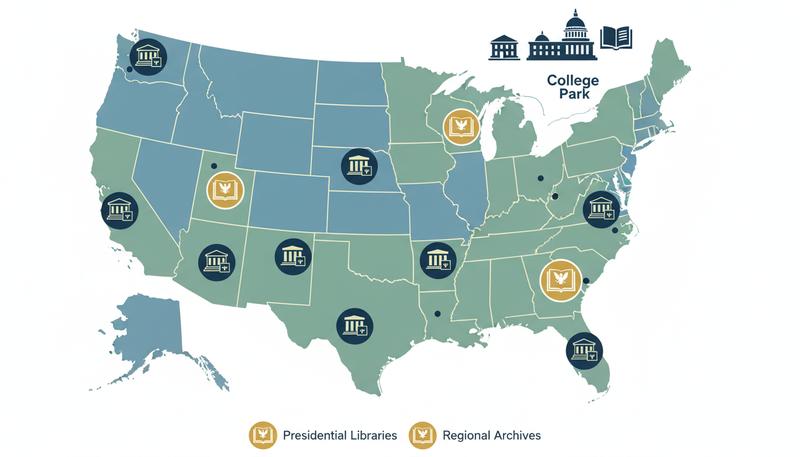
One of the most common mistakes new NARA researchers make is thinking of it as a single place. It isn't. NARA is a distributed system with facilities scattered across the country, and knowing the geography is essential before you start planning any research.
The Washington, D.C. Building (Archives I)
The original National Archives building on Pennsylvania Avenue — often called "Archives I" — is the one you've probably seen in photographs: that neoclassical building with the rotunda that houses the Declaration of Independence, the Constitution, and the Bill of Rights. Behind those famous display cases is an actual working research facility. Archives I holds the oldest federal records, particularly those from the colonial and early national period. We're talking about records of the Continental Congress, the first federal courts, State Department records through the mid-nineteenth century, and the census schedules from 1790 through 1906.
For genealogists and early American historians, Archives I is often the destination. You'll need a researcher card (free, available on-site with a government-issued photo ID) and the reading room operates on a scheduled basis — it's worth checking online or calling before you travel.
College Park, Maryland (Archives II)
The much larger facility, opened in 1994, sits about eight miles northeast of downtown Washington in College Park. This is where the bulk of twentieth-century federal records live: most military records, State Department files from the mid-twentieth century onward, records of civilian agencies like the EPA and Department of Labor, audiovisual materials (photographs, film, audio recordings), and the cartographic and architectural holdings. If you're researching anything from roughly the 1930s onward, Archives II is usually where you're headed.
The facility was purpose-built for research. Climate-controlled stacks, a large reading room, staff who specialize in different record groups. Like Archives I, it requires a researcher card, but the infrastructure here is designed for the kind of sustained work that twentieth-century research often demands.
The 15 Regional Facilities
This is where NARA's geography gets especially useful for local and regional researchers. NARA operates fifteen regional facilities — called "National Archives at [City]" — and they're strategically distributed to hold records relevant to their geographic areas. These facilities primarily hold federal court records, land records, records of federal agencies that operated regionally, and related materials.
graph TD
    A[NARA System] --> B[Archives I - Washington DC]
    A --> C[Archives II - College Park MD]
    A --> D[15 Regional Facilities]
    A --> E[Presidential Libraries - 15 locations]
    A --> F[Federal Records Centers - Intermediate storage]
    D --> G[Northeast: Boston, New York, Philadelphia]
    D --> H[Southeast: Atlanta]
    D --> I[Midwest: Chicago, Kansas City, St. Louis]
    D --> J[Southwest/West: Fort Worth, Denver, Riverside, San Francisco, Seattle, Anchorage, Honolulu]
For example: if you're researching New Hampshire federal court records, NARA's court records page tells you those are at the National Archives at Boston (located in Waltham, Massachusetts, despite the name). All bankruptcy case files, regardless of where the case was filed, go to the National Archives at Kansas City. Circuit Court records from New York, New Jersey, Puerto Rico, and the U.S. Virgin Islands are at the National Archives at Philadelphia.
This geographic distribution isn't random. It reflects a practical logic: records were created regionally, and they're stored near where the activity they document occurred. A federal land claim filed in California was processed by a federal land office in California, and those records ended up in the regional facility serving that area. It makes sense once you internalize it. But it trips up researchers who assume everything is in Washington.
Tip: Before you travel anywhere or submit any request, use NARA's online facility finder and the National Archives Catalog to confirm exactly which location holds what you need. Staff at regional facilities are often specialists in their particular holdings and can be enormously helpful by phone or email before you visit.
Federal Records Centers: The In-Between Stage
There's one more piece of the infrastructure worth knowing about. Federal Records Centers (FRCs) are intermediate storage facilities, not archives. When federal agencies retire records that might eventually have permanent value — or that must be kept for legal or administrative reasons but haven't been appraised for permanent retention yet — they go to an FRC. NARA operates seventeen FRCs, often co-located with regional archives facilities. The thing to understand: FRC holdings are not accessible to the public the same way archival holdings are. Access depends on the originating agency's rules. If you're searching for relatively recent federal records, this distinction matters.
Record Groups: The Logic of How NARA Organizes Everything
Understanding Record Groups is probably the single most important conceptual key to navigating NARA effectively. Almost every confusion I've seen researchers encounter — "I can't find it," "the staff says it's not here," "I don't understand what I'm looking at" — traces back to not understanding Record Groups.
The concept itself is simple: NARA organizes its holdings by the federal agency that created the records. Each major agency or department gets assigned a Record Group number (RG). Records of the Department of State are Record Group 59. Records of the Bureau of the Census are Record Group 29. Records of the War Department are Record Group 107. Records of the Office of Indian Affairs are Record Group 75. And so on.
This system reflects a core principle of archival science called provenance: records should be organized according to their creator, not according to their subject matter. The reasoning is both practical and intellectual. Practically, keeping records together with others from the same office preserves the administrative context that gives individual documents meaning. Intellectually, provenance lets you understand not just what a record says but why it was created, by whom, and for what purpose — which is exactly the contextual understanding that strong historical research always requires.
Remember: NARA organizes by creator, not by subject. If you search for records about a topic — say, Japanese American internment — you may need to look across multiple Record Groups (War Relocation Authority, Army, State Department, Justice Department) because multiple agencies touched the subject. Understanding the agency history becomes part of the research.
The practical implication is this: before you search the catalog or contact a facility, try to figure out which federal agency would have created the record you're looking for. This requires some historical thinking. If you're looking for records of a federal trial, think about which court had jurisdiction. If you're looking for immigration records, think about which agency processed immigrants in that era — it changed over time, cycling from the Treasury Department to the Department of Commerce and Labor to the Department of Labor to the Immigration and Naturalization Service under Justice, and so on. If you're researching federal land grants, think about the General Land Office and its successor, the Bureau of Land Management.
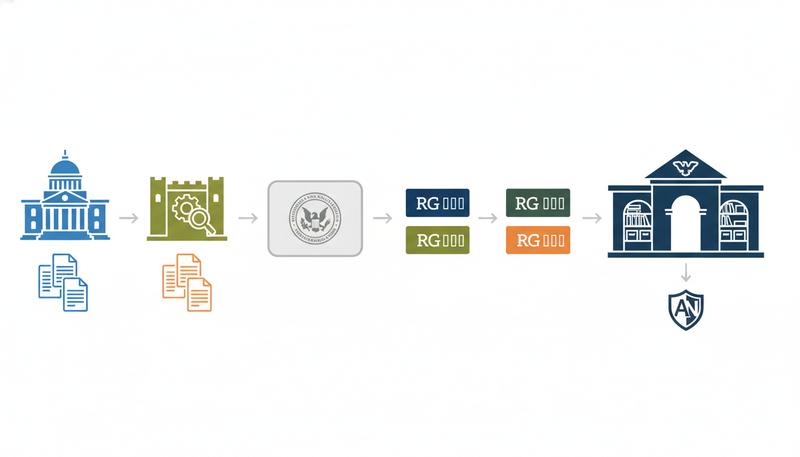
NARA's website maintains a list of all Record Groups and their contents, and the National Archives Catalog allows you to filter searches by Record Group. Getting comfortable with the RG system turns you from someone who is searching blindly into someone who understands the filing logic of the world's largest archive.
The National Archives Catalog: Your Primary Search Interface
The National Archives Catalog (catalog.archives.gov) is the central online finding system for NARA holdings. It's free, publicly accessible, and — once you understand how it works — genuinely powerful. It's also, like most archival catalogs, somewhat different from what you're used to if your research experience is mainly Google or a library system.
Here's what the catalog actually contains: descriptions of NARA's holdings at multiple levels of detail. At the broadest level, you'll find Record Group descriptions. Within those, Series descriptions (groups of related records, like "Case Files" or "Incoming Correspondence"). Within series, sometimes File Unit descriptions. And at the most granular level, descriptions of individual Items — and for a growing portion of the holdings, actual digital scans.
The key word there is sometimes. The catalog is not complete. Not every series is fully described at the file unit or item level. Not everything that exists in the stacks has a corresponding catalog entry. This isn't a failure of NARA — it's just the reality of describing billions of pages of records with limited staff. It means that a negative result in the catalog ("I searched and didn't find it") does not mean the records don't exist. They might just not be cataloged yet. Or they might be described under different terminology than you used.
Searching the Catalog Effectively
The catalog's search interface has a few features worth understanding:
Keyword search is the starting point for most researchers, but results can be noisy. Use quotation marks for exact phrases. Use the filter panel on the left side of results to narrow by Record Group, by location, and — critically — by whether digital content is available.
The "Online" filter is your best friend if you're doing remote research. Checking "Digitized" shows you only the records that have been scanned and are viewable in the catalog. This subset represents a small fraction of NARA's total holdings, but it's growing rapidly thanks to digitization partnerships with Ancestry, FamilySearch, and Fold3.
Browsing by Record Group is often more productive than keyword searching when you're unfamiliar with a collection. Navigate to the Record Group for the agency you're interested in, then browse the series descriptions. This gives you a structural sense of what the agency created and preserved, rather than relying on keyword matches.
Staff-created guides supplement the catalog. NARA's website has research guides for popular topics (genealogy, military records, court records, and more) that often provide better entry points than the catalog itself for common research questions. The genealogy research guide is particularly thorough and includes links to related digitized records.
Interpreting Catalog Records
When you find a series or item description in the catalog, pay attention to a few key fields:
- Scope and Content Note: This is the most important field. It describes what's actually in the records — what information they capture, what time period they cover, what's included and what's excluded.
- Access Restrictions: Some records are restricted due to privacy, national security classification, or donor-imposed restrictions. This field will tell you.
- Physical Location: This tells you which NARA facility holds the physical records — essential for planning visits or reproduction requests.
- Arrangement: How the records are organized within the series (chronologically? alphabetically? by case number?). This tells you how to navigate them once you have them in hand.
What Is Digitized — and What Isn't
Let's be honest about the current state of NARA digitization, because unrealistic expectations cause a lot of wasted effort.
A relatively small percentage of NARA's total holdings are available online. For genealogically popular records — census schedules, passenger arrival lists, pension files, some military service records — digitization is quite extensive. This is largely because commercial partners like Ancestry.com and FamilySearch have invested in scanning them in exchange for the right to offer them through their subscription platforms. NARA's census records from 1790 through 1950 are among the most thoroughly digitized holdings, accessible through partner sites (with subscriptions) and sometimes directly through the NARA Catalog.
But outside of genealogically popular record types, digitization drops off sharply. Twentieth-century agency records — the operational files of federal departments, correspondence, policy documents, classified materials that have been declassified — are mostly not online. Many court records are not digitized. Large categories of military records are not digitized, and some, famously, were destroyed in the 1973 National Personnel Records Center fire, but that's a story for the military records section.
graph LR
    A[Research Need] --> B{Is it available online?}
    B -->|Yes - digitized in Catalog| C[View via catalog.archives.gov]
    B -->|Yes - via partner| D[Ancestry/FamilySearch/Fold3 subscription]
    B -->|No - requires physical access| E{Can you visit?}
    E -->|Yes| F[Plan in-person visit to relevant facility]
    E -->|No| G[Submit reproduction request / hire local researcher]
    C --> H[Download or cite directly]
    D --> H
The Practical Implications
For remote researchers — those who can't easily travel to Washington or to a regional facility — the digitization gap means you need to think carefully about your options:
- Check the catalog first for digital images. Use the "online" filter.
- Check Ancestry, FamilySearch, and Fold3 for records digitized through partnership arrangements. FamilySearch is free; the others require subscriptions.
- Submit a reproduction request through NARA's Ordering Reproductions system for specific items you've identified in the catalog. This is a paid service — more on fees in a moment.
- Hire a local researcher (NARA maintains a list of independent researchers who work in Washington-area facilities) if you need extended research in un-described or un-digitized collections.
Warning: Don't assume that because a record type is digitized, the specific record you need is online. Digitization is often incomplete within categories — some years are scanned, others aren't; some geographic areas are covered, others not. Always verify for the specific date range and location you're researching.
Presidential Libraries: A Separate NARA System
Presidential Libraries are NARA facilities, but they operate as a semi-distinct system, and researchers sometimes don't realize this. There are currently fifteen Presidential Libraries, ranging from the Franklin D. Roosevelt Library in Hyde Park, New York (the oldest, opened in 1941) to the Obama Presidential Center (still in development). The Trump administration, notably, opted out of the traditional NARA system in favor of a private foundation model.
Each library holds the papers, records, and artifacts of a specific president's administration. This includes the president's personal correspondence and official papers, but also the records of the White House staff, the National Security Council, and other offices within the Executive Office of the President during that administration.
Presidential Libraries matter for researchers working on policy history, diplomatic history, political biography, and the history of the executive branch. They're also increasingly important for journalists and researchers using FOIA — classified records from presidential administrations are reviewed and released through the libraries, not through the central NARA facilities.
Each library has its own research room, its own finding aids (increasingly available online), and its own digitization program. The online portals vary significantly in how complete and searchable they are. The NARA research portal links to each library's website.
A few things to know about Presidential Library research:
- Access is open to the public, free of charge, with the same researcher card process as other NARA facilities.
- Many records are still classified or restricted, particularly from more recent administrations. Expect significant gaps.
- The physical library location matters: if you need Roosevelt records, you're going to Hyde Park, New York. Eisenhower is in Abilene, Kansas. Nixon is in Yorba Linda, California.
- Digitization varies widely by library and has accelerated in recent years, but much material still requires in-person visits.
Ordering Reproductions and What to Expect
If you've identified records in the catalog that aren't digitized and you can't visit in person, NARA's reproduction service is your path to obtaining copies. The process has improved significantly with online ordering, but it's worth calibrating your expectations.
The Order Process
For records you've identified in the National Archives Catalog, you can submit a reproduction request online through your catalog account. For records not yet fully cataloged, you'll need to contact the relevant facility directly — by phone or email — to request a search and copy order.
You'll need to provide as much identifying information as possible: Record Group number, series name, box number, folder title, document title or description. The more specific you are, the faster and more accurately staff can locate your materials.
Fees
NARA charges fees for reproduction services. As of this writing, basic paper photocopies run a few dollars per page, digital scans are available for many record types, and certifications (official certified copies with NARA's seal, often required for legal purposes) carry additional fees. Fee schedules are published on NARA's website and do change, so check the current rates before budgeting.
Turnaround times vary considerably. Requests for popular, well-described records can be filled in a few weeks. Requests requiring manual retrieval and searching in un-described collections can take months. Patience is not optional here.
The Self-Service Alternative
If you visit a NARA facility in person, you can photograph documents yourself with a personal camera or smartphone — no flash, flat documents — at no charge, subject to facility rules. This is by far the most cost-effective approach for researchers with large copy needs. One day in the reading room with a good camera can yield hundreds of documents that would cost significant money to order remotely.
Common Research Mistakes at NARA (and How to Avoid Them)
After watching researchers — including experienced ones — bump into the same walls repeatedly, here are the most common mistakes and how to sidestep them.
Mistake 1: Searching the Catalog Like a Search Engine
The catalog rewards archival thinking, not keyword thinking. If you search for "Japanese American internment," you'll get some results, but you'll miss massive amounts of relevant material held under neutral bureaucratic series titles like "Central File" or "Project Files." Understand which agencies touched your topic, find their Record Groups, and browse their series descriptions. Then supplement with keyword search.
Mistake 2: Not Calling Ahead
Reading rooms have hours. Appointments may be required. Specific materials may need to be retrieved from offsite storage in advance. Some researchers have found that the box they needed was at the conservator for treatment. A quick email or phone call before traveling can save enormous frustration. NARA staff are generally helpful to researchers who communicate clearly about what they need.
Mistake 3: Confusing What's in the Catalog with What Exists
The catalog describes a subset of holdings. Staff at any NARA facility will tell you: there is significant material in the stacks that isn't in the catalog yet. If you've exhausted the catalog for a particular Record Group and haven't found what you need, ask a reference archivist whether there are uncataloged series that might be relevant.
Mistake 4: Assuming Records Are at the Washington Facilities
As discussed above, court records, land records, and regional agency records are often at regional facilities — not in Washington. NARA's court records research guide explicitly maps which states' records are at which facilities. Check the geography before you book travel.
Mistake 5: Ignoring the Access Restrictions Field
Some records require a formal request or special permission to view. Classified records require declassification review. Privacy-restricted records (personnel files, medical records, records about living individuals) have access rules. Records with donor-imposed restrictions may require written permission. Finding out about restrictions after traveling is miserable. Read the catalog entry's restriction field carefully.
Mistake 6: Underestimating Digitization Partner Sites
Many researchers go directly to catalog.archives.gov and conclude that records aren't available online when, in fact, they've been digitized by a commercial partner and are available on Ancestry or FamilySearch. The catalog increasingly links to partner-held digital content, but not always. NARA's genealogy start page lists the key partner relationships and record types they've digitized.
Putting It Together: A Research Scenario
Let's run through a concrete example to see how these pieces fit. Suppose you're researching the history of a federal dam project on a Western river in the 1940s — you want to understand the land acquisition process and what happened to the families displaced.
First, you'd think about which federal agency managed dam construction and land acquisition in the 1940s. The Bureau of Reclamation (Department of the Interior) was the primary agency for Western water projects. That gives you Record Group 115 — Records of the Bureau of Reclamation.
You'd go to the National Archives Catalog and search within RG 115, browsing series descriptions for anything related to land acquisition, relocation, or specific project names. You'd note which series appear to be relevant and which facility holds them — likely Archives II in College Park for twentieth-century Interior Department records, but possibly a regional facility depending on project location.
You'd check whether any relevant series have been digitized. If not, you'd contact Archives II to understand the series arrangement and plan either a visit or a targeted reproduction request. You might also check whether the presidential library for the relevant administration (FDR's library in Hyde Park for a 1940s project) holds any policy-level correspondence.
At every step, you're thinking not "what is my topic?" but "who created the records, why, and where did they end up?" That shift — from subject thinking to provenance thinking — is what separates effective NARA research from spinning your wheels.
NARA is vast, and no single visit or search session will reveal everything it holds about any significant topic. But the architecture is coherent once you understand it, and the staff — despite institutional pressures and workload — genuinely care about helping researchers access the record. The documents are there. The systems exist to find them. Now you know the map.
Only visible to you
Sign in to take notes.