How to Conduct Family Interviews for Better Stories
Conducting Family Interviews That Actually Reveal Something
Now that you have gear you understand and can operate reliably, you're ready for the moment that actually matters: the conversation itself. Because here's what happens next — you point that camera at someone you love and ask them to tell you something true. And most of the time, it doesn't work.
There's a scene that plays out in family videos all over the world. Someone points a camera at Grandma and asks, "So, what was it like growing up?" Grandma smiles, says something like, "Oh, it was wonderful — we didn't have much, but we were happy," and the camera operator says, "That's great, thanks." Three minutes of footage. Nothing usable. A story that died in generalities before it ever had a chance to live.
This happens not because Grandma doesn't have anything to say. She has decades of specific, irreplaceable, extraordinary experiences stored in her memory. It happens because nobody asked her the right questions — and because nobody built the kind of conversation where those specific memories feel safe and natural to share.
Do Your Homework: Why Research Matters Before You Hit Record
The secret that professional documentary filmmakers know is this: the best interviews come from preparation that happens before the camera ever rolls.
When you walk into an interview with your grandmother and you already know that her family moved from Mississippi to Detroit in 1952, that her father worked at the Ford River Rouge plant, and that she went to Northwestern High School — she feels known. She doesn't have to explain the basics. She can go deeper, because you've already covered the ground level. And more importantly, you can ask the follow-up questions that matter, the ones that wouldn't occur to someone coming in cold.
For a family documentary, your research sources are straightforward:
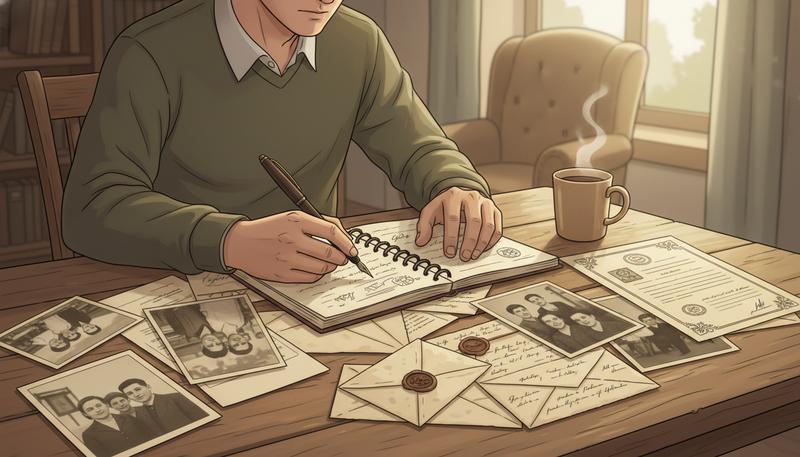
- Family documents: old letters, diaries, military discharge papers, immigration records, photo albums with dates written on the back. These are gold. A single sentence in a letter can become the seed for a whole line of questioning.
- Other family members: talk to aunts, uncles, parents before you interview the main subject. Their stories will seed your questions and often unlock memories the person you're interviewing might have forgotten they had.
- Historical context: if your grandfather fought in Korea, spend an hour reading about the Korean War. If your grandmother's family was part of the Great Migration, learn something about it. This context lets you ask informed follow-up questions that go beyond the surface.
- Previous conversations: what has this person mentioned, almost in passing, that you've always wanted to know more about? Sometimes the most important stories are the ones that came out sideways, almost accidentally.
You're not trying to become an expert. You're trying to know enough that you can be genuinely curious in an informed way. There's a difference, and your subject will feel it.
Question Design: The Architecture of a Good Interview
Here's something that might seem almost too simple to matter, but it genuinely changes everything: the difference between a question that produces a summary and a question that produces a story is usually just the word "when."
Compare these two:
- "What was your childhood like?" → Produces a summary: "It was good. We were a close family."
- "Can you tell me about a specific day from your childhood — something you can still picture clearly?" → Produces a story.
The documentary world has a phrase for this: the "tell me about a time" structure. It's deceptively simple and almost never fails.
Open-ended questions invite the subject to lead. They can't be answered with yes or no, and they don't point toward a specific answer you're hoping for. "What was your relationship with your mother like?" opens up possibilities. "Were you close with your mother?" shuts them down — it's yes/no, and it produces exactly that.
Sensory prompts are extraordinary tools for unlocking memory. The brain doesn't just store facts; it stores the whole sensory experience of a moment. Asking someone to return to a specific sensory detail can unlock a whole cascade of memory that wouldn't come out any other way. Try:
- "What do you remember smelling when you walked into your grandmother's house?"
- "What did the neighborhood sound like at night?"
- "Can you picture what you were wearing that day?"
These aren't tricks. They're invitations to actually be present in the memory, not just report on it from a distance. The answers you'll get back are almost always richer and more specific than direct questioning produces.
Chronological structure helps both the interviewer and the subject. Starting at the beginning and moving forward in time gives the conversation a natural spine. The Smithsonian oral history methodology explicitly recommends "starting at the beginning and proceeding chronologically" — not because you'll use every bit in order, but because it gives the subject a clear path to walk through their own life.
Here's a sample arc for an interview with an elderly grandparent:
graph TD
    A[Early childhood: family, home, neighborhood] --> B[School years: friends, teachers, formative events]
    B --> C[Young adulthood: work, romance, marriage]
    C --> D[Parenthood: raising children, sacrifices, joys]
    D --> E[Later life: what changed, what stayed the same]
    E --> F[Reflection: what they'd want to be remembered for]
You don't have to follow this exactly. But having a map means you're never lost, even when a great tangent takes you somewhere unexpected — and the best interviews usually do.
Questions to Avoid
You'll waste significant time — and potentially shut down your subject — with certain question types. Here's what the professionals learn to avoid, usually the hard way:
Yes/no questions. "Did you enjoy school?" will get you "yes" or "no," maybe with a brief elaboration. "What did you love and hate about school?" gets you somewhere real. The fix is almost always to add "what" or "how" or "tell me about" at the beginning.
Leading questions. These telegraph the answer you're hoping for, which means you won't get the truth — you'll get your subject performing the answer they think you want. "That must have been really hard, right?" is a leading question that contains its own answer. "How did that feel?" invites whatever actually happened.
Compound questions. This is the interviewer's fatal habit. "What was your relationship with your father like, and how did that influence how you raised your own children, and do you think you were similar or different as a parent?" Your subject has to pick one question to answer, and they'll pick the safest one. Ask one question. Then stop. Wait.
Questions that produce abstractions instead of scenes. "What's the most important lesson you've learned?" sounds profound, but it reliably produces fortune-cookie answers. Instead, try: "Is there a specific moment — something that happened — that changed the way you think about how to live?" That's the same question, but it demands a story rather than a summary.
Future-oriented hypotheticals. "What would you want your grandchildren to know about you?" These produce prepared, formal-sounding answers. You'll get better material from the past: "Can you think of something that happened in your life that you've never really told anyone about?"
Building Rapport Before the Camera Rolls
The pre-interview conversation may be the single most important thing you do, and most people skip it entirely.
Here's how it works: arrive early, before you set up any equipment. Make tea. Sit down. Talk. Not about the interview — about anything else. How's the garden? Did you see that game? Tell me about that photo on the shelf.
This conversation does several things simultaneously. It settles your subject's nerves, which are almost certainly there even if they don't show it. It signals that this is a conversation, not an interrogation. And it often produces the best material of the entire session — the casual, unguarded anecdote that comes out when the camera isn't rolling.
The Smithsonian's methodology [recommends a pre-interview call or visit to "get acquainted and discuss procedures"](https://siarchives.si.edu/history/how-do-oral-history). Even for family members you know well, this matters — because the camera changes the relationship slightly, and the pre-interview conversation is where you re-establish that you're still just the person they trust.
One specific technique that works beautifully: during the pre-interview chat, let them tell a story. Any story. Don't redirect it, don't make notes, just listen. Then, when the camera rolls, you can say, "You were just telling me about the time your father drove the wrong way into town — can you tell me that story again, from the beginning?" Now they're not trying to think of something to say. They're just repeating something they just said. The second telling is almost always better than the first — more confident, more detailed, more genuinely felt.
Tell them explicitly what the interview will be like. How long will it take? What kinds of things will you ask about? Can they take breaks? Will they be able to review what they said? These aren't just courtesies — they're the conditions under which someone feels safe enough to be honest.
Physical Setup: Making the Space Work
Now for the technical architecture of the interview. The goal of setup is invisibility: you want your subject to forget, as quickly as possible, that they're being filmed. Every visible microphone, uncomfortable chair, and blinding light source works against that.
Location selection is the first decision. The IDA's guide to documentary interviews is emphatic on this point: always shoot indoors where you can control sound and light. Outdoors may seem appealing — natural beauty, good light — but you'll be at war with shifting sun, wind, passing cars, and birds. The footage may look beautiful; the audio will be unusable.
Choose a room where you can control:
- Appliances: turn off the refrigerator, the HVAC, the ceiling fan. (Set a reminder to turn the fridge back on. This is one of those things that sounds silly until you forget it and spend the rest of your evening wondering why it's so quiet.)
- Lighting: close blinds or curtains on windows that would create backlight behind your subject
- Acoustics: hard surfaces (tile, hardwood, bare walls) create echo. Carpeted rooms with bookshelves and upholstered furniture absorb sound and are your friends
Choosing the right chair matters more than it sounds. Experienced documentary shooters recommend avoiding chairs that swivel, roll, or creak. A wooden chair that creaks when your subject shifts their weight will ruin your audio. A rolling chair will let them drift out of frame. A high-back sofa will dominate the composition and they'll slowly sink into it over the course of an hour. Use a solid armchair or straight-backed chair, and add a pillow if needed to get them at the right height.
Background framing is where many family videos telegraph their amateur status. You want depth and visual interest in the background, but nothing that competes with your subject's face. Bookshelves work well — they suggest interiority and personality without being distracting. Family photos in the background can be powerful. What doesn't work: a blank wall (flat and institutional), a window behind the subject (backlight nightmare), or a cluttered kitchen counter (busy and random).
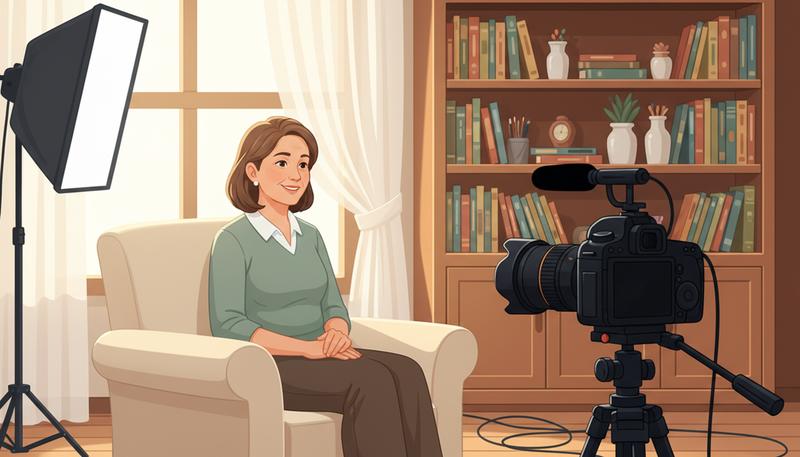
Camera height and eyeline. The camera should be at or very slightly below the subject's eye level. Cameras aimed up at people make them look powerful; cameras aimed down make them look diminished. For a seated interview, that usually means the camera is about chest-height on a tripod.
The subject should not be looking directly into the lens — that creates a "news anchor" look that distances the viewer. Instead, they should be looking slightly off to the side of camera, toward the interviewer. The interviewer sits close to the camera — ideally within a foot or two — so the subject's gaze is almost at the lens without quite being there. This is the position that creates the feeling of intimacy, of a conversation overheard.
Framing. For a single-camera interview, frame your subject in a medium close-up: head and shoulders to mid-chest. Leave "look room" on the side toward which they're looking — if they're looking left toward the interviewer, have more space on the left side of the frame. The subject should not be perfectly centered in the frame; slightly off-center reads as more natural and cinematic.
graph LR
    A[Interviewer\n Close to camera] --> B[Camera\n Eye-level]
    B --> C[Subject\n Faces interviewer]
    D[Window light\n 45° from subject] --> C
    E[Fill card or\n second light] --> C
Single Camera vs. Two Cameras
The choice between one camera and two cameras changes the edit more than it changes the shoot.
With a single camera, you're committed to one angle. Every cut you make in the edit has to be covered by b-roll (shots of the subject's hands, the photos they're describing, other relevant images). This is actually fine — often better than fine. Many of the greatest documentary interviews are single-camera, and the focused intimacy of one angle can be more powerful than coverage.
With two cameras, you can cut between angles — a wide shot and a close-up, for instance — which means you can cut within an answer without the jump cut that would occur if you had only one angle. This is enormously useful in the edit. The tradeoff is complexity: you're managing two tripods, two sets of levels, two focuses, and you'll need to sync the footage in post.
For family filmmakers, the honest advice is this: start with one camera and do it well. One camera, properly framed, with good audio, will produce far better results than two cameras set up carelessly. Master the single-camera interview, and you'll have the foundation for anything more complex later.
Lighting for Interviews: Simple Solutions That Work
You don't need a lighting kit. Natural window light, properly managed, is one of the most beautiful light sources in the world — it's what painters spent centuries trying to simulate. But you have to know how to use it.
The key principle: you want the light source to be to the side of your subject, not behind them. A window behind your subject creates silhouette — their face goes dark and the background blows out. A window to the side creates a natural, dimensional light that models the face and looks beautiful on camera.
Position your subject so a window is at roughly 45 degrees from the side — not directly to the side (which can create too dramatic a shadow on the far cheek) and not directly in front (which is flat). Turn off any ceiling lights, which create a flat, overhead look that flattens features and reads as institutional.
The challenge with window light is that it changes. A cloud passing over will drop your exposure mid-sentence. For longer interviews, you may need to close the blinds and use a supplemental light — an LED panel, a lamp with a daylight bulb, even a well-positioned ring light. The goal is consistency.
For the shadow side of the face, add a simple fill: a piece of white foam board (from any art supply store) positioned opposite the window and angled toward the subject will bounce the window light back into the shadows, softening the contrast and revealing facial detail. This is a technique that professional directors of photography use on expensive productions, and it costs about $3.
Documentary cinematographers consistently note that audiences will forgive a flawed image but will tune out for bad sound. That said, there's no reason not to get both right, and with window light and a foam board, you're most of the way there.
Audio for Interviews: The Difference Between Good and Unusable
Audio is where family interviews most often fail technically. And unlike bad framing, which you can sometimes rescue in post, bad audio is usually fatal. You cannot fix reverb in a bathroom, or a refrigerator hum, or wind noise in post-production. Not really. Not to a standard that sounds right.
The fundamentals:
Use a lavalier microphone. The built-in microphone on your camera is almost certainly too far from your subject to capture clean dialogue. A lavalier — the small clip-on microphone you see clipped to newscasters' lapels — solves this by placing the microphone 6-10 inches from the subject's mouth, which is where it belongs. Affordable lavalieres (the Rode SmartLav+ is a solid choice) connect directly to phones and produce dramatically better audio than any camera's built-in microphone.
Clip it correctly. The lav goes at the center of the chest, under or just at the neckline — high enough to be close to the mouth, concealed enough not to draw the eye. The cable should be routed to prevent cable noise (the rustle of a wire against fabric ruins audio). The subject's necklace or collar should not be rubbing against it. Check by asking them to turn their head both ways and nod — if you hear fabric noise, reposition.
Check levels before rolling. As Georgetown University's documentary audio guide emphasizes, "your microphone levels should never peak into the red during your test. The optimal point for your microphone levels is just below the red." This means asking your subject to speak at the volume they'll use in the interview — "tell me about what you had for breakfast this morning" — while you watch the levels on your recorder or camera. If the levels peak, drop the input gain. If they barely register, raise it.
Wear headphones. This is non-negotiable. You cannot hear the audio by watching a level meter. The meter tells you the volume; headphones tell you what it sounds like. Headphones will reveal the refrigerator hum, the AC duct, the subject's necklace clicking, and the car outside — before those things ruin your footage.
Record room tone. Before you leave any interview location, ask everyone to stay perfectly still and silent for 30 seconds. Record that silence. This is the ambient sound of the room — the baseline noise floor that editors use to fill gaps between pieces of audio and to make transitions smooth. Every editing guide will tell you this, and Georgetown's audio documentation confirms it: "At the end of any interview or any scene of b-roll, record 30 seconds of ambient sound. This will come in very handy when you are editing your documentary's soundtrack in post-production."
How to Listen: The Hardest Part of Interviewing
You've done the preparation. You're in the room. The camera is rolling. And now the hardest part begins: listening.
Active listening in a documentary interview is different from conversational listening. In conversation, we're often half-listening while we think about what we're going to say next. In an interview, you're listening for multiple things simultaneously:
- The emotional content: what does this person feel about what they're describing?
- The specific detail: did they just mention a name, a place, a moment that opens a door?
- The absence: what aren't they saying? What are they circling around?
- The usability: is this sentence self-contained? Does it include context, or does it refer to something only the interviewer knows?
That last one is critical. When your subject says, "That was when I really understood what he meant," they're assuming you know who "he" is. In a documentary, that answer is unusable without context. You need to gently redirect: "Can you say that again, including a little more about who you're talking about and when this was?" Teaching subjects to speak in complete sentences — which include the context — is part of interview technique, and the best time to do it is early, with a light touch.
Following the unexpected answer is where interviews become extraordinary. You had your questions planned. Your subject starts answering one and suddenly mentions, in passing, that her father once drove them all to Canada on a whim and they got stuck at the border for three days. Every instinct says: stay on track, get back to your questions. The opposite is true: follow that. Ask about the border crossing. Ask what they ate. Ask what her father said when they finally crossed back. The planned question will wait.
The Smithsonian's oral history protocol describes this as "following up on details or unexpected avenues of information" — one of the core competencies of skilled oral history practice. The interviewer who sticks rigidly to their questions gets planned answers. The interviewer who follows the subject gets the truth.
Getting Usable Answers: When to Try Again
Sometimes an answer simply doesn't work. Maybe it was too vague. Maybe the subject referred to something without explaining it. Maybe they started in the middle, assumed context, or answered a different question than the one you asked. This happens in every interview. The professional response is to try again, without making anyone feel bad about it.
The most graceful way: "I want to make sure I understand — can you walk me through that from the beginning, starting with where you were and what happened first?" This isn't a criticism. It's an invitation to tell the story better, which almost everyone will accept willingly.
Another technique: echo the last thing they said and pause. If they say "It was the hardest thing I ever did," you say quietly: "The hardest thing you ever did..." and then wait. The pause creates space, and people almost always fill it with the detail or emotion that was just below the surface.
Silence is one of the most powerful tools in an interviewer's kit. We're trained by conversation to fill silence immediately, but in a documentary interview, a five-second pause after an answer frequently produces the most honest thing a subject says. Count to five in your head before asking the next question. It will feel interminable. Do it anyway.
Ethics and Consent: Filming Family with Care
The fact that you're filming family doesn't mean consent is automatic. In some ways it makes consent more important — because the power dynamics within families are complex, because elderly relatives may not fully understand how the footage will be used, and because the trust involved is real and personal.
With elderly relatives, be specific about what you're making and who will see it. "I'm making a film about your life for the family — something we'll watch together and that the grandkids can see when they're older" is concrete and honest. Don't promise that the footage will remain private if you intend to share it publicly. The Smithsonian's oral history ethics guidelines emphasize that subjects should understand their rights clearly, including the right to review and the right to revoke consent, and this applies just as much to family members.
With children, the ethical bar is higher. Young children cannot give informed consent; parents or guardians make that decision. But children old enough to understand should always be asked if they want to be filmed, and their "no" should be respected — even if they're in the middle of the thing you most wanted to capture. Nothing is worth making a child feel surveilled or unsafe.
With sensitive topics, move carefully. If you know the interview might touch on divorce, illness, estrangement, addiction, or grief, think through in advance whether you're prepared to handle those topics with care. Sometimes the most important stories are also the most painful. An interview that opens something that the subject can't close is a harm, not a gift. You can always ask a gentle lead-in: "I know this might be hard to talk about — do you want to go there, or would you rather not?" And then respect the answer completely.
What to do when the interview gets emotional: don't stop filming, but do stop talking. Let the emotion exist. A tissue box should always be within arm's reach. Don't rush to comfort with a question — comfort with silence and presence. Some of the most powerful moments in documentary history happen when an interviewer simply doesn't speak, and the subject sits with something real.
When someone cries, or when their voice breaks, many first-time interviewers reflexively cut the camera or change the subject. This is understandable — it comes from compassion — but it's often the wrong choice. The moment of emotion is usually the moment of truth. After a pause, you can gently ask: "Do you want to continue?" And if they do, let them.
There will be interviews where someone says something and then asks you not to use it. Honor that request, always, without argument. The relationship is more important than any footage, and a family member who trusts you to respect that boundary will tell you something better in the next five minutes.
Putting It All Together: The Interview as a Conversation
The technical competence — the lighting, the audio, the framing — matters enormously. But it all exists in service of a single goal: a conversation in which someone feels safe enough to actually tell the truth.
When that conversation works, something remarkable happens. You'll know it because you stop thinking about the camera. Your subject stops thinking about the camera. The questions start generating themselves from the answers, and you're following a thread neither of you could have predicted at the start. The footage you get in those moments is irreplaceable — not because of the technical execution, but because of the human connection underneath it.
That's what this section has been building toward. Not the gear. Not the framing. The conditions under which a person will tell you something they've never said out loud before, something their children don't know, something that reveals exactly who they are.
Your family has those stories. The only question is whether someone creates the right conditions to hear them.
Only visible to you
Sign in to take notes.