How to Make a Complete Family Documentary From Start to Finish
Putting It All Together: A Complete Family Documentary From Start to Finish
You now know how to preserve a film once it exists — how to protect it, store it, and ensure it survives for the people who come after you. But preservation begins with creation. Before you can archive, backup, and vault your work, you have to make it. This final section is where theory becomes practice, where all the techniques in this course — the interviews, the B-roll, the sound design, the editing — come together into a complete, watchable film.
What follows is not a formula or a checklist, but a narrative account of a real family documentary project from beginning to end. The subject is a grandparent portrait. The filmmaker is someone very much like you. The process is exactly as messy and course-correcting as actual filmmaking always is. The grandparent portrait is the ideal first serious project. It's the subject that matters most, the relationship you already have, the stories that are literally irreplaceable — and it's the project that will teach you everything you need to know to make the films that last.
Starting With the Treatment
Before you pick up a camera, you need to know what film you're making. Not in detail — documentary never works that way — but in intention. This is the job of the treatment: a one-page document that answers three questions. What is this film about? What questions will it try to answer? And what might it actually look like when it's done?
Here's a real example:
CARL: A PORTRAIT
Working Treatment — Family Documentary Project
Subject: Carl W., 84, retired iron worker, lifelong resident of [city], husband (deceased spouse: Eleanor), father of three, grandfather of four.
Central question: What does a man learn from a life of physical work, and what does he want the people who come after him to understand?
Likely themes: Labor and dignity. Marriage and loss. The texture of a specific American working-class life that no longer exists in the same form. What he's proud of and what he wishes he'd done differently.
Structure: Single-interview portrait, 12–18 minutes, built around Carl's voice with B-roll of his hands, his house, objects that matter to him. Minimal narration — just enough to provide context the interview can't supply.
Tone: Unhurried. Respectful. Not sentimental — Carl wouldn't tolerate sentiment — but emotionally honest.
Key images I'm looking for: His hands (38 years of foundry work). The kitchen table where Eleanor used to sit. His tool shed. His face when he talks about something that surprised him in his own life.
What success looks like: A film Carl watches and says, "Yeah, that's right." A film his grandchildren will watch in 40 years and feel like they understand who he was.
That's it. One page, maybe 250 words. But it does something crucial: it forces you to know what you're looking for before you start looking. Without this, an interview becomes a conversation with a camera running. With it, a conversation becomes research toward a specific film.
The treatment also serves as an anchor against drift. Halfway through editing, when you're tempted to include a long anecdote about Carl's neighbor that's funny but irrelevant, you can return to the treatment and ask: does this serve the central question? Usually, the answer clarifies itself.
The Shot List
Alongside the treatment, draft a shot list — not as rigid commands, but as a menu of images to look for on interview day. Documentary B-roll is partly planned and partly discovered. The shot list covers the planned part.
Interview setup shots:
- Wide establishing shot of Carl in his chair (before moving to tighter framing)
- Close-up of his hands at rest
- His face in profile
B-roll to capture on interview day:
- Carl's hands doing something: making coffee, holding a tool, turning a page
- The kitchen — table, window, Eleanor's chair (he'll know which one without being asked)
- His tool shed, exterior and interior
- Objects on the mantle: photographs, a union bowling league trophy, whatever's there
- The view from his front porch
- His shoes by the door (there's always something in the shoes)
- Mail on the counter
- Whatever room he watches television in
Audio notes:
- Room tone in the living room (where the interview will be)
- Kitchen sounds if possible: percolator, refrigerator
- Outside: neighborhood ambience — birds, traffic, lawn equipment
The shot list is a hypothesis about what will matter. Some of these shots will be exactly right. Others will be abandoned when something better presents itself. The list isn't a contract; it's a starting point that frees you to improvise because you've already thought about the fundamentals.
Location Scouting: Choosing the Right Room
Arrive 90 minutes before the interview is scheduled to begin. This sounds like a lot of time. It isn't.
Carl's house has three main spaces that could work: the living room, the kitchen, and the den. Each deserves a quick assessment.
The kitchen is immediately rejected. The refrigerator is too loud to switch off — it has a continuous cooling cycle — the overhead fluorescents create flat, institutional light, and the linoleum floor will create reflections that muddy the audio. Beautiful room for B-roll. Terrible room for an interview.
The den is tempting. A large window with good morning light, Carl's chair, years of accumulated objects that suggest his life. The problem is that window. Morning light is lovely now, but the interview will run at least 90 minutes, and the sun will move. By the time Carl is talking about the most important things, the light will be completely different. Shooting indoors where light and sound can be controlled is the foundational rule of documentary interviews.
The living room wins. Carpet for good sound, one north-facing window (consistent, soft light that won't shift dramatically over 90 minutes), a recliner Carl likes, and enough clear wall space for a clean background. The only problem is an HVAC register directly above the chair that produces a faint continuous hiss. The solution: turn off the heat for the duration. It's October. Carl puts on a sweater. Make a note to turn the heat back on when you leave.
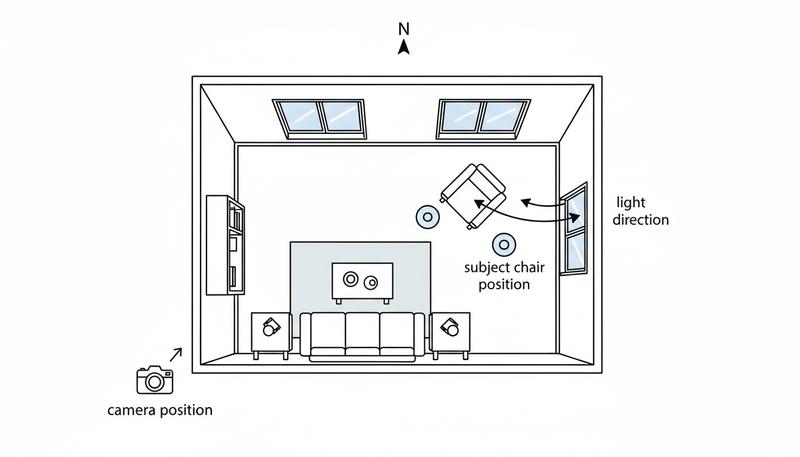
Position Carl's recliner eight feet from the north wall so there's depth behind him. Unplug a lamp that creates a distracting highlight. Two family photographs on the side table stay in frame — they'll be slightly out of focus at your shooting aperture, but you can make out they're photographs, which is exactly right. The story of a man told in a room that contains the evidence of his life.
Position the camera at Carl's eye level. Adjust the tripod down from standard height because he'll be sitting in a low chair. This matters more than people think. A camera angle even slightly above eye level subtly diminishes the subject. Eye level says: I'm here with you. I'm listening.
Gear Check
The equipment for this project is modest by professional standards and completely adequate for the work:
- A mirrorless camera (Sony a7 III) with a 50mm equivalent lens
- A small LED panel for fill light
- A lavalier microphone (Rode Wireless GO II) clipped to Carl's shirt
- A backup audio recorder (Zoom H5) set to record room tone and as a safety track
- A sturdy tripod
- Extra batteries and memory cards (two of each more than seems necessary)
- Headphones
Test the lavalier before Carl sits down — not just for signal, but for clothing noise. Carl is wearing flannel, notorious for generating rustle. Run the clip through the second buttonhole. Tape a small loop of excess cable to the inside of the shirt with medical tape to prevent the wire from pulling. Ask Carl to move around, turn his head, shift in his seat. Some rustle. Adjust the shirt collar. Better. Not perfect. Make a mental note to watch for moments when Carl turns his head sharply; those will likely need repair in the audio edit.
Position the LED fill light camera-left at about 45 degrees, aimed slightly past Carl's face to create a gentle shadow on the far side. The north window provides a soft key light from camera-right. The result is not dramatic cinema lighting — it isn't supposed to be. It's the quality of light that makes a person look like themselves in good light.
One thing easy to forget: the release form. Carl has agreed to be filmed, but for any film that might be shared beyond immediate family — even a Vimeo link — a simple signed document makes sense. Print one the night before: one page, plain language, stating that Carl agrees to be filmed and that his image and voice may be used in a family documentary. He reads it, asks if this is "a legal thing," and signs without drama when his granddaughter explains it's just paperwork.
Conducting the Interview
The interview starts at 10 a.m. Carl has had coffee. You've had coffee. Start the camera rolling before Carl realizes it's rolling — not deceptively, but because starting the camera early prevents the moment where someone says "okay, we're recording now" and everyone stiffens.
Follow the arc you've prepared from Section 5: chronological and concrete first, moving toward reflection and meaning later. The opening questions are almost too easy.
"Tell me where you were born."
Carl says Youngstown, Ohio. His father worked in the steel mills. They moved to this city when Carl was seven because his uncle had a job lead.
"What do you remember about that move?"
He remembers the truck. He remembers his mother crying in the front seat, though she'd deny it if you asked her. He remembers the house they moved into was smaller than the one they left, and that his parents pretended this was fine.
Good. The camera is running. Carl is talking. The audio levels are healthy. Listen, don't perform listening — subjects can always tell the difference. Real listening means letting silences sit, not rushing to the next question, occasionally nodding without speaking. It means tracking what hasn't been said yet and holding those threads for later.
The interview runs about 95 minutes. You'll ask perhaps 40 questions, of which maybe 25 generate usable material. The chronological arc covers Carl's childhood, his entry into the foundry at 19, his first meeting with Eleanor ("she was the only woman in the union hall who could beat me at darts"), his kids' childhoods, Eleanor's illness and death six years ago, and what his life looks like now.
The technique that matters most isn't in the question list. It's the follow-up:
"You said she could beat you at darts. Did she?"
Carl: "Every time. I let her once, and she knew it immediately, and she didn't speak to me for two days."
That's the texture that wasn't in the original answer. That's the film.
The Unexpected Moment That Changes Everything
At the 67-minute mark, ask a question that wasn't on the list. It arises from something Carl said twenty minutes earlier — a passing reference to his youngest son, Danny, that had weight to it. File it away and return to it:
"You mentioned Danny earlier. What's his life like now?"
Carl is quiet for a moment. Not the performance of thinking — actual thought.
"Danny's had a hard road. He's got the drinking problem I didn't have when I was his age. I should say — I had it. I just figured it out earlier."
Another pause.
"I've thought a lot about what I could have done different with Danny. I don't think it was any one thing. I think sometimes a life goes a certain direction and you don't know why, and you have to make peace with not knowing."
Say nothing. Carl continues for another three minutes without prompting, talking about Danny with a precision and honesty that suggests he has thought about this a great deal and rarely gotten to say it out loud. This is the emotional center of the film. It wasn't in the treatment. It wasn't in any question list. It arrived because you were listening closely enough to catch a thread and pull it.
This is why you don't script interviews. You prepare so you can improvise.
After the interview, shoot 30 seconds of room tone with everyone still in the room, then ask Carl to sit quietly while you record 60 more seconds with just Carl and the ambient sound of the house. This will be essential for filling gaps between sentences in the edit.
Shooting B-Roll on the Same Day
After a 20-minute break, the B-roll session begins. Work from the shot list but also from what the interview revealed. The shot list is now partly obsolete and partly more specific.
Danny's story changes what you look for. A photograph of Danny as a boy appears on the mantle — you hadn't noticed it before. A school photo, Danny maybe 10 years old, gap-toothed smile. This goes on the list.
B-roll captured:
Carl's hands get five minutes of coverage: resting on the arm of the chair, wrapped around a coffee mug, turning the pages of a union directory from 1978 that you asked him to find. The hands tell 38 years of foundry work without a word being spoken. They're large, scarred, articulate. Shoot them in several focal lengths — a wide shot of Carl in his chair with hands visible; a tight close-up that fills the frame with nothing but hands.
The kitchen gets coverage even though the interview wasn't shot there: the table, two chairs (one slightly more worn than the other — Eleanor's), the percolator (Carl still uses a percolator), the window above the sink looking onto the backyard. The shot of the percolator becomes important later: there's something about the sound of it — gurgling, hissing, then silence — that perfectly captures the texture of a quiet morning in this house.
The tool shed is shot exterior and interior. Interior: a pegboard with tools hung on it, each with a painted outline showing exactly where it goes. Carl sees you photographing this and says, "Eleanor did that. Every tool has a place." Make a note: this line might need to go into narration if it doesn't fit elsewhere in the interview.
The front porch gets a wide shot of the neighborhood and a close shot of Carl's shoes — brown work boots, worn at the toe — sitting by the door. This image will open the film.
Danny's photograph on the mantle: shot straight on, then slightly raked to reduce glare.
The recliner empty: Carl has stepped outside for a moment, and quickly get a shot of his chair unoccupied, the impression of him still in the cushion. This will be used under a section where Carl talks about what it's like to be alone in the house now.
The B-roll session takes about 45 minutes. Some shots are from the list; others are found. Shoot at 1/50th of a second shutter speed (double the frame rate) for natural-looking motion and at a relatively wide aperture (f/2.8 to f/4) to create enough depth of field that the background is soft but legible.
Before leaving, record nat sound: the percolator in the kitchen (three minutes of it, beginning to end), the creak of the front door, the sound of the tool shed door, birdsong from the porch, the specific quality of silence in the living room where Carl sits in the evenings. These sounds will be used as transitions and texture in the edit. The percolator, in particular, will become a recurring audio motif — the sound of this house in the morning, of Carl alone, of time passing.
Building the Radio Edit
You arrive home with approximately 95 minutes of interview audio, 45 minutes of B-roll, and 15 minutes of nat sound. Total raw material: roughly 2.5 hours.
The first edit task is the radio edit: build the film from audio alone, ignoring video entirely, until the story works as sound.
Begin with a transcript. Use an AI transcription service (Descript, for example) to generate a rough transcript of the interview overnight. The transcript will be imperfect — it renders "Eleanor" incorrectly, mishears technical terms — but it's good enough to work from, and working from a transcript is vastly faster than scrubbing through raw footage.
Read the transcript with a highlighter (physical paper works best for this). Use three colors: yellow for strong content, green for essential content, pink for moments of unexpected depth or emotion. The pink highlights are where the film lives.
After reading, make an initial rough pass: which sections of the interview answer the central question of your treatment? Which sections serve the arc from chronology to reflection to meaning? Which sections are Carl being polite or filling time, and which sections are Carl telling the truth?
This selection process is editorial work in the fullest sense — it's where your perspective and your subject's story meet and either click or don't. For this project, they click. Carl's voice has authority and precision. His pauses are meaningful. The challenge isn't finding good material; it's accepting that good material has to be cut.
graph TD
    A[95 min raw interview] --> B[Full transcript read + highlighted]
    B --> C[Essential moments identified — pink highlights]
    C --> D[Rough radio edit — ~35 min]
    D --> E[Story arc review: does it flow?]
    E --> F{Does story hold?}
    F -- Yes --> G[Tighten to ~18 min radio edit]
    F -- No --> H[Identify gaps, add or reorder]
    H --> G
    G --> I[Radio edit locked — begin assembly cut]
Start the radio edit at about 35 minutes — too long, but right for a first pass. Build it in the editing software (DaVinci Resolve, Premiere, or Final Cut) using only audio clips, arranging them in rough narrative order. Then listen to it straight through, without pausing, taking notes.
What becomes clear on first listen:
-
The chronological opening (childhood, move to the new city) is interesting but too long. Carl talks for 12 minutes; the radio edit needs about 4. The best moments: the truck, his mother crying, the smaller house.
-
The foundry years compress well. Carl describes the work with specificity and pride, and the specificity is what makes it worth keeping. Cut anything general; keep anything particular.
-
Eleanor is everywhere in this interview, even when not being discussed directly. She enters the film in the dart story, stays present in details like tool outlines on the pegboard, and becomes central in the section about her illness. You need an explicit moment where she's properly introduced — a place where narration will serve the film.
-
Danny's section is the emotional center. The 3-minute monologue Carl delivered unprompted is used nearly in full, with only the first 30 seconds (throat-clearing, settling in) trimmed.
-
The film's final beat is Carl's answer to the last question: "What do you want your grandchildren to understand about your life?"
Carl said: "That I tried to do right by people. And that I didn't always, and that I knew it, and that knowing it is the most important part."
The radio edit ends there. There's nothing to add.
After two more passes of tightening — cutting false starts, redundant points, any moment where Carl is summarizing rather than remembering — the radio edit settles at 17 minutes and 40 seconds. This is the spine of the film.
The Assembly Cut: Where the Story Actually Lives
With the radio edit locked, place B-roll over the audio. This is where the film becomes a film.
Build the assembly cut in layers:
Layer 1: The interview footage. The camera footage of Carl in his chair, tightly framed, speaking. This is the baseline. It goes on the timeline in the same order as the radio edit.
Layer 2: B-roll. As Carl speaks, place B-roll over his words. The general principle: when the B-roll illustrates what Carl is saying (his hands when he talks about work, the mantle when he mentions Eleanor's photographs), it goes on top. When what Carl is saying doesn't need illustration — when his face and voice are the point — the talking head footage stays exposed.
The assembly cut reveals several surprises:
The porch shoes open the film better than anything else. You'd thought the film might open on Carl himself — a wide shot of him in his chair, or his hands. In the edit, the film wants to begin before Carl. The boots by the door, the neighborhood visible through the screen, birdsong: this is the world Carl inhabits before he opens his mouth. The boots stay.
The tool shed pegboard image is more powerful as a visual than as narration. You'd considered writing a line about Eleanor's tool outlines. In the assembly, when this shot appears over Carl saying "she had a system for everything, I'll give her that," the connection is made without words. The narration line goes in the bin.
The Danny photograph is difficult. It appears at the right moment — right as Carl begins the Danny monologue — and it's clearly the right image. But it's 10 years old, a school photo. Make a note to ask if anyone has a more recent photo of Danny. They do — his sister texts one that same afternoon, Danny at a family picnic two years ago, laughing. This becomes the photograph in the film.
The pacing in the foundry section is wrong. In the radio edit, this section flows well. In the assembly cut, with B-roll of Carl's hands and the union directory, it feels slow — the B-roll shots linger beyond their usefulness. Trim each B-roll cut by about a second and a half, and the section comes alive.
This is the central lesson of the assembly cut: the radio edit tells you what the story is, but the visual cut tells you how it breathes. They're related but not identical, and the film finds its actual rhythm only when both are working together.
Writing Narration That the Interview Couldn't Provide
After the assembly cut is rough-stabilized, two gaps become clear where narration is needed. Not wanted — needed. Places where the story requires information that Carl never provided and where no B-roll can supply it.
Gap 1: Eleanor's introduction. Carl mentions Eleanor early ("she could beat me at darts") but never explains who she is in a way that will land for a viewer who doesn't know the family. You need one sentence that contextualizes Eleanor — something that tells the audience: this woman became the center of his life.
First draft: "Carl met Eleanor at a union social event in 1963. They were married the following year. She died in 2017."
This is accurate and completely wrong. It sounds like an obituary. Reading it aloud confirms the problem.
Revision: "Carl met Eleanor in 1963. He'd spend the next fifty-two years trying to keep up with her."
Better. The second sentence tells us something about Carl's relationship to Eleanor — the power dynamic, the affection — rather than just reporting dates. It sets up the dart story, which immediately follows, as evidence of the claim.
Gap 2: Context for Danny. When Carl's monologue about Danny arrives, a viewer who doesn't know the family needs to understand that Danny is Carl's youngest child and that their relationship has been strained. Carl implies this but never states it. Without context, the monologue's emotional force is diluted.
First draft: "Carl's youngest son, Danny, has struggled with alcoholism for most of his adult life. Their relationship has not always been easy."
Too explanatory, too clinical. Reading it aloud confirms it sounds like a case worker's report.
Revision: "Of Carl's three children, his youngest — Danny — has had the hardest road. Carl takes responsibility for some of that."
This works because it's in Carl's register — "hardest road" is language Carl uses — and because the second sentence creates a question the monologue then answers: what does Carl think he's responsible for?
Record both narration lines on a quiet afternoon using a USB condenser microphone and a closet full of hanging clothes as a makeshift vocal booth. You're not a trained narrator, which is fine: authenticity of voice matters more than polish in family documentary. Record three takes of each line. Select the clearest take. Place the narration tracks in the edit, adjust the level to sit just above the ambient sound of the interview room, and the result feels continuous — not like an outside voice intruding, but like a thread being gently pulled.
Choosing and Clearing Music
The music question is where many family filmmakers get stuck, and where many finished films run into trouble when shared online. The approach here is methodical.
The film needs two or three pieces of music:
- An opening piece that establishes the world before Carl speaks — something that evokes a specific American life, a specific era, without being obvious.
- A piece for the Danny section — something that can hold the emotion of Carl's monologue without competing with his voice.
- An ending piece that resolves the film with appropriate weight.
Begin at Musicbed and Artlist, both subscription services that provide music licensed for video use including sharing on YouTube and Vimeo. These services solve the rights question cleanly: a subscription covers unlimited use of their catalog for the license period.
Search by mood and instrument rather than genre: "sparse," "acoustic," "American," "melancholy without sentimentality." This produces about 200 results. Filter by listening to the first 30 seconds of each. Most are eliminated immediately — too produced, too contemporary, too recognizably similar to movie trailer music.
Three pieces make the shortlist:
- A solo acoustic guitar piece with a slightly tentative fingerpicking style — for the opening, it has the quality of someone beginning to tell a story
- A piano and cello duet that builds slowly — this could work for the Danny section, but the cello might push the emotion past where Carl's measured voice lives
- A solo piano piece, very quiet, almost tentative — this works for the ending
Live with these three pieces for a day, playing them against rough sections of the film to test the fit. The guitar piece opens the film over the boots and the neighborhood. It's right: it sounds like morning, like a particular kind of American life. The piano piece ends the film over a final shot of Carl in his chair, the afternoon light shifted, the camera slowly pulling back. Also right.
The Danny section, ultimately, takes no music at all. Carl's voice carries it. Adding music would layer your emotion on top of Carl's, and Carl's is better. Some of the best documentary filmmaking is knowing when silence — or near-silence, with only room tone and nat sound — is the only honest choice.
Fine Cut, Color Correction, and Audio Mix
The rough cut is 19 minutes and 20 seconds. The target is 15–18 minutes. The fine cut process is about finding the seven or so minutes that don't actually need to be there.
This is the hardest part of editing, because by this point you've been living with this material for weeks and everything feels essential. The trick is to watch the film at speed (not scene by scene) and note every moment where attention drifts. Those are the moments to interrogate.
After two more passes, the film is 16 minutes and 48 seconds. Nothing essential was cut; the cuts came from the ends of sentences (Carl's habit of adding a redundant summary after the real thought), from B-roll shots held two seconds longer than necessary, and from a three-minute section about Carl's early foundry years that was genuinely interesting but didn't serve the central question. That section — Carl describing the specific process of iron casting — is saved as a separate short film, because it deserves its own space.
Color correction is minimal. The interview was shot in consistent north-facing window light, so the color balance is largely correct. Make two adjustments in DaVinci Resolve: a slight warming of the skin tones (the LED fill light runs slightly cool) and a subtle contrast lift in the shadows to give depth to Carl's face in the closer shots. The B-roll, shot at different times of day and in different rooms, needs more attention — the kitchen shots in particular have a warmer color temperature than the living room footage, and they're cooled slightly to feel continuous.
The goal isn't to make the film look like a professional production. The goal is to make it look like the world Carl actually inhabits, faithfully rendered. Color correction in family documentary should be invisible: you should never notice it unless you compare original and corrected versions side by side.
Audio mix is the final and most technically demanding step. The elements to balance:
- Carl's voice (the lavalier recording) — the primary element, should be clear and present without being loud
- Nat sound and room tone — supporting texture, should be audible but below conscious notice
- Music — should support emotion without pulling attention from Carl's voice
- Narration — should match the level and feel of Carl's voice
Process the lavalier recording with a gentle high-pass filter (removing low-frequency rumble below 80Hz), a light de-esser (Carl's S sounds were occasionally harsh), and a compressor set conservatively to even out his dynamic range without squashing his voice's natural expressiveness.
Bring music in at -20 to -18 dB during dialogue sections and allow it to rise to about -12 dB in the brief instrumental passages (the opening and the ending). The principle, drawn from professional documentary practice, is that music during interview sections should function like weather — you feel it, you're affected by it, but you don't consciously process it.
Export the final mix and listen on three different systems: laptop speakers, earbuds, and a living room television. The living room television reveals a problem: the low end of the opening guitar piece is slightly muddy at higher volumes. A small EQ cut at 200Hz cleans it up. This is why you listen on multiple systems before calling something done.
Sharing the Film
Export the finished film as a high-resolution H.264 file (1080p, 24fps) and upload it to Vimeo as an unlisted link — visible only to people with the link, not indexed by search engines. This preserves the family's privacy while making it easy to share across devices and platforms.
Send the link to three family members first: Carl's daughter (your mother), Carl's other son, and one of Carl's grandchildren. The note with the link says: Please watch this before showing it to Carl. I want to know if I got anything wrong.
The responses arrive within 24 hours. There are no corrections. Carl's daughter says she cried, which wasn't expected. Carl's son says he didn't know Carl had said anything about Danny, and thanks you for handling it with care. The granddaughter says she watched it twice.
Two days later, drive to Carl's house and watch it together on his television. Carl watches with his arms crossed. He makes no sound for 16 minutes and 48 seconds.
When it ends, he's quiet for a moment.
"That's me," he says.
Not "that's good" or "that's interesting." That's me. The highest possible standard a portrait can meet.
He watches it a second time before you leave.
What to Do Next
The grandparent portrait is finished. The question now is: what does this practice become?
The answer, for most family filmmakers, is incremental. You don't immediately begin a series of ambitious multi-part documentaries. You take what you learned from this film and apply it to the next smaller thing — a birthday, a holiday, a summer road trip — with more intention and more skill than you would have brought before.
The practice philosophy that this course has tried to establish is this: every piece of footage you shoot with documentary intention is in conversation with every other piece. Carl's boots by the door are in conversation with the percolator in the kitchen and the photograph of Danny and Carl's crossed arms as he watches himself on screen. Over years, the conversations multiply. A family archive isn't a collection of videos; it's a web of cross-references, each piece illuminating others.
graph LR
    A[Grandparent Portrait] --> B[Holiday Short Film]
    B --> C[Road Trip Diary]
    C --> D[Child's Coming-of-Age Portrait]
    A --> E[Second Grandparent Interview]
    E --> D
    D --> F[Family Archive: A Living Document]
    B --> F
    C --> F
    A --> F
The next project is simpler: a 5-minute film about Christmas morning, shot with more attention to B-roll and nat sound than any Christmas morning the family has filmed before. Nothing as ambitious as Carl's portrait. Just the application of the same principles — find the story, listen for what you don't expect, get the sound right, edit toward meaning — to a smaller canvas.
Then the project after that. Then the one after that.
The filmmaker who made Carl's portrait is not the same filmmaker who packed the gear into a bag that October morning, anxious about asking questions that might be too personal, worried about the light in the living room, uncertain whether any of it would be worth Carl's time and patience.
That's not because you learned a set of techniques. It's because you proved something to yourself: I can look at a person I love, and see them clearly enough to make something that shows other people what I see.
That's the difference between a home video and a family documentary. It was never the equipment. It was the intention.
It was always the intention.
A Final Word on the Archive
Before you leave Carl's house that afternoon, do one more thing: back up the project in three places. The finished film, the raw footage, the project files, the transcript — everything that went into this film — goes onto an external hard drive that lives at Carl's house, onto a second drive that lives at your home, and onto cloud storage.
This matters more than any editing decision. The film that captures Carl at 84 will become, in time, the most important film this family has. Not because it's well-made (though it is), but because Carl will not always be 84, and this particular version of him — the man who crosses his arms watching himself, who says "that's me" in a quiet living room — will only exist in this film.
Proper archival practice — multiple copies, multiple locations, documented formats — is the final act of intention. Everything else in documentary filmmaking serves the moment. Archiving serves the future.
Make the film. Back it up. Share it. Then go find the next story.
It's there. It's always been there. You just needed to know how to look.
Only visible to you
Sign in to take notes.