How to Close the Intention-Behavior Gap With If-Then Planning
Closing the Intention-Behavior Gap: Implementation Intentions and If-Then Planning
We've spent considerable time now understanding what happens inside the brain during habit formation, persistence, and change. We've seen that old neural pathways don't disappear—they remain thick and competitive, ready to reassert themselves under stress or when old cues show up. We've learned that successful change isn't about erasing the old circuit; it's about building a new one that's strong enough to win. But here's the thing: understanding the neuroscience of habits is only half the battle. The other half is actually doing something with that understanding. And that's where we hit a puzzle that seems to contradict everything we've just learned about human motivation and behavior.
Consider this question: Why do genuinely smart, motivated, deeply committed people routinely fail to do things they've explicitly decided to do? This isn't a moral failing. It's not ignorance. Study after study in behavioral science reveals something unsettling: the best predictor of whether someone will change a behavior isn't their intention to change. It's something else entirely. We know the brain has robust mechanisms for automating behavior once neural pathways get reinforced. But what about that critical first phase—the moment when you decide to act differently, before new pathways have time to consolidate? The gap between what people intend to do and what they actually do is one of the most replicated findings in all of behavioral science. Understanding that gap—and one remarkably well-supported technique for closing it—is what this section is about.
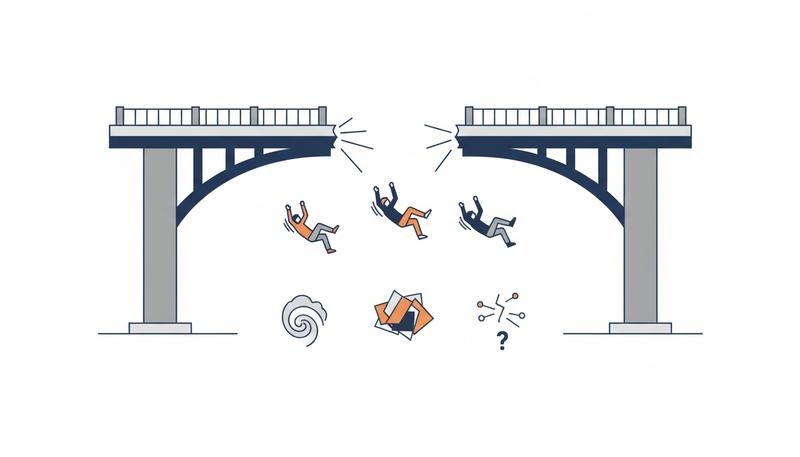
Why the Gap Exists: Three Ways Good Intentions Fall Apart
Most people assume the intention-behavior gap is a willpower problem. Someone decides to exercise more, doesn't feel like it on Tuesday, and gives up. But that's not really what's happening. When researchers dig into the actual failure points, they find something more interesting: the gap isn't about motivation evaporating. It's about memory, attention, and the way your brain handles competing demands in real-world situations.
There are three main ways a genuinely intended behavior fails to materialize:
Forgetting. You meant to do the thing, but the moment arrived and it slipped your mind. This happens constantly because intention-setting and action-execution are separated in time. You plan to call your friend on Tuesday, but Tuesday arrives in a flurry of meetings and emails, and by evening you've forgotten entirely. Your motivation hasn't changed—the cue simply didn't trigger the memory.
Competing demands. The intention is still there, but something else demands your attention more urgently. You planned to eat a salad at lunch, but your coworker suggests pizza. You planned to work on the report, but a Slack message lands and suddenly feels more pressing. These aren't failures of commitment. They're failures of execution priority in a moment with multiple options. The intended behavior loses the moment, even though you still prefer it in the abstract.
Relevance failure. This is the sneakiest one. The situation where the behavior should happen arrives, but your brain doesn't recognize it as the situation you planned for. You decided to "exercise more," so you planned to "do it whenever you have time." But what counts as "having time"? Is it the 20 minutes between meetings? The evening after work when you're tired? The Saturday morning? The cue is there, but it isn't connected to your goal in any way your brain can actually retrieve.
Notice that none of these failure modes are really about motivation. The person wants to do the thing. They just haven't created a reliable link between the right situational trigger and the intended response. This is a planning problem, not a willpower problem—and that distinction is genuinely important, because planning problems have engineering solutions.
Peter Gollwitzer and the Implementation Intention
In 1999, psychologist Peter Gollwitzer published a paper that would eventually become one of the most influential in all of behavioral science. His core insight was deceptively simple: what if, instead of just forming a goal intention ("I intend to exercise more"), people also formed an implementation intention that specified exactly when, where, and how they would act?
The format is almost cartoonishly straightforward:
"If situation X arises, then I will perform response Y."
That's the whole thing. If-then. When I encounter this specific cue, I will do this specific thing. Gollwitzer called these "implementation intentions" to distinguish them from the higher-level goal intentions they're supposed to serve. And when the effect sizes started rolling in from dozens of studies, they were striking enough to raise eyebrows across the field.
The canonical early study involved patients scheduled for orthopedic surgery who were asked to write a plan specifying exactly when and where they would take their first independent walk after the operation. The results were striking: patients who wrote the plan resumed walking significantly faster than those who only set a goal. This matters because these were people in real pain, with genuine motivation to recover. The implementation intention wasn't changing their desire—it was changing their execution.
Hundreds of studies followed. Exercise initiation, dietary change, cancer screening attendance, medication adherence, academic work, voting, recycling—across every domain researchers tested, the if-then plan showed consistent, reliable effects.
Remember: Implementation intentions aren't a motivational tool. They don't make you want something more. They're a translation tool—they convert existing motivation into reliably triggered action by pre-specifying the situational cue that will activate the response.
The Neural Mechanism: What If-Then Planning Does to Your Brain
Here's where the story gets genuinely interesting, because implementation intentions aren't just a behavioral trick. They appear to produce measurable changes in how the brain processes relevant situations.
Think back to the habit loop we covered earlier. Habits operate through a cue-response structure: a specific stimulus in the environment activates an associated routine automatically, mostly bypassing effortful deliberation. The basal ganglia, not the prefrontal cortex, are running the show. This is the automatic system at work.
Gollwitzer's insight was that if-then planning essentially hijacks this same mechanism on purpose. By mentally linking a situational cue to a response in advance, you're doing deliberately what habit formation does through repetition. You're creating a prospective memory structure—a mental filing system waiting for the specified cue to appear. When it does, the plan fires.
EEG research has provided direct evidence. Achtziger, Bayer, and Gollwitzer used event-related potentials to examine what happens when people with implementation intentions encounter their specified cue. They found enhanced processing—specifically, the P300 component, associated with attentional allocation and context updating, was amplified. The brain was treating the specified situation as important in a way it didn't for people who had only formed goal intentions.
fMRI work added anatomical detail. Studies show that when implementation intentions activate, there's increased engagement in prefrontal regions involved in action planning—but the critical feature is that this engagement is automatic, not deliberate. The person doesn't have to consciously remember their plan and consciously decide to act. The situation itself retrieves the plan and initiates the response. Research on the neural basis of implementation intentions suggests this is why the cognitive load required to execute the behavior is dramatically reduced compared to acting on a goal intention alone.
This is the key functional parallel: implementation intentions work like habits—situationally triggered, automatic, low-effort—but they can be installed in a single planning session rather than through weeks of repetition. They're a shortcut into the automatic system.
graph TD
    A[Goal Intention<br/>e.g., 'I want to exercise more'] --> B{Failure Modes}
    B --> C[Forgetting]
    B --> D[Competing demands]
    B --> E[Relevance failure]
    F[Implementation Intention<br/>'When X happens, I will do Y'] --> G[Situation X Encountered]
    G --> H[Automatic Retrieval<br/>of Response Y]
    H --> I[Behavior Executed]
    style F fill:#2a9d8f,color:#fff
    style I fill:#2a9d8f,color:#fff
    style C fill:#e76f51,color:#fff
    style D fill:#e76f51,color:#fff
    style E fill:#e76f51,color:#fff
The Effect Sizes: How Well Does It Actually Work?
The behavior change literature is full of interventions that look impressive in a single flashy study and then collapse under meta-analytic scrutiny. Implementation intentions are not one of those. They've held up unusually well.
The landmark meta-analysis, conducted by Gollwitzer and Sheeran in 2006 and synthesizing 94 independent studies with a combined sample of around 8,000 participants, found a medium-to-large effect size of d = 0.65. In psychological research, this is genuinely large—comparable to some pharmacological interventions. More importantly, the effect was consistent across domains: health behaviors, academic achievement, prosocial behaviors, and emotion regulation all showed substantial effects.
Subsequent meta-analyses have refined the picture. A comprehensive review of implementation intention research found that the effect is strongest when:
- The person already has a strong goal intention (you can't substitute for motivation that isn't there)
- The target behavior is a one-time or relatively discrete action (easier than complex ongoing behaviors)
- The implementation intention is highly specific (vague specifications produce vague results)
- There are clear, reliable situational cues available to serve as triggers
The effect is weaker when the behavior requires sustained effort over time without a clear endpoint, or when the specified cue is rarely encountered. These boundary conditions matter practically, and we'll come back to them.
Tip: When you see effect sizes for implementation intentions cited in popular books, they're often averaged across all conditions. The effect is genuinely stronger for simple discrete behaviors with clear cues—so if you're designing an if-then plan, aim for those conditions.
The Specificity Principle: Why Vague Intentions Fail
One of the most consistent findings in the implementation intention literature is that specificity isn't optional—it's the whole game. A vague implementation intention is essentially a goal intention with extra formatting.
Compare these:
- "If I have a chance to exercise, I'll take it."
- "If it's Monday, Wednesday, or Friday morning and my alarm goes off at 6:30, I'll put on my running shoes and walk out the front door."
The first statement gives your brain nothing to work with. "A chance to exercise" could describe almost any moment or no moments at all. The brain can't pre-load a trigger it can't recognize.
The second statement specifies the exact situational context—day, time, physical cue—and the exact initial response. Notice that it doesn't require committing to a full 5-mile run. It commits you to the first step: shoes on, door open. That's deliberate. Research on action initiation suggests that the real bottleneck is usually starting, not sustaining. Get someone through the door and the run often happens.
The components of an effective if-then specification are:
When: A specific time, or a specific triggering event (after X happens, at the moment when Y occurs). Time-based cues work, but situation-based cues are often more reliable because they fire whenever the trigger appears rather than requiring clock-watching.
Where: The specific location, or spatial context. "At the gym" is acceptable; "at the squat rack near the entrance" is better.
What: The precise behavior, specified at the level of an observable first action. "Exercise" is too abstract. "Put on running shoes" or "open the meal-tracking app" is concrete enough for the brain to pre-load.
Research on habit formation in clinical settings consistently shows that behaviors specified at this level of granularity—concrete, context-specific, tied to observable environmental cues—are the ones that successfully become automatic over time. The specificity isn't bureaucratic pedantry. It's functional.
Habit Stacking: Combining Implementation Intentions with Existing Cues
One of the most powerful applications of implementation intentions is what's sometimes called habit stacking—anchoring a new behavior to an existing, already-automatic habit. The logic is clean: if you already have a highly reliable cue-response link for some established behavior, that behavior can serve as the trigger for your new one.
The formula becomes: "After I [CURRENT HABIT], I will [NEW BEHAVIOR]."
Your existing habit fires automatically. When it does, your implementation intention fires on the back of it. You've borrowed the reliability of an established neural pathway to launch a new one.
Examples:
- "After I pour my morning coffee, I will immediately take my medication."
- "After I sit down at my desk, I will write my top-three priorities before opening email."
- "After I lock my front door, I will take three deep breaths before starting my commute."
The science here is straightforward. The existing habit already has a reliable, situation-specific trigger. By linking your new behavior to that trigger, you're specifying the "if" with something that's essentially guaranteed to occur and to trigger the memory. The habit formation literature consistently shows that stable situational contexts are the most reliable anchors for new automatic behaviors—and an existing habit is one of the most stable situational contexts available.
There is a practical constraint worth naming: the new behavior needs to be compatible with the existing one in terms of time, location, and cognitive load. Trying to stack a 30-minute meditation onto a behavior that happens at random moments throughout a chaotic day will stress the link until it breaks. The anchor habit should be something that (a) happens at a predictable time and place, (b) provides genuine availability for the new behavior, and (c) happens with enough frequency that you get enough repetitions to build automaticity.
Warning: Habit stacking fails when people choose an anchor habit that sounds logical but is inconsistent in practice. "After I wake up" sounds reliable but the morning sequence varies by day. "After I start the coffee maker" is more concrete and consistent. Specificity wins again.
When Implementation Intentions Work—and When They Don't
No technique in behavioral science works for everyone, in every context, with every type of behavior. Being honest about the boundary conditions of if-then planning makes you a better designer of behavior change—and protects you from the mistake of applying a technique past its zone of effectiveness.
When implementation intentions work best:
Strong underlying goal intention. This is the most important moderator. If-then plans amplify motivation that already exists. They don't generate motivation from scratch. Someone who genuinely wants to eat healthier but keeps forgetting is a perfect candidate. Someone who isn't particularly motivated to exercise won't benefit much from a precise plan—you'd need to address the motivation first.
Discrete, bounded behaviors. Taking medication, attending a screening, submitting a form, sending an email—these are behaviors with clear start and end points. Implementation intentions shine here because the "if" and the "then" are both crisp and unambiguous.
Situations where competing responses are weak. If-then planning works partly by pre-committing a response, making it less likely that a competing impulse wins in the moment. But when competing impulses are very strong (severe cravings, intense anxiety, significant temptation), the pre-committed response is harder to execute. The intention helps, but not as much.
Memory and prospective planning demands are high. If the main problem is forgetting to do something you'd happily do if you remembered, implementation intentions are almost perfectly targeted at the problem.
When implementation intentions work less well:
Complex, ongoing behaviors with no clear endpoint. "Becoming more mindful throughout my day" doesn't map well onto an if-then structure. There's no clear situational cue and no clear bounded response. You'd need to decompose this into specific, discrete sub-behaviors.
When the cue is rare or unpredictable. If the specified "if" condition doesn't reliably occur, the plan can't fire. "If someone offers me fast food, I'll decline" is a reasonable implementation intention, but if you almost never encounter that situation, you're not getting practice repetitions.
When the person lacks the skills or resources to execute the behavior. Implementation intentions address the initiation problem, not the competence problem. A person who has decided to learn guitar and plans to "practice every evening at 7pm" will still be stuck if they don't own a guitar or know any chords. The gap between intention and behavior here isn't a timing problem—it's a capability gap.
When the specified response requires extended, effortful engagement. Implementation intentions are excellent at getting you to the gym. They're less effective at ensuring a high-quality workout once you're there, because that's sustained effort, not a triggered initiation.
Coping Planning: An Extension Worth Knowing
A practical extension of basic implementation intentions is coping planning—forming if-then plans specifically for anticipated obstacles rather than just for the target behavior itself.
The structure is: "If obstacle O arises, then I will respond with strategy S."
For example:
- Basic implementation intention: "If it's 7am on a weekday, I will immediately go for a 20-minute walk."
- Coping plan: "If it's raining and I'm tempted to skip, I will put on my rain jacket and walk anyway for at least 10 minutes."
Research combining goal intentions, implementation intentions, and coping plans finds that this three-layer approach produces the largest effects—particularly for behaviors that require sustained effort over time, where anticipated obstacles are predictable. The coping plan essentially extends the pre-commitment to the specific friction points that derail most people.
This is where practitioner intuition becomes important: the obstacles that will derail your specific behavior change are often knowable in advance. Weather for outdoor exercise. Tiredness for evening behaviors. Social pressure for dietary behaviors. Stress for any complex behavior. Spend five minutes thinking through the two or three most likely failure modes for your intended behavior, and write an if-then plan for each one. This isn't pessimism—it's engineering.
Practical Design: How to Write an If-Then Plan That Will Actually Work
Let's pull everything together into a concrete design process. Think of this as a template you can apply to any behavior change goal you currently have.
Step 1: Clarify the goal intention. What, specifically, are you trying to accomplish? Be honest about whether you have genuine motivation here. Implementation intentions won't manufacture desire. If the goal is externally imposed and you're not actually invested in it, that's a different problem to solve first.
Step 2: Identify the critical behavioral bottleneck. Where, specifically, does your current attempt to act on this goal fall apart? Common answers:
- "I forget to do it until the moment has passed."
- "I mean to start, but then something else comes up."
- "I wait until I feel motivated, and that feeling doesn't reliably come."
- "I don't have a consistent time or place for it."
Your if-then plan should be targeted at the specific failure mode, not just at the behavior in general.
Step 3: Specify the situational "if." Choose a cue that is: specific, reliable, and situated in the right context. Ask yourself: when, exactly, should this behavior happen? What will the world look like at that moment? What sensory or contextual features will be present? What will you have just done?
If possible, anchor to an existing habit (habit stacking). If not, use a specific time-and-location combination.
Step 4: Specify the "then" as a first observable action. Don't specify "exercise for 30 minutes." Specify "put on running shoes and walk out the front door." Don't specify "work on the project." Specify "open the document and read the last paragraph I wrote." The goal is to pre-commit to the initiation, not the full behavior—momentum tends to carry the rest.
Step 5: Write coping plans for the top two or three anticipated obstacles. Think through: what are the most likely reasons this plan will fail on any given day? For each one, write a secondary if-then: "If [obstacle], then I will [specific response]."
Step 6: Write it down and read it. There's good evidence that forming an implementation intention should be deliberate and somewhat effortful—writing it down engages the memory more deeply than just thinking it. Read the plan aloud at least once. Some researchers argue that mentally simulating the cue-response link is itself part of what creates the anticipatory retrieval structure in memory.
Here's a complete example:
Goal intention: I want to do a 20-minute meditation practice every morning.
Implementation intention: If it is any weekday morning and I have finished my first cup of coffee, I will immediately sit down in the blue chair, set a timer for 20 minutes, and close my eyes.
Coping plan 1: If I feel too rushed or stressed to meditate, I will sit down anyway and do just 5 minutes.
Coping plan 2: If I forget until after I've already started working, I will do the 20 minutes at lunchtime instead, using the same chair and timer.
Notice: specific cue (finished coffee, weekday mornings), specific location (blue chair), specific initiating action (sit down, set timer, close eyes), and coping plans that lower the bar rather than abandoning the intention when friction appears.
This takes about three minutes to write. The research suggests it can substantially increase the probability that a behavior you're genuinely motivated to do will actually happen. For a three-minute investment, that's one of the better returns available in the behavior change literature.
One final note on what implementation intentions are not: they're not a hack that lets you skip the hard work of building genuine habits. They're a bridge—a tool for closing the initiation gap while repeated performance builds the automatic cue-response links that characterize true habits. Think of an if-then plan as training wheels for a habit. Once the behavior has been initiated enough times in the same context, the if-then structure becomes redundant because the situation itself reliably triggers the action. At that point, the basal ganglia have taken over, the habit is installed, and you can direct your conscious planning toward the next frontier.
The intention-behavior gap is not a character flaw. It's a predictable consequence of how memory and attention work under real-world conditions. Which means it's a problem that yields to the right engineering—and now you have the blueprint.
Only visible to you
Sign in to take notes.