How the Habit Loop Works: Cues Cravings Routines Rewards
We promised to pull craving apart and follow the whole chain from start to finish — from cue all the way through to reward. That's what we're doing now, but with something the original model was missing. Back in the early 1990s, when MIT researchers were watching rats navigate their T-mazes, they found a clean three-part pattern: cue, routine, reward. That structure stuck around for a reason — it's genuinely useful and it's held up remarkably well. But then neuroscience got more granular, and researchers noticed something the original model had glossed over. There was a gap between the trigger and the action, and that gap explained everything about why cues actually work and why some habits feel irresistible while others fall apart.
That gap is craving.
The three-part loop describes what happens, but it doesn't explain the pull. Why does the cue set off the routine? What's the force that connects them? Here's where dopamine's predictive function — the thing we just dug into — becomes visible in real behavior. The moment a cue appears, dopamine doesn't fire at the reward itself. It fires at the prediction of the reward. And that dopamine spike? That's craving. That's the wanting, the anticipation, the pull toward action. To understand this properly, we need to expand the loop from three parts to four.
graph TD
    A[Cue] --> |Triggers prediction| B[Craving]
    B --> C[Routine]
    C --> D[Reward]
    D --> |Encodes memory, strengthens cue| A
Here's the key part: the craving isn't about the chocolate itself. It's about the anticipation of the chocolate — the wanting that fires before the reward even arrives. As we covered when we looked at dopamine, that anticipation is neurologically distinct from the actual reward. Dopamine spikes when the cue appears because the cue predicts the reward. By the time you're eating the chocolate, the dopamine signal is already fading. What you were actually chasing, neurochemically speaking, was the anticipation state the cue created.
This distinction is why habits are so difficult to interrupt. The craving drives the action. Willpower shows up too late — after you've already bitten into the chocolate, after the dopamine has already done its job. You can't think your way out of an anticipation that's already firing in your brain.
Remember: The craving is not the reward. It's the brain's prediction of the reward — generated automatically by the cue, before you've consciously decided to do anything.
The Five Categories of Cues
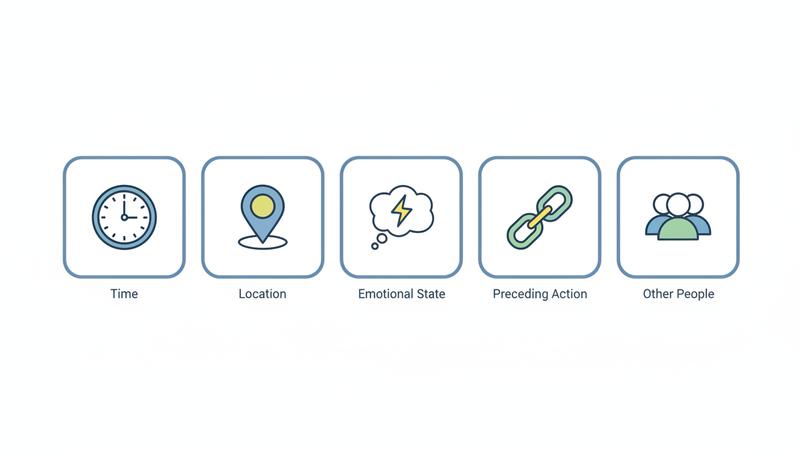
Cues are far more varied than most popular accounts suggest. Social psychologists Wendy Wood and David Neal, who have spent careers studying how context shapes automatic behavior, established in the research literature that situational cues fall into several distinct categories — each operating through a different mechanism. Charles Duhigg's The Power of Habit brought this taxonomy to a wide popular audience, organizing the categories into a memorable five-part framework. That's the version most people have encountered. But behind the readable narrative is a body of empirical work worth knowing — because each cue type, understood properly, requires a different approach to change.
1. Time
Time cues are the most obvious. You eat lunch at noon not because hunger suddenly arrived at 12:00 PM but because noon itself has become the trigger. You feel a flutter of anxiety every Sunday evening because your brain has learned that Monday is coming. Time cues are powerful precisely because you can't escape them — unlike a location you might avoid or a person you might distance yourself from, the clock keeps ticking.
2. Location
Your brain wires behaviors directly to physical spaces with stunning precision. Sit down at a desk and you might immediately feel focused — if you've built that association. Or you might feel restless and scattered — if the desk has become paired with endless social media scrolling instead. Studies on context-dependent behavior change reveal something striking: when people move to a new city or house, behavior change becomes dramatically easier. Not because they suddenly have more willpower, but because the physical environment hasn't yet developed the cue associations. The location cues haven't been trained in yet.
3. Emotional State
This is where things get murky. Emotional cues — stress, boredom, loneliness, anxiety — are among the most powerful habit triggers, and also the hardest to see clearly. You don't consciously notice you're stressed and then decide to snack. The stress directly triggers the craving, completely bypassing deliberate choice. And emotional cues are stubborn. When you change your location or your schedule, other cues lose their power. Emotional cues often survive intact, which is one reason people struggle with stress-related habits even after major life changes.
4. Preceding Action
One behavior naturally cues the next. Wake up, make coffee. Make coffee, check your phone. Check your phone, scroll the news. This is how morning routines lock into place — not through careful planning but through sequential rehearsal. Each completed action becomes the cue for the next one in line. Behavioral scientists call this action bundling, and it's the mechanism behind both deliberately building habit chains and accidentally creating the ones you want to break.
5. Other People
Social context acts as a powerful trigger. You eat more when dining with friends. You drink more in a room full of drinkers. You work harder in a library full of focused people. Being around other people activates behavioral scripts you've rehearsed in similar situations — which is why you might revert to family dinner patterns you thought you'd outgrown the moment you're back at your parents' table.
How Cues Evolve: From External to Internal
Here's something most simplified habit models skip over: cues don't stay the same throughout a habit's life.
When a habit is new, cues tend to be external and obvious — a physical location, a specific time, something in your environment you can point to. But as the habit gets older and more established, the system internalizes. The trigger shifts from external signals to internal states — feelings of hunger, restlessness, anxiety, sometimes even faint physical sensations you don't quite notice. This evolution is precisely why mature habits are so resilient.
Early on, if your smoking habit is triggered only by standing outside the office entrance, you can disrupt it by taking a different route. But after years of practice, the trigger has become a diffuse sense of stress or a particular kind of social discomfort. Now the cue is everywhere. You can't reroute around your own emotional states.
Research on how habits automate and contextualize shows consistently that behaviors which begin attached to external triggers eventually become responses to internal contextual states — feelings and bodily sensations — that the person may not even consciously recognize. This is part of why people in recovery often struggle to identify what's actually triggering their cravings: the cue has become subtle, internal, and emotionally entangled.
For practical habit design, this internalization reveals two things. First, when you're building a new habit, those early external cues matter enormously — they're doing the heavy lifting until the habit can develop internal triggers. Second, when you're trying to break a habit, you need to find the actual internal cue, not just the obvious external one.
Tip: When you're trying to track down a habit's true trigger, don't just ask "what was happening around me?" Also ask: "What was I feeling? What had I just finished doing? What time was it? Who was I with?" The real trigger might be any one of these — and it's often not the most obvious one.
Rewards as Information Signals
The common idea about rewards is that they're pleasures — the chocolate at the end of the maze, the dopamine hit from getting likes, the satisfaction of scratching an itch. They certainly feel like pleasures. But what they actually do is more important than how they feel.
Rewards are signals. When your brain receives a reward after a behavior, it doesn't just produce a pleasant sensation. It sends a message backward through the chain: that was worth doing. This backward signal — carried by dopamine, encoded into the striatum — updates the connection between cue and routine. The reward is the teacher, not just the prize.
This has an uncomfortable implication: your brain doesn't necessarily learn what you intended it to learn from a reward. It learns whatever the reward was paired with. If you reward yourself with a glass of wine after a hard workout, you might be strengthening two different habit loops simultaneously — one around exercise, one around stress relief through alcohol. Your brain doesn't distinguish your intentions. It just tracks correlations.
Research on how the basal ganglia encode habits shows this reward process operates incrementally. Habits aren't built through sudden insight or decision. They're built through slow accumulation of reinforced associations. Each loop completion strengthens the neural pathway slightly. Each reward deepens the groove a little more. This is why habits feel effortless once they're mature — the groove has become a channel, and behavior flows through it automatically.
The feedback cycle looks like this:
graph TD
    A[Reward received] --> B[Brain encodes: this cue predicted this reward]
    B --> C[Cue-response connection strengthens in striatum]
    C --> D[Next time cue appears, craving fires more strongly]
    D --> E[Behavior occurs faster, with less conscious deliberation]
    E --> F[Reward received again]
    F --> A
This explains why habits don't require you to remember them — your explicit memory handles that. They require repetition to automate them. The striatum needs many loops to build the procedural encoding that makes behavior feel automatic and effortless.
The True Craving vs. The Assumed Reward
One of the most useful insights from the four-part loop is this: what you think the reward is and what your brain is actually craving are often completely different things.
Charles Duhigg tells a story from his own habit work that illustrates this perfectly. He noticed he was leaving his desk every afternoon and buying a cookie from the cafeteria, a pattern he wanted to break. His first assumption was that he was craving sugar. But when he started experimenting — eating different foods, going to different locations, timing things differently — he discovered something unexpected. What actually satisfied the craving wasn't sugar. It was a 15-minute social interaction with colleagues. The cookie was incidental. It was just the excuse for a break in the day.
This kind of mismatch happens constantly. People assume:
- They're snacking because they're hungry (often it's boredom, loneliness, or procrastination)
- They're checking social media because they want information (often it's a craving for connection or escape)
- They're drinking to relax (often they're using it as a transition ritual, and the transition itself is the real reward)
If you try to change a habit by substituting a reward that addresses the assumed craving instead of the actual craving, the new behavior won't stick. The loop doesn't close. The original habit comes roaring back.
The practical way to identify what you're actually craving is simple but requires honesty: when the cue fires and before you go through the routine, pause. Ask yourself what you're expecting to feel afterward. Then try different routines and notice which ones actually quiet the craving — which ones actually satisfy, rather than just delay. Duhigg called this "the golden rule of habit change": keep the cue and the reward, change only the routine. But to do that, you have to actually know what the reward is.
Warning: Substituting a superficially similar routine almost never works if it doesn't address the underlying craving. Replacing cigarettes with carrot sticks fails for most people, not because carrots aren't healthy, but because the craving was never about oral fixation — it was stress relief, and carrots can't deliver it. More precisely, the brain's informational tracking system registers what researchers call a prediction error: it expected the neurochemical signal of stress relief, received something entirely different, and flags the loop as incomplete. The habit doesn't close, and the original behavior reasserts itself with full force.
Habit Chains: When Loops Link Together
In real life, individual habits almost never operate alone. They chain together into extended sequences — what most people call routines. Your morning routine is a habit chain: each completed loop becomes the cue for the next one.
graph LR
    A[Alarm sounds] --> B[Routine: silence alarm, get up]
    B --> C[Reward: immediate silence]
    C --> D[Cue: upright in bedroom]
    D --> E[Routine: walk to kitchen]
    E --> F[Reward: movement breaks grogginess]
    F --> G[Cue: in kitchen]
    G --> H[Routine: make coffee]
    H --> I[Reward: smell/anticipation of caffeine]
The preceding-action cue is what holds these chains together. Waking up doesn't directly cue coffee-making — there are several links in between. But because those links have been practiced in sequence so many times, the whole chain runs as a single unit. This is why disrupting a morning routine at any point — oversleeping, being in a hotel, having a guest in the kitchen — can throw off the entire sequence. The chain depends on its links being intact.
Habit chains are also where you find what researchers call keystone habits — behaviors that, once established, naturally pull other behaviors along with them. Exercise is the classic example: people who successfully build a regular exercise habit often find improvements in diet, sleep, and even financial self-control they never deliberately pursued. The exercise habit creates a spillover effect, partly through shifted identity ("I'm someone who takes care of myself") and partly through changed routines (waking earlier, needing better sleep to perform well, etc.).
Understanding habit chains also reveals a powerful design principle: instead of building a habit from scratch, you can attach it to a chain that's already running automatically. The new behavior becomes a link in a sequence that already flows without thinking. This is the mechanism behind "habit stacking" — though the underlying science is the preceding-action cue, not mysterious stacking magic.
Why Willpower Can't Break the Loop
And this brings us to an uncomfortable truth: once a habit loop is established, willpower is almost irrelevant as a way to break it.
Here's why: an established habit has encoded the cue-craving-response-reward sequence deep in procedural memory, in the striatum and basal ganglia, at a level far below conscious deliberation. When the cue fires, the craving activates before you've even made a decision. By the time your prefrontal cortex shows up to weigh in, you've already picked up your phone and unlocked it. You're not deciding whether to snack — you're already walking to the kitchen.
Willpower operates in the window of deliberate choice. But research on how habits work consistently shows that automatic behavior runs in parallel to conscious thought, not in sequence with it. Trying to stop a habit through willpower is like trying to suppress a reflex by thinking hard about it.
This doesn't mean change is impossible. It means effective change requires something different. It requires environmental design (preventing cues from firing in the first place), routine substitution (keeping the loop structure but swapping the behavior), or identity-level shifts (changing the sense of self that the habit serves). Not raw suppression. We'll explore each of these in the chapters ahead.
What the four-part loop gives you is the diagnostic framework. When a behavior is stubbornly refusing to change or stubbornly difficult to establish, you can trace it through the loop and find where it's actually breaking. Is the cue not firing reliably? Is the craving not strong enough to drive action? Is the routine too effortful? Is the reward too delayed or too unclear? Each failure point has a different solution — and none of them is "try harder."
The loop isn't your enemy. It's a feature of an extraordinarily efficient brain that learned to automate its most-repeated behaviors in order to free up capacity for the hard thinking. Working with that system — rather than against it through sheer determination — is what the rest of this course is about.
Only visible to you
Sign in to take notes.