How to Price Your Side Hustle Without Undercharging
Pricing Your Work: How Not to Leave Money on the Table
Now that you've built an audience and established a foundation of consistent visibility — the flywheel from the previous section actually starting to turn — it's time to address the decision that will determine whether this becomes real income or stays a time investment. That decision is pricing. And here's the uncomfortable truth: if you've already done any freelancing or sold any digital products, you've almost certainly undercharged. Not by a little. Probably by a lot.
This matters more now than ever, because the audience you've spent months building is worthless if you're monetizing it at prices that keep you stuck on a treadmill. Chronic undercharging doesn't just cost you money in the short term. It shapes how your audience perceives you, what kind of clients or customers you attract, how many hours you're trading for each dollar earned, and whether your side hustle ever becomes something you'd actually want to do full-time. Pricing is the highest-leverage skill in your entire business — and it's especially critical now that you actually have an audience to monetize.
You can be a mediocre marketer and survive. You can have an average product and survive. But if you systematically underprice your work to the audience you've built, you're running a treadmill that gets faster every year — more clients, more hours, more hustle, same income. Getting this right — or even close to right — is worth more to your actual take-home than almost anything else covered in this course.
Why Beginners Underprice (And the Real Cost of Doing So)
The psychology here is predictable, which is oddly comforting. Almost every new online earner goes through the same mental gymnastics: "I don't have a big portfolio yet, so I should charge less." "I'm not sure I'm worth more than that." "What if they say no?" "Other people on Fiverr are charging $15, so..."
The problem isn't lack of confidence — it's a flawed mental model. Most beginners price based on how they feel about themselves rather than based on the value they deliver or what the market actually supports. And here's what makes this trap particularly sticky: low prices don't feel like a mistake at first. They feel practical. Conservative. Safe. You land your first client, then another, and you think you're winning. But what you've actually done is train the market to see you as a low-cost option — which attracts the clients who are most price-sensitive, most demanding, least likely to respect your boundaries, and least appreciative of your work.
Eighteen months in, you're booked solid with low-paying gigs that barely cover your living expenses, and wondering why this doesn't feel like success.
Remember: Your price is a signal. Low prices don't just mean less money — they communicate lower quality, attract lower-quality clients, and create a self-fulfilling cycle that's genuinely hard to break once you're in it.
The Three Pricing Models — And When to Use Each
Before we talk about specific numbers, you need to understand that the structure of how you charge matters almost as much as the number itself. There are three main models, and choosing the wrong one will cost you money in ways that compound over time.
graph TD
    A[Pricing Models] --> B[Hourly]
    A --> C[Project-Based]
    A --> D[Value-Based]
    B --> E[Best for: brand new beginners, unpredictable scope]
    C --> F[Best for: defined deliverables, repeatable work]
    D --> G[Best for: strategic outcomes with clear ROI]
Hourly billing is where most people start, and it makes sense as a training-wheels model. You set a rate, track your time, and bill accordingly. Simple, transparent, easy to explain to a client.
The problem — and this is a genuine structural problem, not just a preference — is that hourly billing punishes efficiency and caps your earning potential. If you figure out how to do a task in two hours that used to take you five, you just took a 60% pay cut on that deliverable. The faster and better you get, the less you earn per project. That is a genuinely perverse incentive structure. You're being rewarded for being slow.
Consulting research from a study of nearly 1,000 practitioners confirms this: consultants using value-based pricing are far more likely to hit $10K+ project values than those billing hourly. The data is clear. Hourly billing doesn't scale.
Use hourly when you're truly new and genuinely uncertain how long things take. Stop using it as soon as you have enough data to estimate scopes reliably.
Project-based pricing is the natural upgrade. Instead of billing hours, you quote a flat fee for a defined deliverable. "I'll write three blog posts for $450." "I'll design your logo for $800." "I'll set up your email sequences for $600."
This works better for everyone. The client knows exactly what they're paying — no surprises when you send the invoice. You don't have to track time down to the minute. And if you get faster at the work, your effective hourly rate goes up automatically without negotiation. It also forces useful discipline: you have to scope the project clearly before you start, which reduces scope creep and those endless "one more small thing" requests.
The risk is underestimating how long things actually take, especially early on. A practical rule of thumb: estimate how long you think it'll take, double it, and price based on that doubled estimate. You'll be right more often than you'd expect.
Value-based pricing is the model that separates amateur freelancers from professionals who build real income. Instead of pricing based on your time or your deliverables, you price based on the economic value of the outcome to your client.
This sounds more complicated than it is, but the mental model is simple: if you can help someone generate $50,000 in new revenue, charging them $5,000 is an easy yes. You just delivered a 10x return on their investment. If you're charging $500 for the same work because "that seems like a fair hourly rate," you've dramatically underpriced the value and left thousands on the table.
Value-Based Pricing: Anchoring to the Client's Outcome
Value-based pricing requires a shift in how you think about what you're actually selling. You're not selling hours. You're not selling deliverables. You're selling outcomes — and outcomes have economic consequences that you can anchor your price to.
Here's a concrete example. Say you're a freelance email copywriter. Working hourly, you might charge $75/hour, a campaign takes you six hours, and you invoice $450. Fine. But now consider what happens when that campaign goes out to the client's list of 10,000 subscribers and converts 2% at a $100 product. That's $20,000 in revenue. Suddenly your $450 looks absurd against the value you just created.
Value-based pricing says: "I'm going to charge a percentage of the expected outcome, or a flat fee that's clearly reasonable given the stakes." In this case, $2,000–$3,000 isn't unreasonable — it's still a tremendous ROI for the client.
To make this work in practice, you need to:
- Understand the client's business context. What does a new customer cost them to acquire? What's their average order value? What's the business problem you're solving in concrete financial terms?
- Estimate the value of solving the problem. Not with false precision — with a reasonable range. "If we fix this conversion rate issue, you could reasonably expect X additional revenue per month."
- Price as a fraction of that value. 10–20% of projected value is a common anchoring heuristic among consultants. You don't have to announce this math to the client — you just need it to inform your number.
Value-based pricing does require confidence and communication skills, which is why [39% of consultants have never tried it, simply because they don't know how](https://www.consultingsuccess.com/consulting-fees). But it's learnable, and even a partial application of value-based thinking — asking yourself "what's this actually worth to them?" before quoting — will shift your numbers meaningfully upward.
Researching Competitor Pricing Without Guessing
You don't have to invent your pricing from scratch. The market has data, and most of it is hiding in plain sight if you know where to look.
For freelance services:
- Search for your service category on Upwork, Fiverr Pro, and Toptal. Look at what established providers (not the bottom-tier gig workers) actually charge. Ignore the $5 gigs — those aren't your competition if you're building something real.
- Look at freelancer LinkedIn profiles. Many list their rates in their "about" sections or in posts. You can see what's working for people doing what you do.
- Join relevant Slack groups or Facebook communities for your field. Pricing threads come up constantly, and people are usually candid about what they're charging.
- Ask directly. "Hey, I'm new to offering X service — do you have a ballpark sense of what's typical?" is a completely reasonable question in most professional communities.
For digital products:
- Find five to ten comparable products on Gumroad, Etsy, or the creator's own website. Note the prices. Note what's actually included.
- Pay attention to where products cluster — this tells you where the market expects to spend, which you can then decide to match, undercut (with caution), or exceed (if your offer is genuinely stronger).
- Read reviews on competitor products. Customers often reveal what they felt was missing or what disappointed them, which tells you exactly where there's room to charge more for a better version.
The goal isn't to copy a competitor's price — it's to understand the range the market finds acceptable, so you can make an informed decision rather than a guess driven by anxiety.
Psychological Pricing Tactics That Actually Work
Here's where pricing gets interesting, because humans are not rational calculators. The psychology of price perception is well-documented and genuinely useful — as long as you're not using it to trick people.
Charm pricing: the $97 vs. $100 question. Yes, prices ending in 7 or 9 do perform better for digital products, particularly at lower price points. The psychology is real: $97 feels categorically different from $100 because our brains process the left-most digit first. $97 lives in the "$90s" in our minds; $100 crosses a psychological threshold into a new tier.
This matters most in the $47–$197 range for digital products. At higher price points — say, $2,000 for a consulting package — $1,997 starts to look a bit silly and can actually undermine the premium positioning you're building. Use charm pricing for lower-ticket products; use round numbers for high-ticket offers where confidence and clarity matter more.
Anchoring. The first number someone sees dramatically shapes how they perceive everything that comes after. If you offer a $5,000 consulting package alongside a $1,500 one, the $1,500 option suddenly looks like a deal — even if, in isolation, $1,500 would have seemed expensive. This is why pricing pages almost always show the highest tier first.
You can use anchoring even in a single-offer context by mentioning the cost of not solving the problem before you reveal your price. "Most businesses in this situation are leaving $X on the table every month" primes the reader to see your fee as an investment, not just an expense.
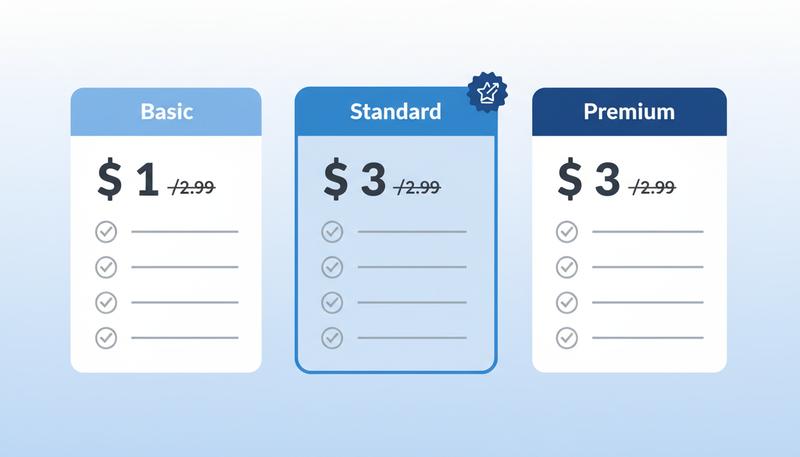
Tiering and decoy pricing. Offering three tiers — Basic, Standard, Premium — isn't just about giving people options. It's about making your target tier feel obviously reasonable by comparison. The "decoy" effect means people tend to avoid the cheapest option (feels low quality) and the most expensive (feels excessive) and default to the middle. If you want people to buy your $297 option, put a $97 option and a $497 option alongside it.
This is called the "compromise effect" in behavioral economics, and it's extraordinarily reliable. Structure your tiers to make your real target feel like the sensible choice.
Digital Product Pricing Strategy: Low, Mid, and High Ticket
Digital products are unique because your marginal cost of an additional sale is essentially zero. This changes the entire pricing calculus: you're not pricing based on cost-plus, you're pricing based on positioning and perceived value.
The digital product world roughly breaks into three tiers, each with different strategic logic:
Low-ticket ($7–$47): Entry-level products like templates, short ebooks, small prompt packs, or useful spreadsheets. The goal here isn't maximizing revenue per transaction — it's lowering the barrier to entry, building your buyer list, and getting people into your ecosystem. Low-ticket products are your "try before you buy" mechanism for a much larger audience. The downside is that you need significant volume for meaningful income: 100 sales of a $27 product is $2,700. Good, but not life-changing.
Mid-ticket ($97–$497): More substantial products — comprehensive courses, template bundles, in-depth guides, or productized service packages. This is often the sweet spot for solo creators because the price is high enough to generate real revenue without requiring the relationship-building overhead of high-ticket sales. According to creator platform best practices, creators are advised to research competitor pricing and understand their audience's actual budget range to inform their positioning strategy.
High-ticket ($500+): Premium courses, masterminds, done-with-you programs, or consulting packages. These require more relationship-building and trust before someone pulls the trigger, so they typically sell better to warm audiences — people who already follow you, have bought from you before, or have been referred by someone who has. But high-ticket products change the economics dramatically: 10 sales of a $997 course is $9,970.
Tip: Most solo creators should eventually have products at multiple price points — a low-ticket entry product, a mid-ticket main offer, and a high-ticket option for the buyers who want more. This "value ladder" captures revenue across different buyer segments without requiring you to build entirely separate marketing systems.
Productizing Services: Packaging What You Do Into Scalable Offers
Custom freelance work has a ceiling. You can only take on so many bespoke projects before you're completely maxed out — and bespoke work is also harder to sell, harder to scope, and harder to systematize.
The alternative is productizing: turning repeatable services into fixed-price, fixed-scope packages that you sell like a product.
Instead of "I do social media marketing — tell me what you need and I'll send you a custom quote," you offer something like "The Social Media Starter Pack: 30 days of content for one platform, 12 posts, written and designed, delivered in 7 days. $597."
The magic of productization:
- You scope it once, then deliver it repeatedly. Your processes get tighter with each iteration, your delivery time drops, your effective hourly rate climbs.
- It's easier to sell because the client knows exactly what they're getting — no discovery call, no vague estimating.
- It's easier to market because you have a concrete offer, not just a vague capability.
- It enables you to raise prices systematically as demand increases, without renegotiating every single client engagement individually.
The key is finding the work you do repeatedly that follows a similar pattern each time, then designing a package around that pattern. What do clients always need first? What problem do you solve most frequently? That's your productized offer.
How and When to Raise Your Rates
Many freelancers raise their rates once — when they first set them — and then quietly hold them steady for years, gradually delivering more value while charging the same amount. Over time, this becomes a slow-motion pay cut as you get better at your work and your costs go up.
Here's when you should raise your rates:
- When you're booked out more than four weeks ahead consistently
- When you haven't raised rates in more than six months
- When you're regularly completing projects faster than expected
- When new clients accept your quotes without hesitation (a reliable sign you're underpriced)
- When your results for clients are clearly measurable and significant
According to consultant research, a practical system is to raise your hourly rate by $25 with every completed project when you're starting out. Once you're working on project-based or value-based pricing, aim for a 15–25% increase every six to twelve months while you're building momentum. This compounds fast.
The exact language for telling existing clients:
This is the part that feels scary, and there's no magic script that makes it painless. But here's language that actually works:
"I wanted to give you advance notice that my rates are increasing on [DATE]. My new project fee for [type of work] will be [new rate]. Because we have an established working relationship, I'm happy to honor current rates for any projects you book before [DATE]. I'm looking forward to continuing to work together."
Key elements: advance notice (4–6 weeks minimum), clear effective date, option to lock in the old rate by acting soon (creates urgency without pressure), and a warm close. Don't apologize for the increase. Don't over-explain it. Don't offer to negotiate unless they ask.
Most clients will accept the increase without comment. Some won't — and that's actually useful market data. If everyone accepts without pushing back even a little, you still haven't raised your rates enough.
Warning: Raising rates mid-project is almost never okay. Lock in your rate for the current scope of work, and apply the new rate to the next project or renewal. Springing a mid-project rate increase on a client damages trust in ways that are genuinely hard to repair.
Handling Price Objections
When someone hears your price and says "that's a bit more than I was expecting" or "I need to think about it" or "is that negotiable?" — what are they really saying?
Most of the time, they're not saying no. They're saying one of three things:
-
"I'm not sure this is worth it." This is a value problem, not a price problem. Your job is to clarify the outcome more specifically. "The [X deliverable] I'm proposing typically results in [Y outcome] for clients in your situation. If that happens for you, does the investment make sense?" If they still push back, the problem may be that the value of the outcome itself doesn't justify the cost — meaning this isn't a great fit, not that your price is wrong.
-
"I have a budget constraint." This is a scope conversation. "I completely understand budget constraints. Is there a part of this project that's highest priority? We could start with that for [lower price] and address the rest later." This is a legitimate negotiation that serves both of you — you're not discounting your rate, you're scoping down the actual work.
-
"I'm testing to see if you'll fold." Some clients will say almost anything to get a discount, not because they can't afford your rate but because they always try. If you cave immediately, you've trained them to expect it. Hold the line: "My rate reflects the value I'm confident I'll deliver. I'm not able to come down on price, but I'm happy to adjust scope if that helps."
The one thing you should almost never do with a price objection is immediately discount without adjusting scope. That signals that you didn't believe in your own price — which makes the client question whether they should either.
Discounting: When It's Strategy and When It's Sabotage
Discounting is not inherently evil. It's a tool, and like most tools, it's fine when used correctly and destructive when misapplied.
Legitimate reasons to discount:
- Genuine early-bird or launch pricing (time-limited, announced in advance, not handed out on request to anyone who asks)
- Volume discounts for ongoing retainer relationships or multi-product bundles
- Referral incentives when a client actively brings you new business
- Strategic "loss leader" on a first project with a client you have high confidence in for a long-term relationship
Discounting that damages you:
- Discounting whenever anyone pushes back, regardless of reason
- Running perpetual sales so your "sale price" becomes your real price
- Offering wildly different rates to different clients without clear logic (this tends to get out)
- Discounting out of self-doubt rather than strategy
The simplest rule: if you're discounting because the client is a strong strategic fit and you want to earn their trust for a long relationship, that can be a reasonable investment. If you're discounting because you're afraid of losing the sale, that's your pricing anxiety talking — and feeding it only makes it louder.
Building a Pricing Page That Converts
Whether you're selling a product or a service, at some point you need to put your price somewhere publicly visible — and how you do this matters.
Transparency vs. mystery: There's a legitimate debate here. Service providers sometimes argue for "contact me for pricing" to allow for customization. But for most solo online businesses, particularly at the beginning, transparent pricing wins for two reasons: it pre-qualifies clients (people who see your rate and contact you anyway are serious), and it saves you enormous amounts of time not quoting people whose budgets don't align.
The exception is genuinely complex, highly customized consulting engagements where every project is fundamentally different. If you're still figuring out your offers, transparent pricing gives you faster feedback on whether your pricing is actually landing correctly with your audience.
What a good pricing page includes:
- Clear description of what's included (be specific — "three rounds of revisions" beats "unlimited revisions" because it's concrete)
- The outcome the buyer can expect, not just the deliverable they're getting
- Social proof adjacent to the price (a testimonial, a result, a case study)
- One clear CTA per tier — don't make people hunt for how to actually buy
- FAQ section addressing the most common objections (this is often where real "value" gets communicated before the purchase conversation even starts)
Anchor the reader on value before revealing price. The sequence matters. "Here's the problem. Here's what happens if you don't solve it. Here's how I solve it. Here's what result my clients typically get. Here's the investment." That order primes the reader to see your price in context. Listing a price with no preamble forces the reader to evaluate it in a vacuum — which usually feels more expensive than it should.
Pricing is one of those skills where you will never feel fully ready, and waiting until you do is expensive. The best thing you can do is set a price that makes you slightly nervous, see what happens, and adjust from there. The market will give you better feedback than your anxiety will.
And remember the core thesis: the barrier isn't that you lack credentials or capital or the perfect offer. It's the willingness to charge what your work is actually worth, even before you're certain you deserve it. Because here's the thing — by the time you're certain, you've probably already left quite a bit on the table.
Only visible to you
Sign in to take notes.