Quantum Physics Basics for Beginners
You know the problem now: classical computers are fundamentally limited by their one-at-a-time approach, and no amount of engineering speed-ups will change that. But here's where it gets interesting. The solution doesn't come from making classical computers faster. It comes from a completely different branch of physics — one that operates by completely different rules.
Quantum physics is the science of how things behave at the smallest scales: atoms, electrons, photons. And it's genuinely strange. Not in the way that calculus seems hard until you practice — but in a way that bothered the greatest physicists of the 20th century for decades, and still puzzles experts today. The physicist Richard Feynman famously said, "I think I can safely say that nobody understands quantum mechanics."
But here's the critical insight: that very weirdness — the parts that make quantum physics so counterintuitive — is exactly what makes quantum computers possible. In fact, quantum computers don't work despite quantum physics being strange. They work because it's strange. So before we can understand how a quantum computer actually functions, we need to understand three specific quantum phenomena that are the real engines behind the technology: superposition, entanglement, and interference. Each one is genuinely bizarre. Each one is also genuinely real. Together, they explain how quantum computers could potentially do things that classical computers absolutely cannot.
Phenomenon One: Superposition (Being Two Things at Once)
Here's where the weirdness starts. Imagine a classical bit — that 0 or 1 we talked about in Section 3. In a classical system, a bit is either 0 or 1. Right now. Definitely. We might not know which one, but it's one or the other.
A quantum particle is different. It genuinely is, in a meaningful physical sense, both states at once until you measure it. It's not that you don't know which state it's in. It's that the particle itself doesn't "know." The state doesn't exist until measurement forces it to pick one.
This is superposition.
The technical version: a quantum particle can exist as a combination — a superposition — of multiple possible states simultaneously. An electron can spin "up" and "down" at the same time. A photon can take two paths through an optical device at the same time. As IBM explains, a qubit in superposition "represents a combination of all possible configurations of the qubit" — not a vague maybe, but a mathematically precise combination of possibilities, each with its own probability.
The moment you measure the particle, this superposition collapses. The electron "chooses" to be up or down. The probabilities snap into a single definite outcome. But before that measurement? Both were simultaneously real.
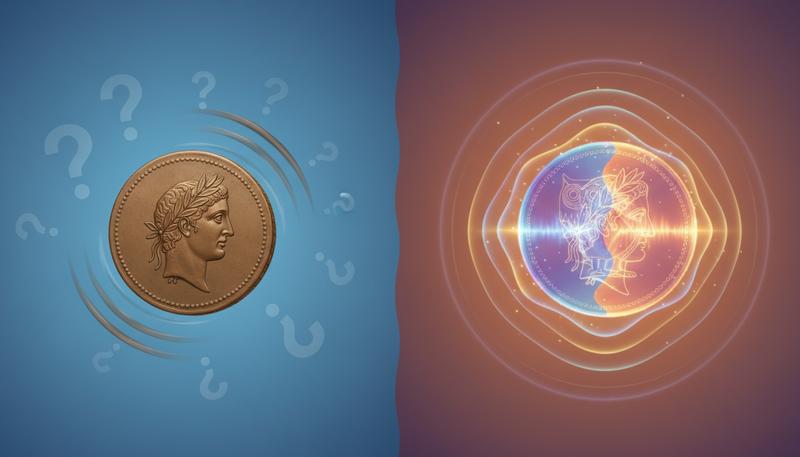
Schrödinger's Cat — Explained Properly This Time
You've probably heard of Schrödinger's cat. Maybe you've seen it on a t-shirt. But the actual idea is worth understanding properly, because it's usually explained badly.
Erwin Schrödinger — one of the founders of quantum mechanics — was actually making a joke. Or at least, an argument. He was bothered by what superposition implied, and he constructed a thought experiment to show how absurd it seemed.
Here's the setup: You put a cat in a perfectly sealed box. Inside the box, there's a small amount of radioactive material and a Geiger counter hooked up to a poison dispenser. If a radioactive atom decays, the Geiger counter triggers the poison, and the cat dies. If the atom doesn't decay, the cat lives.
Now, radioactive decay is a quantum event. According to quantum mechanics, before you look, the atom is in a superposition of "decayed" and "not decayed." The decay genuinely hasn't happened or not happened yet — both possibilities are real and ongoing. But if the atom is in superposition, then by extension, so is everything connected to it: the Geiger counter, the poison dispenser, and... the cat.
Which means, according to the strict logic of quantum mechanics, until you open the box, the cat is simultaneously alive and dead.
As NIST describes the experiment: "Because the decay of the atom is uncertain, at any given time, the cat is in a superposition of dead and alive. Only when someone opens the box and measures the cat does its state 'collapse' to being either definitively alive or definitively dead."
Schrödinger wasn't saying this is how cats actually work. He was trying to highlight that quantum mechanics, taken seriously, leads to conclusions that seem completely insane when applied to large objects. Real cats are made of trillions of atoms, and quantum effects get washed out at that scale — a phenomenon called decoherence. But at the level of individual particles, superposition is absolutely, experimentally real. It's been confirmed by thousands of experiments.
Here's what Schrödinger's cat should actually teach us: the weirdness isn't a metaphor. It's a real property of small things that we need to take seriously — even if it makes our brains hurt.
What Superposition Is NOT
This is important. The most common misconception about superposition is that it means a particle is "in two places at once." You'll hear this everywhere — in articles, in YouTube videos, in marketing copy from quantum computing companies. It's a simplification that crosses the line into being wrong.
Superposition doesn't mean a particle is in two places. It means a particle is in two (or more) possible states simultaneously — and "state" can mean energy level, spin direction, polarization, or many other properties. The particle isn't somehow split or doubled. Its properties are genuinely indeterminate until measurement.
Think of it this way: imagine a musical chord. When you play a C-major chord, you're not playing three notes in two places at once — you're playing all three simultaneously, and they combine into something new. Superposition is like that. The particle holds multiple states simultaneously in a mathematically precise combination, and that combination can actually be manipulated and used before the measurement forces it to collapse.
That manipulability is what makes superposition useful for computing, as we'll see in the next section. For now, just hold onto the idea: quantum particles can hold multiple possible states at the same time, and that's real, measurable, and exploitable.
Phenomenon Two: Entanglement (Einstein's "Spooky Action")
If superposition makes your brain itch a little, entanglement might make it seize up entirely. But stick with me, because it's also one of the most beautiful things in physics.
Entanglement happens when two quantum particles interact in such a way that they become correlated — linked at a fundamental level. From that point on, the quantum state of one particle is tied to the state of the other, no matter how far apart they are.
Here's what makes this wild: when you measure one particle and its superposition collapses to a definite state, the other particle's superposition instantly collapses to a corresponding state — even if it's on the other side of the planet. Or the other side of the galaxy.
Let's use an analogy. Imagine you and a friend each take one glove from a pair and travel to opposite sides of the world without looking at which glove you have. When you land and look at yours — it's the left glove. You instantly know your friend has the right one, without calling them.
But that's not quite right for quantum entanglement, because there's a crucial difference. In the glove scenario, the gloves were always left and right — you just didn't know which was which. In quantum entanglement, before you measure, neither particle has a definite state. The states are created by the measurement itself, and they're created simultaneously for both particles, regardless of distance.
Albert Einstein hated this. He called it spooky action at a distance — "spukhafte Fernwirkung" in German — and spent years arguing that it couldn't be right. Surely, he thought, there must be some hidden information that determines the outcomes in advance, like the predetermined left/right gloves. His objection led to one of the most interesting debates in the history of physics.
But experiment after experiment has proven Einstein wrong on this particular point. In 1964, physicist John Bell came up with a mathematical test that could distinguish between "predetermined hidden variables" and genuine quantum entanglement — and Bell test experiments show that quantum mechanics violates Bell inequalities and is incompatible with local hidden-variable theories. However, alternative theories such as Bohmian mechanics maintain predetermined states through non-local mechanisms, so the experiments do not definitively rule out all forms of predetermined states. The correlation is genuinely instantaneous and genuinely spooky.
NIST physicist Andrew Wilson captures the romance of it: "Let's say you have an entangled pair of particles and you put one on the Moon and the other on the surface of the Earth. If you then do something to the one on the Earth, you simultaneously affect the other. It's kind of romantic!"
It is kind of romantic. It's also deeply useful.
graph LR
    A[Particle A\nNo definite state] <-->|Entangled| B[Particle B\nNo definite state]
    A --> C[Measure Particle A\nCollapses to: SPIN UP]
    C --> D[Particle B instantly\ncollapses to: SPIN DOWN]
    B -.->|No measurement needed| D
One Important Clarification: No Faster-Than-Light Communication
Here's where people often leap to an incorrect conclusion: if measuring one entangled particle instantly affects its partner, can we use that to send information faster than light?
No. And understanding why is actually illuminating.
When you measure an entangled particle, you get a random result — the particle is equally likely to be spin-up or spin-down. Your distant partner measures their particle and also gets a random result. The results are correlated — they always match in the expected way — but each person just sees random noise until they compare results through a normal, speed-of-light-limited channel.
You can't use entanglement to transmit a message, because you can't control what result you get when you measure. The randomness is real. The correlation is real. But the ability to send meaningful information isn't there.
What you can use entanglement for is coordination and computation — letting separated qubits remain linked in ways that allow quantum computers to perform calculations using the correlations between them. It's a computational resource, not a telephone.
Phenomenon Three: Interference (The Noise-Canceling Headphones for Wrong Answers)
Of the three quantum phenomena, interference is probably the least famous — it doesn't have a cute cat or an Einstein quote attached to it — but it might be the most directly important for actually making quantum computers work. It's the mechanism by which quantum computers actually compute.
To understand interference, let's start with waves.
When two ocean waves meet each other, something interesting happens. If the peaks of both waves align, they combine into a bigger wave — this is called constructive interference. If the peak of one wave meets the trough of the other, they cancel each other out — this is destructive interference. The same thing happens with sound waves, light waves, and any other kind of wave.
Quantum particles have wave-like properties. (This is the famous "wave-particle duality" — particles behave like waves in some ways and like particles in others, depending on how you interact with them.) Because of this, quantum states can interfere with each other, just like waves.
Here's where it gets useful: in a quantum computer, when you set up a computation using superposition, you're essentially creating a system where many possible answers exist simultaneously, each with a certain probability. Quantum interference lets you manipulate those probabilities — you can design the computation so that wrong answers interfere destructively (canceling each other out) and right answers interfere constructively (amplifying each other).
The result: when you measure the system at the end, you're much more likely to get a correct answer.
Think about noise-canceling headphones. They don't block sound by putting a physical barrier around your ears. Instead, they listen to incoming noise and generate a sound wave that's the exact mirror image of it — same frequency, same amplitude, but flipped. The two waves cancel each other out, and you hear silence. Destructive interference, put to work.
Quantum computing does something analogous with computational paths. The paths that lead to wrong answers are designed to cancel out. The paths that lead to right answers are designed to reinforce. You don't have to check every possible answer — the quantum system has been engineered so that the right answer rises to the top.
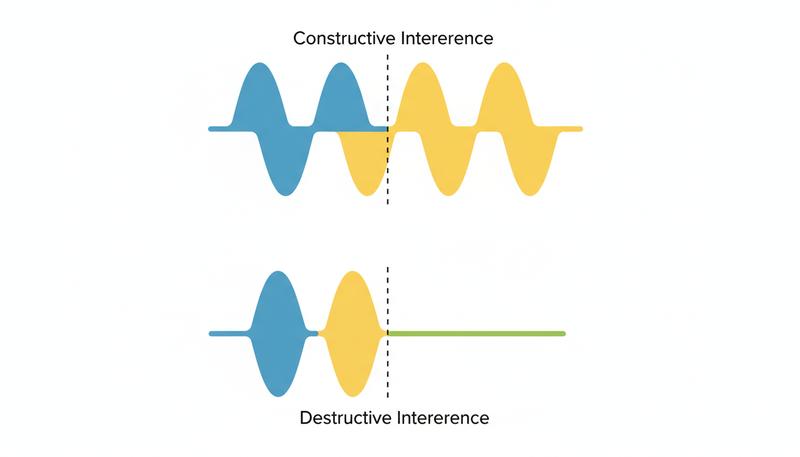
This is critically important: interference is what gives quantum algorithms their power. It's not just that quantum computers try all possible answers at once (a common misconception). It's that they try all possible answers and then use interference to make the right answer emerge. Without interference, you'd just have a machine that produces random results.
IBM captures this precisely: "These amplitudes become the probabilities of the outcomes of a measurement of the system. These waves can build on each other when many [states interfere]." The architecture of a quantum algorithm is essentially a carefully choreographed interference pattern — a dance of waves designed to wash away noise and leave behind signal.
How the Three Properties Work Together
Here's where it all starts to click. Superposition, entanglement, and interference aren't just three isolated weird facts about the universe. They work together as a system, and that system is the engine of quantum computing.
graph TD
    A[Superposition\nHold multiple states simultaneously] --> D[Quantum Computation]
    B[Entanglement\nLink qubits across the system] --> D
    C[Interference\nAmplify right answers, cancel wrong ones] --> D
    D --> E[Measure output\nCorrect answer emerges with high probability]
Here's the rough sequence of how a quantum computation works, conceptually:
Step 1 — Superposition loads all possibilities. Qubits (which we'll meet properly in Section 5) are placed into superposition, allowing the system to represent many different possible answers at the same time. You're not trying each answer sequentially — you're holding all of them simultaneously.
Step 2 — Entanglement links qubits together. Through entanglement, the qubits become correlated in complex ways. This allows the system to represent relationships between variables and conditions — the kind of structure that's necessary for solving complex problems. Think of it as weaving the possible answers together so that changing one affects others in controlled ways.
Step 3 — Interference does the computation. A series of quantum operations manipulates the system so that paths leading to wrong answers destructively interfere with each other (their probabilities decrease) and paths leading to right answers constructively interfere (their probabilities increase). The mathematics of the problem is encoded in how the interference is set up.
Step 4 — Measurement reads the answer. When the superposition is finally measured, it collapses to a single definite state. But because the interference has been carefully arranged, that state is very likely to be the correct answer.
NIST explains that this is why quantum computers won't replace classical computers for everything — they're specialized tools that exploit these quantum properties to attack specific types of problems where interference can be engineered to efficiently find correct answers. For writing emails or browsing the internet, you don't need any of this. For finding the optimal configuration of a protein or breaking encryption, it might make the difference between possible and impossible.
Why This Matters (And Why It's Not Magic)
Let's be honest about something: quantum physics is described as "weird" and "spooky" so often that it's easy to start treating it like magic. It's not magic. It's physics — a branch of physics that's been tested to extraordinary precision, that underpins the technology in every semiconductor, and that has made predictions confirmed to more decimal places than almost any other scientific theory in history.
When physicists say that superposition is real, they don't mean it's a convenient mental model. They mean there are experimental results — like the famous double-slit experiment, where individual particles create interference patterns that can only be explained by them passing through both slits simultaneously — that simply cannot be explained any other way.
The quantum world is strange because it operates by different rules than our everyday experience. Our brains evolved to understand things at human scales — throwing spears, judging distances, predicting where prey will run. We didn't evolve any intuition for the behavior of electrons. That's not our fault, and it doesn't mean the electrons are confused. It means we have to stretch our intuitions to accommodate a reality that's genuinely richer and stranger than the one we're built to navigate.
Quantum computing is the project of taking that strangeness and putting it to work. Every quantum algorithm is essentially a clever exploitation of superposition, entanglement, and interference. The engineers building quantum hardware are trying to create systems where these phenomena can be precisely controlled — which is enormously difficult, because the quantum world is also extremely fragile. (More on that challenge in Section 6.)
But the phenomena themselves are not in doubt. They're real. They're the operating system of the universe at its smallest scales. And they are, genuinely, the key to understanding why quantum computers are not just faster versions of what we already have — but something categorically new.
A Quick Cheat Sheet Before We Move On
You're about to meet the qubit — the quantum computer's basic unit of information — and it will make a lot more sense if these three concepts are solid in your head. Here's a fast summary:
Superposition: A quantum particle can exist in multiple states at the same time until measured. A qubit can be 0 and 1 simultaneously — not as a guess or a metaphor, but as a real physical condition that can be mathematically manipulated.
Entanglement: Two quantum particles can be linked such that measuring one instantly tells you something about the other, regardless of distance. In a quantum computer, this allows qubits to coordinate in ways that vastly expand computational power.
Interference: Quantum states can combine like waves, with some outcomes amplified and others cancelled. Quantum algorithms are designed to use this property to make right answers more likely and wrong answers less likely by the time you measure.
Three properties. One weird, powerful machine. Let's go look at how that machine is actually built.
Only visible to you
Sign in to take notes.