How to Finish and Share Your Game
You made it through playtesting — and if you actually ran those structured sessions, scheduled the next one, and committed to the iteration loop, then you've already learned the hardest lesson in game design: finishing a game isn't about perfection, it's about deciding when you're ready to call it complete.
But here's what trips up most designers at this stage: the gap between "iteration" and "done." You've spent the last section learning that games get better through frequent, small changes informed by playtest feedback. You know the loop: playtest, observe, revise, repeat. That's how you move from "interesting idea" to "actually works." But iteration can continue forever if you let it. So when do you stop? When do you declare the game finished and actually put it into the world?
This final section is about making that decision — and then living with it. We'll talk about what "done" actually means in practical terms, how to recognize when your game has enough depth and coherence to share, and how to get it into other people's hands. Along the way, we'll revisit the core idea that's been threading through everything: that understanding why players make decisions is the real superpower behind great game design. Because finishing your game means understanding that you're not building for perfection — you're building for play.
When to Stop Iterating
Here's the question nobody wants to ask: at what point are you just tinkering?
You've got rules that work. Core mechanics that feel solid. Feedback that's coming back positive — or at least coherent. So you tweak a resource cost from 3 to 2. Then back to 3. Then 2.5. You're not learning anything new from playtest sessions anymore. You're watching players have fun, but you're adjusting marginal values on the assumption that maybe they'd have slightly more fun if that one card cost one less.
You've hit diminishing returns.
The practical wisdom here is that game design is fundamentally about iteration and testing — but iteration must have an end. The version that teaches, challenges, and rewards in the right proportions is the one that ships. Save the fine-tuning for a second edition.
Polishing vs. Finishing: Know the Difference
These are two different activities, and conflating them is a trap.
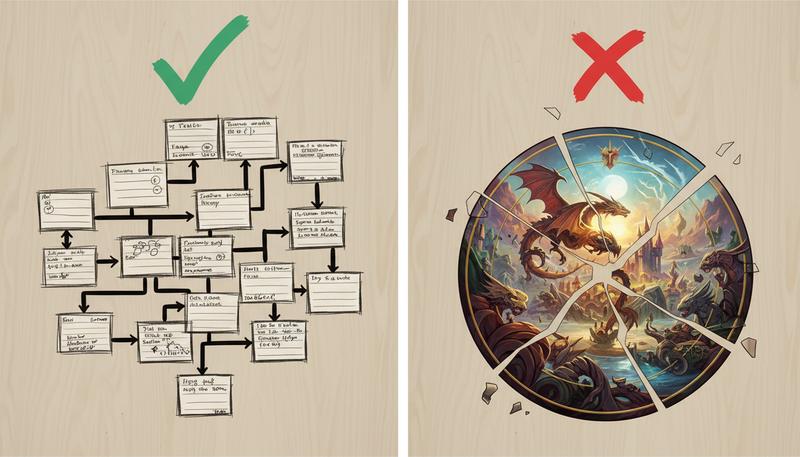
Finishing means resolving open questions. Are all the rules written down? Are there any game states that can't be resolved? Do players have meaningful choices throughout? Is the game's core loop complete? Finishing is about structural integrity.
Polishing means making things nicer without changing what they are. Better card art. Cleaner layout. Smoother component quality. More evocative flavor text. Polishing is about surface quality.
Here's the trap: polishing feels like progress, and it's often more pleasant than the hard work of finishing. Tweaking fonts is more comfortable than confronting the nagging feeling that your third-round pacing is off. So designers (especially new ones) often polish games that aren't actually finished yet — and end up with something that looks beautiful but plays unevenly.
Finish before you polish. Always.
Once you've finished — real finishing, structural finishing — then polish adds genuine value. Better visual hierarchy in your rulebook makes the game more accessible. Consistent iconography reduces cognitive load. Good component quality communicates to players that you took this seriously and they should too.
For a print-and-play or prototype context, "polish" might mean:
- Clean, readable card text (no typos, consistent formatting)
- Consistent visual language (all cards for a category look similar)
- A single-page summary of the rules
- Clear distinction between game components through color or shape
You don't need professional art to have a polished prototype. You need coherence — the feeling that everything was designed by the same brain with the same intention.
How to Write a Rulebook That Actually Makes Sense
Every designer thinks their rules are clear. Every first-time reader gets confused. This is a law of nature.
Writing a good rulebook is genuinely hard, and it's a different skill from designing the game. You're not just transcribing rules — you're teaching the game to a stranger who can't ask you questions. That requires you to inhabit beginner's mind, which is nearly impossible when you've been staring at your own game for months.
Here's a structure that works:
1. The Overview (30 seconds of reading)
What is this game about? What are players trying to do? What's the core tension or drama? This doesn't need to be long — two or three sentences. "In Merchant's Road, players are competing traders trying to build the most valuable route network before the kingdom closes its borders." Done. Now the reader has a frame.
2. Components List
What's in the box? How many of each thing? This section sounds boring but it's crucial — it's the first thing players do when they open a game, and if the component count is wrong or unclear, you've started on the wrong foot.
3. Setup
How do you prepare to play? Step by step, in the order you'd actually do it at a table. Include a diagram if the setup is spatial. Mention what a "starting state" looks like.
4. Turn Structure
What happens on a player's turn, in sequence? This is the heart of the rulebook. Be specific about what's optional, what's mandatory, and what order things happen in. Use numbered lists, not paragraphs, for sequences.
5. Special Rules and Edge Cases
The stuff that only comes up sometimes. Put it here, not in the main turn structure. If players ask "but what happens when...?" — the answer belongs in this section.
6. Winning
When does the game end? How do you determine who wins? This deserves its own section because players are always looking for it.
7. Example of Play
An illustrated example of two or three turns, showing how the rules work in practice. This is optional but extremely valuable — it's often the first thing experienced gamers read, and it's often the thing that un-sticks confused readers.
A few specific traps to avoid:
Front-loading exceptions. Don't explain edge cases before you've explained the base rule. New players can only hold so much in working memory.
Using your own jargon without definition. You've invented a word called a "flux token" and now you use it in the rules before defining it. Your readers are lost. Define every term before you use it, or include a glossary.
The passive voice plague. "Cards are drawn" — by whom? "Points are scored" — how? Active voice forces you to be specific about who does what.
Skipping the implicit. You know that players take turns clockwise. You forgot to write that down. Now every new group has an argument. Write down everything that feels obvious to you, because it probably isn't.
The single best investment you can make in your rulebook is having someone completely unfamiliar with your game read it and try to play solely from what's written. Watch them. Don't explain anything. Take notes on where they pause, where they misread, where they invent rules. Every confusion is a revision target.
Getting Your Game Out There
You have a finished game. Now what?
The answer depends on what you want: feedback, community, distribution, or just the joy of someone else playing your thing. Here's the landscape:
graph TD
    A[Finished Game] --> B[Local / Personal]
    A --> C[Online Community]
    A --> D[Self-Publishing]
    B --> E[Friends & Family]
    B --> F[Local Game Clubs / Meetups]
    C --> G[BoardGameGeek]
    C --> H[Reddit: r/tabletopgamedesign]
    C --> I[Discord Communities]
    D --> J[Print-and-Play on itch.io]
    D --> K[Tabletop Simulator / TTS Workshop]
    D --> L[Crowdfunding / Full Publication]
Friends and Family — The obvious starting point, and don't dismiss it. Real play sessions with people who will give you honest feedback (or whose silent frustration you can observe) are invaluable. The caveat: friends are often too kind. Watch behavior as much as you listen to words.
Local Game Groups — Most cities have tabletop gaming groups that meet regularly, often at game stores, libraries, or community centers. These are fantastic for playtesting because you'll find experienced players who have strong opinions and aren't afraid to share them. Search Meetup.com or ask at your local game store.
BoardGameGeek (BGG) — The dominant online community for tabletop games, with specific forums for game designers. The design forum is full of people working through similar problems. BoardGameGeek's game design community offers critique, advice, and connection to fellow designers. Posting your game there, even as a work-in-progress, can get useful eyes on it.
itch.io — The go-to platform for independent game publishing, including print-and-play board games and tabletop roleplaying games. You can list your game for free or set your own price. The itch.io tabletop section has a genuinely active community. For a first release, this is one of the lowest-friction ways to share something with strangers.
Tabletop Simulator — If your game works digitally, Tabletop Simulator (a paid app on Steam) lets you create a virtual version that anyone in the world can play. The workshop is full of community-made games, and it's a great way to run remote playtesting sessions.
Reddit — Subreddits like r/tabletopgamedesign and r/gamedesign are active communities where designers share works-in-progress and ask questions. The feedback can range from brilliant to unhelpful, but the community is generally supportive of newcomers.
For video game designers, the equivalent path runs through: itch.io (same platform, just for digital games), Game Jams (great for rapid prototyping and getting attention), and communities like the TIGSource forums or Discord servers organized around specific tools like Unity, Godot, or RPGMaker.
The Final Exercise: Teach Your Game to Someone New
Before we go any further, here's the assignment that ties everything together:
Sit down with someone who has never seen your game. Teach it to them. Watch them discover it.
Don't coach. Don't explain things that aren't in the rules. Let them read the rulebook if you have one. Observe what they do, what they ask, what surprises them, what confuses them. Pay attention to the moment when they first understand the core decision — when the game clicks for them.
This experience will teach you more about your game in 30 minutes than weeks of solo revision. You'll feel the places where your design works and the places where your mental model leaked into your rulebook. You'll see whether the game is actually fun independent of your enthusiasm for it.
More than that: you'll feel something a bit magical. You'll watch someone interact with a thing you made, having experiences you intended for them to have. That's a genuinely profound creative experience, and it doesn't get old.
The teaching test also reflects something important we've touched on throughout this course — that the fundamental rationality of game design is about interactive situations, not isolated choices. Your game only works when real people are actually playing it. Theory is the map; play is the territory.
Revisiting the Big Thesis
Let's take a breath and look at the whole journey.
We started in game theory — with the Prisoner's Dilemma and Nash Equilibria and the strange, counterintuitive ways that rational agents behave in interactive situations. We asked: when smart people choose badly together, why does that happen? And we found that the structure of incentives — who gets what under which conditions — shapes behavior more powerfully than individual intent.
Then we carried that insight into game design. We saw that a game mechanic is essentially a structured choice environment: you decide what options players have, what consequences follow, and what information is visible to whom. Game design fundamentals — mechanics, systems, goals, and rewards — are the levers you pull to create specific decision landscapes for players.
The connecting tissue between these two worlds is this: if you understand why people make decisions, you can design spaces where better decisions feel natural, worse decisions are structurally discouraged, and the most interesting decisions are right in the middle of the experience.
This is why the Nash Equilibrium matters for game designers. Not because you'll necessarily run the math — most designers don't — but because understanding that players will converge on stable strategies tells you something crucial: if there's one obviously dominant strategy, players will find it, use it, and then leave. Your job is to design a decision space where no single strategy dominates. Where adapting to what your opponent does is always interesting.
This is why the Prisoner's Dilemma matters. It teaches you that the same underlying logic — defect to guarantee a good personal outcome — can lead groups to terrible collective outcomes. When you design cooperative games or games with trade and diplomacy mechanics, you're essentially managing this tension. The question isn't "will players defect?" The question is "what have I built that makes cooperation the more interesting and rewarding path?"
This is why flow and psychology matter. Understanding that players need calibrated challenge — not too easy, not too hard — to enter states of genuine engagement means you design tutorial curves differently, difficulty ramps differently, and reward schedules differently. You're not just making rules; you're engineering mental states.
And this is why playtesting and iteration matter more than anything else. Because the space between "game as designed" and "game as experienced" is where all the real action is. Your theory about how players will behave is a hypothesis. The playtest is the experiment.
For the Board Game Designer: What Comes Next
If you've built a board game or card game, here are the directions you can grow:
Go deeper on game theory. The concepts covered in this course — Nash Equilibria, cooperation and defection, information asymmetry — are the beginner's toolkit. From here, you can explore mechanism design (the study of constructing incentive structures, which is game theory applied to design), auction theory, social choice theory, and evolutionary game theory. A great next text is Ken Binmore's Playing for Real, which is a genuinely readable introduction to game theory at a higher level.
Go deeper on game design. The canon of game design writing is surprisingly rich. Salen and Zimmerman's Rules of Play is the academic foundation — dense but thorough. Richard Garfield's essays on what makes card games work are essential if you're building card games. Reiner Knizia's design philosophy (elegant mechanics, zero redundancy) is worth studying even if you don't love his games.
Learn from the BGG Top 100. The BoardGameGeek Top 100 rated games is a curriculum. Play as many of them as you can and ask: what is the core decision? What is the dominant strategy, and why doesn't it feel dominant in play? What does the theme contribute mechanically? How does the game teach itself?
Enter game design contests. The Board Game Design Lab runs design challenges. The 200-word RPG challenge is a fantastic constraint exercise. The Solitaire Print-and-Play Design Contest on BGG is accessible and community-supported. Constraints are creative fuel; deadlines are magic.
Pursue publication (when you're ready). If you want to pursue traditional publishing, the path involves: designing to a publishable standard, submitting to publishers who accept unsolicited prototypes (most don't, but some do), attending conventions like Gen Con or Origins where publishers meet designers, and building a reputation in the design community first. It's a long road. Self-publishing via crowdfunding has become a real alternative for designers with an audience.
For the Video Game Designer: What Comes Next
If your game is digital (or you want it to be), the trajectory looks different:
Learn a game engine — but learn design first. As one overview of game development makes clear: game engines teach game building, not game design. Don't spend six months learning Unity syntax before you can answer "what is the core decision loop of my game?" The design fundamentals transfer from physical to digital, but the tools don't teach them.
Pick an engine appropriate to your ambitions. Godot is free, open-source, and increasingly capable — a fantastic choice for 2D games and smaller 3D projects. Unity has the largest community and learning resource base. Unreal Engine is the industry standard for high-fidelity 3D. RPGMaker exists specifically for certain genres. Don't start with the most powerful tool; start with the one where you can get to playable fastest.
Do game jams. Game jams — 48 or 72-hour sprints to build a game around a theme — are the best learning accelerator in the field. Ludum Dare, Global Game Jam, and dozens of smaller jams run constantly. You'll ship something, which is the most important habit to develop. You'll see what other designers do with the same constraints. You'll build a portfolio.
Study what makes digital games feel different from physical ones. The feedback loop in a video game is immediate and audiovisual in ways a board game can't match. Animation, sound design, and "game feel" (the tactile quality of controls) are dimensions of design that have no physical equivalent. Game Designer Rami Ismail's talks on game feel are a great entry point. Jan Willem Nijman's "The Art of Screenshake" GDC talk is required watching.
Get into the theory more deeply. Video games have produced some of the most interesting applied game theory in the world — from the economic complexity of Eve Online to the mechanism design of competitive multiplayer matchmaking. Mark Rosewater's design blog for Magic: The Gathering is a masterclass in iterative design applied to a living system. Valve's economist-in-residence Yanis Varoufakis wrote fascinating essays on the emergent economics of Team Fortress 2's virtual economy.
Where to Find Your People
Game design is social. The lone-genius-in-a-garage model is a myth that produces bad games. The designers who improve fastest are the ones embedded in communities where they're seeing others' work, getting feedback on their own, and discussing ideas constantly.
A few communities worth knowing:
Board Game Design Lab — Podcast and community focused on game designers at all levels. The host, Gabe Barrett, has interviewed hundreds of designers, and the back catalog is a fantastic education.
r/tabletopgamedesign — Active Reddit community. Good for asking specific questions and sharing works-in-progress.
The Game Crafter — A print-on-demand service for board game components, but also a community with forums and a game design marketplace. Useful when you're ready to produce professional-quality prototypes without a huge investment.
GDC Vault — The Game Developers Conference publishes many of its talks for free. This is a goldmine of professional game design thinking — narrative design, systems design, economic design, accessibility, everything. The free tier has years of material.
IndieCade — The indie game festival community, useful for networking and finding peers in independent game development.
Local game stores. Seriously. Walk into one, ask if they have an open play night, and introduce yourself as a game designer looking for playtesters. This works more often than you'd expect.
What Making Games Gives You That Playing Them Doesn't
Here's something that's hard to explain but worth trying to articulate: making games changes how you play them.
When you design, you start seeing the architecture behind every game you pick up. You notice the feedback loops and ask what behavior they're reinforcing. You feel the shape of the decision space — where it's open and free, where it's being subtly channeled. You appreciate elegant constraints. You sympathize with designers when an edge case slips through. You can't play a game anymore without some part of your brain running a quiet commentary about why it's working.
This is not a loss. It's a deeper form of engagement.
But more than that, making games gives you something that playing them can't: the experience of being responsible for someone else's fun. When you watch someone discover a system you built, laugh at an interaction you didn't entirely anticipate, lean forward in concentration at a decision you designed — that's a particular kind of satisfaction that has no equivalent in consumption. You made a little world. Someone went into it and had a real experience.
Game design at its heart is about crafting meaningful experiences — not just mechanics and numbers, but moments of excitement, surprise, frustration, and satisfaction. When you've done it well, you feel it. And it will make you want to do it again.
There's also something else. The skills you've built in this course — thinking systematically about decisions and incentives, modeling how behavior changes under different structural conditions, testing hypotheses against real-world feedback, iterating without ego — these transfer. They transfer to how you think about organizations, relationships, negotiations, policies. Game theory, as we've seen throughout this course, isn't just about games. It's a language for thinking about any situation where outcomes depend on multiple agents making choices. And now you have a fluency in it that you didn't have before.
The Course in One Diagram
Let's map the whole journey, one last time:
graph TD
    A[Game Theory: Why Do Players Choose What They Choose?] --> B[Nash Equilibria & Dominant Strategies]
    A --> C[Cooperation, Defection & Social Dynamics]
    B --> D[Design Insight: Avoid Dominant Strategies]
    C --> E[Design Insight: Structure Cooperative Incentives]
    D --> F[Mechanics & Systems Design]
    E --> F
    F --> G[Gameplay Loops & Feedback]
    G --> H[Player Psychology & Flow]
    H --> I[Your Game Concept]
    I --> J[Prototype]
    J --> K[Playtesting & Iteration]
    K --> L{Done?}
    L -->|Not yet| K
    L -->|Yes| M[Share, Reflect, Grow]
Every node in that diagram was a section of this course. And you've traveled through all of them.
One Last Thing
If you take nothing else from this course, take this:
Understanding why players make decisions is the difference between designing a game and designing an experience.
Rules are just rules until you understand that a player staring at their hand of cards is making decisions influenced by risk tolerance, social pressure, information gaps, cognitive load, and a dozen other factors that have nothing to do with the formal structure of your ruleset. Mechanics are just mechanics until you understand that a game where cooperation and defection are both viable paths will create richer, more human drama than a game where one is always correct.
The game theory and the game design aren't separate topics that happen to be bundled together. They're the same inquiry approached from different angles. The theorist asks: given this structure of choices and payoffs, what will rational agents do? The designer asks: what structure of choices and payoffs will produce the experience I want? Both questions require you to model players as thinking, feeling, strategizing humans — not just as pieces on a board.
You now have both lenses. Use them together. Every design decision is a hypothesis about player behavior. Every playtest is data. Every finished game is a theory of fun that you've built and tested in the world.
That's the whole thing. That's the practice.
Now go make something.
Further reading:
- Ken Binmore, Playing for Real — Game theory for the genuinely curious non-specialist
- Katie Salen & Eric Zimmerman, Rules of Play — The foundational academic text on game design
- Jesse Schell, The Art of Game Design: A Book of Lenses — Practical design wisdom organized as a set of analytical perspectives
- Richard Garfield's essays on Magic: The Gathering design — Available scattered across the internet; look for his pieces on "gaming" versus "playing" and randomness in games
- GDC Vault (free tier) at gdcvault.com — Years of professional game developers talking about what they've learned
- BoardGameGeek Design Forum — Where the board game design community actually lives
Only visible to you
Sign in to take notes.