How Video Games Keep You Coming Back: The Gameplay Loop
You've just spent the last section learning to read game mechanics like a designer — to reverse-engineer the decision spaces hiding inside every game system. You learned that mechanics aren't arbitrary rules; they're carefully engineered incentive structures rooted in game theory. They create the choices players face.
But here's what we haven't talked about yet: why do players keep coming back? Why does understanding a mechanic's structure not feel hollow or repetitive, but instead compulsive? Why does analyzing Catan's resource trading system deeper actually make you want to play more, not less? The answer isn't hidden in the mechanics themselves — it's in how those mechanics are packaged into something that loops.
There's a moment that every gamer knows. It's 11 PM. You told yourself you'd stop at 10. You're not even sure why you're still playing — the last hour felt almost automatic, like your hands just kept going. And then you think: "One more run. Just one more." That's not an accident. That's a gameplay loop working exactly as designed — and now you're ready to understand why.
The Three Nested Loops
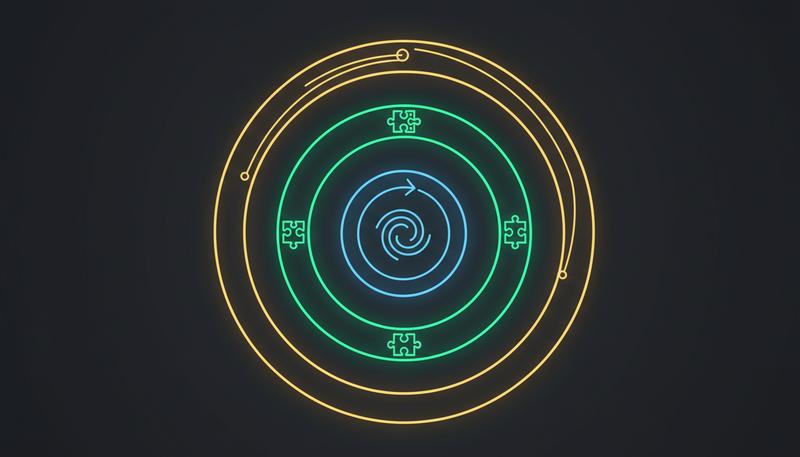
Games rarely have just one loop. Instead, they stack them. A short loop, a medium loop, and a long loop. These nest inside each other like Russian dolls, each one giving the others meaning.
Let me use a concrete example: a typical action RPG like Dark Souls or The Witcher.
graph TD
    subgraph Long Loop [Long Loop - Hours/Entire Game]
        L[Complete the narrative arc<br/>Defeat final boss, finish story]
    end
    subgraph Medium Loop [Medium Loop - Minutes to Hours]
        M[Clear a dungeon<br/>Gain levels, unlock new zone]
    end
    subgraph Short Loop [Short Loop - Seconds to Minutes]
        S[Attack enemy<br/>Dodge, hit, get experience]
    end
    S --> M
    M --> L
The short loop operates in seconds. In a combat game, it's the cycle of attacking, blocking, and managing resources in a single encounter. In Tetris, it's placing a piece and watching lines clear. In poker, it's betting, watching opponents react, and resolving a hand. This loop needs to feel immediately satisfying — if the short loop feels bad, players won't stick around long enough to experience anything else.
The medium loop plays out over minutes or maybe an hour. It's clearing a dungeon, completing a quest, finishing a Monopoly round, building out a section of your Minecraft base. The medium loop provides structure — it gives the short loop somewhere to go. You're not just fighting enemies in a vacuum; you're fighting to clear this particular camp so you can find the map piece.
The long loop is the macro arc of the whole game — the campaign, the seasonal ladder, the journey to build the ultimate city. It gives the medium loop meaning. You're not just completing quests; you're assembling the pieces of a larger story.
The magic is in how they nest. Short loops feed medium loops which feed long loops. If any one of the three feels broken, the whole structure wobbles. This is why some games feel exhausting after a few hours even if they seem impressive from the outside — their long loop is grand but their short loop feels repetitive. And it's why some modest, simple games feel endlessly replayable — they've nailed the short loop.
The Loop in Real Games
Let's make this concrete by walking through some specific examples, because abstract frameworks only get you so far.
Minecraft
Minecraft's genius is that it has one of the most elegant short loops ever designed, even though it looks deceptively simple: see resource → mine resource → use resource to make tool → mine better resource. The feedback is tactile (the block breaks, the item appears in your inventory), the reward is immediate (new material!), and the motivation to repeat is obvious (now you can make something better).
This feeds into medium loops — building a shelter, then a farm, then a mine system, then a redstone contraption. Which feeds into long loops — surviving the first night, defeating the Ender Dragon, completing your mega-project.
Crucially, block placement in Minecraft is listed as a canonical example of a genuine game mechanic — not because it's technically complex, but because it creates consequences throughout the entire game. The mechanic interacts with every other system. That's what makes a loop robust: when the core action ripples outward through multiple layers.
Poker
Poker's loop is beautiful in its compression. Short loop: assess your hand, make a bet, watch how opponents respond, see the community cards, resolve the hand. Medium loop: manage your chip stack across multiple hands in a session. Long loop: across a tournament, the meta-game of survival and pressure.
What makes poker's loop so compelling is that every single element matters simultaneously. The short loop constantly feeds information into the medium and long loops. "Am I up or down?" "Is this player bluffing more now that they're low on chips?" "Should I take a risk here or stay conservative?" Poker is a masterclass in designing a loop where every repetition generates new strategic information.
Monopoly
Monopoly is an instructive failure, which I think is just as valuable as studying successes. Monopoly has a short loop (roll dice, move, take action) and a long loop (accumulate property and bankrupt opponents), but its medium loop is almost nonexistent. After the property-buying phase ends, the game enters an interminable late stage where the outcome is essentially decided but nothing interesting is happening. Players are stuck in the short loop with no meaningful decisions to make.
The result is that Monopoly is famous for taking forever and causing family arguments — not because it's a bad concept, but because the loop structure breaks down after the midpoint. This is exactly the problem that plagues any game with a runaway leader — the moment one player pulls ahead, everyone else is effectively already lost.
A Typical RPG
A well-crafted RPG like Hades or Final Fantasy VII layers loops with real artistry. The short loop is combat — dodge, attack, use abilities, manage resources. The medium loop is progressing through a dungeon, completing a mission, upgrading your character. The long loop is the narrative arc and world completion.
What Hades does especially brilliantly — and this is worth stealing for your own designs — is tie the long loop directly into the short and medium loops. Each run doesn't just give you mechanical upgrades; it gives you story beats, new dialogue, relationship developments. The loops aren't parallel; they're interwoven. Dying in Hades advances the story. You never feel like you wasted time. That's exceptional loop design.
Goals and Rewards: The Engine Inside the Engine
A loop isn't a loop without something to want. Goals and rewards are what transform a cycle of repetition into a cycle of motivation.
There's a useful distinction between extrinsic rewards and intrinsic rewards. Extrinsic rewards are things the game gives you — XP, items, currency, achievements, new levels. Intrinsic rewards are feelings — competence, mastery, the satisfaction of solving a puzzle, the pride of creative expression. Both matter, but the relationship between them is tricky.
Research in behavioral psychology — specifically work on Self-Determination Theory — suggests that when extrinsic rewards are layered on top of intrinsically motivated activities, they can actually crowd out the intrinsic motivation. This is sometimes called the "overjustification effect." If someone already loves playing chess and you start giving them money for every win, they may start to feel like they're playing chess for the money rather than for the love of the game.
For game designers, the practical takeaway is: intrinsic rewards should be the foundation, and extrinsic rewards should amplify them, not replace them. The best games make you feel genuinely competent and creative — and then also give you a cool hat for doing it.
Goals and rewards in game design work together to give players purpose. Without goals, players feel lost. Without rewards, goals feel hollow. The design challenge is making sure there are goals at every loop level — micro-goals for the short loop (defeat this enemy, clear this room), mid-range goals for the medium loop (complete this dungeon, earn this upgrade), and macro-goals for the long loop (finish the game, achieve mastery) — and that each level of goal comes with proportionate rewards.
Variable Reward Schedules: The Slot Machine in Your Game
Now we're getting into territory where the science gets genuinely fascinating and slightly uncomfortable.
In the 1950s, behavioral psychologist B.F. Skinner ran experiments that would eventually reshape not just psychology but the entire games industry. He found that animals (including humans) respond differently depending on when and how often rewards are delivered. He identified several "schedules of reinforcement":
- Fixed-ratio: reward after every X actions (every 10 enemies killed → loot drop)
- Variable-ratio: reward after a random number of actions (sometimes after 3 enemies, sometimes after 20)
- Fixed-interval: reward after a set time (daily login bonus)
- Variable-interval: reward after a random time period
The bombshell finding was that variable-ratio schedules produce the most compulsive behavior. The unpredictability is the feature, not a bug. When you don't know exactly when the reward is coming, you keep going longer and more persistently than if you knew exactly what to expect.
You've experienced this. It's why you kept fishing in Stardew Valley for "just a few more casts." It's why you opened "just a couple more" loot boxes. It's why card games feel so different from chess — the randomness of your hand creates a variable-ratio situation that drives continued play even through losses.
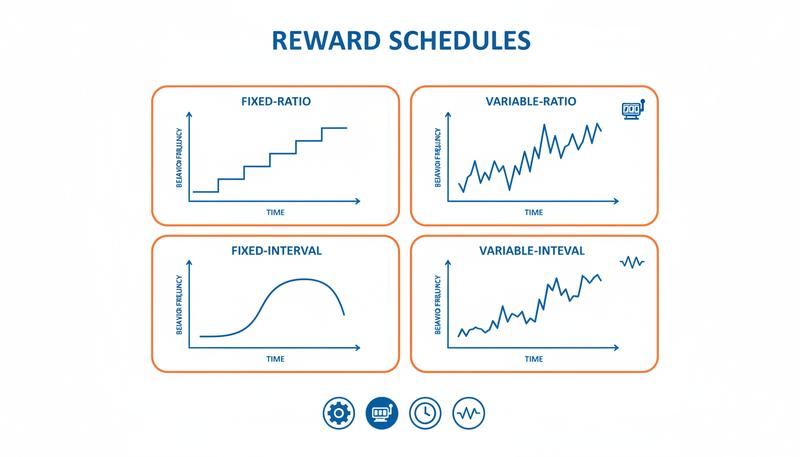
Loot boxes in modern games are literally slot machines using variable-ratio schedules — and many countries have started regulating them as gambling. This has sparked genuine ethical debate in game design about where player motivation ends and manipulation begins.
Here's my honest take: variable reward schedules are a powerful tool, and like any powerful tool, they can be used responsibly or exploitatively. Using unpredictability to make fishing feel exciting and the next chest feel tantalizing — that's great design. Using it to extract money from players who can't stop themselves — that crosses a line. As a designer, you're going to have to make this call consciously. The fact that it works doesn't make it right. The question worth asking is: am I creating a loop that players will look back on with satisfaction, or one that they'll look back on wishing they'd stopped sooner?
Grinding vs. Genuine Engagement: The Critical Distinction
There's a moment in many RPGs where the fun stops. The combat was exciting for the first twenty hours, but now you need to kill three hundred more of the same enemies to level up enough to proceed. The mechanics haven't changed. But something fundamental has shifted: you're no longer playing to experience something; you're playing to check a box.
That's grinding. And every designer's nightmare is a game that becomes a chore.
The difference between grinding and genuine engagement isn't the repetition — loops are, by definition, repetitive. The difference is whether the repetition continues to generate new information, decisions, or experiences.
Consider the difference between two hypothetical games:
- Game A: Kill 300 goblins to reach level 20. Each goblin fight is identical.
- Game B: Kill 300 goblins to reach level 20. Each goblin fight is procedurally varied, and the goblins start adapting to your tactics after you defeat 100 of them.
The repetition count is the same. But Game B keeps generating novelty, which keeps the loop from feeling hollow.
The key question to ask about any loop in your game is: Does repeating this action keep providing new experiences, choices, or information — or does it just require more of the same input for the same output?
Mechanics need to create meaningful consequences throughout a game to maintain their value. A mechanic that felt meaningful in hour one but becomes automated by hour ten has exhausted its loop potential. The solution is usually one of three things: variation (the mechanic changes or evolves), escalation (the mechanic becomes harder and requires more skill), or combination (the mechanic starts interacting with new systems that weren't in play before).
Dark Souls does all three simultaneously. Combat is your constant short loop, but the enemies get more complex, the environments introduce new constraints, and the knowledge you've accumulated about the game keeps changing how you fight. You're always doing "combat" but you're never doing the same combat.
How Loops Create the Feeling of Mastery
There's something deeply satisfying about getting better at something — watching your skills grow, noticing that things that used to be hard are now easy, and feeling genuinely competent. Psychologist Mihaly Csikszentmihalyi called the peak version of this state "flow" — a condition of intense, effortless engagement where you're perfectly matched to the challenge at hand.
(We'll dig deeper into flow in the section on player psychology, but it's worth flagging here because loops are the mechanism that enables flow.)
Good loop design creates a natural feedback path toward mastery. The short loop gives you immediate information about your performance. The medium loop shows you your progress. The long loop reveals how far you've come. When all three work together, players feel themselves getting better in real time — and that feeling is one of the most powerful motivators a game can provide.
This is why games that are too easy feel boring and games that are too hard feel frustrating. Both break the loop. Too easy: the action produces feedback and reward but requires no skill growth, so there's nothing to master. Too hard: the action produces feedback but no reward (you keep failing), so the motivation to repeat eventually dies.
The sweet spot — and this is the designer's central challenge — is making the loop hard enough to require skill but structured enough that skill growth is visible. Players need to be able to perceive their own improvement, or the loop feels meaningless.
Practical Design Principle: Make Every Layer Count
If you take one tactical idea from this section, let it be this: design your loops in layers, and make sure each layer has its own satisfying closure.
A short loop should feel complete and satisfying even if the medium loop isn't done yet. A medium loop should feel meaningful even if you quit before finishing the long loop. This is what makes games feel "just one more"-able — at any moment, you're close to the end of some loop, so there's always something to finish.
Candy Crush is diabolically good at this. Each puzzle is a short loop with clear feedback and completion. Each "episode" of levels is a medium loop with its own visual theme and completion reward. The endless overall progression is the long loop. You're almost never more than two minutes from finishing something, which means you almost never feel like you can safely stop.
You don't have to use this for evil. Games like Celeste use the same layered-loop approach to create something that feels genuinely rewarding and emotionally resonant. The short loop (execute a difficult platforming sequence) feeds a medium loop (complete a chapter with its own emotional arc) feeds a long loop (help a character work through anxiety and self-doubt). The mechanics reinforce the meaning. That's the goal.
Exercise: Map the Loop of a Game You Love
This is one of my favorite exercises because it's both analytical and immediately practical. Do this with a game you genuinely enjoy — the more you love it, the more interesting your findings will be.
Step 1: Identify the core action. What do you spend most of your time doing in this game? Be specific. Not "I play the game" — what's the atomic unit of action? Placing a card? Moving a piece? Shooting an enemy? Making a trade? Write it down.
Step 2: Map the feedback. When you take that action, what does the game tell you immediately? Is there a sound? An animation? A number? A change in the game state? How fast is the feedback? How clear is it?
Step 3: Identify the reward. What do you get for completing the action successfully? Is it intrinsic (a feeling of accomplishment, a clever solution) or extrinsic (XP, currency, a new item)? When does the reward arrive — immediately, or after a delay?
Step 4: Notice the motivation. What makes you want to do the action again? Is it curiosity about what comes next? A desire to keep improving? A goal you're building toward? Something else?
Step 5: Find the nested loops. What's the short loop (seconds)? What's the medium loop (minutes to an hour)? What's the long loop (hours or the whole game)? Draw them as concentric circles if that helps.
Step 6: Ask the grinding question. At what point, if any, does the loop start to feel like a chore? What's happening at that point that's different from when it felt fun? What would you change?
If you do this exercise carefully for one game, you'll start seeing loops in every game you play afterward. And once you can see the loops, you can start designing them.
The gameplay loop is where game theory and game design start to really converge. Remember back when we talked about Nash equilibria and player decisions? Every iteration of a loop is a decision point — a moment where the player's choices interact with the game's systems to produce an outcome. The loop is the structure that makes all those individual decisions add up to something. Get the loop right, and players will surprise you with what they build inside it. Get it wrong, and even a technically impressive game will feel like work.
Next, we'll zoom out and look at how all those loops and mechanics connect into larger systems — and why the interactions between elements often matter more than the elements themselves.
Only visible to you
Sign in to take notes.