How to Preserve Oral History and Record Personal Stories
Oral History: Preserving Lives in Their Own Words
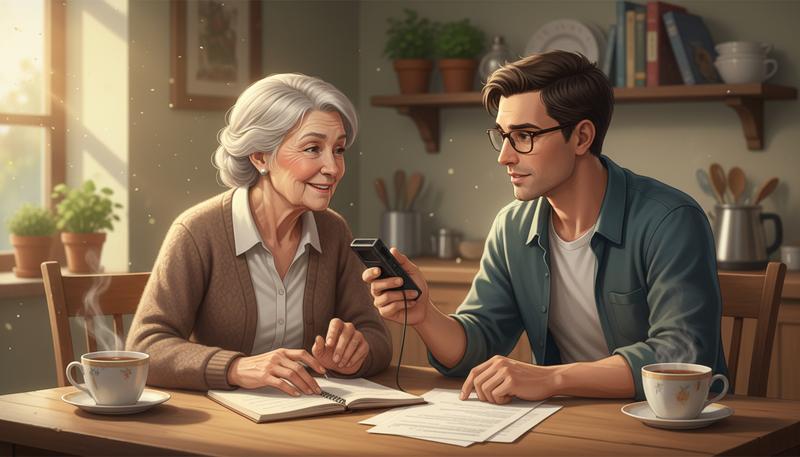
During the 1970s, oral history interviews with Navajo elders were conducted and documented by researchers using reel-to-reel tape recorders, with the Smithsonian Institution Archives' Oral History Program established in 1973 to preserve such materials. What strikes you when you look at it isn't the equipment. It's what the photograph actually captures — two people in a room, separated by age and experience and often by culture, trying to bridge that distance so that something irreplaceable can survive. One person has questions and a notepad. The other has a lifetime.
The relationship you're watching in that photograph — the quality of attention, the respect for the other person's rhythm and truth — doesn't change between a journalistic interview and an oral history interview. But the stakes do. And so does the entire architecture around it.
Oral history is both the oldest form of interview humans have ever used and, in some ways, the most philosophically rigorous about what we're actually doing when we sit down with another person to ask them about their life. Every culture preserved its knowledge through the spoken word before writing existed. But oral history as a formal discipline — with its own professional standards, its ethics framework, its archival methodology — is a twentieth-century invention, born from a very specific recognition: the documentary record was incomplete in systematic ways. Workers, women, Indigenous communities, immigrants, soldiers who never became generals — their versions of events vanished unless someone went to find them and record them.
That mission requires not just good questions but a particular kind of commitment to the person you're talking with, and to the future audiences who will encounter their words long after you're gone. The techniques oral historians have developed over decades to pursue it contain lessons that apply far beyond the archive.
Not the Subject
Here's where terminology becomes philosophy: oral historians do not call the people they interview "subjects." They call them "narrators."
This isn't semantic punctiliousness. It's a statement about power and purpose. When you call someone a subject, you position them as an object of study — something observed, examined, categorized. The researcher has the agency; the subject provides the data. When you call someone a narrator, you acknowledge that they are the author of their own story. The oral historian's job isn't to extract information but to create the conditions in which that person can narrate their life on their own terms.
The practical consequences are significant. A subject answers your questions. A narrator tells their story, and your questions are scaffolding, not architecture. Studs Terkel, the great American oral historian, described his method as simply getting people to talk about their work, their lives, their experiences — and then staying out of the way. His recordings of working-class Americans in Working and Hard Times feel like direct transmissions from human lives precisely because Terkel seemed to forget he was conducting research. He remembered only that he was listening to a person.
This philosophical stance — the narrator as author, not subject — changes your posture in the room. You are not in charge. You are in service.
The OHA's Framework: Four Pillars
The Oral History Association's best practices document organizes oral history work around four key elements: preparation, interviewing, preservation, and access. Each one is worth spending time with, because together they constitute a complete philosophy of the interview-as-artifact.
graph TD
    A[Preparation] --> B[Interviewing]
    B --> C[Preservation]
    C --> D[Access]
    A --> A1[Research & narrator selection]
    A --> A2[Informed consent process]
    A --> A3[Repository selection]
    B --> B1[Pre-interview conversation]
    B --> B2[Recording session/s]
    B --> B3[Review opportunity]
    C --> C1[Transcription]
    C --> C2[Archival deposit]
    D --> D1[Public access]
    D --> D2[Restrictions if agreed]
Preparation begins well before you arrive with a recorder. It means researching the narrator's life and historical context thoroughly enough to ask genuinely informed questions — not to show off your knowledge, but to meet them at their level and to recognize significance when they offer it. As the OHA guidelines put it, interviewers should "become familiar with the person, topic, and historical context by doing research in primary and secondary sources, as well as through social engagement with individuals and communities." Social engagement. Not just reading documents. Going to the community fair. Sitting in on the church service. Understanding, before you ask a single recorded question, the texture of the world your narrator inhabits.
Preparation also means finding a repository — an archive, library, or institution — that will house the finished oral history. This is easy to defer and then regret. The right repository must be selected before the project begins because its capacities and policies will shape your agreements with narrators about access and preservation.
Interviewing is where the actual relationship happens, and we'll spend most of this section here.
Preservation — transcription, archival deposit, metadata, digitization — is what separates oral history from every other kind of interview. A journalist can jot notes and never return to the tape. An oral historian creates something intended to survive for generations, which means attending to the technical and institutional infrastructure that makes survival possible.
Access is the question of who gets to hear or read this record, under what conditions, and with whose permission. This is where oral history's ethics become most demanding.
Informed Consent as an Ongoing Process
Most people imagine consent in research as a form you sign at the beginning: I agree to participate, I understand my rights, here is my signature. Oral history doesn't work that way — or rather, it understands that the form is only the beginning.
Informed consent in oral history is a process that runs throughout the entire relationship between interviewer and narrator. The OHA's guidelines specify that this involves multiple conversations before any recording begins: one to describe the project and its purposes, one to discuss the narrator's own expectations and goals for the interview, and a pre-interview session to prepare. These conversations aren't just procedural. They are the foundation of the relationship, and the relationship is what makes the recording possible.
Why does this matter? Because the narrator needs to know, genuinely and specifically, what they are agreeing to:
- What topics will be covered?
- Who will hear this recording and when?
- Will they have a chance to review it before it becomes public?
- Can they restrict access to portions of it, or to the whole thing, during their lifetime?
- Who owns it legally once it's deposited in the archive?
- What happens if the project's purpose or funding changes?
These are not bureaucratic questions. A narrator who tells you about a traumatic event — wartime experience, migration under threat, labor organizing in a company town — needs to understand whether that recording could be heard by their employer, their family, their government, in ten years or fifty. Getting consent "at the start" without this specificity is not really consent at all.
The most careful oral historians return to questions of consent at the end of each session, asking narrators whether they want to reconsider anything they've said, whether they want to restrict any portion of the recording. The narrator retains moral authority over their own story even after the legal agreements are signed.
Multi-Session Interviewing: When Weeks Become a Practice
One of the most distinctive features of oral history — and one that sets it most sharply apart from journalistic interviewing — is the multi-session interview. A journalist rarely has more than one crack at a source. An oral historian may conduct five, six, or eight sessions with the same narrator over the course of several months.
This changes the dynamics profoundly, and not always in the ways you'd expect.
The obvious advantage is depth. You can't excavate an entire life in two hours. A narrator who fought in a war, raised children, built a business, buried a spouse, and reinvented themselves at sixty-five needs time to unfold. Each session has its own rhythm and its own discoveries, and the narrator often comes back to subsequent sessions having thought about the previous one — having remembered things they'd forgotten, having decided to tell you something they'd initially held back.
There's also a phenomenon that oral historians call "secondary elaboration" — the way the act of remembering in one session primes memory for the next. You talk about your childhood neighborhood in session one, and by session three, you're recalling the smell of a specific bakery on the corner that you hadn't thought about in forty years. Memory works associatively, and serial conversations create the associative conditions for it.
But multi-session interviews also introduce complications. The relationship deepens, which is good for disclosure and potentially complicated for objectivity. A narrator may begin to see the oral historian as a friend, which changes what they're willing to say — and in what ways they're willing to perform their life. There's a risk of the relationship becoming so close that the historian loses critical distance. There's also the opposite risk: the narrator's initial openness dries up in later sessions, especially if they've said something they regret.
Managing the arc of a multi-session interview requires thinking about it like a story with chapters. The early sessions establish chronology and context — where were you born, what was your family like, where did you go to school. The middle sessions dig into the central experiences — the work, the political activity, the defining events. The later sessions are for the hard stuff — the losses, the failures, the complexities, the moments when the narrator's self-understanding is most at stake.
In practice, I've found that the most valuable material often surfaces in what I think of as the "third session sweet spot." By then, the narrator has stopped performing their official narrative — the one they've told before, to family, to local newspapers — and started telling you the real one. The mask has slipped, not because you pried it off, but because you've been patient.
How to Elicit Memory
Memory is not a filing cabinet. You don't just ask someone to retrieve information. Memory is reconstructive, associative, emotional, and deeply tied to sensory experience. Oral historians have developed specific techniques to work with this reality rather than against it.
Chronological scaffolding. Start with the facts: dates, places, names, sequences. Not because these are the most important things, but because they give the narrator a structure to hang the meaningful material on. "Walk me through what a typical day looked like when you were working at the mill" is far more productive than "Tell me what your work was like," because the chronological and physical specificity of "a typical day" gives the narrator something concrete to follow.
Sensory prompting. Memory is stored sensorially. The most effective oral historians ask about what people saw, heard, smelled, touched. "What did the factory floor sound like?" "What were you wearing when that happened?" "Can you describe the room you were in?" These questions seem almost embarrassingly small, but they unlock specific episodes rather than general impressions. There's neuroscience behind this: episodic memory is deeply intertwined with sensory and contextual encoding, and sensory cues are among the most reliable retrieval triggers.
Follow the affect. When a narrator's voice changes — slows down, becomes more careful, cracks — follow that. Don't rush through the emotional moment to get back to your agenda. The emotional inflection points in an oral history interview are almost always signaling something important. "You paused there. What's in that pause for you?" is a question I've borrowed from therapists and it's devastatingly effective.
Return and circle. In a multi-session interview, you have the luxury of returning to topics that were mentioned briefly and then dropped. "Last time you mentioned your brother was involved in the union organizing. Can we go back to that?" The narrator's willingness to return to a topic, and how their account changes or deepens on the second telling, is itself information.
The photograph technique. One of the most reliable techniques for unlocking memory in oral history is to look at photographs together. Old family albums, workplace photos, community images — these externalize memory and make it concrete. A narrator who can't quite remember when something happened will often recognize a photograph and immediately reconstruct context around it. Many oral historians deliberately build a "photograph session" into their project planning.
Memory and Truth: A Sophisticated Account
Here's where oral history distinguishes itself from both journalism and legal testimony in an important and uncomfortable way: it does not treat subjective memory as a deficiency to be overcome. It treats it as the data.
The journalistic instinct is to verify. You interview someone about an event, and you check what they say against the documentary record. If there are discrepancies, you correct them, note them, or treat them as problems. Legal testimony is evaluated in part by whether it matches verifiable facts. The oral historian's relationship with memory is more complicated and, I'd argue, more honest about the nature of human experience.
When a narrator misremembers a date, gives an account that contradicts official records, or tells a story that has clearly been shaped and polished over decades of retelling — all of that is evidence. The gap between what "really happened" (insofar as that's recoverable) and what a person remembers and how they narrate it tells you something essential about how they have processed their own life. A veteran who insists a battle took place in spring when the records say August is not simply wrong. He is telling you something about how he experienced time, perhaps about trauma's capacity to disorder memory, perhaps about the stories that he and his comrades told each other afterward to make sense of what had happened.
This isn't the same as saying "anything goes" or that oral histories are just unchecked anecdote. The OHA's best practices emphasize verification, context, and situating individual narratives within broader historical frameworks. But the commitment to the narrator's perspective — to recording and preserving the account as given — reflects a genuine epistemological position: that there is truth in subjectivity, not despite it.
Alessandro Portelli, the Italian oral historian whose work is foundational to the field, argued that what is distinctive about oral sources is precisely their subjectivity. "Oral sources tell us not just what people did, but what they wanted to do, what they believed they were doing, and what they now think they did." That last phrase is key. How a person narrates their past in the present tense is itself a document.
This means the oral historian's job is partly to record and partly to contextualize — to note, in the interview metadata and any published analyses, where a narrator's account diverges from other accounts or documentary evidence, not to dismiss the discrepancy but to treat it as a question worth investigating.
Archiving and Access: Who Owns a Life?
The question of ownership in oral history is genuinely complex, and practitioners have different views on it. Here's the rough framework that most professional oral historians work within:
During the interview, the narrator owns their story. The oral historian is a steward, not a proprietor. This is a moral position, not just a legal one.
After the interview, legal rights are typically transferred to the archive through the signed agreement — but with significant carve-outs and restrictions negotiated with the narrator. A narrator might agree that the full interview can be used for research purposes, but only after a period of restricted access. They might allow the audio to be publicly available but require that particularly sensitive portions be sealed for twenty-five years. They might grant rights for one purpose — an educational exhibit — but not another — commercial documentary production.
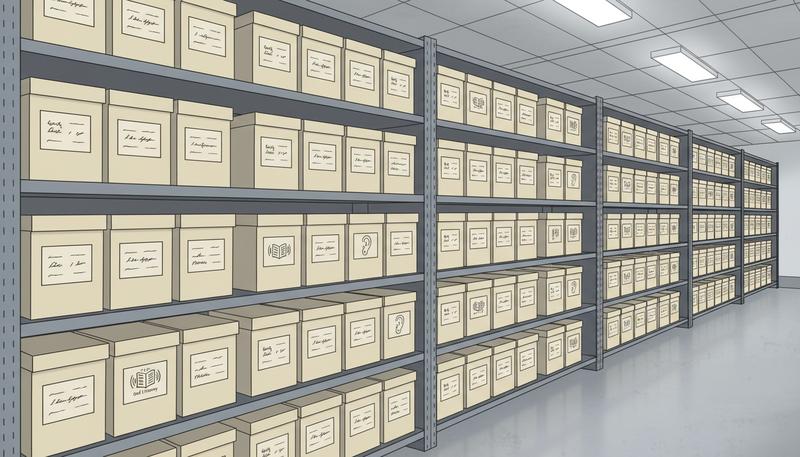
The most important principle is that these restrictions must be enforceable. This is why the selection of a repository matters so much: a library or archive that has the institutional infrastructure to enforce access restrictions, to maintain digitized recordings, and to produce metadata that makes the material discoverable without overexposing it — this isn't a bureaucratic detail. It is what makes the narrator's rights real in practice rather than just on paper.
Community oral history projects — those conducted with Indigenous communities, with diaspora communities, with groups who have historical reasons to distrust institutional researchers — often negotiate collective ownership alongside individual rights. The community as a whole may have the right to determine what is shared with outsiders. This model challenges the standard Western framework of individual intellectual property rights, and it has forced oral historians to think more carefully about what "access" means and who "the public" actually is.
Building a Practice: What Good Looks Like in the Room
Let me be concrete about what oral history practice looks like in actual preparation and execution, because the philosophical framework only means something if it changes what you do.
Narrator selection isn't random and shouldn't be driven purely by convenience. The OHA guidelines are explicit that oral historians should "choose potential narrators based on the relevance of their experiences to the subject at hand, while striving to identify and incorporate as many diverse voices as possible." In practice, this means resisting the temptation to interview the already-visible — the community leader, the newspaper-quoted spokesperson — in favor of the people whose perspectives are systematically underrepresented. Oral history has historically corrected the documentary record by seeking out the people who didn't write the documents.
The pre-interview conversation is not the interview. This is a common mistake among newcomers. The pre-interview is where you explain your project, establish rapport, take notes about themes to pursue, and let the narrator tell you what they want to talk about — all without the recorder running. The conversation that happens before recording is often more revealing about where the real material lives than the recording itself. When the recorder comes out, something shifts. The pre-interview lets you figure out what's on the other side of that shift.
Recording quality matters more than most new oral historians think. You are creating a document for fifty years from now. A narrative full of traffic noise, HVAC hum, and clipped sentences because the microphone was across the room is a document that future researchers will find nearly unusable. The OHA's best practices explicitly call for "high-quality recording... with consideration of future audiences and long-term preservation." Invest in a decent microphone. Scout the location in advance. Bring backup batteries. This isn't glamorous, but it is professional responsibility.
The interview guide is not a script. It's a document of themes and possible questions, organized loosely, that you use as a safety net. The experienced oral historian rarely looks at it, but they are never panicked about losing the thread because they know the safety net is there. Peter Laufer, journalism professor and interview scholar, describes the trap of the question list perfectly: it leads interviewers to treat conversations as transactions, checking boxes rather than following genuine curiosity. In oral history, the guide exists to give you confidence — so that confidence can be forgotten.
Beginning the recording. Every oral history recording should begin with the narrator, in their own voice, stating their name, their location, and the date. This isn't ceremony. It's archival infrastructure. In fifty years, when someone pulls this file, that opening statement is what allows them to locate it in time and space and confirm that they have the right recording. It also gives the narrator a moment to settle into being recorded, to hear their own voice through the device, to begin the transition into narrator mode.
What Oral History Teaches Every Interviewer
You may never conduct a formal oral history interview. You may work in news, in podcasting, in documentary, in corporate communication. The techniques and philosophy of oral history still have things to teach you that other interviewing traditions don't.
The long view. Oral historians think about the life as a whole, not the event of the moment. Even in a short journalistic interview, asking a subject about the longer arc of their experience — where they came from, what brought them to this moment, where they think it goes from here — yields a different quality of response than asking about the immediate incident.
Narrators, not sources. Even in contexts where you're clearly not creating an archival document, treating the person across from you as the author of their own experience rather than a provider of quotes changes the interview. They feel it, and they open differently.
The ethics of permanence. Oral historians are forced to think, before every project, about the long-term life of what they're creating — who will access it, what uses it might be put to, what the narrator's rights are in perpetuity. This is a useful discipline for anyone who records or publishes conversations. The questions "What is this for? Who might see it? What does this person's consent actually mean?" should be asked before every recorded interview, not just in the archive.
Sensory prompting and chronological scaffolding work in any interview context. If you're doing a half-hour podcast conversation with a scientist about their research, asking them to describe what their lab smells like on a normal day will get you something that no question about their methodology will. The specific and the sensory are always the way in.
Memory as evidence. The oral historian's sophisticated relationship with memory — treating subjective accounts as data rather than deficient versions of documentary truth — has applications in journalism, in documentary, in any context where you're asking people to reconstruct experience. The discrepancy between what someone remembers and what the records show is often your best story, not a problem to be corrected and discarded.
The interview as oral historians practice it is the interview slowed down, made more intentional, and weighted with the consciousness of time. That consciousness doesn't require an archive or a repository agreement. It requires only that you walk into a conversation understanding that you are in the presence of something finite — a person, a life, a particular vantage point on history — and that your job is to honor it with your full attention.
That is not so different, after all, from what every good interviewer is trying to do.
Only visible to you
Sign in to take notes.