How to Listen Actively and Get People to Open Up
The Discipline of Listening: Active Listening as a Craft Skill
Here's something that happens in interviews more often than most journalists would care to admit: a subject says something genuinely surprising — a detail that changes everything, a qualification that upends your whole premise, a small phrase that opens up an entirely new line of inquiry — and the interviewer nods and moves straight to the next prepared question.
When this happens, it's almost never because the interviewer doesn't care. They came prepared. They're genuinely interested. But something more fundamental broke down: the actual act of receiving what the subject was offering. This is where the interior work we covered in the last chapter — becoming genuinely curious about another human being — meets the craftwork of this one. Real curiosity only becomes better interviews if it's paired with an actual capacity to listen. And listening, despite looking passive, is the most cognitively demanding active skill in the entire enterprise. It's the one that gets practiced the least, taught the least, and noticed only when it's missing.
Terry Gross, who's been conducting interviews for NPR's Fresh Air since 1975 and has probably spent more cumulative hours in deliberate conversation than almost anyone alive, describes her approach to a subject's words as treating them like a gift that generates the next question. Not a prompt. Not a segue. A gift. That distinction matters because it reveals something essential: listening is not passive reception. It's an active, disciplined practice — one that protects the rapport you've built and transforms it into discovery. This section is about developing that capacity.
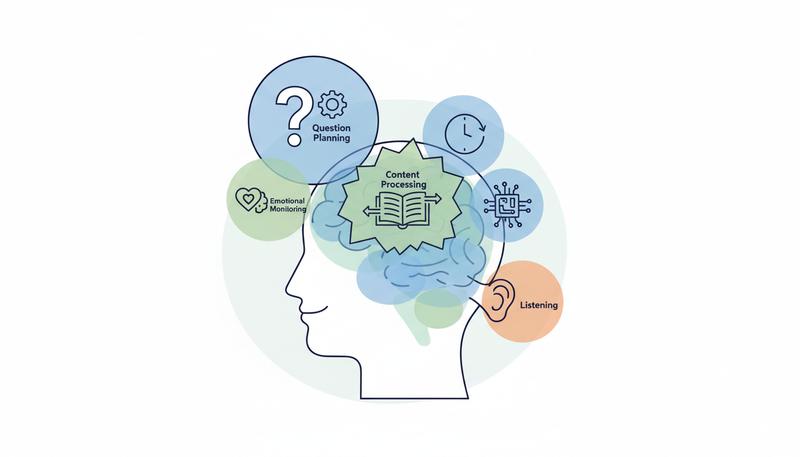
There's a phenomenon worth naming: performative listening. The interviewer appears attentive, makes appropriate eye contact, nods in the right places, but there's an internal monologue running underneath — okay, they're wrapping up, I need to ask about the contract dispute, should I do that now or wait until after the background stuff? The subject feels heard. The interviewer looks present. But the information isn't being absorbed at the depth where it becomes useful.
This explains something anyone who's transcribed their own interviews will recognize immediately: the transcript surprise. You sit down with the audio and you encounter things you don't remember. Not because the tape is wrong. Because you weren't fully there.
What Active Listening Actually Is
The clinical literature on active listening developed most thoroughly in therapeutic and medical contexts — places where failing to truly hear a patient carries serious consequences. But the framework translates almost perfectly to interview work.
The StatPearls clinical definition of active listening breaks it into three core components: comprehending what the speaker is saying (both the literal content and the broader meaning), retaining that information (so you can respond to it and build on it), and responding in ways that demonstrate to the speaker that they've been heard. Notice that third part. Active listening isn't just a private, internal act — it has a social dimension. It produces signals that the speaker can read. This is what distinguishes it from just sitting quietly, and it's why it matters specifically for interviews: a subject who feels heard is a subject who keeps talking.
In clinical settings, active listening has been shown to improve patient disclosure, increase trust, and produce more accurate diagnostic information. The parallel in interviews should be obvious. Research consistently finds that people share more — more honestly, more fully, more specifically — when they feel genuinely attended to. They also self-correct more, returning to things they said earlier to add nuance or admit uncertainty. That's often where the most valuable material lives.
What active listening is not is the aggressive, forward-leaning "active" of talk radio or cable news — jumping in, pushing back, performing that you're paying attention through sheer force. That's useful in debate contexts. It's corrosive in interview contexts. Real active listening often looks, from the outside, almost passive. The body is still. The face is open. The questions, when they come, often start with something the subject just said. The interviewer appears unhurried, even when time is slipping away.
The Three Layers of Listening
Experienced interviewers — and experienced therapists — describe listening as operating on at least three simultaneous levels. Being good at it means attending to all three at once.
The first layer is content: the literal informational substance of what's being said. This is what most interviewers think they're capturing, and often are — at least partially. Who, what, when, where. The facts. The chronology. The argument. Necessary but not sufficient.
The second layer is emotion: the affective texture that surrounds the content. Not just what someone is saying but how they feel about it. This layer is often more revealing than the first. A scientist describing a failed experiment in flat, affectless language is saying something fundamentally different from a scientist describing the same experiment with barely suppressed excitement. A politician's voice that drops slightly when they mention a specific colleague is saying something different from the words actually coming out. The emotional layer transmits through vocal quality, pace, volume, word choice, and the energy with which ideas are introduced. Missing it means missing significant information.
The third layer is what's not being said: the gaps, the elisions, the sudden shifts in direction, the questions that deflect other questions, the topics that never surface unless you surface them. This is the most difficult layer to attend to because it requires you to hold in mind simultaneously what the subject is saying and a running model of what a complete account would include — and then notice the distance between them. It's where the most important material sometimes lives.
graph TD
    A[What is said: Content] --> D[The Full Story]
    B[How it's said: Emotion] --> D
    C[What is not said: Gaps & Elisions] --> D
    D --> E[Interviewer's Real Understanding]

    style A fill:#4a90d9,color:#fff
    style B fill:#e8a838,color:#fff
    style C fill:#c0392b,color:#fff
    style D fill:#27ae60,color:#fff
    style E fill:#2c3e50,color:#fff
Michael Barbaro, host of The Daily at the New York Times, has talked about his approach to the emotional layer in terms of ongoing calibration — noticing when a source's language becomes suddenly more hedged, when energy spikes or drops, when they're speaking from a script versus speaking from lived experience. He treats those shifts as directional signals. They tell him where the real story might be.
The third layer — the gaps — is where experienced accountability reporters really distinguish themselves. An official who answers every question except the one about timing. A CEO who speaks expansively about strategy and says nothing concrete about execution. A subject who becomes suddenly more general when you ask for specifics. None of that registers if you're only listening to content.
Reflecting and Paraphrasing: Staying Present Without Interrupting
One practical tool that active listening produces is the capacity to reflect and paraphrase — to demonstrate to a subject that you've understood them without interrupting the flow, and to give them a chance to correct or deepen what they've said.
This technique comes directly from therapeutic practice, where it's considered foundational. But it's also just good conversational craft. When you paraphrase accurately, something tends to happen: the subject either confirms and moves forward, or they correct — "Well, that's not quite it" — and in correcting, they often get closer to what they've been trying to say. Either way, you win. You've either confirmed you heard correctly, or you've created a condition where the subject goes deeper.
The key is paraphrasing accurately enough that it feels like genuine reception rather than mechanical mimicry. Therapists distinguish between selective reflection — feeding back a specific phrase or image the speaker used — and paraphrasing — rendering the meaning in your own words. Both are useful, and they serve slightly different functions. Selective reflection ("You said 'trapped' — can you say more about that?") signals that you caught a specific word and found it significant. Paraphrasing ("So if I understand you right, the problem wasn't the decision itself but the way it was made") shows you've integrated the larger meaning and are testing your understanding.
What's particularly useful about this tool is that it buys you thinking time without appearing to stall. Instead of going silent while you figure out what to ask next — which can feel awkward — reflecting what was just said keeps the conversation moving while also advancing comprehension.
The Open Notebook's guide on steering interviews describes this as one of the key techniques for maintaining flow without losing control or making the subject feel interrogated. It's a way of being present in the conversation rather than ahead of it.
One caution: over-paraphrasing can become its own problem. It can slow an interview down, feel performative, or create the sense that the interviewer needs the subject to repeat themselves constantly. Used judiciously — maybe two or three times in a long interview, at moments of real complexity or emotional weight — it's powerful. Used as a tic, it becomes noise.
Nonverbal Listening: The Body That Hears
There's a version of interview advice that treats nonverbal communication as a performance: maintain good eye contact, nod appropriately, lean in slightly to show engagement. Follow these tips and your subject will trust you.
The problem with that framing is that it treats nonverbal behavior as costume. And subjects — especially experienced ones — can smell costume from across the room.
Real nonverbal listening isn't performed. It's the natural outward expression of genuine internal engagement. When you're actually paying attention, your body orients toward the speaker, your facial expressions respond to the emotional content of what's being said, and your smaller reactions — the slightly raised eyebrow, the momentary frown of concentration, the quick nod that says yes, keep going — happen without planning. These micro-responses signal to a subject, below conscious analysis, that there is another human being in the room genuinely receiving them.
This matters particularly in face-to-face and video interviews. Eye contact does something interesting: it creates a mild sense of accountability in the speaker. When someone is looking at you — really looking, not staring — there's a gentle pressure to be accurate, to be specific, to say the thing you actually mean rather than the thing you usually say. It's not that people can't lie while being looked at; they can and do. But it raises the cost slightly, which sometimes makes a difference.

Conversely, an interviewer who spends significant time looking at notes or a laptop signals something specific: this person's questions matter more than your answers. That signal produces a corresponding response — the subject starts answering the questions rather than talking.
In audio-only or phone interviews, the nonverbal channel collapses to the paralinguistic: those small sounds — the mmm, the yeah, the barely audible exhale of recognition — that tell a speaker you're still with them. Radio producers are exquisitely aware of this. The challenge in audio interviews is that these sounds, recorded on the same channel as the subject, create edit problems later. Many radio journalists learn to do a kind of silent nodding — mouth open slightly in the expression of listening, head moving, but not actually vocalizing — that produces the behavioral readiness to respond without creating audio artifacts. It's a strange thing to learn, and the first few times you do it consciously it feels bizarre. Then it becomes second nature.
The Note-Taking Dilemma
Here's something nobody warns you about when you start interviewing: the notebook is sometimes the enemy of listening.
Note-taking is, for most journalists, a deeply ingrained habit and a professional survival skill. And in many contexts — especially print journalism — it's necessary. You can't rely entirely on recordings. You need to flag the moment something matters. You need to capture direct quotes with enough accuracy that you can verify them later. Notes aren't optional.
But the act of writing is cognitively expensive. When you write, your visual attention goes to the page. Your working memory is occupied with transcription — holding the words in short-term memory long enough to get them down. And the small gap between what the subject says and your pen catching up is, exactly, a gap in listening.
The tension is real and there's no perfect solution. What experienced interviewers develop is a minimalist note-taking practice: not trying to capture everything, but flagging the moments that matter with a few key words or a folded page corner, then trusting the recording to hold the rest. The goal is to use notes as anchors — markers that let you navigate the recording efficiently later — rather than trying to build a complete parallel transcript in real time.
Jodi Kantor's advice, cited in CJR, emphasizes the importance of preparation: to ask a really high-yielding question, you need to have done your homework, not from how much information you extract by brute force. A fully present interviewer who captures 60% of the content and catches every significant emotional shift will produce a better story than an absent one who captures 90% but misses everything that wasn't explicit.
Some interviewers solve this partly by using two-column notes: one column for content, one for observations — emotional texture, body language, the things you noticed but couldn't quite name. The second column is often where the story actually lives.
A practical compromise many journalists land on: if you're recording, write barely at all during the interview itself. Focus almost entirely on listening and response. Then, immediately after the interview ends — in the car, in the elevator, before you check your phone — spend five minutes writing down the things that struck you, the moments that felt significant, the things you want to make sure you find in the recording. This post-interview note practice can be more valuable than the interview notes themselves, because it captures your immediate intuitive response to the conversation before analysis smooths it out.
Terry Gross and the Gift of Words
Terry Gross has given a number of interviews about her own interview practice — a meta-conversation she's clearly thought about for decades — and the consistency with which she returns to a single idea is striking. The subject's words, she says, are the source of the next question. Not your prepared list. Not the chronology you mapped out beforehand. The words they just used.
This sounds like a technique. It's actually a philosophy, and the difference matters.
A technique can be applied strategically, somewhat independently of whether you're actually listening. You can remind yourself to "use the subject's language" as a rule and occasionally pull a phrase from what they said to launch your next question, even if you weren't fully present for the rest of it. You might do this well enough that it looks like real responsiveness.
What Gross is describing is something more fundamental: a relationship to the conversation in which the subject's words are primary and your prepared questions are secondary. The questions serve as fallbacks — what you ask when the conversation hasn't given you something better. When it has, you follow it.
This requires a particular kind of security. A lot of interview anxiety — especially for less experienced interviewers — is really question anxiety: what do I ask next? When you're anxious about what to ask next, you stop listening to what's being said now, because your brain has concluded that the future question problem is more urgent than the present reception problem. Terry Gross's philosophy resolves that by making the current answer the answer to the question problem. If you listen well enough, the subject tells you what to ask.
This is what CJR's interview advice is pointing at when it describes the best interviews as conversations rather than interrogations — a subject being genuinely listened to starts to participate in the inquiry rather than simply respond to it. They surface things they think you might want to know. They add context unprompted. They occasionally say "and this is something I've never actually told anyone," which is a sentence that only gets said in rooms where someone is really listening.
Common Barriers to Active Listening
Understanding what gets in the way is as important as understanding what good listening looks like. The barriers are worth naming explicitly because they're mostly invisible — they operate below conscious awareness.
Confirmation bias is perhaps the most insidious. When you've done thorough research (as you should, per Section 3), you arrive at an interview with a mental model of the story. That model has power. It shapes which things you register as significant and which you skip past. When a subject says something that fits the model, it goes in the notebook. When they say something that complicates it, the brain sometimes processes it as noise — background information the model will eventually accommodate — rather than as a potential signal that the model is wrong.
The journalist who's decided, before the interview, that a company's failure was primarily a leadership problem will hear everything through that lens, and will unconsciously weight evidence that confirms it. This isn't dishonesty. It's the ordinary operation of human cognition. The antidote is deliberate: periodically force yourself to articulate what you've heard that complicates or contradicts your assumptions. If you can't name anything, you haven't been listening carefully enough.
Time pressure is the second major barrier, and it's structural. Most interviews are too short. You have 30 minutes with someone who has 30 years of relevant experience, and there are twelve things you need to know and you're aware, starting around minute 22, that you're running out of time. This awareness collapses listening. When you're worried about covering everything, you stop being present for anything.
Experienced interviewers manage this partly by aggressive pre-interview triage — deciding in advance what they actually need versus what would be nice to have, so that when time pressure hits, they have a clear sense of what to sacrifice. But there's also a more philosophical intervention: accepting that you will not get everything, and that the things you get by being fully present are more valuable than the things you'd get by rushing to cover the list.
Mental preparation for the next question is the barrier we've already discussed, but it deserves reemphasis because it's so pervasive. The fix is partly structural: if you have a question list, put it somewhere you can see it with peripheral vision rather than somewhere that requires you to look down. Some interviewers use a card on the table rather than a notebook precisely so they can glance at remaining questions without breaking eye contact.
Emotional contagion and management is a barrier that rarely gets mentioned but matters particularly in high-stakes interviews. When a subject is upset, frightened, angry, or distressed, those emotions have a way of entering the room and affecting the interviewer. A subject in tears can trigger a caregiving response that pulls your attention toward managing the emotional situation rather than listening to what's being said within it. A hostile or defensive subject can trigger a defensive response that narrows your listening to threat detection. Recognizing these dynamics — which the clinical literature on active listening addresses extensively — is the first step toward not being controlled by them.
Listening for the Story Beneath the Answer
The most sophisticated form of interview listening isn't about comprehending what someone says. It's about attending to the gap between what someone says and how they say it — and recognizing that gap as information.
This gap shows up in different ways. Sometimes it's a tonal mismatch: someone describes a traumatic event in the careful, composed language of someone who has told this story many times before, and then, briefly, their voice changes — something raw surfaces for a moment before the composed narration resumes. That moment is significant. It's where the story gets real.
Sometimes it's a structural mismatch: someone answers a direct question about X by talking extensively and fluently about Y, which is related but different. The evasion may be conscious or unconscious, but it's directional. It points toward something.
Sometimes it's a confidence mismatch: someone speaks with total certainty about some things and becomes suddenly qualified and hedged about others. That shift in epistemic confidence — "I believe" versus "I know for a fact" — is meaningful. It tells you where you should probe harder.
Sometimes it's a vocabulary mismatch: someone whose language has been consistently technical suddenly reaches for a metaphor — "it felt like being abandoned in a storm." The shift to figurative language often signals you've reached the edge of what their habitual narration can handle. Something more personal is trying to surface.
Learning to hear these signals requires a kind of binocular attention: one channel tracking what's literally being said, another tracking the meta-information surrounding it. This is genuinely difficult, and it takes practice. But it's also one of the things that separates an interviewer who gets good material from one who gets great material.
[The discipline of attending to emotional undertones](https://www.theopennotebook.com/2024/02/20/how-to-steer-an-interview-so-you-get-what-you-need/) is something science journalist Isobel Whitcomb describes as essential when interviewing people about difficult personal experiences — recognizing when someone is at the edge of what they're comfortable sharing and deciding whether to pursue that edge or give them space. That decision requires having actually heard the signal in the first place.
Training Yourself to Listen: Practical Exercises
Listening is a skill, which means it responds to deliberate practice. Most people don't practice it deliberately because it doesn't feel like practice — it feels like just paying attention. But attending to the specific dimensions of listening that matter for interviewing can be developed systematically.
The re-listening exercise is the most direct: after any recorded interview, listen to the recording without looking at your notes, and write down every significant moment you missed or undervalued in real time. Not to judge yourself, but to build pattern recognition. Over time, you'll start to notice what you systematically miss — whether that's emotional undertones, structural evasions, or vocabulary shifts — and you can start compensating for those specific blind spots.
The paraphrase practice can be done in ordinary conversation. After someone says something substantive, try to paraphrase it back to them before responding. Notice how often you get it slightly wrong. Notice what it takes to get it right. This builds the muscle for interview contexts where accurate paraphrase becomes the tool, not just a politeness.
The silence training that Section 7 covers in more depth has a listening component: learning to sit with what someone has just said rather than immediately filling the space. Silence is partly a speaking tool (which Section 7 addresses) but it's also a listening tool — the moment after someone speaks is when you process what they said, and filling that moment immediately with your next question shortens the processing window.
The three-layer audit is a post-interview reflection practice. After any substantial conversation — interview or otherwise — ask yourself: what was the content, what was the emotional texture, and what wasn't said? The third question is the hardest and the most important. If you can't answer it at all, you were only listening to the first layer.
Conversational ethnography — the practice of attending to conversations you're not participating in — is an old journalism exercise that has genuine value for listening development. Sit in a coffee shop. Listen to the conversation at the next table. Not for the content. For what's happening underneath it. Who's leading? Who's performing? Who's actually saying the thing they mean? This kind of observation, sustained over time, develops the capacity to hear multiple layers simultaneously.
The underlying principle behind all these exercises is the same: listening is not the default state of the brain in a conversation. The default state is preparation for speech. Genuine listening is the discipline of overriding that default — of treating someone else's words as more urgent than your own next words. That's not natural. It's learned. And like every other craft skill in this course, it gets better with attention and practice.
What the best interviewers have in common — across journalism, oral history, documentary, and broadcast — is not that they ask better questions than everyone else. It's that they listen better. Their questions are better partly as a consequence of that listening. The conversation generates the inquiry. The subject, without fully realizing it, tells them where to go.
That's the discipline. And it's worth everything.
Only visible to you
Sign in to take notes.