How to Use Silence in Interviews to Get Better Answers
Silence as a Tool: The Counterintuitive Power of Saying Nothing
We've established that listening is the foundation of great interviewing — that the discipline of attention, sustained over time, is what separates skilled interviewers from those who simply ask questions. But there's a paradox embedded in that discipline: the moment when listening becomes most difficult is often the moment when the interviewer feels the strongest urge to speak. That moment is silence.
Here's something that happens in nearly every interview conducted by someone new to the craft, and in far more interviews conducted by experienced practitioners than anyone would admit: the subject finishes a sentence, and the interviewer immediately starts talking. Not because they have a great question ready. Not because the moment demands it. But because silence has appeared, and silence feels like a problem to be solved. It isn't. Silence is often the most productive thing happening in the room. And the interviewer who learns to sit inside it — to resist the almost physiological compulsion to fill it — will consistently get things out of people that no question could have extracted.
This is harder than it sounds. Much harder. Because the drive to fill conversational silence isn't a bad habit you picked up somewhere. It's wired into you by decades of social conditioning, by every conversation you've ever had, by the unspoken rules of polite exchange that govern human interaction from childhood. Unlearning it requires deliberate, sustained practice — the same kind of systematic work we applied to listening itself. But the reward is extraordinary: a tool that works precisely when questions fail, that creates pressure without aggression, and that signals to your subject, at a level below conscious thought, that you are the kind of interviewer who will wait for the real answer.
When you maintain eye contact, perhaps with a small nod that says I'm still here, I'm still listening — the subject experiences something cognitively interesting. They have finished speaking, but the conversation has not moved on. The question has not been answered, in some felt sense. And in the absence of any external pressure, they begin to apply pressure to themselves.
They add. They clarify. They correct. Sometimes they say the thing they had decided not to say.
Why Interviewers Fill Silence
Understanding why we rush to fill silence matters, because the cure requires diagnosing the disease correctly. There are at least four distinct reasons, and they operate differently.
Anxiety about competence. Early interviewing can feel terrifying — the heart races, there's fear of appearing unintelligent, a worry that the source will think you don't know what you're doing. Rushing to the next question feels like demonstrating preparedness — look, I have more questions, I know what I'm doing here. But silence, counterintuitively, often signals far more confidence than a rapid-fire follow-up. It says: I'm comfortable enough with this conversation to not fill every inch of it with sound.
Social training. In ordinary conversation, filling silence is correct behavior. It means you are attentive, that you're not putting the burden of performance entirely on the other person. We learn this young, and we learn it well. The interviewer's task is to recognize that the interview is not ordinary conversation, even when it looks like one. Different rules apply here.
Fear of seeming rude. This one is subtle. There's a particular flavor of interviewer — often thoughtful, often good at the relational parts of the work — who conflates silence with withholding warmth. If I don't respond immediately, am I being cold? Is this person going to feel judged, or hung out to dry? The answer, in most cases, is no. Silence with warm body language — an open posture, a slight forward lean, maintained eye contact — reads as I am still very much here, and I want more. That is not cold. That is intense engagement.
Insufficient preparation. Sometimes interviewers fill silence because they genuinely don't know what to say next, and filling silence with words feels better than filling it with obvious blankness. This is the category that preparation solves. When you know your subject and your material deeply, you can afford to wait, because you know that what comes next — from either of you — will be worth having.
Count to Seven
The practical technique most commonly taught in interviewing workshops is some version of "count to seven." After a subject finishes speaking, do not respond. Count to seven in your head. This sounds simple. It is not.
The first time most people practice this, they make it to about three before the discomfort becomes intolerable and they blurt something out. The second time, maybe four. Progress comes in halves and ones. The reason to count to seven rather than, say, four, is that the threshold of discomfort is around four seconds — which means you need to get past it, into the territory where the silence is genuinely doing something. Seven gets you there. Some practitioners go longer: experienced documentary interviewers will sometimes sit in silence for fifteen, twenty seconds, watching the subject internally debate whether to say more.
What you are doing while you count matters. You are not staring blankly into the middle distance. You are maintaining a kind of active receptivity: looking at the subject (not intensely enough to feel like a stare, but steadily enough to communicate presence), keeping your body language open, possibly tilting your head slightly to one side, which researchers have found signals genuine curiosity and attentiveness. You are not checking your notes. You are not glancing at your recorder. You are waiting, and you are making it clear through every non-verbal signal available to you that you are waiting because you want more, not because you have run out of questions.
Terry Gross of NPR's Fresh Air — perhaps the most celebrated radio interviewer of the modern era — has spoken about the terror of dead air in broadcast contexts: "in radio, dead air is really a scary thing." Her solution is not to eliminate silence but to develop the skill of thinking out loud, using a rambling formulation to buy time while the real question crystallizes. This is a broadcast-specific adaptation, and we will return to it. But even Gross's technique preserves the essential function: slowing down, creating space between what the subject said and what happens next.
What Subjects Do in Silence
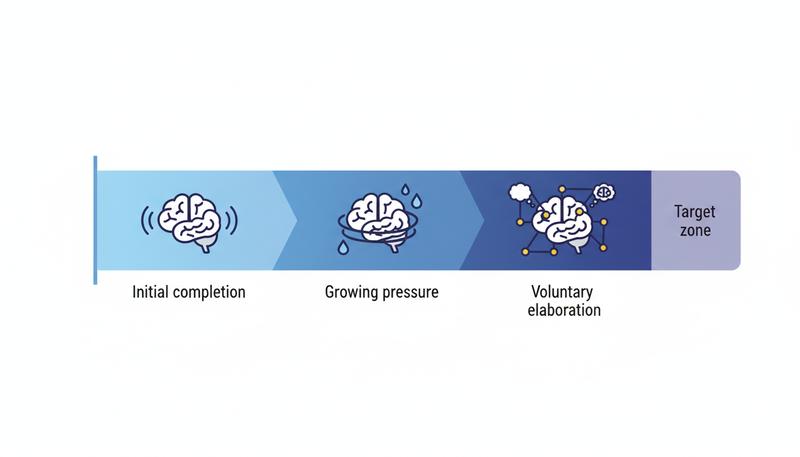
This is where the psychology gets genuinely interesting. When a subject answers a question and the interviewer doesn't respond, the subject enters a brief but significant cognitive loop. The loop runs something like this:
I've answered the question. The interviewer hasn't moved on. Is my answer insufficient? Did I say something unclear? Should I say more? Did I miss something? What are they waiting for?
This loop produces elaboration. It produces correction. It produces the thing the subject wasn't planning to say but says now, because the silence has created a pressure that feels, from the inside, like an unanswered demand. The subject doesn't necessarily know that they are responding to strategic silence — they just experience the pull to continue.
This is why silence is particularly powerful after incomplete or evasive answers. If a subject has given you a non-answer — a rehearsed talking point, a pivot away from the actual question — a follow-up question can simply be deflected. The subject is practiced at deflecting questions. But silence is harder to deflect. You can't redirect silence. You can't argue with it. You can only sit inside it and feel its weight, the way the subject is sitting inside it and feeling its weight.
graph TD
    A[Subject gives answer] --> B{Interviewer responds?}
    B -->|Yes, immediately| C[Subject feels validated]
    C --> D[Conversation moves on]
    D --> E[Shallow answer accepted]
    B -->|No, holds silence| F[Subject feels unresolved pressure]
    F --> G{Subject's internal loop}
    G -->|Was that enough?| H[Subject elaborates]
    G -->|Did I miss something?| I[Subject clarifies or corrects]
    G -->|What are they waiting for?| J[Subject reveals more]
    H --> K[Deeper disclosure]
    I --> K
    J --> K
There is a particular kind of moment — interviewers who have been at this long enough will recognize it immediately — where you can see someone deciding to tell you something they had not planned to tell you. A slight shift in posture. A different quality of eye contact. A pause before a sentence starts that is longer than the pauses before any of the sentences that came before it. That moment is often preceded by silence. The interviewer's silence gave the subject the room — the actual conversational space — to arrive at that decision.
Productive Silence vs. Dead Air: Reading the Room
Here is the distinction that prevents the technique from becoming a blunt instrument: not all silence is productive. Some silence is just confusion, or mutual blankness, or the conversational equivalent of two people both stepping the same way in a hallway. The skill lies in reading the difference.
Productive silence feels taut. There is something in the air — a question still hovering, an answer not quite resolved, a subject who is visibly processing. Their eyes may move, their hands may shift slightly, they are working on something. That is the silence you maintain.
Dead air feels deflated. The subject has genuinely said everything they intended to say. They're looking at you with slight puzzlement, or mild politeness, waiting for the next question. If you let that go on, you aren't extracting more — you're just making someone uncomfortable for no productive reason. That's when you speak.
Reading the difference requires practice, and it requires paying attention not to what the subject is saying but to how they are being. This circles back to the listening we described earlier: when your full attention is on the person across from you rather than on your notes or your next question, you develop a sensitivity to the microexpressions and body language that tell you whether a silence is pregnant or empty.
A useful heuristic: if the subject's lips are slightly parted, or if they are drawing breath as if to continue, you are in productive silence. Hold it. If they are sitting back with closed body language and a slightly expectant expression, they have finished. Move on.
Silence After the Incomplete Answer
This is the most reliable and most frequently useful application of the technique. A subject gives you an answer that is clearly the first layer — the official version, the polished summary, the thing they came prepared to say. You want the second layer. The thing beneath that.
You could ask a follow-up question. But questions can be deflected. Questions can be answered with another official version. A silence after an incomplete answer communicates something that a follow-up question does not: I was expecting more, and I am going to wait for it.
The best formulation, if you feel the need for any vocalization at all, is something like a soft "mm-hmm" — the kind that says I heard you without saying that was enough. Or, if words feel necessary, the minimal ones: "Go on." "Tell me more." "What happened next?" These are not questions in any meaningful sense. They are permission slips. They open a door without specifying what should come through it.
Michael Barbaro of The Daily has articulated the value of the minimal formulation well: the shortest questions in the world are sometimes the most valuable. "Why?" "What were you thinking?" These one-word prompts function similarly to silence — they create space without directing traffic.
Silence as Response to Evasion
This is the advanced application, and it is where silence becomes genuinely powerful in high-stakes contexts: the accountability interview, the difficult conversation, the situation where someone is actively trying not to give you what you need.
When a subject evades a question, the natural impulse is to rephrase, to press, to try the question from a different angle. All of these approaches have their uses. But they also signal something: I acknowledge that an exchange has occurred. A follow-up question treats the evasion as an answer of sorts, even if inadequate. It moves the conversation forward. It lets the subject off the hook slightly — they deflected one question and here comes another one.
Silence after an evasive answer does something different. It sits with the evasion, holds it, refuses to accept it as a completed transaction. The subject says something that doesn't answer the question. You wait. You maintain eye contact. The question is still in the air. The subject has to decide what to do with that.
Most people cannot hold that position indefinitely. The social pressure of being faced with patient, attentive silence is considerable. The subject either eventually answers more directly, or they say something revealing in their attempt to break the silence — a justification, a reframing, an explanation of why they can't answer, all of which is information.
What silence does that a follow-up question cannot: it refuses to let the transaction close. It doesn't move forward. It doesn't accept what was offered. It simply holds the space and waits. In the context of journalism and documentary practice, this is a kind of power that no rephrased question can replicate — precisely because it is so uncommonly used that most subjects have no practiced defense against it.
How Format Shapes the Rules
The norms around silence change significantly depending on whether you're working in broadcast, print, or documentary contexts. Understanding these differences prevents you from deploying a technique in a context where it doesn't work — or missing an opportunity in a context where it can work better than you think.
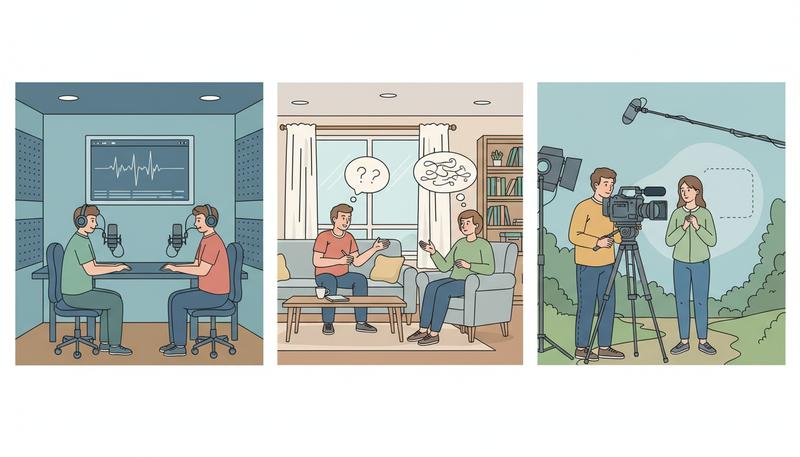
Broadcast radio and podcast. As Terry Gross has described directly, "dead air is really a scary thing" in radio. In a live or semi-live broadcast context, extended silence is genuinely problematic — it signals technical failure to listeners. For this reason, broadcast interviewers develop specific adaptations: the thinking-out-loud bridge, the restatement, the minimal verbal prompt ("right," "yes," "go on") that fills microseconds without directing the conversation. These are legitimate techniques; they serve the silence function without creating actual dead air. In a podcast recorded for later editing, the calculus is different — a long silence can simply be edited out if the subject eventually says something worth keeping, or trimmed if the subject doesn't. Many documentary-style podcast producers actively preserve significant silences in their final edits because they convey atmosphere and authenticity.
Print journalism. The print interview is the most forgiving environment for silence. Nobody is listening in real time. The recorder is running, and pauses register only in the transcript. Many experienced print journalists are the most skilled practitioners of strategic silence for precisely this reason: the format removes the social pressure that makes broadcast silence scary. You can hold silence for fifteen seconds in a print interview with no technical consequence whatsoever.
Documentary and video. Documentary context is where silence can become something more than a technique — it can become a visual element with its own expressive power. A subject sitting in silence, visibly processing, visibly deciding, makes for extraordinary footage. Some of the most memorable moments in documentary film are not answers to questions but the space before answers, the visible internal negotiation. Experienced documentary directors develop what can only be described as a relationship with on-camera silence: they know how to sit with a subject in front of a camera in a way that feels like companionship rather than interrogation, and within that companionship, silence does remarkable things.
The Non-Question Question
Adjacent to silence, and worth treating explicitly, is a set of verbal moves that function like silence in their effect: they create space and invite elaboration without specifying what should fill that space.
These are what we might call non-question questions — vocalizations that technically break the silence but preserve its essential function.
"Tell me more about that." Not a question; a permission. It says: what you just said has weight, and I want more of it, and you get to decide what more means. The absence of specificity is deliberate. You're not directing — you're opening.
"Go on." Even more minimal. Two words that say: I'm here, keep going. The subject can take this in any direction they choose, which means they take it in the direction that feels most pressing to them — often the direction that is most revealing.
"Mm-hmm." When deployed as a prompt rather than an acknowledgment, this sound says: I received what you said and it wasn't enough. The subtlety of tone matters enormously here. An "mm-hmm" that rises slightly at the end is a prompt; one that falls is a conclusion.
"What was that like?" This question appears throughout oral history practice — it pivots from event (what happened) to experience (what it felt like to be there). It invites reflection rather than report, memory rather than summary.
Repeating the last phrase. This is a technique borrowed from active listening practice: when someone says "and I just felt completely lost," you might say, softly, "completely lost" — back to them, as a mirror. It is not agreement. It is not a question. It is an invitation to go deeper into exactly that idea.
These minimal prompts share a common architecture: they are responsive (showing that you heard) without being directive (not telling the subject where to go). They function, in many ways, as audible silence — they take up just enough space to prevent dead air, while doing what silence does: clearing the path for what the subject is about to say.
Practicing the Unpracticable
Here is the uncomfortable truth about teaching silence as a skill: it is almost impossible to practice in a context where it doesn't matter, and deeply uncomfortable to practice in a context where it does.
You cannot really practice strategic silence in ordinary conversation without making the people around you feel strange. You cannot drill it in a classroom exercise the same way you can drill, say, how to frame a question, because the classroom exercise removes the social stakes that make silence hard. The difficulty of silence is not technical — it's not that you don't know how to not speak. It's that not speaking in a live, high-stakes human interaction feels like violating something fundamental about how people are supposed to behave toward each other.
The most effective practice method I have encountered involves what amounts to micro-experiments in low-stakes interview settings: peer interviews in pairs, with one person explicitly tasked with holding silence for five seconds after each answer, and both people debriefing on the experience afterward. The debrief is as valuable as the practice itself — the person who held the silence reports what they felt, and the person who was held often reports something surprising: they didn't experience the silence as cold or rude. They experienced it as being taken seriously. They felt like the interviewer was genuinely interested in what they had to say. That is not what the interviewer expected them to feel. But it is, repeatedly, what people feel.
The other practice method is intentional journaling about specific interviews you have conducted: where did you fill silence you should have held? What triggered the impulse? This builds the metacognitive awareness that makes real-time calibration possible. You cannot notice when you are rushing to fill silence in the moment unless you have spent time noticing it in retrospect.
What makes this skill worth all the difficulty of developing it is this: silence is genuinely impossible to fake. You cannot perform strategic silence without actually being present and attentive — the moment you are somewhere else in your head, the silence becomes visibly empty, and the subject senses it and closes up. To use silence effectively, you have to actually be interested. You have to actually want to hear what comes next. And when you develop the capacity to hold silence with genuine curiosity rather than staged technique, you discover that you have learned something much bigger than a tactic. You have learned a different quality of attention — the kind that people, without knowing exactly why, respond to by telling you things they haven't told anyone else.
That is, in the end, what this entire course is trying to teach: not a set of moves, but a way of being with another person that makes truth feel possible. Silence is where that philosophy becomes most visible, most pure — the interviewer who says nothing but means everything, simply by being completely, wholly, unmovably there.
Only visible to you
Sign in to take notes.