How to Build Your Own Interview Practice
Putting It Together: Building Your Own Interview Practice
We've arrived at the final piece of the puzzle — and it's not another technique. It's what you do with all of this once you're actually out in the world, alone with a recording device and another person's trust. Everything this course has argued — about curiosity, preparation, listening, silence, and ethics — only becomes real if you build it into a sustainable practice. And the truth is that building a practice isn't about accumulating more knowledge. It's about developing the reflective discipline to turn experience into genuine expertise.
Many interviewers experience a moment during their professional development where they listen back to a recording — maybe a conversation they thought went well — and hear themselves repeating a mistake they had been working to correct. Talking too much. Rescuing the silence. Asking the follow-up question before the first answer was actually finished. Steering the conversation back to your agenda right when the subject was about to say something real. It's humbling. It's also exactly what's supposed to happen. The ethical practice we discussed earlier — that commitment to treating subjects as ends in themselves, not means to your stories — this doesn't happen through good intentions alone. It requires the kind of deliberate self-awareness that lets you see the gap between what you intended and what you actually did.
The interviewers who get genuinely better over the course of a career aren't the ones who stop making mistakes. They're the ones who develop enough clarity to notice those mistakes clearly — in real time or in retrospect — and learn from them. That's what this final section is about: building the reflective infrastructure that transforms accumulated experience into craft mastery.
The performer is subtly more interested in the quality of their questions than in the answers. The questions are elegant and interesting; the listening, less so.
The under-preparer shows up with genuine curiosity and warmth but without the research depth to push past the first layer. They get pleasant conversations. They rarely get revelations.
None of these are permanent conditions. They're patterns — habits formed under the pressure of the interview situation — and habits can be changed with enough deliberate attention. The key is being honest enough to identify which ones are yours.
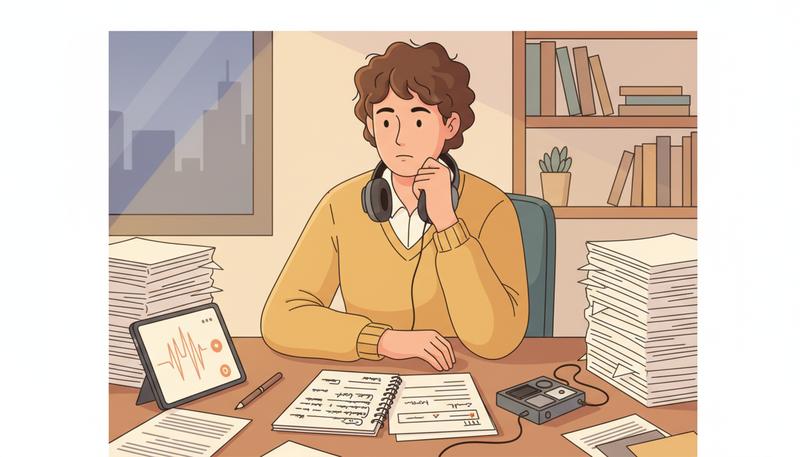
A useful exercise: listen to three recordings of yourself conducting interviews. Not for content, not for what the subject said, but for your own behavior. Track how often you speak. Track how many of your questions were truly responsive to what was just said versus pre-loaded from preparation. Track how many times a silence opened and how you responded. Track the moments when you were clearly in your head rather than in the room. This audit is uncomfortable. Do it anyway.
Designing Your Pre-Interview Ritual
Ritual sounds like it belongs in a different kind of book. But the pre-interview period — the hours before a significant conversation — is genuinely critical, and leaving it unstructured is leaving performance on the table.
Michael Barbaro has talked at length about the labor that goes into The Daily's interview preparation: thinking carefully about the arc of the conversation, what a question might look like, what possible answers might emerge, where the conversation might need to go. The point isn't to script the interview — it's to do enough thinking in advance that you can be fully present during it, rather than trying to think and listen simultaneously.
A practical pre-interview ritual has three phases:
The knowledge phase should happen well before the day of the interview — ideally days in advance. This is when you do your deep research: reading everything you can find by and about the subject, understanding the context, finding the specific details that will let you talk to this person at a level that signals genuine engagement. Peter Laufer, James Wallace Chair of Journalism at the University of Oregon, is blunt about what happens when interviewers skip this step: you end up asking "tell me about the book" — a question that signals you've done no work and forfeits any chance at substantive conversation.
The question synthesis phase happens the night before or the morning of. This is when you move from raw research notes to actual questions — not a script, but a genuine attempt to identify what you most want to understand, what the subject probably knows that you don't, and what the structure of the conversation might look like. Terry Gross describes a process of circling key passages in books, dog-earing pages, taking notes from those notes, and building a memory bank of material. The goal isn't to memorize questions; it's to have thought so carefully about the subject that you can hold the key territory in your head.
The clearing phase is the hour before. This is often neglected, but it matters enormously. You need to arrive at the interview as present as possible — not distracted by the other story you're working on, not still mentally revising your question list, not running through logistics. Different interviewers have different clearing rituals. Some re-read their notes one final time and then put them away. Some take a walk. Some have a specific physical routine — tea, a few minutes of quiet — that signals to their nervous system: we're here now, this is what we're doing. The content matters less than the intention: you are transitioning from preparation mode to presence mode.
graph TD
    A[Days Before: Deep Research] --> B[Night Before: Question Synthesis]
    B --> C[Morning Of: Review & Prioritize]
    C --> D[1 Hour Before: Clear & Arrive]
    D --> E[Minutes Before: Physical Presence]
    E --> F[The Interview Itself]
    F --> G[Immediately After: Memory Notes]
    G --> H[Days After: Full Debrief]
One practical note: your question list, however carefully constructed, is a departure document, not a flight plan. You're using it to get airborne. Where you go from there should be determined by what you find in the air.
The Post-Interview Debrief: Learning While It's Fresh
Most interviewers, when a conversation ends, have one priority: getting to the material. Transcribing, writing, editing, publishing. The interview itself recedes quickly — replaced by the artifact it produced.
This is a mistake. The interview as an experience — what happened in the room, how it felt, what you noticed, what surprised you — contains a tremendous amount of information about your practice that disappears quickly if you don't capture it.
The post-interview debrief should happen as soon as possible after the conversation ends — ideally within a few hours, definitely within twenty-four. It doesn't need to be elaborate. It needs to be honest.
Some questions worth sitting with:
What surprised me about this conversation? Surprises are diagnostically rich. If you're never surprised, you may be interviewing in a way that confirms rather than discovers. If the same things keep surprising you, that's a pattern worth examining.
Where did I lose the thread? Every long interview has moments where the connection loosens — where the subject gets a little more guarded, or you get a little less present, or the conversation drifts away from what matters. Where did that happen? What preceded it? Could you have recovered it, and did you?
What was the question I didn't ask? This is often the most revealing question. You finish a conversation and realize, walking back to the car or listening on the subway, that you never asked the thing the whole conversation was really about. Why not? Were you afraid of the answer? Did you assume you already knew? Did you run out of time because you spent too long on setup?
Where was I genuinely listening, and where was I performing listening? Active listening is a learned skill that requires ongoing practice and refinement, not a fixed ability you either have or don't. There are moments in any interview when you're truly present — genuinely absorbing what the person is saying, following it wherever it goes. And there are moments when you're going through the motions: nodding, maintaining eye contact, waiting for your moment. Knowing which parts of the interview were which is essential for knowing what to work on.
Write your debrief notes by hand if you can. There's something about the physical act of writing that encourages more honest self-assessment than typing. Don't edit yourself. You're not producing a document anyone else will read. You're having a conversation with your own practice.
Deliberate Practice: Getting Better Between Interviews
One of the most persistent myths in interviewing is that you get better by doing more interviews. Experience matters, obviously — but experience without reflection tends to reinforce your existing habits rather than change them. You get more fluent at doing what you already do.
Deliberate practice is different. It means targeting specific weaknesses, designing exercises that isolate particular skills, and paying close enough attention to your own performance that you can actually tell whether you're improving. Research on active listening confirms this — the ability to communicate effectively is not innate, and it requires ongoing practice and deliberate refinement, not just accumulated exposure.
Here are specific exercises for the three core skills this course has emphasized most seriously:
For question design: Take a profile you've read recently — a long magazine piece or documentary portrait — and write fifteen questions you would have wanted to ask. Then evaluate them: Which ones are seeking information you could have found through research? Which ones would only a thoughtful human conversation reveal? Which ones are genuinely open — inviting narrative rather than confirming your hypothesis? Do this regularly and you'll start to see patterns in your own question-generating tendencies.
A companion exercise: take a transcript of someone else's interview — a published one, ideally from an interviewer you admire — and identify every question. Categorize them. What proportion are open versus closed? How many are genuine follow-ups to the immediately preceding answer versus pre-loaded? How does the question sequence build across the conversation? You'll learn as much from dissecting a master's technique as from practicing your own.
For listening: Have a conversation with someone — a friend, a colleague, anyone — with the explicit intention of not speaking unless you're asking a genuine question in response to something they just said. No advice. No analogies to your own experience. No finishing their sentences. Just listening and asking. Most people find this nearly impossible for more than three or four minutes. The discomfort is the point — it reveals how much of what we call "conversation" is actually two people waiting for their turn.
A more demanding version: listen to an interview recording you haven't transcribed yet and try to capture, in real time, not just what the subject is saying but what they're not saying — the hesitations, the qualifications, the moments when the language gets suddenly vaguer or more formal. These are often the places where the real story lives.
For silence: This one requires a partner willing to experiment. Conduct a short practice interview — five to ten minutes — on any topic. Your only constraint: after each answer the subject gives, wait at least five seconds before asking the next question. Full seconds, counted internally. Don't fill the silence with "uh-huh" or "right" or "interesting." Just wait. The first few times you do this, it will feel unbearable. After a few sessions, you'll start to notice how often subjects fill their own silence with something far more interesting than what they said first.
Learning from Your Best and Worst Interviews
Retrospective analysis is one of the most underused tools in an interviewer's development. We tend to remember our best interviews with pride and our worst with something between embarrassment and repression. Neither response is particularly useful.
The interviews worth spending the most time on are your outliers — the conversations that went dramatically better or worse than expected. These are the ones with the most diagnostic information.
When an interview went exceptionally well, the useful questions are: Why? Not "the subject was great" or "we had chemistry" — those are descriptions, not explanations. What was your preparation like? How did you approach rapport? Were there specific moments when the conversation shifted from surface to depth, and what preceded them? What did you do that you don't always do?
Terry Gross describes following key words and phrases back into deeper territory — picking up something the subject said and asking them what they meant by it — as one of her primary techniques for moving from good to great. When you hear yourself doing this on a recording, mark it. These are the moments of craft you want to replicate.
When an interview went badly, the instinct is to move on. Resist it. Bad interviews contain some of the most important information you'll ever get about your practice. Not the surface explanation — "the subject was hostile" or "the connection kept dropping" — but the underlying one. Did your preparation fail to anticipate the subject's actual frame? Did you fail to establish enough trust before moving into difficult territory? Did you push when you should have waited? Did you miss a signal that the subject was about to say something important?
Keep a journal of these retrospective analyses. Not a diary — a practice log. After six months, patterns will emerge that you couldn't have seen in any individual debrief.
Building a Subject-Centered Philosophy
Everything this course has argued — from the opening claim that the interview is a relationship compressed into time, through all the specific techniques and ethics and craft considerations — points toward a single organizing principle: the interview is not about you.
This sounds obvious. In practice, it's genuinely difficult.
The gravitational pull toward the interviewer's agenda is strong and mostly unconscious. You have things you need to know. You have a story to tell. You have questions you've spent hours crafting. And the subject is right there, capable of answering them — if you can just keep the conversation on track.
But the interviewers who consistently get people to say things they wouldn't normally say are the ones who have learned to subordinate their agenda to the subject's experience. Not abandon it — subordinate it. There's a difference. You still have a job to do. But you do it in a way that starts from genuine curiosity about who this person is and what they actually know, rather than from an eagerness to confirm the shape of the story you've already decided to tell.
Peter Laufer puts it this way: you're trying to develop a relationship as fast as you can, so that you move past question-and-answer into actual conversation. And from that conversation, you learn about the person — not just the dry facts, but the texture of their experience, the things they've thought about, the things they're still working out. "The reveal is greater," he says, almost as an aside. But that reveal is everything.
Being subject-centered doesn't mean being passive. It doesn't mean following wherever the subject wants to go, allowing avoidance and deflection and spin to go unchallenged. The most subject-centered interviewers are often the most persistent — because they genuinely want to understand, and they don't let the subject off the hook when the answer hasn't come yet. The difference is the motivation. You're pushing because you're curious, not because you're competing.

The Long Game: How Reputation Compounds
This course has mostly focused on the architecture of individual interviews. But there's another dimension of the craft that only becomes visible over time: the way reputation accumulates, and how it changes everything.
Experienced interviewers know something that beginners don't quite believe: the quality of your previous conversations determines the quality of your future ones. When you have a track record of treating subjects with genuine respect — publishing what they actually said rather than a distorted version of it, calling them when the record needs to be corrected, handling difficult material with care — people talk about it. Subjects recommend you to other subjects. Publicists tell their clients you're "fair." People who would normally be wary of journalists or documentary makers agree to talk to you because someone they trust says you're worth talking to.
This is not a soft benefit. It's a compound advantage that grows substantially over a career.
The interviewers known for depth and fairness — who have been doing this work for decades and whose subject lists read like an alternative history of the culture — didn't get there by being more talented at technique than everyone else. They got there by doing the work with integrity, consistently, for long enough that the work spoke for itself. By the time Terry Gross had been doing Fresh Air for twenty years, people wanted to talk to her not just because she had an audience but because they knew she'd actually read the book. That's a reputation built one conversation at a time.
The corollary is equally true. The interviewers who develop a reputation for gotcha journalism, for misrepresenting what subjects said, for caring more about the story they wanted to tell than the truth of what they found — those reputations also compound. Sources dry up. People decline. The aggressive approach that looked like a competitive advantage in year two starts looking like a liability in year ten, because you've burned the relationships that would have led to the best stories.
There's a patience required here that is genuinely hard in a media environment obsessed with immediacy and attention. But the interviewers who are still doing exceptional work at the end of long careers understood, somewhere along the way, that they were playing a different game than the one the media environment seemed to be playing.
What the Best Interviewers Share: The Common Thread
This course has drawn from oral historians, investigative journalists, documentary filmmakers, broadcast interviewers, and podcast hosts. These are different crafts with different constraints, different ethical frameworks, different audiences. But the practitioners who do this work at the highest level across all these forms share something that goes beyond technique.
They are genuinely interested in people. Not in a performed or professional way — actually interested. Curious about how people came to believe what they believe, experience what they've experienced, make the choices they've made. This sounds like a personality trait, not a learnable skill. But it's more accurate to say it's a discipline — a commitment to approaching each conversation as if it might contain something you don't already know, which requires setting aside the assumption that you do.
They are disciplined preparers who use their preparation to be more present, not less. The prep doesn't give them a script; it gives them enough confidence in the territory that they can follow unexpected paths without getting lost. Michael Barbaro has been explicit about this: the apparent spontaneity of a great interview often reflects enormous upstream labor. The naturalness is earned.
They respect the people they interview — even, and especially, the people they're holding accountable. This respect doesn't mean softness. It means treating subjects as intelligent adults who deserve a genuine interlocutor, not a trap or an audience.
They're comfortable with not knowing. The most dangerous moment in any interview is when the interviewer thinks they understand what's happening. Understanding closes you off to surprise. The best interviewers maintain what the Zen tradition calls "beginner's mind" — a willingness to be wrong about what the conversation is, even as it's happening.
And they've developed, over time, what you might call a tolerance for the unresolved. Real conversations are messy. People contradict themselves. They don't know what they think. The story doesn't wrap up the way you expected. Interviewers who need resolution — who need the conversation to produce the thing they came for — often reach for it in ways that distort it. The interviewers who produce the most honest work have learned to be faithful to complexity.
A Final Word on the Gift
There is something that every section of this course has circled without quite landing on, and this seems like the right moment to say it directly.
When someone agrees to be interviewed — really interviewed, not a brief comment on the record but a sustained conversation about their experience, their work, their thinking, their life — they are extending an act of trust. They are giving you their time, which is irreplaceable. They are giving you access to their inner world, which is not something people do casually. And they are trusting that you will do something honest with what they share.
This is true of the celebrity who has done a thousand press tours and thinks they have nothing left to reveal. It's true of the politician who has learned to say everything without saying anything. And it's especially true of the ordinary people who have never been interviewed before and don't quite know what they're agreeing to — the oral history subject describing their immigration to a researcher, the survivor telling their story to a documentary filmmaker, the family member who sat down to talk because they thought it might help somebody understand.
The interview is not an extraction. It is a relationship — brief, compressed, sometimes strange, occasionally profound — and like all relationships it carries obligations that don't end when the recorder goes off. The obligation to tell the truth about what you found. The obligation to handle what you were given with care. The obligation to remember that the person on the other side of the table is not a source or a subject or a character in your story, but a human being who trusted you enough to talk.
The interviewers who carry this understanding into every conversation — not as a performance of sensitivity but as a genuine ethical commitment — are the ones who get told things. Not because they've mastered some psychological trick for unlocking people, but because people can feel the difference between being used and being heard.
That is the core of what this course has been arguing. The interview is an act of attention. The best interviewers are the ones who have learned to make that attention real — disciplined and curious and genuinely directed outward, at the world and the people in it, rather than at their own reflection.
Go do your next interview. Go do it better than the last one. And after it's done, sit down and figure out what it taught you.
That's the practice. There's nothing more complicated than that, and nothing harder.
Only visible to you
Sign in to take notes.