What is an Interview: Common Mistakes
What an Interview Actually Is (And What Most People Get Wrong)
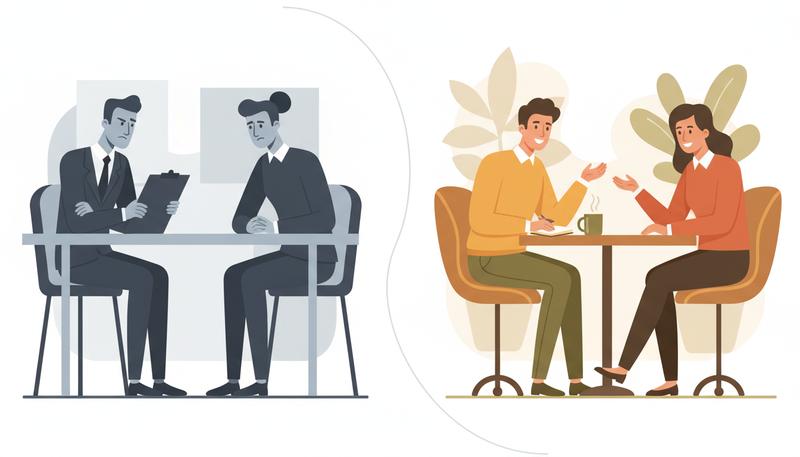
Most people who haven't spent much time thinking about interviewing — and that includes plenty of journalists early in their careers — operate on what I'll call the extraction model. The logic is clean and seductive: you have information you need, the subject has information, and the interview is the mechanism that transfers it from them to you. Better questions unlock better answers. More preparation gives you more control. The interviewer's job is essentially technical — find the right key for the lock.
But here's where the extraction model falls apart, and why it fails so reliably: people are not locks. When a subject senses — whether consciously or not — that they're being processed, something shuts down. This isn't pathological. It's just how humans work. It's the same instinct that makes us say "fine" when someone we don't trust asks how we're doing. We give the minimum required response and withhold everything that actually matters.
Picture this scene, because you've probably witnessed something like it: a young journalist sits across from a local politician. She's prepared, eager, notebook ready, twelve questions written out in order. He's got his talking points memorized, his communications director hovering nearby, decades of practice turning non-answers into something that sounds like answers. She asks question one; he delivers talking point three. By question six, she's rattled and increasingly aware she's not getting what she came for. What went wrong? The easy answer is that he was evasive — which is true but not useful. The harder answer is that she was conducting the wrong kind of conversation entirely. One built on extraction rather than on anything that might actually be called a relationship.
And here's the thing that really breaks the extraction model: it's also less efficient than it claims to be. The journalist with twelve scripted questions often comes away with twelve partial answers, each one carefully curated for presentation rather than truth. The journalist who abandons the script after question three, because something surprising just happened, sometimes comes away with the whole story.
There's a control paradox at the heart of interviewing, and every experienced interviewer eventually crashes into it. The more you try to control the interview, the less you actually get. The more tightly you grip your agenda, the more you foreclose the unexpected turns that tend to produce the most valuable material. Max Linsky, who interviews professional interviewers on the Longform Podcast, puts it bluntly: "Do your research and write down tons and tons of questions. Only bring 15-20 questions to the interview. Only ask 10 of them. If you need to ask all 20, you're not having a conversation."
That last sentence is everything. If you're asking all your questions, you're executing a questionnaire, not conducting an interview.
The Relationship Model
The alternative is what I'll call the relationship model, and it starts from a completely different place. Instead of asking what do I need from this person?, it asks who is this person, and what would they say if they actually felt safe to say it?
The relationship model doesn't mean being soft, or pretending to be their friend, or letting subjects off the hook. It doesn't mean abandoning your agenda. It means understanding that the real stuff — the unscripted stuff, the things people reveal rather than report — flows through relationship. And relationship, even a compressed, temporary one that lasts forty minutes in a coffee shop, requires something genuinely present from the interviewer.
It requires actual curiosity.
Not performed curiosity. Not the professional habit of leaning forward and nodding while you're mentally three questions ahead. Real interest in who this person is and what their life contains. This sounds like a soft skill, like something nice to have. It's the opposite. It's the central discipline of the craft, and it's surprisingly hard to sustain across hundreds of interviews — many with people you didn't choose to spend time with and wouldn't in ordinary life.
The reveal is greater. That phrase should hang over every interviewer's desk.
A Taxonomy of Interviews
Part of what makes the relationship model work is recognizing that different interviews demand different postures — not different philosophies, but different applications of the same underlying approach.
Three broad categories exist, and confusing them with each other is one of the most common mistakes working journalists make.
Informational interviews are about gathering knowledge, background, expertise, or facts. You're talking to the water-quality scientist, the historian who specializes in Reconstruction, the software engineer who can explain what the code actually does. The subject may have no emotional stake in the conversation; they're there to share their knowledge. The relationship model still applies here, but it looks different: what you're building is intellectual rapport — signaling that you've actually done your homework, that you can engage at a real level, that you won't waste their time or misrepresent what they know. Jodi Kantor of the New York Times has observed that "To ask a really high-yielding question, you need to have done your homework." With experts, homework is the primary trust signal.
Emotional or narrative interviews are the core of oral history, personal profiles, documentary filmmaking, and literary journalism. You're asking someone to share their experience — a loss, a journey, a transformation, a memory they've carried. These require the most patient application of the relationship model because you're asking people to do something genuinely vulnerable: hand you their interior life and trust you not to damage it. The establishment of emotional safety here isn't optional. The interviewer who pushes to the "important" questions before that safety exists will get a polished surface. That's all they'll get.
Accountability interviews are the ones that make people nervous about becoming journalists in the first place. You're confronting someone with their own contradictions, their failures, their alleged wrongdoing. The subject has strong incentives to manage, deflect, and evade. You have an obligation to push. This is where the extraction model seduces you most powerfully — because you do have specific information needs, specific discrepancies to put on the record — and where it most spectacularly fails. The journalist who arrives as an adversary gets stonewalled. The journalist who arrives genuinely trying to understand what actually happened often gets something the adversary approach never does.
graph TD
    A[The Interview] --> B[Informational]
    A --> C[Emotional / Narrative]
    A --> D[Accountability]
    B --> E[Build intellectual rapport\nDemonstrate preparation\nAsk at the right level]
    C --> F[Build emotional safety\nMove slowly\nHold space for complexity]
    D --> G[Stay curious, not combative\nPrepare the evidence\nAsk what actually happened]
None of these types is pure. A profile of a public official who's done something questionable is both narrative and accountability. An oral history interview with a scientist contains both informational and emotional material. Knowing which mode you're primarily in — and when you're shifting — is one of the subtler skills this course will develop.
Why Conversations Are Not Interviews (And Why the Best Interviews Feel Like Them)
Here's a paradox good interviewers have to hold simultaneously: conversations and interviews are fundamentally different, and yet the best interviews feel like conversations.
A conversation is mutual. Both parties have roughly equal standing, roughly equal license to steer where things go. There's no agenda beyond the exchange itself. You can stop when you feel like it, drift wherever the talk takes you, reveal as much or as little as you want.
An interview is asymmetrical. The interviewer has an agenda. The interviewer controls — or attempts to control — the arc. The subject is, at some level, performing for a purpose beyond the moment: their words may be published, broadcast, archived, used as evidence. The power dynamic is real, even in the most collegial interviews.
And the moment a subject becomes conscious of this asymmetry as something to manage against — the moment the interview feels like an interview — you lose access to what you were actually after. The subject shifts from speaking to presenting. From remembering to positioning. From feeling to curating.
The skill is creating the experience of genuine conversation within the structure of a purposeful, agenda-driven exchange. It requires the interviewer to be genuinely present — not performing attention while mentally flipping to the next question, but actually there, actually interested, actually moved by what's being said. Subjects can tell the difference. It may be the single most important thing here, and it's the hardest to fake indefinitely, which is why the interviewers who do this consistently tend to be people who find human beings genuinely interesting.
This also means that real preparation — which the next section covers at length — serves the relationship model, not the extraction model. You don't prepare so you can execute your questions. You prepare so you can set your questions aside and actually hear what you're being told.
The Interviewer's Fundamental Job
If you had to distill this whole enterprise into a single sentence, here's the best I've found: the interviewer's job is to create conditions where truth becomes easier to say than to withhold.
Notice what that implies. It doesn't say force the truth out. It doesn't say trick them into revealing things. It doesn't say be so clever they can't avoid answering. It says: arrange things so that saying what's real is the path of least resistance.
Sometimes those conditions are about safety — the subject needs to believe their story will be handled with care. Sometimes they're about permission — the subject needs someone to signal that it's okay to say the complicated, unsanctioned, contradictory thing. Sometimes they're about timing — the right question at the wrong moment produces nothing; the same question at the right moment produces everything. Sometimes they're about your own stillness — the subject needs you to stop talking long enough for them to gather what they actually want to say.
There are many techniques in this course. All of them serve this single underlying condition.
The Traditions This Course Draws From
Interviewing as a practiced craft has developed independently across several quite different professional worlds, and each has contributed something the others tend to miss.
Investigative journalism gave us the structure of accountability: the insight that interviews are sometimes adversarial by necessity, that the interviewer has an obligation to press, that being polite is not the same as being honest, and that a subject's discomfort isn't automatically a sign you've overstepped.
Oral history gave us the opposite wisdom: that the most powerful interviews aren't the ones that press hardest, but the ones that listen deepest. The oral history tradition, codified by practitioners at the Oral History Association and beyond, rests on a simple truth — every human life contains irreplaceable testimony — and the interviewer's job is to step aside and let that testimony emerge. The oral historian is, in some sense, the most patient interviewer alive.
Documentary filmmaking gave us an understanding of the physical and psychological context of the interview — what the presence of a camera does to a subject, how location and setup shape what people are willing to say, and how the best documentary interviewers (think Errol Morris, think Frederick Wiseman) construct situations where the camera becomes invisible and the subject forgets they're performing.
Audio journalism — public radio, podcasting, the long-form interview show — gave us perhaps the most sophisticated understanding of silence, pacing, and the musicality of conversation. Audio producers listen differently because in audio, a hesitation is content. A sob is a story element. The silence before a difficult answer is something your listener actually hears, in a way they don't with printed words.
This course draws from all these traditions because none alone is sufficient. The investigative journalist who has never sat with the patience of an oral historian will blow past the most important moments. The oral historian who has never internalized accountability will let powerful people off the hook. The print journalist who hasn't thought about audio's understanding of pacing will miss the most revealing moments in her transcripts, buried in the pauses she glossed over.
graph LR
    A[Investigative Journalism] --> E[A Unified\nInterview Philosophy]
    B[Oral History] --> E
    C[Documentary Film] --> E
    D[Audio Journalism] --> E
    E --> F[Genuine curiosity\nStrategic preparation\nDisciplined listening]
Who This Course Is For
I wrote this for people who conduct interviews as part of their work — journalists of all kinds, obviously, but also documentary filmmakers, oral historians, podcast hosts, researchers, and anyone who sits down with a human being and tries to understand something true about them or their experience.
I also wrote it for people who interview occasionally rather than constantly — the magazine editor who does one profile a year, the nonprofit communicator whose job occasionally demands a recorded conversation, the academic who needs to conduct fieldwork interviews. The principles don't shift with frequency. If anything, the occasional interviewer needs the framework more, because she can't rely on accumulated muscle memory to carry her through.
I did not write it for people whose interest in interviewing is primarily tactical — how to "win" an interview, how to dominate a subject, how to extract what you need and move on. Those books exist. They are not very good, and they produce exactly what you'd expect: defended, adversarial, thin.
A word about how to move through what follows. This course is organized the way an interview itself is organized: from preparation through execution through the specialized contexts where that execution happens differently. The early sections lay philosophical and practical groundwork. The middle sections cover specific skills in depth. The later sections deal with the contexts — oral history, accountability, documentary, broadcast — where those skills get applied in distinct ways. The final section is about building a practice, which is the only word I know for the ongoing, imperfect, deeply personal discipline of doing this work over time.
You can read it straight through. You can skip to what you need. But if there's one section I'd ask you not to skip, it's this one — not because of anything I've said, but because the questions it raises will keep resurfacing. What do you actually want from an interview? What do you owe the person in the room with you? What does it mean to listen? Those questions don't have fixed answers. They're the questions that distinguish the interviewers who get people to tell the truth from the ones who just get people to talk.
The difference is everything.
Only visible to you
Sign in to take notes.