Ethics of interviewing power consent and subject responsibilities
We've spent the last section learning how to reach someone — how to use the camera, the microphone, the warm-up, the b-roll conversation as tools for restoring human contact in a technically optimized environment. But reaching someone is only half the story. Once you reach them, once you create those conditions where a person can tell you something true, you've entered a relationship that carries obligations beyond craft. You've made someone vulnerable. You've built trust. And that trust, once established, is not yours to spend as carelessly as you might think.
There's a scene I return to often when I think about interviewing ethics. A journalist I know — experienced, well-meaning, good at her job — spent three hours with a woman whose son had been killed by police. The mother talked. She talked about her son's childhood, his laugh, his habit of calling her every Sunday. She talked about the night she got the call. She talked about things she had never told anyone. The story ran. It was well-written. It won a regional award. The journalist sent the mother a copy of the article. The mother called her, crying. Not because anything was factually wrong. Not because she'd been misquoted. But because she hadn't understood, not really, that her private grief was going to be published for strangers to read over their morning coffee. She'd understood it intellectually — she knew she was talking to a journalist — but she hadn't understood it emotionally, in her body, the way you understand a thing when it becomes real. "I thought you were just listening," she said.
That sentence has stuck with me. I thought you were just listening. It captures something true and uncomfortable about what we do when we interview people: we make them feel heard, and then we use what they say. The ethics of the interview live in that gap — between the warmth of the exchange and the coldness of the product. Most craft guides treat ethics as a checklist appended to the end: get consent, don't make promises you can't keep, be fair. That's not wrong, but it misses the deeper point. Ethics isn't a constraint on good interviewing. It's constitutive of it. The most effective interviewers are also, almost always, the most ethically thoughtful ones — because trust, which is the foundation of every good interview, is built on a foundation of genuine respect for the person sitting across from you. When that respect is real, subjects sense it. When it's performed, they sense that too. This section is about developing that respect into a set of practices that are both principled and pragmatic.
The Asymmetry of Power
Here's what most people don't talk about when they talk about interviewing: you are not equals in that room, no matter how much you try to set that aside.
The person you're interviewing has agreed to be vulnerable with you. They've agreed to have their words recorded, stored, shaped, and eventually shared with an audience they don't control. Meanwhile, you hold all the structural power: you know what happens next, you control the narrative frame, you get to decide what parts of their story matter. Most of the time, this asymmetry doesn't feel intentional or malicious. But that doesn't make it any less real. It's the architecture of the situation, and it operates whether you acknowledge it or not.
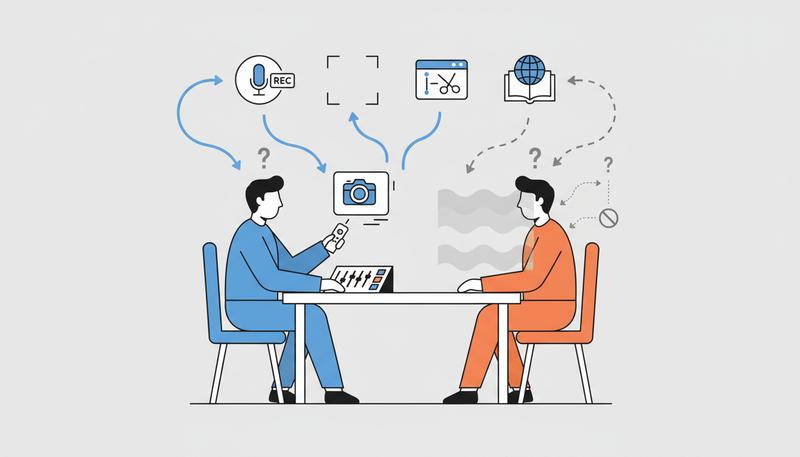
The power imbalance operates on several levels at once:
Informational asymmetry. You come to the conversation knowing what's already out there about this person or topic. You may have read documents they haven't seen. You may know what other sources have said about them. You may have information that directly contradicts what they're about to tell you. In investigative work, this asymmetry is deliberate and strategic — you're often holding back what you know until you see how someone responds. In softer contexts, it can still catch subjects off guard in ways that feel unfair.
Contextual control. You decide which comments count as "on background" and which are "on record." You choose the order of your questions, which shapes how someone thinks through their answers. You decide which quotes survive the editing process and which ones don't. The subject can only react to the frame you've already set.
Temporal advantage. You have the luxury of thinking about what was said — reviewing recordings, reading transcripts, letting things marinate overnight. The subject speaks in real time, in the moment, under the pressure of your presence, and then watches their unrehearsed, spontaneous words become permanent.
Reputational leverage. This one's subtle but important. Especially with people unused to media attention — people in crisis, people who've never been in the news before, people from communities that don't often get to tell their own stories — being interviewed by you carries weight. You're the gatekeeper to visibility. That power, even when unspoken, can shape what people feel comfortable saying.
None of this means the interview is inherently exploitative. But it means the interviewer has obligations that go way beyond asking good questions. The Oral History Association's best practices put it directly: oral historians must recognize that narrators are not isolated individuals but members of communities who may have "historically complex relationships with researchers." The same applies in journalism, podcasting, and documentary work. The power asymmetry is structural, baked into the form itself, and that calls for deliberate responses.
Informed Consent: More Than Signing a Form
The standard institutional answer to the power problem is informed consent. Get the subject to sign off on the interview, have them acknowledge they know what they're doing, and you're covered legally. This is sound from a liability perspective. From an ethics perspective, it's the bare minimum, and sometimes not even that.
Real informed consent — the kind that actually respects the person you're talking to — requires that several things happen before the recording even starts:
They understand what you're actually working on. Not some vague description ("I'm doing a story about housing") but specific enough that they can make a real decision. If you're investigating a developer's practices and a tenant's experience is going to be part of that story, they need to know that upfront. If the oral history they're contributing to will be archived somewhere and accessible to future researchers, they need to know that too. Not buried in a consent form — explained, in conversation.
They know how this material will be used. Will it be published? Where? In what format? Will audio be broadcast or just quoted in text? Could it be packaged into a documentary years from now? Could it be presented differently than you're imagining right now? The Oral History Association suggests discussing "the plans for preservation and access, the potential uses of the oral history" as part of informed consent — not as fine print, but as a genuine conversation.
They understand what control they will and won't have. This is where journalists often get uncomfortable, because the honest answer is: not much. Subjects don't get to approve the story before it runs. They don't get to retract quotes they later regret. In journalism, editorial control stays with the journalist and the publication, full stop. Being straight about this upfront — even when it makes people hesitant — is more ethical than letting them labor under the misconception that they have more control than they do.
Ground rules are explicit and agreed to. What does "off the record" actually mean in this conversation? What does "on background" mean? What happens if you learn something that contradicts what they told you? These things need saying out loud, in plain language, before anything gets recorded.
The OHA guidelines recommend that oral historians offer narrators an opportunity to review the material before it becomes public. Journalism operates under different constraints — prior approval would give subjects veto power over accountability reporting, which defeats the purpose — but the underlying impulse is sound: give people as much transparency and agency as the format allows.
Here's what actually works in practice: consent is not a moment, it's a process. Someone may agree to an interview one month and feel completely different about it after the story runs. They may consent to discussing one thing and feel blindsided when their words end up illustrating something adjacent. The relationship doesn't end when the interview does. Staying in touch, following up to clarify things, being reachable when the person has questions — that's what treating consent as genuine rather than transactional looks like.
graph TD
    A[Initial Contact] --> B[Describe Project Specifically]
    B --> C[Explain How Material Will Be Used]
    C --> D[Clarify Ground Rules: On/Off Record]
    D --> E[Subject Makes Informed Decision]
    E --> F[Interview Proceeds]
    F --> G[Post-Interview: Fact-Check, Clarify]
    G --> H[Publication]
    H --> I[Follow-Up Communication]
On the Record, Off the Record, On Background: What These Actually Mean
The vocabulary of source agreements gets used constantly and misunderstood constantly, even by people who've been doing this for years. Let's be precise about what each one means, because the differences matter.
On the record means the source's words can be quoted directly and attributed to them by name. This is the default setting. If no agreement has been explicitly made, treat everything as on the record. This is important: the source doesn't get to decide retroactively that something was off the record if they didn't say so beforehand.
Off the record means the information cannot be published at all, in any form, under any circumstances. Not quoted, not paraphrased, not used to inform your reporting. Nothing. This is a strong protection. Many people think they're asking for this when they actually mean something weaker. If someone tells you something off the record, you literally cannot use it — though you can, theoretically, try to get the same information from another source who is on the record.
On background means you can use the information but cannot identify the source by name. You can write "according to someone familiar with the matter" or "a senior administration official said" — the information is in the story, the source is not. Some journalists use "on background" and "not for attribution" interchangeably; others draw subtle distinctions between them. The ethical move is to clarify with your source which they mean and what that actually protects.
Here's the crucial part: these agreements must be established before the information is shared, not after. A source cannot tell you something and then say "oh, by the way, that was off the record." Technically, they have no such power. In practice, many journalists honor this as a courtesy — because good relationships matter more than winning a single point — but ethically you're under no obligation. The standard is that off-the-record agreements get negotiated first, information shared second.
What happens when you agree to keep something off the record? You've made a promise, and your word is everything in this business. It's your professional reputation, boiled down. Breaking an off-the-record agreement doesn't just violate someone's trust; it marks you as someone who can't be trusted, and that reputation travels fast through any community where sources talk to each other. A journalist who burns sources doesn't get them for long.
The genuinely difficult question is what to do when someone tells you something off the record that seems genuinely important — information the public needs, information that could prevent harm. This is one of the real ethical tensions in journalism, and there's no clean resolution. The starting point is: you made a promise, and breaking promises has consequences beyond this single story. If the information is important enough, the ethical path is to work to get it on the record another way — not to use the off-the-record version because you've decided the story justifies it.
The Gap Between What Subjects Expect and What Gets Published
This scenario happens all the time in newsrooms: someone agrees to be interviewed, talks openly, and then reads the published story and feels ambushed. The facts are all correct. The quotes are accurate. But the framing, the context, the way their words are being used to make a point — it's nothing like what they imagined while they were talking.
This gap between expectation and reality is one of the most common and underacknowledged sources of genuine harm in journalism.
Managing expectations without promising things you can't deliver is genuinely tricky. You can't promise someone the story will be positive or that they'll come across sympathetically or that their quote will lead the piece. But you can — and absolutely should — give them a realistic sense of what the story is about, what role their contribution plays, and what to expect when it's published.
A few practical approaches that work:
Tell people what the story isn't. If someone's hoping the story will vindicate them and you know it won't, say so. "I want to be straight with you — this story is going to look at both sides of this dispute, and your former employer has given us documentation that we're going to have to address." It's uncomfortable. It's also fair.
Describe your publication and audience. If the story is going to run on the front page, say that. If it's a short item that will get buried in the B section, they should know that too. These details change how people feel about being part of the story.
Explain who else you're talking to. Not in a way that betrays confidential sources, but in a way that gives subjects realistic context. "I've spoken to a dozen people who worked with you," or "I've interviewed five other people in this situation" — that's information they deserve to have as they decide whether to participate.
Stay connected between interview and publication. If the story takes significant turns — if new documents emerge, if another source contradicts something the first person said — they deserve to know and to respond. This isn't just about fairness; it's about accuracy. Their response to new information might be essential to getting the story right.
One thing you cannot honestly do: tell someone the story will be fair and then write something unfair. But fairness doesn't mean the he-said-she-said balance trap. It means representing their position accurately even if you're ultimately critical of it, giving them genuine opportunity to respond to claims made against them, and not selectively editing quotes in ways that distort what they meant.
Interviewing People in Crisis and Grief
Trauma-informed practice is becoming standard language in journalism training, and it should be. When you interview someone who is acutely grieving — a parent hours after losing a child, a survivor in the immediate aftermath of violence, someone in shock from fresh trauma — you're not operating in normal interview conditions, and the standard interview ethics are insufficient.
The foundational principle is simple: the person's wellbeing comes before the story. Full stop.
This should be obvious. In practice, under deadline pressure, with a competitive story on the line, it is not always practiced. A few concrete things this actually means:
Slow down. People in crisis often agree to interviews they later deeply regret, not because anyone pressured them but because shock and grief impair decision-making. If someone has just received devastating news, consider whether right now is actually the right time to interview them. Sometimes it isn't. The story can wait a day. The person cannot un-talk what they've already said.
Use your real title and purpose. Don't soften your role so much that subjects don't realize they're talking to a journalist. Some journalists in competitive situations deliberately let grieving subjects believe they're offering more emotional support than journalistic interest. That's exploitative, full stop.
Know when to stop. If someone becomes visibly distressed, if they're asking to stop and you're using your warmth and rapport to keep them talking, if they seem confused about what's happening — stop. You can come back. You can find another angle. The story will still be there.
Know what support exists and share it. If your reporting regularly involves people in crisis, know what local mental health services, victim advocates, or crisis counselors are available. Being prepared to connect someone with actual help isn't about becoming a therapist; it's about basic human decency.
The Dart Center for Journalism and Trauma has developed extensive resources on trauma-informed interviewing — everything from how to approach survivors to how to protect your own mental health when covering difficult material. Their framework is worth knowing even if you only occasionally find yourself interviewing people in difficult circumstances.
What does trauma-informed practice actually look like in the room? It means explaining things slowly and checking for understanding. It means asking for consent at multiple points, not just once at the beginning. It means being willing to answer the subject's questions about what happens next. It means watching for signs of distress and responding to them as a human being first, a journalist second. And it means — this is the hard one — sometimes deciding that the story you could get isn't worth what getting it would cost the person you're talking to.
The Oral History Narrator: Different Relationship, Different Obligations
In the previous section we discussed oral history as a form and method. Here I want to address what makes oral history ethically distinct.
When someone sits down with an oral historian and gives their life story — the kind of extended, reflective account that might span multiple sessions and cover decades of lived experience — they're doing something profoundly vulnerable. They're entrusting you with their memory, their self-understanding, their account of who they are and what they've experienced. The relationship this creates is fundamentally different from a news interview. It's more sustained, more intimate, and it comes with heavier obligations.
The Oral History Association's best practices recognize this explicitly. They call for narrators to be given the opportunity, when possible, to review the oral history before it becomes public. They call for clear communication about what happens to the recording after the interview ends — because when you archive an oral history, you're not just publishing it once. You're making it potentially accessible to researchers and public users decades from now. You're creating a document that may outlive the person who gave it to you.
This temporal dimension changes everything about the ethics. When someone gives you their memories for an archive, they're probably thinking about what those memories mean right now. They may not be thinking about how researchers fifty years from now — in a context neither of you can predict — might interpret or use what they've said. Good oral history practice involves helping narrators think about this dimension, not in a way that frightens them out of participating, but in a way that helps them make a genuinely informed choice about what they're leaving behind.
There's also the messier question of what to do when a narrator, in the course of telling their story, reveals something that implicates other people. They might describe abuse they suffered at someone's hands, someone still living. They might reveal information with legal implications. They might, simply, say things that will hurt family members who eventually read the transcript. These situations require careful judgment. The narrator's story is theirs to tell, absolutely, but oral historians also have some responsibility to people whose stories those are — especially when those people have had no chance to respond.
The most important thing an oral historian can do with vulnerable narrators is make the agreement real, not just formal. Walk through what will happen with the recording. Discuss specifically who might access it. Talk about what the narrator wants to communicate and why, and make sure the process actually serves those goals, not just your research agenda.
When You Record What Someone Didn't Mean to Reveal
Every interviewer who has worked long enough has had this moment: someone says something they clearly didn't intend to say. It slips out in the middle of a story about something else. It comes in a moment of emotional loosening. The conversation moves forward, but you know what you heard.
What do you do with that?
There's no universal answer because context matters enormously. But here's a framework for thinking it through.
First: Did the subject understand they were being recorded and that anything they said could be published? If the answer is yes, then the basic rule is you're not obligated to protect them from themselves. People are responsible for what they say to journalists. If a CEO accidentally reveals something damaging about their company while talking about something else, that's still what they said.
Second: How experienced is this person with being interviewed? Is this someone used to media, someone who knows the stakes and how to manage themselves? Or is this a grieving parent, someone giving their first interview ever, a young person who doesn't fully grasp the permanence of recorded words? The vulnerability of the subject changes what ethical practice demands. The seasoned executive who lets something slip has less claim on your protection than the community member who didn't fully understand what they were walking into.
Third: Does publishing what they revealed serve a genuine public interest, or is it just interesting? This is the hardest call. A lot of things that people inadvertently reveal are interesting without being important. A public figure's strained relationship with their sibling might be fascinating, but if it has nothing to do with their public role, publishing it because it slipped out feels more like exploitation than journalism.
Fourth: Could publishing this cause harm disproportionate to any legitimate public interest? This becomes especially relevant when subjects accidentally reveal their own stigmatized experiences — mental health struggles, sexual history, substance use — things they clearly didn't intend to share publicly and that revealing could genuinely damage their lives.
The ethical instinct to develop here is not "can I use this?" but "should I use this?" The first question has legal and contractual answers. The second has a moral one.
Interviewing Across Power Gradients
The ethics of interviewing a senator are not the same as the ethics of interviewing a refugee. This should be obvious, but it often gets flattened into a single framework of "be fair to your subjects," which doesn't actually capture what matters.
When your subject is powerful — a politician, an executive, an institution's spokesperson — they have resources. Media training. Communications staff. Lawyers. Experience being interviewed. They know how to protect themselves and their interests. In these interviews, your primary obligations are accuracy and fairness — represent their positions correctly, give them a real chance to respond to criticism, don't distort their words.
You don't, however, owe powerful subjects the kind of protection you owe vulnerable ones. If a governor says something that damages their interests, the fact that they didn't mean to say it doesn't obligate you to suppress it. Power comes with visibility and scrutiny. That's not cruelty; it's accountability.
When your subject is vulnerable — a low-income tenant, a crime victim, an undocumented immigrant, a child — the obligations shift. These subjects often don't understand the context as well. They may not have anyone advising them on their interests. They may need something from you — visibility for their cause, simply being heard — that affects their ability to give fully free consent. They may face real consequences if certain information is published: job loss, family conflict, even physical danger.
IRE's guidance on investigative interviews focuses heavily on the accountability dimension. But the flip side of accountability journalism is this: when you're investigating powerful people and institutions, you often rely on vulnerable people — workers, witnesses, victims — to tell you what's actually happening. What you owe those vulnerable sources is not just gratitude; it's protection. Think carefully about what publishing their names could cost them. Offer anonymity when it's warranted. Make sure they understand the actual risks before they decide to go on the record.
The CJR's coverage of interview craft emphasizes preparation as foundational to good interviewing — and that preparation, in an ethical context, includes preparing to protect your sources. Know what risks exist before you put a vulnerable person on the record.
graph LR
    A[Subject Power Level] --> B{High Power: Officials, Executives}
    A --> C{Low Power: Victims, Witnesses, Everyday People}
    B --> D[Obligations: Accuracy, Fairness, Right of Response]
    C --> E[Obligations: Explanation, Protection, Ongoing Consent, Risk Assessment]
    D --> F[Accountability is the Priority]
    E --> G[Wellbeing is the Priority]
The Publication Moment: What You Owe Subjects After the Interview
The interview ends. Weeks pass. The story publishes. What are your obligations in that space between?
Verify your quotes. This sounds basic, but transcription errors happen, quotes get garbled in the move from audio to text to edit. Before publishing a direct quote, it's worth going back to the actual recording or transcript to make sure you've got it right. This isn't the same as giving subjects approval; it's just basic journalistic accuracy.
Clarify when something seems factually off. If a subject told you something that, now that you've done more reporting, appears to be factually incorrect, go back to them before you publish. Not to let them change their answer to something more favorable, but to give them a chance to explain or correct a date, a name, a number that seems wrong. There's a difference between editing a quote to make it sound better (wrong) and checking whether a fact is actually right (necessary).
Loop back when major developments happen. If your story takes significant turns after you interviewed someone — if new documents emerge that directly concern them, if another source makes specific allegations against them — they should know about it and have a chance to respond before publication. This is both ethically required and practically important: their response might change your story for the better.
Read the story from their perspective. Before you publish, sit with the story from the perspective of each significant subject and honestly ask yourself: have I represented this person fairly? Not generously — fairly. Have I represented their position accurately? Have I given their explanations adequate weight? Is the context around their quotes honest?
One thing you're generally not obligated to do: let subjects read the story before it runs. Prior approval, in most journalistic contexts, gives subjects veto power over information in the public interest, which undermines independence. But there's a middle path — especially with regular people unused to being in the news — of calling before publication to let them know what's coming and how their words are being used. It's a courtesy, not an obligation, but it reflects genuine respect for someone who spent hours with you.
Reputation as Ethics: Why Fair Dealing Is Your Best Professional Asset
Here's the practical argument for all of this: being genuinely ethical in how you interview is not just the right thing to do, it's the most strategically effective thing you can do.
Your reputation for fair dealing is the most durable professional asset you have. Sources talk to each other. Communities talk to each other. If you've treated people well — if you've been honest about what you're doing, kept your agreements, represented people fairly — that reputation opens doors. It brings people to you. It makes your calls get returned.
If you've been careless or deceptive — if you've burned sources, misrepresented your story, published things that damaged people without justification — that travels faster and farther. A community that doesn't trust journalists doesn't talk to them.
The journalists with the longest, most productive careers aren't the most aggressive or the most clever. They're the ones who've built reputations for reliability: sources know they'll be quoted accurately, they'll understand what the story is about, they'll be treated as human beings rather than raw material. That reputation compounds over time. The first year it might get you one interview another journalist couldn't get. Five years in, it's the difference between doors opening and doors closing.
This isn't naïve idealism. It's a description of how the best practitioners actually work. The journalist who treats sources as disposable is constantly rebuilding from zero. The journalist who treats people well has a growing reserve of trust to draw on.
IRE's guidance on investigative interviewing focuses on strategy — understanding what kind of interview you're walking into, knowing what information you need. But underpinning all strategy is reputation, and reputation is built on ethics. The investigative reporter with a track record of protecting vulnerable sources gets more vulnerable sources. The oral historian who treats narrators with genuine respect gets richer, more honest accounts. The podcast host who doesn't exploit personal stories for entertainment gets people willing to go deeper, to be more honest, to trust them with things they wouldn't tell a stranger.
Building an Ethical Practice
Ethics in interviewing is not a checklist you complete once and then move on. It's a practice — something you think about before every interview, during it, and long after it's done.
A few habits worth building:
Before each interview, ask yourself: what does this person need to know to give genuine informed consent? Not what's legally required, not what's convenient for you to explain — what does this specific person actually need to understand to make a real choice about talking to you?
Make ground rules explicit at the start. Don't assume the subject knows what "on the record" means. Don't assume they understand the recording. Say it in plain language, out loud.
During the interview, notice when someone seems confused about their situation. Are they saying things that suggest they've misunderstood the context? Do they seem to think this is casual conversation rather than journalism? Flag it. Address it. It's better to slow down and clarify than to end up with quotes from someone who didn't actually understand what they were doing.
After the interview, sit with the discomfort of your power. You have used this person's words for your purposes. Did you use them fairly? Did you honor what they were actually trying to communicate, or did you cherry-pick what served your narrative? Did you represent them accurately? This kind of self-interrogation is uncomfortable, but it's what separates interviewers who treat ethics as real from those who treat it as a formality.
When you're genuinely uncertain, protect the person, not the story. This is the hardest one. Stories feel important. They feel urgent. Deadlines create pressure. And sometimes the public interest does outweigh individual costs. But if you can't clearly articulate why publishing something serves a public purpose that justifies its costs — if you're just rationalizing because you want the story — the default should be caution.
The mother who said "I thought you were just listening" was identifying something real. The journalist was listening — that's what made the interview work. But listening is not a neutral act. It's an act with consequences, and those consequences belong to the person you were listening to.
What we owe our subjects, finally, is not just accuracy or fairness or adherence to professional norms. We owe them the dignity of being treated as ends in themselves, not merely as means to our stories. When we get that right — when we combine genuine ethical care with rigorous craft — we don't just become better people. We become better interviewers. The two things turn out not to be in tension at all.
Only visible to you
Sign in to take notes.