How to Prepare for an Interview Like a Professional
The Research Imperative: How to Prepare Like a Professional
We've established that real interviewing draws from multiple traditions and serves distinct purposes — but before you can apply any of those principles, there's a prerequisite that separates the interviewers who get people to tell the truth from those who merely get people to talk. That prerequisite is preparation.
Here's something experienced interviewers hear constantly, usually from someone who just did their first real interview and is genuinely puzzled: Why didn't they tell me anything interesting? The answer, almost always, isn't that the subject was boring. It's not that they were cagey or defensive or had nothing to say. The answer — uncomfortable as it is to hear — is that the interviewer hadn't done the work to earn the interesting answer. They showed up hoping the subject would do the heavy lifting, and the subject, sensing this, gave them exactly what they'd prepared to receive: nothing much.
This connects directly to the ethical questions we posed earlier. You can't answer "What do I owe the person in the room with me?" without first asking "How much of my time, my attention, my intellectual labor am I willing to invest before we ever meet?" Preparation is where that ethical commitment becomes real. Everything else — the good question, the well-timed silence, the moment of unexpected honesty — only becomes possible after you've put in the hours before anyone sits down in a room together.
The ethical dimension goes further than just respect for the subject's time. When you interview someone who is vulnerable — a trauma survivor, an oral history narrator sharing memories of a community that has largely disappeared, a whistleblower with career or legal exposure — your preparation is what allows you to protect them. You need to know enough to understand what's dangerous for them to say, what context their words require, what questions might cause unnecessary harm without corresponding value to the audience. Preparation, in this sense, is part of informed consent. You cannot honestly represent what you're asking someone to be part of if you don't understand the territory yourself.
The Six R's: A Framework for Pre-Interview Work
The Oral History Association's best practices guidelines offer a useful way to think about the full arc of preparation. The framework I find most useful for organizing it comes from Smithsonian oral history methodology, which structures pre-interview work around what practitioners call the Six R's.
The Six R's aren't a linear checklist — they're more like a set of lenses to look through, each illuminating a different dimension of what you need to know before you start recording. They are: Research, Rapport, Record, Reflect, Revisit, and Release — though for our purposes here, we'll focus on the ones that belong to the preparation phase: Research, Rapport, and Record (in the sense of technical setup and documentation planning).
graph TD
    A[Research<br/>Subject, topic, context] --> B[Rapport<br/>Pre-interview contact]
    B --> C[Record<br/>Technical & consent setup]
    C --> D[The Interview]
    D --> E[Reflect<br/>Review & assess]
    E --> F[Revisit<br/>Follow-up & gaps]
    F --> G[Release<br/>Preservation & access]
What this framework does that simple "do your homework" advice doesn't is make explicit the fact that preparation is not a single act — it is a sequence of related activities, each building on the last. You don't just research and then interview. You research, which shapes how you build initial rapport, which shapes what technical and logistical choices you make, which shapes what you're able to get when you sit down to talk.
Let's walk through what each preparation phase actually requires.
Building a Subject Profile: What to Read, Watch, and Listen To
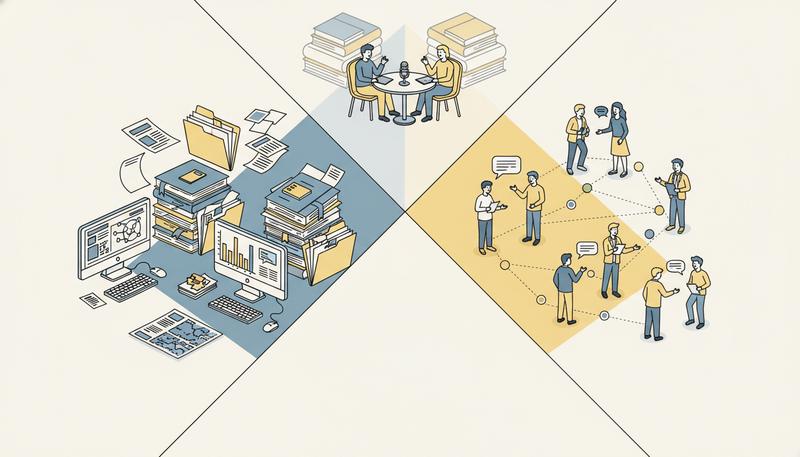
The research phase has two distinct tracks that feed into each other: the paper trail and the human trail. Both matter, and they tell you different kinds of things.
The paper trail — everything documented and on record — tells you what happened. It gives you the chronology of a person's life or career, the public record of their work, the facts you can later verify or push back against. For a journalist interviewing a CEO, the paper trail includes SEC filings, company earnings calls, past press coverage, any litigation history, speeches they've given. For an oral historian working with a World War II veteran, it means military records, unit histories, newspaper archives from the relevant period, maps of the campaigns they served in.
The paper trail is where you start, but it's not where you stop.
The human trail is harder to source and infinitely more valuable. Documents tell you what happened; people tell you what it felt like. Before a significant interview, call three to five people who know your subject — colleagues, former employees, family members if appropriate, rivals, collaborators. Ask them not for facts but for texture: What does this person care most about? What do they never talk about? What are they proud of that nobody ever asks about? What question would make them uncomfortable, and why? What's the gap between their public presentation and the person you encounter privately?
This kind of pre-interview sourcing does something important: it gives you the questions that aren't in any article. The best interviewers I know treat the human trail as mandatory, not optional. If you've only done the paper trail, you know what the subject has already told other people. The human trail is what lets you find what they haven't.
For public figures who have been extensively covered, there's a specific challenge: the archive of prior interviews can actually mislead you. They've been asked the same questions so many times that their answers have calcified. They have perfectly constructed anecdotes — what comedians call "bits" — for their standard talking points. Your job is to find the edge of the known territory and start asking questions from there. That means reading enough of the prior coverage to know exactly what not to ask.
The Oral History Challenge: Researching People Who Left No Public Record
What do you do when your subject has left almost nothing in the public record? This is the central challenge of oral history work, and it's also an increasingly relevant problem as journalists and documentarians try to tell stories about people who have been systematically excluded from official histories.
The Oral History Association guidelines recommend that preparation include "research in primary and secondary sources, as well as through social engagement with individuals and communities and informal one-on-one interactions." That last phrase is doing a lot of work. For subjects who exist mainly in community memory rather than archival record, the preparation is the community immersion.
Concretely, this means:
- Start with what local archives hold that the national archives don't — church records, community newspapers, local historical societies, school yearbooks. These are often digitized incompletely or not at all, which means you have to show up in person.
- Trace social networks outward from your subject. Who are their peers, their contemporaries, people who lived through the same events? Interview those people first, not for your primary project, but to build the contextual knowledge that lets you ask better questions of your actual subject.
- Ask about things, not just events. "What did Sunday mornings look like in your neighborhood?" gives you more texture than "What was the neighborhood like?" Sensory, concrete questions unlock memory in ways that abstract questions don't.
- Learn the language of the period and place. This is underrated. If you're interviewing someone who worked in the garment industry in 1950s New York, you need to know what a "section work" system is, what a union shop card meant, what sweatshop in that era specifically referred to. Getting the vocabulary wrong tells your subject immediately that you're an outsider. Getting it right — or better, asking them to correct and teach you — signals genuine interest.
The goal of all this pre-work is not to arrive knowing everything. It's to arrive knowing enough that your subject can see you're serious, and then to let them fill the gaps that only they can fill. The oral history methodology here carries a crucial insight: the narrator is not just a source of information but an authority. Your research should position you to receive their authority, not to challenge it.
Organizing Research Into a Usable Framework
Here is where a lot of thoughtful, well-prepared interviewers go wrong: they do excellent research, they accumulate rich material, and then they try to put all of it into the interview. They show up with twenty-five questions that represent the full sweep of their preparation, determined to get through all of it, and the interview becomes a forced march through territory the subject finds tedious.
Max Linsky, who interviews professional interviewers on the Longform Podcast, has a rule that I think every interviewer should tattoo somewhere memorable: "Do your research and write down tons and tons of questions. Only bring 15-20 questions to the interview. Only ask 10 of them. If you need to ask all 20, you're not having a conversation."
That's the discipline. The research is not for the questions. The research is for you — so that you understand the territory well enough to navigate it in real time, so that you can recognize when something unexpected is happening that deserves your full attention, so that you have the confidence to abandon your plan when the conversation reveals something more interesting.
My own method — and I've heard variations on this from documentary filmmakers, radio producers, and print journalists — is to distill all the research into three things:
-
One to three overarching themes that the interview is ultimately about. Not topics, themes — the deeper questions underneath the surface questions. What does this person's career reveal about how expertise gets built and then dismissed? What does their immigration story tell us about the gap between the official immigration narrative and what people actually live?
-
Ten to fifteen specific questions, prioritized, with the three most important marked clearly. These are the questions I know I need answered before I leave the room. Everything else is negotiable.
-
A list of specific details — facts, dates, names, moments from the research — that I can deploy as needed to show the subject I've done the work, and to jog specific memories rather than triggering general recollections.
The prioritization of questions is crucial. You need to know, before you walk in, which questions are non-negotiable. Those are the ones you protect. Everything else — the nice-to-have questions, the interesting tangents you prepared for — you hold loosely, ready to sacrifice them the moment the conversation offers something better.
Think in three acts — know where you want to start, where you want to end, and the rough shape of how you want to get there. This is a production framework more than a question framework. It keeps you oriented even when the conversation goes somewhere you didn't expect.
The Danger of Over-Preparation
Now for the uncomfortable truth that most interviewing guides don't tell you.
There is a real and specific way in which doing too much preparation — or more precisely, becoming too attached to your preparation — can make you a worse interviewer. I've experienced this myself, and I've watched it happen to people I've trained. You do excellent research. You develop a rich, nuanced picture of your subject. You walk in the room feeling ready. And then the subject starts talking, and because you're so committed to the version of the story you've already constructed in your head, you don't actually hear what they're saying. You hear what you expected them to say.
The most common mistake interviewers make is arriving with a list of questions and then running through it without any engagement that is conversational, without developing a genuine relationship. What gets lost is the humanity of the encounter — and, practically speaking, the information that only appears when a subject feels genuinely seen rather than processed.
The antidote to this is what I'd call held preparation — bringing your research into the room, but holding it lightly, as a reference point rather than a script. Your questions are a map, not a GPS with turn-by-turn directions. The map tells you the general shape of the territory; the GPS tries to control your route. When the subject says something that takes you somewhere the map doesn't show, a map lets you follow your curiosity. A GPS recalculates and tries to get you back on the planned route.
One practical technique: write your questions down before the interview, read them over carefully, and then don't bring the list into the room. Or if you do bring it, put it face-down on the table until you genuinely need it. The goal is to have the preparation in your body — internalized, available — rather than on a piece of paper you're anxious about getting through.
Pre-Interview Logistics: How Setup Shapes What You Get
Preparation extends past the intellectual work into the physical and technical conditions of the interview itself. These decisions matter more than people realize.
Location is the first choice, and it shapes everything that follows. The oral history literature consistently finds that narrators perform differently in different spaces. Interview someone in their home, surrounded by their objects and their history, and they will give you different material than if you interview them in a neutral conference room or, worse, a hotel lobby. Objects trigger memory — photographs, tools, furniture, diplomas on walls. If at all possible, interview people where they live or work, not where it's convenient for you.
The exception: if the subject's home is also where something traumatic happened, or if being in their own space makes them feel too exposed or observed, a neutral location can actually unlock more. This is a judgment call that requires knowing enough about the subject — again, the research — to make it intelligently.
Recording setup deserves more care than most interviewers give it. Bad audio is not just a technical problem; it's an ethical one. If you're preserving someone's words, you owe them the dignity of a recording that captures those words clearly. For oral history purposes especially, the Oral History Association recommends creating "a high-quality recording of the interview (audio or video format) to capture the narrator's interview accurately with consideration of future audiences and long-term preservation." This means: test your equipment before you arrive, bring backup recording devices (never rely on a single recorder), manage ambient noise where you can, and position your microphone for the subject, not for your own comfort.
A note on the recorder's social function: many interviewers are so focused on the technical requirements of recording that they forget to think about how the equipment affects the subject. A professional microphone on a stand between two people looks different than a small recorder placed discreetly to the side. One signals this is a formal production; the other signals this is a conversation I'm preserving. Neither is universally right. Know your subject well enough to make this choice deliberately.
Consent is not a formality to dispatch quickly so you can get to the real work. It is part of the interview. The Oral History Association's guidelines are clear: informed consent means explaining "the oral history's purposes in terms of topics to be covered and general research questions under study, and reasons for conducting the interview," as well as "the full oral history procedure, including when and how the interview will be recorded, a description of any review process, the plans for preservation and access, the potential uses of the oral history." This conversation, done properly, also does something valuable for you: it clarifies expectations on both sides and often reveals concerns or interests that you didn't know the subject had. The pre-consent conversation is its own form of research.
The pre-interview conversation — the informal chat before you start recording — is wildly underused by journalists and wildly central to the oral history tradition. This is when you build the initial rapport that makes everything else possible. A simple practice: look around the subject's space when you arrive for something that strikes you — something that can spark a genuine moment of curiosity before the formal interview begins. This is not manipulation; it's being a human being in a room with another human being. The plush unicorn on the shelf. The framed jersey on the wall. The stack of books on the desk. These are invitations.

Knowing Your Non-Negotiables — and Being Willing to Walk Away From Everything Else
We'll end this section where every interviewer needs to arrive before they walk into the room: with a clear-eyed answer to the question, What am I here to find out?
Not everything you want to know. Not your twenty-five prepared questions. The two or three things that, if you leave without them, will mean the interview failed on its own terms.
These are your non-negotiables. Know them before you go in. Write them on a card if you need to. And then — this is the discipline — set everything else free. Hold your preparation the way a jazz musician holds their knowledge of theory: it shapes every choice they make, but they're not playing the theory. They're playing the music.
The research you've done isn't there to be recited or demonstrated. It's there so that when your subject says something unexpected, something the record doesn't contain, you have enough context to know it's unexpected. It's there so you can ask the follow-up question that only someone who's done the work could ask. It's there so that when you finally get to the question that matters most — the one you've been circling for forty minutes — you can ask it without a net, knowing that the relationship and the context support it.
Preparation is not what you bring into the interview. It's what the interview becomes possible because of.
That's the imperative.
Only visible to you
Sign in to take notes.