How to Build a Second Brain in 30 Days
Building Your Second Brain: A 30-Day Starter Plan
You've now seen what the Zettelkasten looks like when it works — the surprise connections, the arguments that assemble themselves, the unexpected questions emerging from your own notes. You've also heard the hard truth: that breakthrough doesn't happen in week one. It happens after you've built a few hundred genuine permanent notes and learned to trust the system even when the immediate payoff isn't obvious. The challenge, then, isn't understanding the method. It's actually doing it long enough for it to work.
Most people fail at this transition. They learn the theory, feel genuinely excited, open Obsidian or pull out their index cards, create three notes — and then life happens. Six weeks later they feel vaguely guilty every time they think about the system they abandoned. The difference between those who break through and those who don't isn't talent or inspiration. It's willingness to do the uncomfortable thing over time. This section exists to make that willingness sustainable.
The plan here introduces one layer per week, letting each habit settle before adding the next. By day 30, you won't have a perfect Zettelkasten — but you'll have a living one, and that's the only kind worth having. What you'll have built is the scaffolding: the capture reflex, the processing rhythm, and a small but genuinely connected cluster of permanent notes. The compounding — the moment when the system starts surprising you — happens after this month is over. But you can't reach that point without establishing the foundation first.
Week 1: The Capture Reflex (Days 1–7)
Goal: make capturing an unconscious habit.
Here's the thing about ideas: they're slippery. You're reading something interesting, and a thought occurs to you. You tell yourself you'll remember it. Five hours later, when you actually have time to write it down, it's gone. Not the big idea necessarily, but the specific phrase, the exact moment of connection, the particular angle that made it stick. Your working memory is genuinely limited, and when you're mentally carrying a partially-formed idea while trying to do other thinking, you're paying a real tax on your cognitive resources.
Capture externalizes the load. The Building a Second Brain framework makes this point well: "our brains are for having ideas, not storing them." Writing it down — even imperfectly — releases the mental grip and lets your attention move on to the next thing.
Daily practice this week:
- Keep your capture medium within arm's reach at all times
- When something interesting crosses your attention — a sentence in a book, a thought during a walk, a question you don't immediately know the answer to — write it down. One to three sentences is plenty.
- Don't organize. Don't tag. Don't title carefully. Just capture.
- At the end of each day, spend two minutes moving your captures into a single "Inbox" folder or notebook. That's it.
What good looks like by Day 7:
- You have 20–40 fleeting notes sitting in your inbox
- You've noticed which moments in your day are most generative (for most people: morning reading, commutes, and the 20 minutes before sleep)
- You've had at least once the experience of capturing something and feeling the relief of not having to hold it mentally
What trouble looks like:
- You have 3 notes because you kept waiting for "good" ideas worth capturing — lower your bar dramatically. Capture the mediocre ones too.
- You have 80 notes because you're highlighting everything you read — be more selective; only capture what genuinely surprises or challenges you.

Week 2: First Processing Sessions (Days 8–14)
Goal: learn to write in your own words.
You now have an inbox full of raw captures. This week, you start processing them — not all at once, but in short daily sessions. Processing means reading each fleeting note and asking: does this still seem interesting? If yes, what did it make me think?
The output of processing is a literature note: a note attached to a source (a book, article, conversation, podcast) that summarizes the relevant ideas in your own words. This is where most people hit their first genuine difficulty.
Writing in your own words is harder than it sounds, and the difficulty is informative. If you can't articulate an idea without looking back at the original text, you don't fully understand it yet. That friction isn't a problem with your note-taking system — it's your system working correctly, surfacing a gap in comprehension. The zettelkasten.de introduction describes this as the method's core mechanism: "Insights don't happen in a vacuum. They are the result of making new (unexpected) connections."
Daily practice this week:
- Set aside 15 minutes each morning or evening — schedule it like a meeting
- Open your inbox and pick 3–5 fleeting notes to process
- For each one: does it come from a source? If yes, write one literature note summarizing what the source said about this idea — in your own words, from memory if possible. If the fleeting note is an original thought, note it as such (you'll turn it into a permanent note next week)
- Don't aim to process your entire inbox. Aim to do 3–5 notes per session. Leave the rest.
- Notes you process can be archived or deleted from the inbox.
The 15-minute session structure:
graph TD
    A[Open inbox] --> B[Pick 3-5 fleeting notes]
    B --> C{Does it come from a source?}
    C -->|Yes| D[Write literature note in own words]
    C -->|No| E[Keep as candidate for permanent note]
    D --> F[Archive fleeting note]
    E --> F
    F --> G[Close session — done for today]
What good looks like by Day 14:
- You have 15–25 literature notes
- You've experienced at least once the sensation of struggling to paraphrase something and realizing you didn't understand it as well as you thought
- Your literature notes reference sources but are not copied from them — they're clearly your voice
What trouble looks like:
- Your "literature notes" are mostly copy-pasted quotes — this defeats the purpose; go back and try to say it in two sentences without looking at the original
- You're spending 45 minutes per session trying to perfectly process every note — cut the session at 15 minutes regardless; perfectionism here is the enemy
Tip: A useful prompt when writing literature notes: "If I were explaining this to a colleague over lunch, what would I actually say?" That conversational register is approximately right.
Week 3: Your First Permanent Notes (Days 15–21)
Goal: write notes that belong to you, not to a source.
This is the week the system starts to feel genuinely different from every note-taking tool you've used before. Permanent notes — the atomic, titled, self-contained ideas that form the core of a Zettelkasten — are not summaries of sources. They're statements of your understanding. The zettelkasten.de introduction frames this distinction clearly: the Zettelkasten is "a web of thoughts, not a collection of notes."
A permanent note makes a single claim. It has a title written as a full sentence or question (not a topic label). It can be understood without reading any other note. And it ends with at least one link — to a related note, to a source, or to an open question.
Daily practice this week:
- Continue your 15-minute daily processing session
- Now add a second task: look at your literature notes from last week and ask, "What single idea here could stand alone as a statement I believe or want to explore?"
- Write that as a permanent note. Start with just 3–5 permanent notes this week. Quality matters more than quantity here.
- Write titles as claims or questions: not "Spaced repetition" but "Spaced repetition works because retrieval practice strengthens memory traces more than re-reading." Not "Creativity" but "Original ideas usually emerge from unexpected connections between unrelated domains."
- After writing each permanent note, add one link to another note — even if your collection is small, you can link to a literature note or to a related fleeting note.
The anatomy of a good permanent note:
graph LR
    A[Claim title as full sentence] --> B[2-4 paragraph body explaining the idea]
    B --> C[Reference to source or literature note]
    B --> D[Links to 1-3 related notes]
    B --> E[Tag or structure note connection, optional]
What good looks like by Day 21:
- You have 8–15 permanent notes
- Each one can be read in isolation and makes a coherent claim
- You've noticed that some notes want to connect — that you wrote one and immediately thought of another
- You've written at least one note title that surprised you a little, where articulating the claim clarified what you actually believed
What trouble looks like:
- Your permanent notes are too long — if a note exceeds 300 words, it probably contains two ideas; split it
- You're calling literature notes "permanent notes" because they're in the permanent note folder — the distinction is author: literature notes attribute ideas to sources; permanent notes claim them as your thinking
- You haven't written any links yet — this is urgent; linking is not optional decoration
Remember: The title of a permanent note is the most important sentence you write. A good title makes the note findable from memory and immediately communicates what it argues. If you can't write a one-sentence title, the note isn't ready.
Week 4: Linking in Earnest (Days 22–30)
Goal: make linking the central habit; create your first index entry.
The first three weeks built the input and processing side of the system. Week 4 turns your attention to the network. Linking is where the Zettelkasten stops being an elaborate folder structure and starts becoming something qualitatively different — a tool for thinking rather than a tool for storage.
The key insight: links are not just navigational conveniences. They're cognitive commitments. When you link Note A to Note B, you're making a claim that these ideas have a meaningful relationship. Articulating why you're making that link — even in a single parenthetical phrase — is often where genuine insight emerges.
Daily practice this week:
- Your 15-minute session now has a third phase: before closing each session, look at the permanent notes you wrote this week and ask, "What else in my collection does this connect to? What would a reader of this note benefit from knowing about?"
- Add links with context: not just
[[note title]]but[[note title]] — this note's claim depends on the mechanism described hereorcontrast with [[conflicting note]] - On Day 25 or 26, create your first index entry or structure note. An index entry is simply: a note (or a section of your main index) that lists 3–5 permanent notes around a theme, with a sentence explaining each one. This is your first map of the territory.
- Continue capturing and processing throughout the week — the pipeline doesn't stop.
What good looks like by Day 30: You now have a small but genuinely interconnected cluster. Let's set realistic numbers:
| Metric | Realistic Day-30 Target |
|---|---|
| Fleeting notes processed | Variable |
| Literature notes | Variable |
| Permanent notes | Variable |
Note: These quantities vary by individual practice. The Zettelkasten community emphasizes that there is no minimum or target number, as quality and connections between notes matter more than quantity. | Links between notes | 20–50 | | Index entries or structure notes | 1–3 |
These numbers will feel modest. They should. Luhmann's Zettelkasten grew over 40+ years; what matters at day 30 is that the system is alive — notes are being added, linked, and occasionally surfaced when you're working on something new.
The Minimum Viable Daily Practice
If the above feels like too much, here's the irreducible minimum — the thing you must not drop below:
15 minutes, every day:
- Capture anything interesting that crossed your attention today (2–3 minutes)
- Process 3–5 inbox items into literature notes or permanent notes (10 minutes)
- Add one link you didn't make yesterday (2–3 minutes)
That's it. Fifteen minutes. The people who succeed with Zettelkasten long-term are not the ones who do marathon processing sessions on weekends. They're the ones who show up for 15 minutes every day. The compound interest of consistent small deposits beats the occasional large one.
Tip: Schedule your 15 minutes at the same time each day, attached to an existing habit. "After my morning coffee" or "before closing my laptop at work" both work well. The goal is zero friction to starting.
How to Know If You're On Track
The system is working if:
- You're reaching for your notes when you're working on something, rather than starting from scratch
- New notes are suggesting links to existing ones — not every time, but sometimes
- You've had at least one moment of genuine surprise — a connection you didn't expect, a contradiction you hadn't noticed
- The act of writing a permanent note title forced you to clarify what you actually thought
The system is failing if:
- Your inbox never empties because you never process (capture is not the system; processing is the system)
- Your permanent notes are getting longer and longer (they should be getting shorter and more precise)
- You're spending more time organizing than thinking (this is the most common failure mode; Section 11 covers this in depth)
- You've never linked two notes together (an unlinked Zettelkasten is just a folder with extra steps)
The Long Game: What to Expect at 6 Months, 1 Year, 5 Years
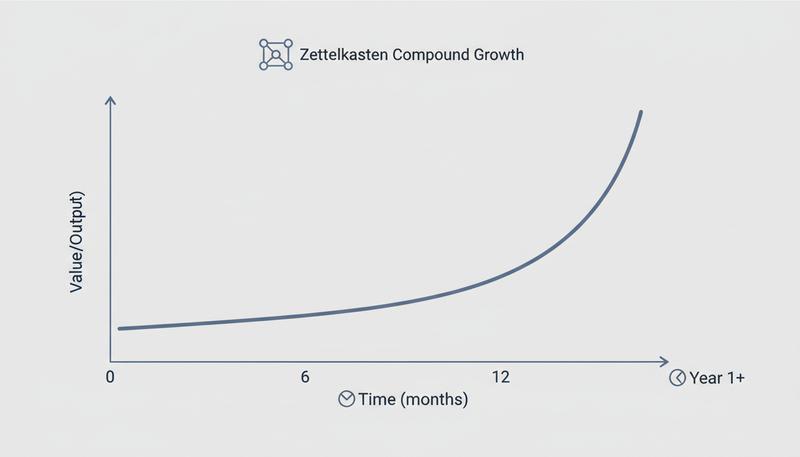
At 6 months (if you've maintained the daily practice): You'll have somewhere between 100 and 300 permanent notes. More importantly, you'll have clusters — groups of linked notes around themes you didn't consciously plan. When you sit down to write something — an essay, a report, a presentation — you'll find that you're not starting from zero; you're synthesizing ideas that have been gestating in your system. The Zettelkasten will have started talking back.
At 1 year: The serendipity effect becomes reliable rather than occasional. You'll look up a note on one topic and find, through a chain of links, something relevant from a completely different domain. Structure notes will start to feel necessary — you'll have enough notes on certain themes that you need a map to navigate them. You might write your first piece of substantial output that emerged largely from your Zettelkasten rather than from a fresh research sprint.
At 5 years: You'll have a genuine intellectual companion. The compounding that zettelkasten.de describes as the method's deepest value will be unmistakably real — ideas from years ago will remain active and relevant, surfacing through links in ways that feel almost uncanny. The difference between someone who has maintained a Zettelkasten for five years and someone who hasn't is qualitative, not just quantitative. They think differently about the material in their domain.
Adapting to Your Context
The four-week plan above is a generalist framework. Here's how to tune it for your specific situation:
If you're a student:
- Your primary input will be assigned reading — treat every reading session as a literature note generator
- Add a "question" note type: when a lecture or reading raises a question you can't answer immediately, write it as a permanent note and treat it as an open thread
- Structure notes organized around courses or essay topics are useful; structure notes organized around grades are not
- The permanent notes you write now will be available for every subsequent course that touches related material. The network effect is compounded by your entire academic career.
If you're a researcher:
- Maintain a clear separation between literature notes (what the source says) and permanent notes (what you think about what the source says); the line between them matters intensely for citation integrity
- Use your Zettelkasten to track the "state of the debate" on questions you care about — permanent notes that explicitly represent positions in a scholarly conversation
- Structure notes that map arguments across multiple sources are essentially free literature reviews; generate them intentionally
If you're a writer:
- Your Zettelkasten is a pre-draft layer. Permanent notes are ideas before they have a home; structure notes are drafts before they have prose
- Develop the habit of tagging notes with potential essay or article angles — not for organization, but as a reminder that this idea has a potential home
- The CODE method from Building a Second Brain — Capture, Organize, Distill, Express — is a useful complementary frame for thinking about how your Zettelkasten outputs eventually become published work
If you're a business professional:
- Focus your permanent notes on decision frameworks, patterns from projects, and lessons from retrospectives rather than abstract theory
- Literature notes from books and articles matter less than "meeting notes processed into insights" — the friction point is turning messy meeting captures into clean permanent notes
- A structure note that maps your organization's recurring problems to your existing insights is immediately actionable and impossible to create without a Zettelkasten
The One Metric That Actually Matters
All the note counts and link densities in the world are proxies. The real question is simpler and harder to fake:
Are you using your notes to think with, or just storing them?
When you sit down to solve a problem, write a piece, or prepare for a meeting — do you open your Zettelkasten? Does what you find there actually influence what you produce? Do connections that emerge from your note network surprise you — show you something you wouldn't have thought of otherwise?
If the answer is yes, even occasionally, you have a working Zettelkasten. It doesn't matter how many notes you have. It doesn't matter whether your folder structure is elegant or your tags are consistent. What matters is whether the system is participating in your thinking, or just passively holding information you've already forgotten you captured.
The Building a Second Brain approach frames this as offloading thinking onto an external system so your biological brain can "imagine, create, and simply be present." The Zettelkasten does something subtly different — it doesn't just offload thinking, it structures it in a way that generates thinking you wouldn't have done otherwise. That's the distinction this entire course has been building toward.
Remember: The test isn't "do I have a lot of notes?" The test is "did my notes help me think something I couldn't have thought without them?" Run that test every week. Optimize for passing it, not for having an impressive system.
The Attitude That Makes It Work
The zettelkasten.de introduction uses a swimming metaphor that's worth sitting with: "If you can't swim, you won't be having any fun at all. Swimming sucks if all you do is float and fight the water. But boy, if you figure out the technique and glide through the water, it is incredible. But you don't learn swimming by aiming for ease and fun. You learn to swim by aiming to be fast and graceful."
The first two weeks of this plan will feel like fighting the water. Processing notes feels slow. Writing permanent notes feels over-elaborate. Making links feels like it requires more connections than you actually have. This is normal. Push through it with the knowledge that you're building the technique, not yet experiencing the glide.
By week four, something will shift. It won't be dramatic — it rarely is. You'll write a note and notice it connects to something you wrote in week one, and the connection will be genuinely interesting to you, not just formally correct. That moment — small as it is — is the system working. Protect it. Show up for it again tomorrow.
Thirty days from now, you won't have a second brain. You'll have the beginning of one. That's exactly right.
Only visible to you
Sign in to take notes.