How Note-Taking Improves Memory and Learning
The Cognitive Science of Note-Taking: What Your Brain Actually Needs
In the previous section, we identified the structural problem: your notes fail not because you capture too much, but because the system doesn't support retrieval, connection, building, and generation. But understanding the problem isn't enough. To truly grasp why the Zettelkasten — and the slip box system Luhmann built — works so differently from conventional note-taking, we need to look at the cognitive science underneath. What actually happens in your brain when you take notes? What distinguishes the feeling of learning from learning itself?
Before we introduce any mechanics or methods, we need an honest conversation about what cognitive science has discovered about how your brain transforms information into usable knowledge. Because here's the uncomfortable truth: the note-taking strategies most of us use most of the time are almost exactly the wrong ones. Not a little wrong. Dramatically, measurably, research-confirmed wrong. The practices that feel most efficient — highlighting, rereading, copying down summaries — are among the least effective techniques cognitive science has identified. Meanwhile, the practices that feel hardest and least satisfying are the ones that actually build durable understanding.
This gap between what feels productive and what is productive is the key to understanding why the Zettelkasten works. It's not magic. It's not personality-dependent. It's a system that — whether Luhmann designed it this way intentionally or stumbled onto it through decades of practice — happens to force exactly the cognitive moves that decades of research confirm are essential for genuine learning and creative output. So let's build the case from the ground up.
The Generation Effect: You Have to Make It
Imagine a simple experiment. A researcher shows you a word and asks you to read it: dog. Another researcher shows you a word with a blank: d_g. They ask you to fill in the blank.
Both groups encounter the same information — the word "dog." One group did almost nothing cognitive. The other had to search their memory, generate the missing piece, and verify it fit. Same stimulus, wildly different cognitive demands.
The results were striking. People who generated the word remembered it dramatically better than people who simply read it. Not a little better. Dramatically better. And this held across dozens of variations: different word types, different time delays, different age groups. The effect proved remarkably robust.
This is called the generation effect, and it's been replicated so many times across so many contexts that it's essentially settled science. Research on the generation effect consistently shows that the act of producing information — even slightly, even imperfectly — creates dramatically stronger memory traces than passively receiving the same information.
The mechanism appears to involve deeper semantic processing. When you generate something, your brain has to search through its existing knowledge, make connections, and construct a representation from scratch. That construction work is what makes the memory stick. When you passively receive information, you can process it at a shallow level — recognizing the pattern without doing the construction work that would make it retrievable later.
What does this mean for note-taking? It means that copying a sentence from a book into your notes is almost entirely useless as a memory-building exercise. The generation effect doesn't kick in until you close the book and try to write the idea in your own words. The moment you're producing rather than reproducing is the moment you're actually learning.
Remember: The feeling of smooth, easy note-taking is often the opposite of learning. Productive struggle — the friction of putting something in your own words — is not a bug to be engineered away. It's the mechanism.
The Testing Effect: Struggle Is the Point
If the generation effect shows that producing beats receiving, the testing effect shows that retrieving beats rereading by an even wider margin.
The core finding: every time you successfully retrieve a memory, you strengthen it. Not just a little — substantially. And the struggle of retrieval, the effortful search through your memory before the answer surfaces, seems to be a significant part of why it works. This counterintuitive insight — that difficulty during learning predicts better long-term retention — is called desirable difficulty, a term coined by cognitive psychologist Robert Bjork.
The practical implication is uncomfortable: you should spend more time testing yourself on material and less time reviewing it. Flashcards aren't just for memorizing vocabulary lists. Closing your notes and writing down everything you can remember from a chapter isn't a final exam trick — it's one of the most effective learning techniques identified across decades of research. The 2013 meta-analysis by Dunlosky and colleagues, which surveyed ten major study strategies used by students, rated practice testing among the highest-utility techniques and rereading among the lowest.
Here's why this matters for knowledge work: the testing effect doesn't only apply to facts. It applies to understanding. When you're forced to reconstruct an argument from scratch — to explain why a particular claim follows from the evidence, to trace the logical chain — you're doing something fundamentally different from reading that argument. You're building it. And when you build it, you own it.
This is also why, as we'll see, the process of writing permanent notes in Zettelkasten is so cognitively valuable. Writing a note in your own words, in full sentences, without looking at the source — that's retrieval practice. You're testing yourself on your comprehension of the idea, surfacing gaps in your understanding, and simultaneously strengthening the memory trace.
graph LR
    A[Read/Encounter Idea] --> B{Processing Type}
    B -->|Passive: Highlight & Reread| C[Shallow Encoding]
    B -->|Active: Generate & Retrieve| D[Deep Encoding]
    C --> E[Fluency Illusion — feels like learning]
    C --> F[Rapid Forgetting]
    D --> G[Genuine Comprehension]
    D --> H[Durable Retention]
Elaborative Interrogation: The Power of Asking "Why?"
There's a third technique worth understanding, because it speaks directly to what makes Zettelkasten different from a filing cabinet full of facts.
Elaborative interrogation is the practice of asking "why is this true?" and generating your own explanation, rather than accepting a fact at face value. It sounds almost insultingly simple. But the research suggests it's remarkably effective, particularly for building the kind of connected knowledge that allows you to actually use what you've learned.
The mechanism is straightforward: when you generate an explanation for why something is true, you're forced to connect the new information to your existing knowledge. You're building the scaffolding that allows the new idea to integrate with everything else you know. Facts stored in isolation — even if perfectly memorized — are brittle. They can't be applied flexibly because they have no connections to pull them into new contexts. Facts embedded in explanatory networks are what allow you to think with your knowledge rather than just through it.
Practically: if you read that the Roman Empire fell partly due to lead poisoning from plumbing, you can copy that fact into a note and forget it. Or you can ask: why would chronic lead exposure cause imperial decline? What cognitive and physiological effects did it have? How does this interact with other explanations? Who disputes this claim, and on what grounds? The process of asking and answering those questions not only makes the fact memorable — it begins to build a mental model of Roman history, toxicology, and historical causation that you can actually use.
This is the intellectual practice the Zettelkasten is designed to externalize and extend. The permanent note isn't a record of what you read. It's the answer to "what do I actually think about this, and why does it matter?"
Tip: When you encounter an interesting claim, practice the one-question rule before moving on: "Why is this true?" Write a sentence answering it in your own words. This single habit activates elaborative interrogation even without any formal system.
The Longhand vs. Digital Debate: What the Evidence Actually Shows
You've probably seen some version of the claim that handwriting notes is better than typing them. It's been cited in newspapers, TED talks, and productivity blogs so often that it's become received wisdom. The truth, as usual, is slightly more complicated — and the most important part of the story is almost always omitted.
The original research on this topic, by Mueller and Oppenheimer (2014), found that laptop note-takers remembered less from lectures than longhand note-takers — particularly on conceptual questions. Their explanation wasn't about the physical act of handwriting itself. It was about transcription. Laptop note-takers, they argued, were more likely to take verbatim notes — essentially transcribing the lecture — while longhand note-takers were forced by sheer writing speed to summarize, paraphrase, and select. The longhand group was doing more cognitive processing during note-taking, not less.
More recent research comparing longhand to stylus-based digital note-taking confirms a similar pattern: students using longhand demonstrated significantly higher cognitive performance across several domains, including information processing speed, working memory, and visual memory. (Stylus-based note-takers did show better inhibitory cognitive control — an interesting nuance suggesting different cognitive demands for different methods.) The researchers are careful to note that effect sizes were small and that longitudinal work is still needed, but the directional consistency across studies is meaningful.
The practical takeaway isn't "throw away your laptop." It's that the medium matters less than the cognitive mode. If you're typing notes in a way that forces you to process, synthesize, and restate — rather than transcribe — you can capture the benefits that come from active processing. The physical act of handwriting may make this easier by making verbatim transcription impossible, but it's the cognitive behavior that does the work.
Which is, incidentally, exactly what the Zettelkasten workflow enforces. You can't write a permanent note verbatim — the whole practice demands you restate ideas in your own words, connect them to other notes, and articulate why they matter. The medium becomes irrelevant when the method is doing the right cognitive work.
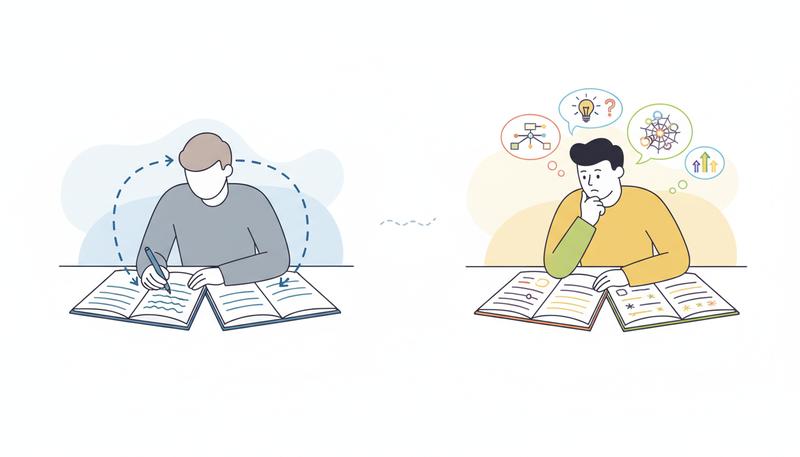
Why Passive Strategies Feel So Right (And Active Ones Feel So Wrong)
This is worth sitting with for a moment, because it explains a lot of human behavior.
Passive note-taking strategies — highlighting, copying, rereading — feel productive because they're fluent. They produce an immediate sense of progress. You've generated a neatly highlighted text, a filled notebook, a dense document of copied excerpts. These are visible artifacts. They feel like work. And they require relatively little cognitive effort, which means they're comfortable to sustain for long periods.
Active strategies — retrieval practice, elaborative interrogation, writing in your own words without looking at the source — feel hard. They're often slow. They generate the uncomfortable sensation of not knowing, of gaps and uncertainty. They produce fewer visible artifacts per hour. From the inside, they can feel like failure.
This asymmetry is almost certainly why passive strategies remain dominant despite decades of evidence pointing in the other direction. Humans are quite good at optimizing for the feeling of productivity rather than productivity itself, especially when feedback loops are slow and delayed.
This is also why most note-taking systems fail at the level of motivation and consistency. If your system doesn't have structural features that make active processing feel natural — or even mandatory — you'll drift toward passive strategies under pressure. The Zettelkasten's design doesn't rely on your willpower or your awareness of cognitive science. Its constraints — write in your own words, write one idea per note, link it to something you already know — make active processing the path of least resistance.
From Exam Prep to Knowledge Work: The Same Principles, Bigger Stage
Almost all of the research described above was conducted on students preparing for exams. Which might make you wonder: does it generalize? If you're a writer, researcher, strategist, or creative professional rather than a student preparing to be tested, do these findings still apply?
They do, but the framing shifts in an important way.
For students, the output is performance on a test. The knowledge has a finish line. For knowledge workers, the output is something different: the capacity to think well about a domain, to make non-obvious connections, to generate ideas that nobody else has generated, to write clearly about complex subjects, to make good decisions under uncertainty.
That's a more demanding target than exam performance — and it turns out the same principles apply, just at greater depth and over longer timescales. The generation effect means that knowledge workers who regularly synthesize and restate ideas are building a richer cognitive network than those who collect and file. The testing effect means that revisiting notes in active rather than passive ways — asking yourself what a note means, how it connects to your current project, why it mattered — builds the kind of flexible, accessible knowledge that creativity draws on. Elaborative interrogation builds the explanatory models that allow genuine expertise rather than just familiarity.
The cognitive scientist Robert Bjork and others have written about the distinction between storage strength (how deeply something is encoded in long-term memory) and retrieval strength (how easily it can be accessed right now). Most of what we do in conventional note-taking optimizes for retrieval strength in the short term — we can find our notes, we recognize the highlighted passages. But Bjork's research suggests that what actually builds durable, flexible knowledge is repeatedly making information hard to retrieve in the short term, then successfully retrieving it anyway. Every time you write a note in your own words rather than copying the source, every time you try to articulate an idea's connection to something you already know, you're doing exactly this.
Warning: There's a seductive version of this insight that leads to deliberately making your notes illegible or cryptic as a form of "productive difficulty." That's not what the research recommends. The difficulty should come from the cognitive work of synthesis and connection — not from artificial obscurity. Your notes should be hard to write and easy to read.
The Cognitive Checklist That Zettelkasten Satisfies
Here's the thread that ties all of this together, and why it matters that you understand it before you encounter the Zettelkasten's mechanics.
Every core practice in the Zettelkasten maps directly onto an evidence-backed learning principle:
Writing notes in your own words, in full sentences → activates the generation effect. You're producing, not reproducing.
Writing from memory rather than open sources → activates the testing effect. You're retrieving, which strengthens the trace.
Asking "why does this matter?" and "what does this connect to?" → activates elaborative interrogation. You're building explanatory networks, not filing isolated facts.
Linking each note to existing notes → forces you to find real conceptual connections, which deepens encoding and creates the associative structure that retrieval draws on.
Returning to old notes while writing new ones → spaced retrieval practice, the most powerful schedule for building durable long-term memory.
None of these is a coincidence. The Zettelkasten, as we'll see when we look at Luhmann's own description of the system, was designed by a man who cared enormously about intellectual productivity — not test performance, but the kind of rigorous, generative thinking that produces original scholarship. The fact that his design choices align so precisely with what cognitive science would later identify as effective learning strategies is either a remarkable coincidence or evidence that Luhmann was, through decades of practice, doing exactly what good cognitive science would prescribe.
graph TD
    A[Cognitive Science Principle] --> B[Zettelkasten Practice]
    C[Generation Effect] --> D[Write notes in your own words]
    E[Testing Effect] --> F[Write from memory, without source open]
    G[Elaborative Interrogation] --> H[Ask why it matters and what it connects to]
    I[Spaced Retrieval] --> J[Revisit and link old notes when writing new ones]
    K[Desirable Difficulty] --> L[Resist copying; embrace the effort of synthesis]
The reason most note-taking systems fail isn't that users are lazy or disorganized. It's that the systems are optimized for the wrong outcome — for storage rather than for thought. They make it easy to capture information and hard to develop it. The Zettelkasten inverts this: it makes capture slightly harder (because it requires genuine processing) and makes development natural and even pleasurable, because the structure of linked notes creates intellectual momentum.
Understanding this — the cognitive science underneath the mechanics — is what lets you use the system intelligently rather than following the rules without knowing why they exist. When you're tempted to copy a passage instead of restating it, you'll know exactly what you're sacrificing. When you're tempted to skip the linking step because it seems like busywork, you'll know it's actually the moment when learning happens.
The mechanics come next. But the mechanisms are what you'll carry with you when everything else changes.
Only visible to you
Sign in to take notes.