Luhmann's Communicating with Slip Boxes Summary and Key Ideas
Luhmann in His Own Words: Reading 'Communicating with Slip Boxes'
Now that we understand the genealogy of Luhmann's thinking — the centuries-long tradition he was responding to, and the specific cognitive problems he was solving — we're ready for the harder part: understanding his actual solution in his own words.
There's a particular kind of frustration that comes from reading about a thinker's ideas through three layers of interpretation and then discovering, on finally reaching the original text, that everyone got it slightly wrong. With Luhmann, this is practically a rite of passage. His 1981 essay "Communicating with Slip Boxes" (Kommunikation mit Zettelkästen) is only a few thousand words long, but it is dense, a little eccentric, and written in the language of systems theory — a sociological framework that doesn't exactly make for breezy reading. Most people who talk about Zettelkasten have never read it. Most people who have read it once read it too quickly. And most of the popular guides to the method, including excellent ones, are translating Luhmann's ideas into a more accessible register that inevitably loses something in the process.
This section is a guided close reading of that essay. We're going to read it carefully, slowly, and in a way that models the exact kind of active engagement the Zettelkasten method is designed to cultivate. By the end, you won't just know what Luhmann said — you'll understand why he said it in the terms he chose, and you'll be able to spot the moments where modern popularizations quietly departed from the original.
One more thing before we start: secondary sources don't replace the original. Read Ahrens and Luhmann. The first gives you the map; the second gives you the territory.
How to Read This Essay: Active Engagement in Practice
Before we dive into the content, a word on method — because this section is also meant to demonstrate something.
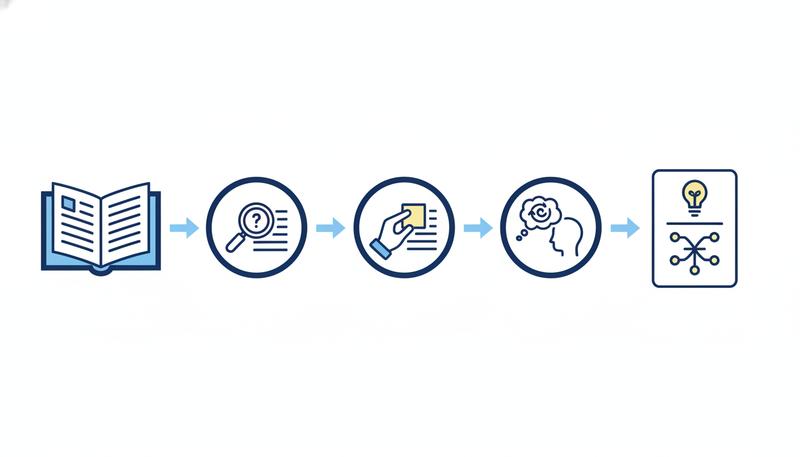
The Zettelkasten approach to reading a text like this isn't passive absorption. It's more like a structured interrogation. As you read, you're asking: What is the author's central claim? What framework are they working within? Where do I agree, disagree, or feel uncertain? What does this connect to that I already know? What question does this raise that I want to pursue?
When you finish a section of text, you're not summarizing it — you're extracting the ideas that are live for you, the ones that created some friction or some spark, and writing those in your own words. Not "Luhmann says X" but "the implication of Luhmann's claim seems to be Y, which would mean Z." This is the difference between literature notes and permanent notes, which we'll explore in Section 6, but it's worth naming here because we're about to do exactly that with the essay itself.
So treat what follows less as a lecture and more as a demonstration. I'm going to walk through the essay's key moves, pausing to show you the questions an active reader asks and where those questions lead.
Luhmann's Opening Gambit: The Communication Framework
Luhmann opens the essay by making a claim that sounds almost absurd: the Zettelkasten is not merely a tool — it is a communication partner. You can have a genuine intellectual exchange with a box of paper.
To understand why he's not joking, you need a quick primer on systems theory as Luhmann practiced it. His entire sociological framework was built around the idea that society is constituted by communication — not by people, but by the exchanges between them. A system is defined by the boundary between itself and its environment, and by the specific operations it performs. Communication is an operation. It requires at minimum two parties, neither of which determines the outcome alone.
When Luhmann says the slip box is a communication partner, he's importing this technical vocabulary wholesale. He's claiming that consulting the slip box is structurally analogous to a conversation: you bring a question or a half-formed thought, the system responds with something that wasn't entirely predictable from your input, and the exchange produces an outcome neither "party" could have produced alone. The slip box has its own internal structure, accumulated over decades, that shapes its responses in ways that surprise even its creator.
This is an unusual and radical claim. Most people think of note-taking systems as passive storage — you put things in, you take things out, you get back exactly what you deposited. Luhmann is saying his system doesn't work that way. It works more like a collaborator.
Luhmann's essay, carefully analyzed and excerpted in this detailed reconstruction, makes the core point explicit: he called the Zettelkasten his "communication partner — an external brain capable of dialoguing with him, facilitating thinking, and even 'surprising' himself."
That word — surprising — is doing a lot of work, and it deserves its own careful treatment.
The Concept of Surprise: How a System Generates the Unexpected
For Luhmann, the capacity to generate surprise is not a bug or a happy accident. It's the central feature of a well-functioning Zettelkasten, and the marker that distinguishes it from ordinary filing systems.
Here's how it works. When you file a note, you place it in relation to other notes based on your current understanding of how ideas connect. But your current understanding is partial, provisional, and constrained by the frame you're in right now. A note about the sociology of trust might get filed near a note about organizational behavior — that's the obvious connection.
But six months later, when you're working on something about epistemology, you might pull out that trust note and discover it's in a cluster of other notes that now looks completely different. The network of connections you've built has grown in ways you didn't consciously track. Notes have acquired neighbors you forgot about. When you pull one thread, a whole web comes with it — and somewhere in that web is a connection you didn't see before, a collision between ideas that generates something new.
This is what Luhmann means by surprise. Not randomness, but the emergence of unexpected order from accumulated structure. It's similar to how a chess master "sees" a move that a beginner can't — not because they're smarter in the moment, but because their trained pattern recognition has built up such a rich substrate that new patterns become visible almost spontaneously.
Tip: Next time you sit down with your notes, try asking a question rather than looking for a specific piece of information. Navigate by curiosity rather than by retrieval. You're much more likely to hit the "surprise" that Luhmann describes.
The key condition for surprise is what Luhmann called complexity that exceeds the individual. The slip box needs to have grown to a point where it contains more structure than you can consciously hold in mind at once. A system with 50 notes is unlikely to surprise you — you know what's in there. A system with 5,000 notes develops a kind of internal topology you can no longer fully map, and navigating it becomes genuinely exploratory.
This is why building the Zettelkasten over a long period is baked into Luhmann's design. The 90,000 cards he accumulated over four decades weren't just a record of his reading — they were the substrate that made productive surprises possible. The system had to become large enough to have, in a sense, a structure of its own that exceeded its creator's moment-to-moment awareness.
graph TD
    A[New note added] --> B[Placed near existing notes by current understanding]
    B --> C[System grows over months/years]
    C --> D[Network develops structure beyond conscious tracking]
    D --> E[Consulting system for new problem]
    E --> F[Unexpected connections emerge]
    F --> G[Surprise: new insight not predictable from input alone]
    G --> A
The Second Memory: Offloading to Think More Freely
The second major concept in the essay is the idea of the Zettelkasten as a "second memory" — and this is where Luhmann's thinking connects most directly to the cognitive science we explored in Section 2.
Luhmann was not a cognitive scientist, and he didn't frame this in terms of working memory or cognitive load. But he was making essentially the same observation: human memory is unreliable, associative, and deeply affected by context and emotion. We remember things that feel important in the moment; we forget things that seem trivial but turn out to be crucial. We're subject to availability bias, recency bias, confirmation bias. Our biological memory is good at many things but terrible at preserving a precise, durable record of ideas and their relationships.
The slip box solves a different problem than most people think it does. The naive version of the "second brain" concept is that you use it to remember more — to offload facts so you don't have to hold them in your head. That's part of it, but it's not the interesting part.
The more important function, for Luhmann, is that externalizing memory frees up cognitive resources for thinking. When you know that an idea is safely preserved in the system, you can stop holding onto it and redirect your attention to the harder work: connecting it to other ideas, questioning it, developing it. The external memory doesn't replace thinking — it liberates thinking from the overhead of storage.
This is the correct reading of one of Luhmann's most quoted lines: "I don't think everything by myself — it happens largely in the Zettelkasten."
People quote this because it sounds provocative and slightly mystical. But Luhmann isn't making a claim about magic or artificial intelligence. He's making a precise point about distributed cognition. Thinking, in his view, isn't purely an internal process that happens in the brain and then gets recorded. It's a process that emerges from interaction — between the thinker and the materials they're working with. When you write, you discover what you think. When you revisit what you wrote, you discover what you meant. When you see two old notes in unexpected proximity, you discover a connection that neither note contained on its own.
The Zettelkasten is not storing thinking that happened elsewhere. It is, for Luhmann, part of the environment in which thinking happens. That's a genuinely different philosophical claim, and it has real practical implications for how you build and use the system.
Warning: It's tempting to quote "I don't think everything by myself" as permission to let the system do your thinking for you. It's the opposite: Luhmann is saying you should be thinking with the system, which requires active engagement at every stage — writing, linking, revisiting. Passive collection generates no surprises.
The Two Slip Boxes: What Luhmann Actually Used
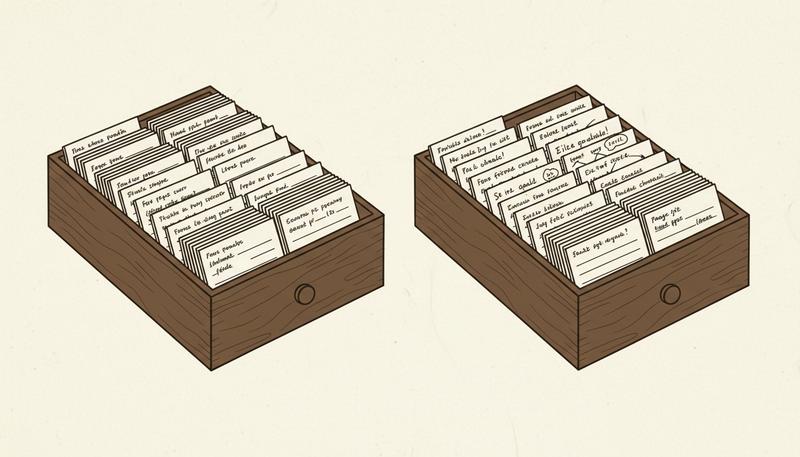
Here's one of the most commonly misunderstood facts about Luhmann's practice: he didn't have one Zettelkasten. He had two, serving entirely different functions.
The first was a bibliographic slip box. This was relatively straightforward — essentially a personal library catalog. Each card held bibliographic information on the front (author, title, year, publisher) and a page index on the back: page X discusses concept Y, page Z contains the key argument. There were no personal thoughts in this box. It was a finding aid, nothing more.
The second was the main slip box — the one that gets all the attention. This is where Luhmann did his actual thinking. And here's the critical part, worth underlining: he made a strict rule for himself: nothing went into the main box that wasn't expressed in his own words. Not quotes. Not summaries of other people's arguments. His own reformulations, his own interpretive glosses, his own ideas sparked by reading.
The two-box architecture separated two distinct activities that most note-takers conflate: recording sources (bibliographic box) and developing ideas (main box). The bibliographic box was populated quickly; the main box was populated slowly and deliberately. Notes in the main box were meant to be, in Luhmann's phrase, "completely independently understandable" — you should be able to read any card without access to its source and still grasp what it's saying.
This distinction has enormous practical consequences. If your Zettelkasten is full of quotes, summaries, and paraphrases tied to specific texts, it's functioning more like a bibliographic box than a main ideas box. That's useful — but it's not what generates the productive collisions Luhmann describes. The collision happens between ideas, not between source texts. And ideas, in Luhmann's system, can only be in the main box if they've been fully translated into the thinker's own voice and conceptual framework.
Luhmann vs. Ahrens: Where the Popularization Diverges
Sönke Ahrens' How to Take Smart Notes is the book that brought Zettelkasten to a large English-speaking audience, and it's a genuinely good book. But it's worth being explicit about where it diverges from Luhmann's original practice, because some of those divergences have real consequences.
The fleeting note as a category. Ahrens introduces "fleeting notes" as the first stage of a three-part workflow (fleeting → literature → permanent). This is a helpful pedagogical structure for students and general readers. But Luhmann himself doesn't use this terminology in the essay, and his two-box system suggests a somewhat different architecture: you capture bibliographic references in one place and develop ideas in another, without an explicit intermediate "literature note" stage. The Ahrens model is a reasonable adaptation, but it's an adaptation.
The emphasis on students. Ahrens is explicitly writing for students writing academic papers, and much of the workflow he describes is optimized for that context — reading sources, producing literature notes, and synthesizing into long-form academic writing. Luhmann was a practicing scholar, not a student, and his system had been running for decades before he wrote about it. The level of development he's describing in the essay is the endpoint, not the starting point.
The framing of output. Ahrens presents the Zettelkasten as a system for producing publishable writing, which it certainly can be. But Luhmann's framing in the essay is more expansive: the slip box is primarily a thinking tool, and writing is one output among others. The distinction matters because it affects how you evaluate whether the system is "working" — Luhmann would say it's working if it generates productive surprises and develops thought, even if no publishable paper results.
The role of hierarchy. We'll dig into this more in Section 8, but Luhmann's numbering system was genuinely non-hierarchical — designed to allow branching and threading without imposing a fixed organizational structure. Some popular implementations have drifted toward more hierarchical folder systems that look like Zettelkasten but don't replicate its key structural property.
None of this is a critique of Ahrens, who is admirably honest about adapting the method for his audience. It's just worth knowing where you're working from the original and where you're working from an interpretation, so you can make informed choices about what to adopt for your own purposes.
Reading the Essay's Key Passages
Let's look at a few of the essay's actual passages and do what a Zettelkasten reader is supposed to do with them — not just note what was said, but ask what it means and where it leads.
On writing as prerequisite to thinking:
Luhmann opens with a claim that would have seemed radical in 1981 and still tends to provoke resistance: "It is impossible to think without writing; at least it is impossible in any sophisticated or networked (anschluSSfähig) fashion."
The active reader's first question is: is this true? The counterexample feels obvious — surely people think without writing all the time. But Luhmann's qualifier is important: sophisticated, connectable thought. He's not saying you can't have passing thoughts without paper. He's saying that the kind of thought that builds on itself, that accumulates, that makes unexpected connections across time — that kind of thought requires external scaffolding. Your working memory is too small and too volatile to hold the kind of multi-threaded, long-horizon intellectual project that produces original work.
This connects to the cognitive science we covered earlier: the limitation isn't intelligence, it's the architecture of biological memory. Writing externalizes the scaffolding that thinking needs to operate at scale.
On the quality of notes:
Luhmann is scathing, in his quiet academic way, about bad notes. He describes the common approach — writing down things because they seem interesting, without thinking about where they fit or what they mean — as producing "trash." (He uses more measured language, but the implication is clear.) The problem isn't volume; it's that undirected collection produces material with no internal coherence, no capacity to surprise, no productive friction. A pile of interesting quotes is not a thinking tool.
The active reader asks: what makes a note good in Luhmann's terms? The answer is that a good note is relational. It's written with awareness of what else is in the system. Its value comes not from its intrinsic content but from the connections it enables. This is why Luhmann spent time — sometimes a lot of time — deciding where in the slip box to place a new note. The placement decision was part of the thinking, not a filing chore.
On complexity and the need for a partner:
One of the essay's subtler arguments is about the relationship between a thinker and the limits of individual cognition. Luhmann was working on systems theory, a framework with extraordinary scope — 'Die Gesellschaft der Gesellschaft' is substantially longer than 800 pages—it is approximately 1,100+ pages (depending on edition), making it one of Luhmann's most extensive works.. No individual mind can hold a project of that scale in working memory. The external system isn't a convenience; it's a structural necessity for a certain kind of intellectual ambition.
Most of us aren't writing 800-page sociological treatises, but the principle scales down. Even a moderately ambitious research or writing project — an article, a dissertation chapter, a book — exceeds what most people can coherently manage without external scaffolding. The Zettelkasten isn't just useful for geniuses with extraordinary projects. It's useful for anyone whose intellectual work has more moving parts than they can track in their heads.
What This Close Reading Yields
Let me model the kind of synthesis that this reading might produce in someone building a Zettelkasten. Not a summary of what Luhmann said, but the ideas that this reading makes live and available for further development:
-
The slip box's value is emergent, not additive. You don't build it to have more information; you build it to have more productive collisions between ideas. That reframes what "success" looks like when you're using the system.
-
Storage and thinking are different operations. A filing system and a thinking system are not the same thing, and conflating them degrades both. Luhmann's two-box architecture encodes this principle in a way that's easy to lose in digital implementations.
-
The "in your own words" rule is functionally essential. Luhmann's insistence on this isn't about credit or originality — it's about processing. The act of reformulating forces comprehension. You cannot paraphrase an idea you don't understand. This makes the rule not just stylistically preferred but structurally necessary.
-
The Zettelkasten as a communication partner suggests a particular attitude. You consult it with questions, not just search queries. This changes how you build it (you add things that you want to be able to "talk to" later) and how you use it (you approach it with intellectual openness, not just information-retrieval intent).
These are the kinds of notes that belong in Luhmann's main box — not "Luhmann says X" but "reading Luhmann suggests Y, which connects to Z, which raises the question W." Each of these four ideas could be the seed of a permanent note that grows connections over time.
Tip: When you finish a difficult text, try writing three to five "implications" — not summaries of what was said, but consequences of taking the argument seriously. These almost always make better permanent notes than any literal summary could be.
The Essay as Method-in-Action
There's a lovely recursiveness to reading "Communicating with Slip Boxes" as part of building your own Zettelkasten practice. Luhmann is describing, in this essay, exactly the kind of productive intellectual exchange that good note-taking is supposed to enable. The essay itself is a product of the system it describes — it emerged from decades of accumulated notes, unexpected connections, and the kind of thinking-in-writing that Luhmann insisted was the only real kind.
Reading it actively, the way we've been doing here, is itself a demonstration of the method. We brought questions to the text. We extracted ideas rather than facts. We asked where each claim leads, what it connects to, what it implies. We noted where the primary source diverges from its popularizations. And we produced, in the process, a set of ideas that are now ours — not Luhmann's, not Ahrens', but something that emerged from genuine engagement with their thinking.
That's the whole game. And it was all right there in the essay, if you read it slowly enough.
Only visible to you
Sign in to take notes.