How to Create a Reading and Writing Workflow for Knowledge Management
The Reading and Writing Workflow: From Source to Permanent Note to Published Output
You now have your minimal vault. Three folders. Three templates. Core plugins enabled. Everything you need to start, nothing more. But a tool without a practice is just furniture. In this section, we turn to what actually happens inside that system — the daily rhythm of how material moves from reading to writing to thinking to output.
Here's something that sounds obvious once you hear it but that almost nobody actually does: reading and writing are the same activity. Not metaphorically. Literally. When you read with the intention of producing permanent notes, you are already writing. You're selecting, translating, connecting, and arguing — all the things that happen when you sit down to "write" something. The Zettelkasten doesn't separate these phases. It fuses them into a single ongoing process where every good reading session deposits material directly into your thinking infrastructure, and every writing project draws from reserves you've been building for months or years.
This is the payoff. Everything in the previous sections — the cognitive science, the note types, the linking structure, the tool setup — has been building to this: a workflow where reading isn't preparation for thinking, and writing isn't the thing you do after you've done enough thinking. They're one continuous act, interrupted only by sleep and lunch. The question this section answers is practical: what does that actually look like, hour by hour, session by session?
How You Approach a Text
Before you start: Spend two minutes orienting. Skim the table of contents, the introduction, the conclusion. What is this source actually arguing? What question is it answering? You're not reading yet — you're deciding how to read. A book arguing a single thesis you already disagree with gets read differently than a book packed with empirical data you want to mine. A paper you're reading for one specific study gets different treatment than a book you're reading because it seems foundational to a topic you care about deeply.
During reading: Read with pen in hand or fingers near keyboard. Your only job is to notice when something interesting happens — when an idea surprises you, when an argument seems shaky, when you find yourself thinking "oh, that connects to..." Capture that reaction immediately. Don't trust yourself to reconstruct it later. The interesting thought you have while reading page 47 is almost certainly gone by page 52.
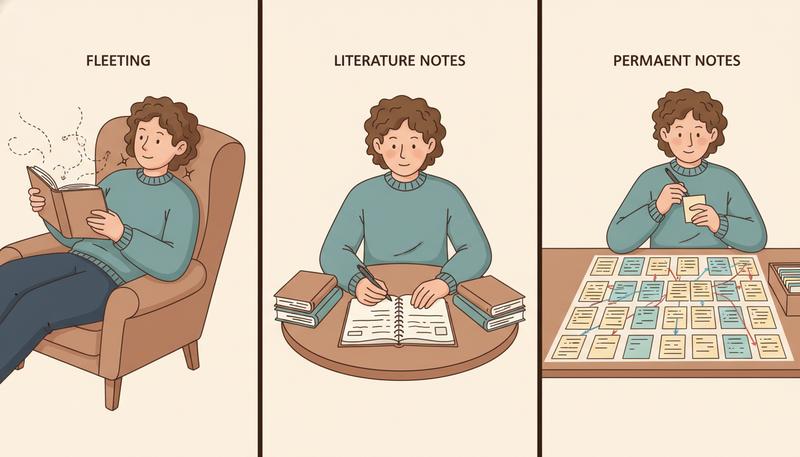
At this stage you're making fleeting notes — rough, fast, informal. They don't need to be sentences. "Kahneman S1/S2 — applies to retrieval practice? check" is a perfectly good fleeting note. Its only job is to hold your reaction long enough that you can process it later.
For literature notes — which you'll make at the end of a reading session rather than moment-by-moment — the key discipline is translation. Don't copy quotes. Rewrite the idea in your own words, at whatever level of compression makes it useful. If you can't restate an argument in your own language, you don't understand it yet, and the literature note is your signal to go back and read more carefully. Ahrens emphasizes keeping literature notes "extremely concise and highly selective — only record content you think you might use in the future."
Tip: Write literature notes after finishing a section or chapter, not sentence-by-sentence. This forces synthesis: you have to decide what was actually important, rather than transcribing everything that seemed interesting in the moment.
The bibliographic layer: Every literature note gets sourced. Author, title, year, page number. This sounds tedious, but it takes ten seconds and saves enormous pain later when you're assembling a draft and need to know where something came from. In a digital system like Obsidian, linking to a bibliographic note is even faster.
The Permission to Stop: Selective Reading as Skill
Here's something the productivity genre rarely tells you: you don't have to finish books.
Not just "it's okay if you don't." More strongly: finishing every book you start is often the wrong move. A book that's worth 40 pages of your attention doesn't suddenly become worth 340 pages just because someone published it that way. Your job is to extract what's useful and move on.
The Zettelkasten framework makes this easier, because your reading has a concrete output: useful permanent notes. Once you've extracted everything from a source that might become a permanent note, you've gotten the value. The remaining pages might be interesting, but if they're not producing material you'll want to think with, they're costing you time you could spend on something richer.
This isn't laziness. It's calibration. Nassim Taleb has called this the "anti-library" mindset — your unread books are not failures, they're optionality. You own them because you might need them, not because you're obligated to process every page. Applied to the reading workflow, it means treating every source as a potential mine and stopping when you've extracted the ore.
In practice: if you're twenty pages into something and haven't produced a single interesting fleeting note, that's data. Maybe the book isn't for you. Maybe you already know this material. Maybe now isn't the right time and you should set it aside for when the topic becomes live for you. None of these are problems to solve. They're decisions to make quickly so you can spend time on something that's actually generating material.
Processing Sessions: The Alchemy Happens Here
Reading generates raw material. Processing turns it into actual Zettelkasten content. These are different cognitive activities and they shouldn't be mixed in real time — you can't read well if you're constantly interrupting yourself to craft permanent notes, and you can't think deeply about a note if you're simultaneously trying to follow an argument.
The processing session is where fleeting notes become permanent notes. It's the phase that most Zettelkasten beginners skip or rush, and it's exactly why their systems feel hollow.
Timing: Ahrens recommends processing fleeting notes within a day or two — they decay fast. A fleeting note that made perfect sense at 2pm Tuesday is often cryptic by Thursday morning. Your literature notes can wait a bit longer, but not indefinitely. A practical rhythm for most people: one or two focused processing sessions per week, each 45-90 minutes, is enough to stay current if you're reading steadily.
What happens in a processing session:
- Pull up your fleeting notes from the last session or two. Read through them quickly.
- For each fleeting note, ask: Is this worth turning into a permanent note? Many won't be. That's fine — fleeting notes are designed to be discarded. Delete the ones that don't hold up.
- For the ones that do hold up, write the permanent note. One idea. Own words. Complete enough to be understood without the source. (If you haven't already reviewed the permanent note format from Section 7, the key is that it should stand alone and speak to a future version of you who has forgotten the context.)
- As you write each permanent note, look for connections to existing notes. This is the crucial step most people underweight. The note you just wrote — what does it remind you of? What does it contradict? What does it extend? Follow those threads. The links you create during processing are where the intellectual value accumulates.
- Add the new note to your index if it's a point of entry for a new topic, or file it into an existing note sequence if it belongs in one.
Warning: The most common processing failure is turning fleeting notes into literature notes rather than permanent notes — i.e., summarizing what the source said rather than articulating what you think. If your permanent notes sound like book reports, you're one step short of the real thing.
A good processing session is cognitively demanding. You're thinking hard, making connections, writing carefully. Don't try to process 200 fleeting notes at once. An hour of genuine processing produces maybe five to ten good permanent notes — that's a great session. Quality over volume, always.
graph TD
    A[📖 Reading Session] --> B[Fleeting Notes\nraw reactions, quick captures]
    B --> C{Processing Session}
    C --> D[Worth keeping?]
    D -->|No| E[🗑️ Discard]
    D -->|Yes| F[Permanent Note\nin own words]
    F --> G[Link to existing notes]
    G --> H[Update index if needed]
    H --> I[Zettelkasten grows]
    A --> J[Literature Notes\nselective summary]
    J --> C
From Zettelkasten to Draft: How Linked Notes Become Arguments
At some point you want to write something for someone else. An essay, an article, a report, a blog post. Here's where many Zettelkasten users encounter a new kind of confusion: they have all these notes, and they're not sure how to make them into a thing.
The conventional approach to drafting starts with an outline. You decide what you want to argue, construct a skeleton, then fill it in. This works, but it has a hidden cost: you've committed to a structure before you've fully explored what you know. You discover material that doesn't fit your outline, and you either force it in awkwardly or leave it on the cutting room floor. The outline becomes a constraint rather than a container.
The Zettelkasten approach inverts this.
Step one: Start with a question, not an argument. What are you trying to understand or say something about? This might be broad ("why do organizations resist change?") or narrow ("is spaced repetition actually more effective for procedural knowledge than for declarative knowledge?"). The question is your compass, not your thesis.
Step two: Search your Zettelkasten for notes related to the question. Follow your links. Don't force a path — explore. You're looking for what's actually there, not confirming what you already planned to say.
Step three: Notice clusters. Certain notes will keep connecting to other notes. A group of five or six permanent notes might all circle the same idea from different angles. That cluster is the embryo of a section, maybe even of the whole piece.
Step four: Arrange the relevant notes into a sequence that makes sense. This is your outline — but notice that it emerged from your material rather than being imposed on it. The difference matters: you're now outlining arguments you already understand rather than making promises about arguments you haven't worked out yet.
Step five: Use the notes as raw material. Write your draft by working through the sequence of notes, translating each into prose, adding transitions, sharpening the argument. Your notes don't become your draft verbatim — you're writing from them, not copy-pasting them. But the intellectual work is largely done. You're not thinking from scratch; you're articulating what you've already worked out.
Remember: The draft is a rearrangement, not a reinvention. The hard cognitive work happened during reading and processing. By the time you sit down to write an essay from your Zettelkasten, you're mostly in editorial mode — shaping material you already understand into a form a reader can follow.
This is why experienced Zettelkasten users describe drafting as comparatively easy. Not effortless — writing is never effortless — but freed from the specific terror of the blank page. The page isn't blank. You have notes.
Bottom-Up Outlining: Letting Structure Emerge
The distinction between top-down and bottom-up outlining deserves its own moment because it's one of the most counterintuitive shifts in the whole Zettelkasten practice.
Top-down outlining (the kind you learned in school): Decide your thesis → create main points → create subpoints → fill in evidence. The structure is a scaffold you build first, then hang content on.
Bottom-up outlining (the Zettelkasten approach): Collect relevant material → spread it out → notice what naturally clusters and what naturally sequences → let a structure emerge. The structure is something you discover, not something you invent.
Bottom-up outlining is better for at least two reasons.
First, it's honest about what you actually know. When you outline top-down, you're often outlining what you wish you knew — promising sections you haven't actually developed yet. Bottom-up outlining only shows you what you've actually worked out. If a section of your outline has no notes behind it, that's not a gap you can paper over with confident prose. It's a signal that you haven't done the thinking yet, and you need to either do it or cut the section.
Second, it frequently produces better arguments. When you let structure emerge from material, you discover connections you wouldn't have planned. Two note clusters that seemed unrelated turn out to speak to each other. An example from an unexpected domain clarifies a point better than the conventional example. The argument you end up making is often more interesting than the argument you thought you were going to make.
The practical technique: Export or list all your relevant notes as titles. (In Obsidian, this might mean pulling up a search for a topic and looking at your results, or viewing a Map of Content note that links to the relevant cluster.) Then physically or digitally move them around until you find an order that makes sense as an argument. This is your outline. Revise it until the sequence of ideas has an internal logic — each note should create some expectation that the next note answers.
Worked Example: A Question Finds Its Argument
Let's walk through what this actually looks like.
The starting point: You're curious about why people find it so hard to change their minds, even when shown good evidence. You have a vague sense this might be worth writing about but you haven't committed to an argument.
Searching the Zettelkasten: You search for notes tagged or linked around "belief," "evidence," "cognitive bias," "persuasion." You find more than you expected:
- A note on confirmation bias, linking to two papers
- A note on motivated reasoning that connects to a note you wrote while reading a political science paper
- A note on the backfire effect (the counterintuitive finding that correcting misinformation sometimes strengthens the original belief)
- A note on identity-protective cognition — the idea that people evaluate evidence based on how threatening it is to their identity
- Two notes from a philosophy of science reading session about Bayesian updating and its limits
- A note connecting motivated reasoning to the workplace, from a business article you half-forgot reading
The unexpected cluster: You notice that the motivated reasoning note, the identity-protective cognition note, and the workplace note are all pointing at the same underlying mechanism — people protect beliefs that are load-bearing for their sense of self. This wasn't what you were looking for when you started searching, but it's more interesting than a generic "here are cognitive biases" piece.
The emerging argument: "Correcting beliefs isn't primarily a problem of evidence delivery. It's a problem of identity threat management." Your notes were already circling this. You just hadn't articulated it until you saw the cluster.
The bottom-up outline:
- The puzzle: why doesn't good evidence change minds?
- The backfire effect: sometimes it makes things worse
- Identity-protective cognition: the mechanism
- What this means for persuasion (your notes from the political science paper)
- Implications for the workplace (your forgotten business article note, now valuable)
- What does actually work: conditions where minds change
The draft: You write through this sequence, pulling from each note cluster, adding transitions and examples. The whole piece is drafted in a single afternoon — not because you're a fast writer, but because you're not doing the intellectual work for the first time. You did it gradually, across dozens of reading sessions, and your Zettelkasten was quietly organizing it the whole time.
This is the payoff Luhmann described when he talked about the slip box as a communication partner that generates surprise. You didn't plan to write about identity-protective cognition. Your notes led you there.
Writing FROM vs. Writing INTO Your Zettelkasten
There's a subtle but important distinction that catches people as their system matures.
Writing INTO your Zettelkasten means adding material: processing a reading session, converting fleeting notes into permanent notes, making connections between existing notes. This is the input mode. You're building.
Writing FROM your Zettelkasten means using it as raw material for an external output: a blog post, a paper, an article, a presentation. This is the output mode. You're harvesting.
Both directions are legitimate and both are necessary, but they require different mental modes and you shouldn't try to do both at once.
The failure mode is treating output-writing as input-building at the same time. You sit down to draft an essay, but instead of pulling from your existing notes, you start researching, processing new sources, generating new permanent notes — and you never actually draft the essay. Or you sit down to process reading material, but instead of adding notes to the Zettelkasten, you immediately try to spin them into publishable prose before they've been properly integrated.
The discipline here is directional awareness: right now, am I building the system or using it? Both are good. Mixing them accidentally produces neither good notes nor good prose.
A practical rule: when you're in output mode (drafting a piece), treat your Zettelkasten as a library you can browse but shouldn't revise. If you notice a gap or a new connection while drafting, make a quick fleeting note and come back to it in your next input session. Don't derail the draft to process new material.
graph LR
    A[📚 Sources &\nNew Ideas] -->|Writing INTO| B[(Zettelkasten)]
    B -->|Writing FROM| C[📄 Published\nOutput]
    D[🔄 Processing\nSession] --> B
    B --> E[🔍 Note\nExploration]
    E --> C
Maintaining Momentum: Keeping the System Alive
Every Zettelkasten practitioner has experienced this: you build the system enthusiastically, maintain it steadily for a few months, then hit a wall. A work sprint absorbs all available attention. You miss two processing sessions. The fleeting notes pile up. You feel vaguely guilty every time you open Obsidian and see the backlog. Eventually you stop opening Obsidian.
This is the normal lifecycle, not a personal failing. The question is how to design around it.
Minimum viable practice: Identify the smallest version of the workflow that still produces value. For many people, this is: one processing session per week, even if it's only 30 minutes. Even if it only produces two permanent notes. Even if the fleeting notes are from three weeks ago. The system doesn't die from slow input — it dies from complete abandonment. If you can maintain some connection to it through heavy periods, it will be there when you return.
Let projects be the engine: The Zettelkasten works best when it's connected to something you're actually trying to produce. When you have a piece to write, you have a reason to search your notes, which reveals gaps, which gives you reading questions, which generates new notes. Pure "I'm just building the system" maintenance is harder to sustain than "I'm working on this piece and I need to understand X better." Use output goals to drive input behavior.
Declare amnesty on the backlog: If you've fallen behind on processing and have three weeks of fleeting notes you haven't touched, don't try to process all of them. Go through them quickly, save anything that's still obviously interesting, and delete the rest. An imperfect Zettelkasten with current material beats a perfect Zettelkasten you've abandoned because you can't catch up.
Separate capture from processing: If the whole workflow feels overwhelming, separate the steps. Some weeks, all you do is capture fleeting notes and you don't process anything. That's fine. The notes degrade but they don't disappear. Some weeks you do a big processing session and don't read anything new. The system accommodates asymmetry.
Tip: Build the habit of opening your Zettelkasten before any research or reading session, not after. Checking what you already have on a topic takes two minutes and often reveals you've already done more thinking than you remembered — which both saves time and reminds you the system is working.
What a Mature Zettelkasten Feels Like
Somewhere around the 200-500 note mark — it varies, because it depends more on the quality of links than the raw count — something shifts.
The system stops feeling like a filing cabinet and starts feeling like a thinking partner.
You search for something on a topic you haven't actively worked on in six months and find four notes you'd forgotten you'd written, connected to each other in ways you didn't deliberately plan. You realize your thinking on the topic has already progressed further than you knew. You have the beginning of an argument, sitting there waiting.
Or: you're trying to explain a difficult concept and you search your notes for an analogy, and the system surfaces one from a completely different domain — something you read for entirely different reasons that turns out to be the perfect illustration.
Or: you're stuck on a piece you're writing and you open your Zettelkasten not because you know what you're looking for, but just to browse — and the act of reading your own past thinking from six months ago jogs something loose and you understand what the piece actually needs to say.
Luhmann described this as the surprise that genuine communication requires: "One of the most basic presuppositions of communication is that the partners can mutually surprise each other. Only in this way can information be produced." When the slip box surprises you, that's information. That's the system doing its job.
This experience is hard to describe convincingly to someone who hasn't felt it yet. It sounds mystical, but it's actually mundane: you've been having a slow, distributed conversation with your past self, and when you look at the transcript, you see things you didn't realize you'd said. Not magic — just the accumulation of many small, disciplined acts of thinking in writing, linked to each other over time.
The Zettelkasten doesn't think for you. It holds your thinking in a form you can see, connect, and build on. That's enough. That's actually quite a lot.
The whole system — the cognitive science rationale, Luhmann's original design, the note types, the linking structure, the processing discipline — all of it is in service of this: giving your past self a way to collaborate with your future self on problems neither of you has fully solved yet. The workflow described in this section is what makes that collaboration concrete and repeatable.
Now you have the mechanics. The next section will show you what breaks them — and how to recognize when it's happening.
Only visible to you
Sign in to take notes.