How to Use Fleeting Literature and Permanent Notes
Note Types in Practice: Fleeting, Literature, and Permanent Notes
We've just explored how atomicity, linking, and emergence work together as an integrated system — one that forces elaborative encoding, creates retrieval practice, and distributes cognition across a lifetime of notes. But here's where the rubber meets the road: how do you actually do this? How do you sit down with a book or article and turn it into atomic, linked notes that will eventually generate emergence?
The answer lies in the three-note taxonomy that Luhmann built into his slip box: fleeting notes, literature notes, and permanent notes. But here's the crucial insight that most productivity writers skip over: this taxonomy is not actually about organization. It's about thinking. The categories exist not to help you file things neatly but to force a specific cognitive process — capture, then engage, then synthesize. Each note type serves a different function in the chain of transformation from raw input to finished thought.
Skip any step, or muddle them together, and you end up with a slightly fancier version of the graveyard we diagnosed in section two. What follows is a practical, honest account of how each note type works, what it costs you when you get it wrong, and exactly what the transformation from raw input to finished permanent note looks like in practice.
Fleeting Notes: The Art of Capturing Without Overthinking
Here's something you need to know upfront: the discipline of the Zettelkasten is not a capturing discipline. It's a processing discipline.
Most productivity systems are, at heart, glorified collection mechanisms. They help you sweep things off your desk and into a container, which feels productive without actually being so. The relief of capture — "I've saved that, I can relax now" — is almost entirely illusory if nothing happens next.
A fleeting note is exactly what it sounds like: fleeting. It's the thought you jot down while reading, the fragment you capture on your phone in the middle of a conversation, the half-formed idea that bubbles up and you're terrified you'll lose. The point of a fleeting note is not to be perfect or polished. The point is to be there when you need it.
Warning: The most common mistake with fleeting notes is treating them like a real filing system. If your "capture inbox" has 2,000 items in it, you don't have a capture system — you have a second graveyard with better aesthetics.
The discipline kicks in when you process them. Many practitioners do this at the end of each day or at the start of a writing session: go through the fleeting note inbox, decide what's worth developing, and either process it into a literature note or delete it. Yes, delete. Not every fleeting note deserves to survive. A good capture habit is generous; a good processing habit is ruthless.
If you find yourself unable to process a fleeting note — you can't quite remember what you meant, or the thought seems to have evaporated — that's useful data. The thought probably wasn't as developed as it felt in the moment. Throw it away without guilt. The real purpose of a fleeting note is to empty the inbox regularly, not to curate it forever.
Literature Notes: Engaging With Sources, Not Summarizing Them
When you sit down with a book, an article, a paper, or a podcast transcript, the output of that engagement should be a literature note. This is a note about a specific source — what it argues, what ideas it contains that are worth keeping, and what you think about those ideas.
That last part is where most people stumble.
A literature note is not a summary. It is not a book report. It is not a collection of your highlights pasted into a document. Those things feel like knowledge work but are actually just transcription — the cognitive equivalent of re-shelving a book rather than reading it. You're moving the information around without actually processing it.
The non-negotiable rule, which Ahrens insists on and which experienced practitioners will confirm from painful experience, is this: write your literature notes entirely in your own words. No copy-paste. No block quotes as the main content. If you can't explain something in your own language, you don't understand it yet — and a literature note that you don't understand is worthless to your future self.
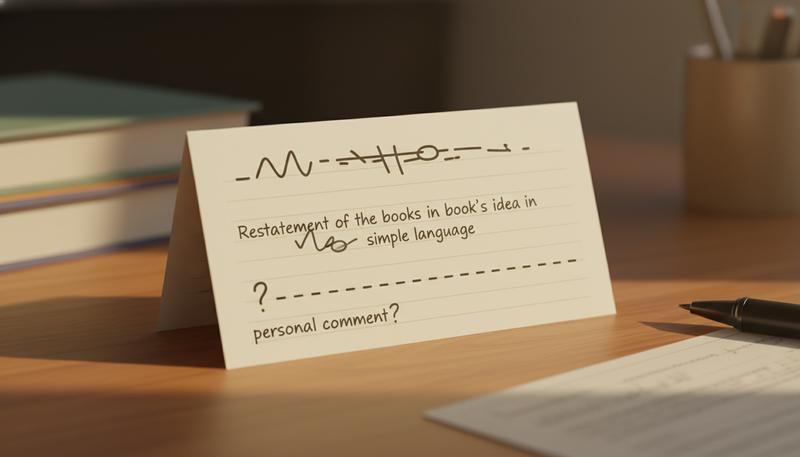
Writing in your own words accomplishes several things simultaneously. First, it forces comprehension — you cannot paraphrase something you don't understand. Second, it creates your version of the idea, which is subtly different from the author's and reflects your current mental model. Third, it means the note is actually readable later. A quote is opaque; a paraphrase in your own voice is alive.
Being Selective: The Thinking Part
Here's the counter-intuitive point that trips up enthusiastic beginners: a literature note with thirty bullet points from a single chapter is worse than a literature note with three.
Why? Because selecting what matters is thinking. When you decide to extract one idea from a chapter rather than everything in it, you're making a judgment: this is what's genuinely new to me, genuinely interesting, genuinely relevant to what I'm working on. That judgment is where understanding begins. A literature note that attempts to capture the entire book is really just a slightly condensed version of the book — and you already have the book.
The test for whether something belongs in a literature note is simple: does this change or extend how I think about something? If the answer is yes, capture it. If it's just "this is interesting" without any clear intellectual consequence, let it go. You can always return to the source.
Practically, many practitioners aim for between three and fifteen items per book, fewer per article. The number matters less than the intention behind it. Every item should pass the test: this is worth thinking about more carefully later.
Tip: If you finish a source and have more than twenty literature note items, do one pass of ruthless editing before moving on. Force yourself to cut the list in half. What you keep will be genuinely worth keeping.
Permanent Notes: Where Synthesis Happens
If fleeting notes are captures and literature notes are engagement, permanent notes are synthesis. They are the notes that live in your Zettelkasten indefinitely, linked to other notes, and written as if for an intelligent reader who has never encountered this idea before — including, importantly, yourself in five years.
What makes a note permanent is not where it's stored or what tag it has. It's three qualities:
1. Self-contained. A permanent note should make sense without reference to anything else. If you need to open a different note or the source material to understand what the note says, it isn't self-contained yet. Write it so it stands alone. Future-you should be able to read it in isolation and get it immediately.
2. Future-self-readable. Your future self will have forgotten the context in which you wrote this note. Write for them, not for now-you. Include enough background that the idea is recoverable. Use clear language. Define terms that might be ambiguous. Assume nothing about what they'll remember.
3. Linked. A permanent note that isn't connected to anything else in your system is an orphan. It won't be found; it won't generate connections; it won't do the work you built the Zettelkasten to do. Every permanent note should link to at least one other note, and ideally two or three — notes that it builds on, contradicts, extends, or provides evidence for. The connections are where meaning lives.
The other thing permanent notes are not: they're not journal entries, they're not reference materials, and they're not summaries of sources. A journal entry is personal and chronological; a permanent note is conceptual and timeless. A reference note (author bio, book metadata) belongs in your reference manager, not your Zettelkasten. A source summary belongs in your literature note file. A permanent note is your thinking about an idea, expressed as a standalone claim or insight that can be connected to other thinking.
graph TD
    A[Source Material] -->|Reading & highlighting| B[Fleeting Note]
    B -->|Processing session| C[Literature Note]
    C -->|Reflection & synthesis| D[Permanent Note]
    D -->|Linking| E[Existing Permanent Notes]
    D -->|Contributes to| F[Future Writing / Output]
    B -->|If not worth developing| G[Delete]
Tracing One Idea Through the Pipeline
Let's make this concrete. Here's how a single idea travels from source to permanent note.
The source: You're reading Daniel Kahneman's Thinking, Fast and Slow, and you come across his description of what he calls "the illusion of understanding" — the tendency of people to believe they understood events after the fact that they could not have predicted beforehand. Kahneman calls this hindsight bias.
Stage 1 — Fleeting note:
You're reading on the couch. You grab your notebook and write:
"Kahneman — hindsight bias — we think we knew it all along. Connects to something about overconfidence? Also: why do postmortems feel so satisfying even when they're useless?"
That's it. Rough, associative, half-formed. It's a placeholder, not a note. You don't try to make it good. You just make sure you don't lose the thread.
Stage 2 — Literature note:
Later that evening, you sit down to process your fleeting notes. You return to the chapter, reread the relevant section, and write:
Kahneman, Thinking Fast and Slow, Ch. 19
After an event, people consistently overestimate how predictable it was in advance. This isn't just bad memory — it's a systematic bias: the mind updates its memory of what it believed before the event to align with what it now knows happened. The result is that we feel we "knew it all along" when we didn't. Kahneman connects this to the illusion of understanding — we confuse the ability to explain the past with the ability to predict the future.
My reaction: this might explain why corporate post-mortems often feel profound without actually producing useful predictions. The analysis sounds rigorous but is retrospectively constructed. Does this also apply to personal narrative — the stories we tell about why our relationships worked or failed?
Notice what happened there. The literature note captures the idea in your own words, attributes it, includes your genuine response (the speculation about post-mortems and personal narrative), and flags a potential extension. It's not long. It's not a summary of the chapter. It's one idea, engaged with honestly.
Stage 3 — Permanent note:
A few days later, processing your literature notes, you decide this idea is rich enough to develop. You write a permanent note:
Title: Hindsight bias produces the illusion of understanding, not genuine insight
Once we know how an event turned out, we systematically overestimate how predictable it was beforehand. This is hindsight bias (Kahneman). The mind retroactively updates its beliefs about what it "knew" before the event — meaning our felt sense of understanding is often a reconstruction, not a memory.
The dangerous consequence: confusing the ability to explain the past with the ability to predict the future. Post-hoc explanations feel rigorous because they are coherent and causally structured — but coherence is not the same as predictive validity.
This has implications for: — Why organizational post-mortems often fail to improve future decisions [[note: post-mortems and organizational learning]] — The seductiveness of narrative in personal memory [[note: narrative self and motivated reasoning]] — The limits of historical explanation as a predictive tool [[note: history as hindsight]]
See also: overconfidence effect, the planning fallacy, availability heuristic
That note is self-contained (you could read it without the literature note or the source), future-self-readable (it defines the concept and its consequences), and linked (it points toward three other ideas, whether or not those notes exist yet). It's maybe 170 words, but it contains a claim, evidence, implications, and connections. That's what makes it permanent.
Remember: A permanent note is not a finished product. It's a thought that is finished enough to contribute to future thinking. It will probably be revisited, refined, and linked further as your system grows.
The Collector's Fallacy: Why Most Systems Fail
It has a name because it's that common. The Collector's Fallacy is the belief that gathering and saving information is equivalent to learning and knowing. It isn't. Not even close.
The Collector's Fallacy operates at every stage of the note-taking process. You highlight entire chapters because every sentence feels important. You save articles to a read-later app and never read them. You build elaborate folder structures in Notion filled with notes you've never processed. You fill your Zettelkasten with literature notes that are just block-quoted paragraphs. You have thousands of notes and nothing to say.
The painful truth is that collecting feels good. It feels productive. The action is legible — I saved that, I highlighted this, I filed it here — in a way that actual thinking isn't. Thinking is slow, uncertain, sometimes uncomfortable. Collecting is satisfying and immediate. It's the productivity theater that lets you feel like you're building knowledge when you're really just moving things around.
The Zettelkasten is a machine specifically designed to break the Collector's Fallacy — but only if you let it. The three-note taxonomy forces processing at every stage. You can't dump highlights into permanent notes; you have to engage with them as literature notes first. You can't leave fleeting notes to accumulate; the system demands they be resolved. Every time you sit down to write a permanent note in your own words, you are doing the thing that collecting only pretends to do.
This is why the Zettelkasten is genuinely harder than most note-taking systems. It is less forgiving of passive collection. But that friction is the point — it's the friction of thinking.
When Is a Note "Done"?
Short answer: it's the wrong question.
Notes aren't done; they're developed enough. A permanent note is developed enough when you could use it to write a paragraph, when it could be linked meaningfully to two or three other notes, when your future self could read it cold and understand what you were thinking. That's the bar.
The temptation — especially for people who are new to the system and anxious about getting it right — is to keep refining a note until it's perfect before adding it to the system. This is a mistake in both directions. An underdeveloped permanent note that just says "hindsight bias — look this up" is too thin. A permanent note that runs to 2,000 words and tries to synthesize everything you've ever thought about cognitive bias is probably too thick — it should be broken into multiple atomic notes.
The craft of permanent note-writing is finding the level of development where the note is genuinely useful without trying to do too much. That level is lower than most beginners expect. A well-written 150-word note that makes one clear claim and points to three connections is better than a sprawling 800-word essay that tries to say everything at once.
The principle of atomicity — that each note should contain one idea and one idea only — is foundational to the Zettelkasten method. It's not a bureaucratic rule. It's what makes notes linkable, findable, and actually useful when you're trying to write something.
The question to ask instead of "is this done?" is: "If I needed to use this thought tomorrow, could I?" If yes, the note is developed enough. File it, link it, and move on. The system will tell you over time which notes need more development — they'll be the ones you keep returning to without being able to connect them to anything, or the ones that feel vague when you read them back.
The Pipeline as a Thinking Practice
Here's the reframe that makes the whole taxonomy click: the three note types aren't a filing system. They're a thinking practice. Fleeting → Literature → Permanent is not a workflow for organization. It's a workflow for comprehension, engagement, and synthesis — which happen to be the three things that actually produce original ideas.
Every stage demands something from you. Fleeting notes demand honesty (capture what actually caught your attention, not what you think should catch your attention). Literature notes demand effort (write it in your own words even when it's hard). Permanent notes demand judgment (decide what this idea means, how it connects to everything else you know, and what claim you want to make about it).
That's not a productivity hack. That's just thinking — made visible, made habitual, made structural. You have to interpret your sources and then rely on your own thoughts henceforth to get the maximum benefit. The three note types are simply a scaffold for doing that reliably, even when you'd rather just highlight and file.
The next section takes up a question that naturally follows: how do permanent notes relate to each other, and what does Luhmann's numbering and indexing system do for the architecture of the whole? But before we go there, do the exercise. Take one idea from whatever you're currently reading, run it through the pipeline, and write a permanent note. It will feel uncomfortable — too short, too uncertain, not authoritative enough. Write it anyway. The discomfort is the work.
Only visible to you
Sign in to take notes.