Civic Humanism and Political Republicanism: The Active Life
Civic Humanism and the Political Dimension: Republicanism, Virtue, and the Active Life
Yet the Renaissance humanist tradition was never purely contemplative. While some of its greatest figures spent their days in studies — translating Cicero, crafting elegant Latin letters about the soul — others took their humanist convictions directly into the political arena. The most consequential Renaissance humanists were chancellors, diplomats, and city officials who governed, negotiated, and sometimes went to war on behalf of their communities. They held a pen in one hand and a ledger of state in the other. And they didn't see this as a compromise of their humanist mission — they saw it as the mission's ultimate expression. This is the story of civic humanism: the political branch of Renaissance thought that took one core conviction we've already identified — that human beings deserve serious intellectual attention and that education develops our capacity for wisdom and virtue — and drew from it a genuinely radical conclusion. The good life, civic humanists insisted, is not achieved by withdrawing from the world. It's achieved by fully engaging with it.
For secular humanism's trajectory, this matters enormously. Secular humanism is not simply a private philosophy — something quiet you carry through life about God and morality. It has always had a public, political face. The civic humanists of Florence were among the first to argue that the examined life and the engaged life aren't in tension with each other; that human flourishing requires not just personal wisdom but active participation in building just communities. That conviction echoes, sometimes with striking directness, through Enlightenment republicanism, modern democratic theory, and the social commitments of secular humanism today.
The Baron Thesis: Crisis as Crucible
The story of how civic humanism emerged has a specific historian attached to it, and a specific historiographical dispute worth understanding before we dive into the ideas themselves.
In 1955, the German-American historian Hans Baron published The Crisis of the Early Italian Renaissance, arguing that civic humanism was born in a moment of political emergency. When Giangaleazzo Visconti, the powerful Duke of Milan, began aggressively expanding his territory in the early 1400s, Florence faced an existential threat. That threat forced Florentine intellectuals to articulate why their republic was worth defending. What made republican self-governance superior to rule by a prince? What made the engaged citizen, wrestling with civic problems, more fully human than the monk in his monastery? The need to answer these questions turned abstract admiration for classical antiquity into a living, urgent political philosophy. Crisis, Baron argued, was the crucible that forged civic humanist thought.
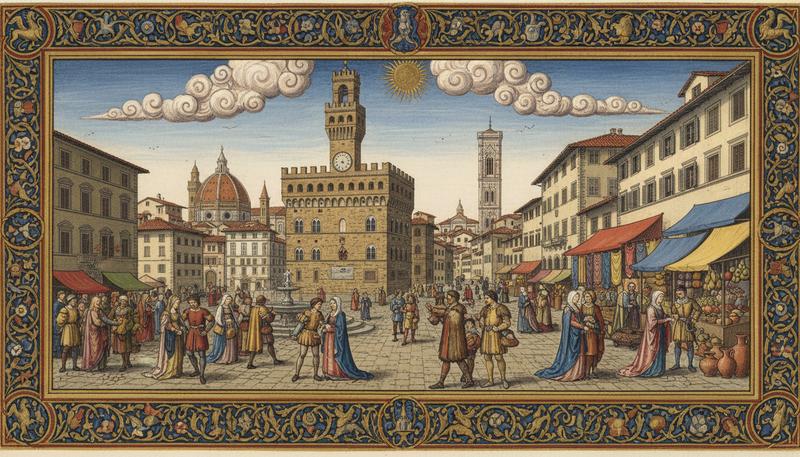
Since Baron published, historians have substantially revised and contested his thesis. Some argued he overstated the Milanese crisis's importance; others found civic humanist themes appearing earlier than his framework would predict, or emerging from gradual intellectual evolution rather than sudden political emergency. Eugenio Garin, working around the same time as Baron, reached similar conclusions independently — which is why the label could just as easily have been "the Garin thesis," as the Stanford Encyclopedia wryly notes. More recent scholars like James Hankins and Quentin Skinner have refined and sometimes challenged Baron's framework considerably.
But here's what's interesting about a thesis that gets partially dismantled by later scholarship: the dismantling often reveals something more fascinating than the original claim. What decades of scholarly debate established beyond reasonable doubt is that some version of the connection between humanist thought and republican political commitment was real — that in Florence, around the turn of the fifteenth century, there was a recognizable intellectual movement combining classical learning, civic engagement, and a defense of republican liberty. The exact causal mechanism matters less than the pattern itself.
And the pattern is genuinely fascinating for our purposes, because it demonstrates something secular humanism has always claimed: ideas don't emerge in a vacuum. Philosophical positions grow in response to real conditions, real threats, real human needs. The civic humanists weren't producing philosophy as an academic exercise. They were trying to make sense of — and help defend — a way of life they genuinely valued.
The Vita Activa: Rehabilitating Political Life
To understand what was radical about civic humanism, you have to understand what it was pushing against. Medieval Christian thought, drawing heavily on Augustine and the monastic tradition, had long elevated the vita contemplativa — the contemplative life, devoted to prayer, study, and withdrawal from worldly entanglement — as the highest form of human existence. The active life, the vita activa, was at best a necessary concession to human weakness, at worst a distraction from the soul's proper orientation toward God.
This wasn't a fringe position. It was essentially the cultural consensus across western Europe for roughly a thousand years. Thomas Aquinas distinguished between active and contemplative lives and, while he granted some dignity to action, he was clear: contemplation was the superior vocation. For ambitious young men of exceptional intellectual gifts, the monastery or the university — dedicated to divine contemplation — was the obvious destination.
The humanists flipped this hierarchy upside down. Or rather, they drew on a different tradition — the classical tradition — to argue that the hierarchy had always been wrong. Aristotle, after all, described human beings as zoon politikon, the "political animal," meaning we're naturally beings who live in political communities and can only achieve proper flourishing within them. Cicero celebrated the active statesman over the withdrawing philosopher. The Roman tradition that the humanists were so excited to recover was shot through with the ideal of civic service — the vir bonus, the good man who used his talents for his community's benefit.
The result was a genuine revaluation of political life. Civic humanists argued that running a city, serving as an ambassador, deliberating in councils, administering justice — these weren't distractions from the examined life. They were the examined life in action. Virtue, for the classical tradition the humanists were reviving, wasn't primarily a private quality (though it required private cultivation). It had to be exercised in the world, in relation to other people, in the messy arena of politics and governance. The philosopher who mastered theory but refused to put it to work for the community wasn't a sage. They were shirking their obligation.
graph TD
    A[Medieval Ideal: Vita Contemplativa] -->|Highest calling| B[Withdrawal from world]
    B --> C[Prayer, monasticism, scholarship]
    D[Civic Humanist Counter-Ideal: Vita Activa] -->|Highest calling| E[Engagement with the world]
    E --> F[Governance, civic service, diplomacy]
    G[Classical Sources] -->|Aristotle, Cicero, Livy| D
    H[Republican Florence] -->|Political context| D
    A -.->|Civic humanists reject this hierarchy| D
This wasn't an argument against intellectual life — the civic humanists were obviously devoted scholars. It was an argument against using intellectual life as cover for withdrawal. The best humanist education, they maintained, prepared citizens to serve their communities. The studia humanitatis — grammar, rhetoric, history, poetry, moral philosophy — weren't ornamental accomplishments. They were practical tools for someone who would govern well, argue persuasively for justice, and understand history well enough to navigate the present.
Coluccio Salutati: The Chancellor as Humanist
No figure better embodies the civic humanist ideal than Coluccio Salutati (1331–1406), who served as Chancellor of Florence for over thirty years, from 1375 until his death. Salutati was simultaneously one of the era's most important Latin stylists, a passionate collector and disseminator of classical manuscripts, and a highly effective political operator who wielded his pen in service to the Florentine Republic with a skill his enemies openly acknowledged.
Giangaleazzo Visconti of Milan — the same tyrant whose ambitions triggered the crisis Baron described — supposedly remarked that a letter from Salutati was worth a thousand cavalry. It may be apocryphal, but it's too perfect to ignore: it captures something genuinely true about both the man and the civic humanist vision. Eloquence, for Salutati, wasn't a private achievement. It was a political resource. The ability to articulate Florence's cause, marshal classical precedents, write persuasively to other Italian states, shame opponents, rally allies — this is what humanist education was for.
Salutati's theoretical writings reinforced what he practiced. In his treatise De vita associabili et operativa (roughly, "On the Social and Active Life"), he argued explicitly against the medieval elevation of contemplation, drawing on Aristotle and Cicero to insist that the active, engaged life was genuinely more virtuous — because virtue requires application. Untested courage is only potential courage. Justice never exercised in concrete situations is mere abstraction. For virtue to be real, it must be practiced, and the primary arena for its practice is communal life.
There's something bracingly practical about this view — something that will resonate with contemporary secular humanists reading it six centuries later. The idea that moral development isn't a private achievement but an ongoing social practice — that we become ourselves through what we do in relation to others — is thoroughly continuous with modern secular ethical thought. It anticipates, in important ways, the pragmatist insistence that ideas must be tested in practice to mean anything.
Leonardo Bruni: Historian, Statesman, Republican Theorist
If Salutati was civic humanism's first great practitioner, Leonardo Bruni (1369–1444) — his birth year was 1369, not 1370 was perhaps its most sophisticated theorist. Also a Florentine Chancellor (he served two terms), Bruni combined practical service with a body of historical and philosophical writing that represents the movement's intellectual high point.
Bruni's History of the Florentine People (Historiarum Florentini populi libri XII) is remarkable on multiple fronts. It's written in elegant Latin modeled on Livy and Thucydides. It treats history as genuinely human process — one driven by human decisions, virtues, and failures rather than divine providence. And it presents Florentine liberty as a story of civic self-determination, in which the republic's independence isn't a gift from God or happy accident but the achievement of citizens who chose to govern themselves and fought to preserve that capacity.
This secularizing shift in historical writing is deeply significant. Medieval historiography had been fundamentally providentialist — history was God's unfolding plan, and kingdoms' rise and fall were ultimately theological matters. Bruni replaced this framework with a human-centered one. What mattered in history were human institutions, human courage, human wisdom, human failures. This is, in a genuine sense, the birth of what we'd recognize as secular historical thinking.
Bruni also produced influential translations and commentaries on Aristotle's Politics and Nicomachean Ethics — new Latin versions far more accurate than medieval Scholastic translations, and versions that foregrounded the political and ethical dimensions of Aristotle's thought rather than bending it to Christian purposes. In his Oration for the Funeral of Nanni degli Strozzi (1428), he sketched a vision of Florentine liberty that's strikingly egalitarian: the republic's greatness lay precisely in its openness to all citizens regardless of birth, in its distributed rather than concentrated power.
This vision was idealized, of course — Florentine politics was deeply factional, oligarchic in practice, not exactly characterized by universal participation. The gap between civic humanist rhetoric and political reality is something honest scholars don't gloss over. But the rhetoric itself matters. Ideals have effects even when imperfectly realized. And Bruni's articulation of equal civic access, of government as a trust held for all citizens, of liberty as a collective achievement rather than private possession — these ideas proved enormously generative for later political thought.
Civic Virtue: What Citizens Owe Their Communities
Running through civic humanism is a concept worth examining carefully because it's simultaneously alien to modern individualism and strikingly relevant to contemporary democratic theory: civic virtue.
For the civic humanists, virtue wasn't primarily about personal piety or private moral excellence — as it largely was in medieval Christian thought and its secular descendants in modern individualism. Virtue was fundamentally social — it was the set of excellences that made you a good participant in communal life. And this required specific capacities: the ability to argue well and listen fairly; commitment to the common good over private interest; willingness to serve in public roles even when inconvenient; historical knowledge sufficient for good judgment; and the practical wisdom (phronesis) to navigate the inevitable messiness of political life.
This is demanding. The civic humanists were unsentimental about human nature — they knew perfectly well that most people, most of the time, are motivated primarily by private interests rather than the common good. This is precisely why civic virtue needed to be cultivated, through education and through institutions that gave citizens the habit of participation. The studia humanitatis wasn't just training for individual excellence; it was the curriculum of republican citizenship.
For contemporary secular humanists, this is a live inheritance rather than historical curiosity. The Humanist Manifestos, which we'll examine in a later section, consistently emphasize obligations to community and society alongside individual rights and freedoms. The secular humanist insistence that we're responsible not just for our own lives but for the quality of the shared communities and institutions around us — this is civic humanism's direct descendant, filtered through Enlightenment and twentieth-century progressive thought.
Machiavelli: Heir, Critic, and Complicator
Any account of civic humanism that ignores Niccolò Machiavelli (1469–1527) is incomplete, because Machiavelli is simultaneously civic humanism's most brilliant inheritor and its most devastating internal critic.
Machiavelli was, in many ways, deeply continuous with the civic humanist tradition. He was a Florentine Republican who worked as Secretary to the Second Chancery of the Florentine Republic for fourteen years. He was a devoted student of ancient history, particularly Rome, and drew on it constantly in his political writing. He was convinced that civic virtue was republican health's foundation and its decline was the key to republican decay. His Discourses on Livy is in many ways the Renaissance's most sophisticated elaboration of republican theory.
But Machiavelli introduced something the civic humanists hadn't wanted to look at too directly: the problem of power's relationship to virtue in a world where not everyone is virtuous. The civic humanist vision worked as an ideal by imagining that good citizens with good educations, guided by proper civic values, would produce good republican governance. What Machiavelli saw — with the cold eye of a man who'd spent fourteen years watching Florentine politics up close — was that this picture was incomplete.
In The Prince, written partly as a bitterly ironic corrective to civic humanist idealism, Machiavelli observed that a prince who tries to be good in all things will come to ruin among those who are not good. The world contains wolves, and adequate politics must account for that. Virtue alone — in the civic humanist sense — wasn't enough. The effective political leader also needed virtù in Machiavelli's more complex sense: a kind of adaptive excellence that included the capacity for cunning, force, and ruthlessness when circumstances required.
This is disturbing, and intentionally so. Machiavelli isn't celebrating political immorality; he's insisting that political idealists who ignore power dynamics will lose to those who don't, with the result that the values they cherish get extinguished rather than preserved. There's a serious argument here — one that civic humanists tended to evade — about the relationship between ethical ideals and political effectiveness.
For modern secular humanists, Machiavelli's challenge still cuts. The commitment to civic engagement — to political participation, to working for just institutions — has to reckon with the reality that politics isn't a philosophy seminar. It involves power, conflict, compromise, and the ever-present temptation to let good ends justify increasingly bad means. The Machiavellian realist inside civic humanism isn't a problem to dismiss; it's a tension to honestly manage.

The Thread from Florence to Philadelphia
The line from Florentine civic humanism to modern democratic theory isn't straight — it runs through several centuries of transformation, translation, and reinvention. But the connections are real.
One crucial transmission point is Quentin Skinner's work and the "Cambridge School" of intellectual history, which painstakingly documented how Renaissance republican ideas — including many drawn directly from civic humanist sources — fed into seventeenth-century English republican thought, the writings of Harrington and Milton, and from there into the political theory of the American founding. James Madison and the Constitution's framers weren't simply deriving their ideas from Locke's liberal theory of natural rights; they were also drawing on a republican tradition that emphasized civic virtue, the dangers of faction and tyranny, and the importance of institutional design in channeling human weakness toward the common good. That's a tradition with civic humanist roots.
The Enlightenment's political dimension, as the Stanford Encyclopedia documents, was deeply shaped by this inheritance. The philosophes — Montesquieu, Rousseau, and others — reworked themes civic humanists had introduced: the relationship between liberty and civic participation, education's importance for republican citizenship, the danger of both tyranny and of a population too privatized and apolitical to resist it. When Rousseau distinguished between the "will of all" (the sum of individual preferences) and the "general will" (what genuinely serves the common good), he was working in an intellectual tradition that Bruni and Salutati would have recognized, even if his vocabulary differed.
The connections to modern democratic theory run forward too. Hannah Arendt's twentieth-century political philosophy — particularly her analysis of the "public realm" as where genuinely human action occurs, and her insistence that political participation isn't a means to other ends but good in itself — is explicitly indebted to the classical tradition civic humanists recovered. Her concept of natality, the human capacity to begin something new in the world, resonates with civic humanism's conviction that political life is where human freedom and creativity find fullest expression.
graph LR
    A[Classical Antiquity: Aristotle, Cicero, Livy] --> B[Florentine Civic Humanism: Salutati, Bruni, c.1400]
    B --> C[Machiavelli's Republican Theory, c.1513-1520]
    C --> D[English Republicanism: Harrington, Milton, 17th c.]
    D --> E[American Founding: Madison, Jefferson, 1776-1788]
    B --> F[French Enlightenment: Montesquieu, Rousseau, 18th c.]
    F --> E
    E --> G[Modern Democratic Theory]
    B --> H[20th c. Political Philosophy: Arendt, Skinner]
    H --> G
Civic Humanism's Political Mandate: Engagement Is Not Optional
We've been tracing intellectual history, but there's a normative claim buried in it that deserves explicit statement. Civic humanism doesn't just describe political engagement as a feature of past thought; it recommends it as a moral obligation. And this recommendation has been absorbed deeply into the secular humanist tradition.
The core argument is straightforward: if human beings are the source of value in the world — if there's no divine authority arranging history toward good ends — then the quality of human institutions is entirely our responsibility. A secular humanist who retreats entirely into private life, who cultivates personal virtue while remaining indifferent to the justice or injustice of surrounding institutions, has failed to take seriously their own worldview's implications. The world is what we make it. If we make nothing, or nothing better, that's a choice — and a morally weighted one.
This is demanding, and it's worth being honest that it creates real tensions with other humanist values, particularly individual autonomy and the right to live as you choose. Not everyone has equal access to political participation; for many people, survival and subsistence legitimately consume the energy civic engagement would otherwise require. Classic civic humanism spoke to and for a privileged class of educated, propertied men. Universalizing its demands — insisting that civic participation is an obligation for all — requires prior commitment to the equality and inclusion that classic civic humanism often failed to practice.
But the underlying insight survives these complications. Contemporary secular humanism's strong emphasis on human rights, democratic governance, social justice, and the obligation to work toward a better world — all of these are recognizably civic humanist commitments. The third and most recent Humanist Manifesto (2003), which we'll examine closely in a later section, is emphatic that secular humanism entails political commitments: to democracy, to civil liberties' protection, to reducing poverty and inequality, to building international institutions adequate to shared global problems.
The Humanist Civic Servant as Model
There's one final thing worth dwelling on, because it speaks to what's most attractive about the civic humanist tradition as a contemporary model. The great civic humanists — Salutati, Bruni, and those who followed — embodied a synthesis that's rare and genuinely admirable: they were simultaneously serious scholars and effective public servants; committed to intellectual life and committed to the common good; devoted to the ancient past as wisdom's source and deeply engaged with their present's urgent problems.
This synthesis isn't easy. It requires resisting two opposite temptations: the temptation of the pure intellectual, who mistakes facility with ideas for wisdom and uses complexity as non-commitment's excuse; and the temptation of the pure activist, who mistakes emotional urgency for careful thought and rushes to action without adequate understanding. The civic humanists, at their best, held these in productive tension. They studied ancient history because it made them better at governing. They governed because it gave their scholarship stakes beyond the merely academic.
For anyone living today trying to work out what it means to be a secular humanist in practice — how to combine intellectual seriousness with genuine political and civic engagement — the Florentine tradition offers something more useful than abstract principles. It offers a portrait of a way of life, visible in the actual careers of historical persons, that took both the examined life and the engaged life seriously without sacrificing either to the other.
That portrait is imperfect, as all historical models are. The civic humanists were men, almost universally; their republic was oligarchic in practice; their classical heroes had themselves owned slaves. Honesty requires acknowledging these limitations. But honesty also requires acknowledging what they got right: that a philosophy worthy of the name must engage with the world it inhabits, and that a humanist who doesn't work — in whatever capacity their circumstances allow — toward a more just, more rational, more flourishing community has not fully inhabited their own convictions.
The vita activa, the active life, isn't a distraction from the examined life. For secular humanists, as for the Florentine chancellors who first argued the point six centuries ago, it's its fullest expression.
Only visible to you
Sign in to take notes.