What Does Humanism Mean
Before we can build secular humanism from the inside out—tracing how its parts fit together as a system and taking its hardest objections seriously—we need to confront a threshold problem that has plagued this tradition for five centuries: the name itself is a minefield. Ask ten thoughtful people what "humanism" means and you will get answers ranging from "something to do with the Renaissance" to "caring about people" to "atheism dressed up in a tuxedo." None of these is entirely wrong. None is entirely right. The word has accumulated layers of meaning like geological strata, and those layers do not always fit neatly together. This is not merely a semantic problem. When the meaning of a word is unclear, the ideas it carries become unclear too—and secular humanism, which rests its entire program on the precision of rational inquiry, deserves better than to be introduced in a fog.
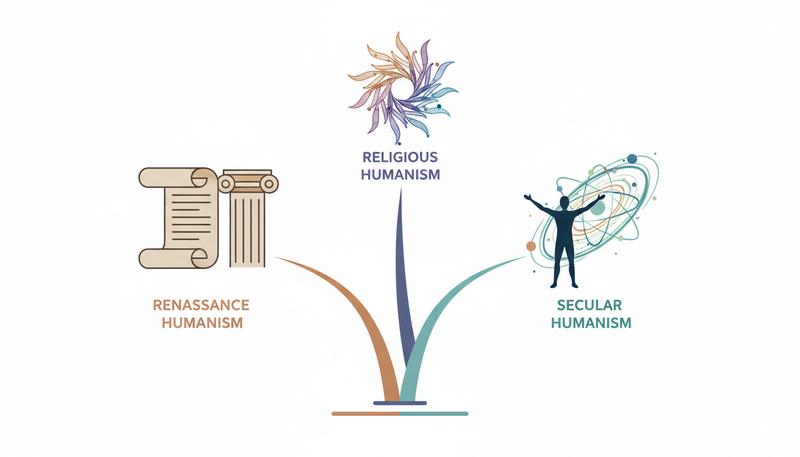
So our first move in building this worldview systematically is to untangle what "humanism" actually designates. This is not bureaucratic throat-clearing; the distinctions we draw here will matter for everything that follows. The word "humanism" has at least three distinct historical meanings, and they are not always compatible. Conflating them is one of the most reliable ways to talk past each other in conversations about this tradition.
The three are: Renaissance humanism, a movement of scholars and educators in fourteenth- through sixteenth-century Italy and beyond, focused on recovering classical texts and emphasizing literature, rhetoric, and human dignity as central to education. Religious humanism, a twentieth-century movement primarily within liberal Protestant and Unitarian traditions, which affirmed human dignity and reason while maintaining a commitment to spiritual experience and often some form of theistic belief. And finally—the focus of this course—secular humanism: the comprehensive, non-religious philosophical worldview that incorporates naturalism, empiricism, a commitment to science, a this-worldly ethics, and a program for finding meaning without supernatural support. The Council for Secular Humanism defines it as "a comprehensive, non-religious lifestance incorporating a naturalistic philosophy, a cosmic outlook rooted in science, and a consequentialist ethical system."
These three humanisms share genuine family resemblances. They all emphasize human dignity, rational inquiry, and earthly flourishing. They all trace part of their lineage to classical antiquity. But their metaphysical commitments diverge significantly enough that treating them as a single thing produces real confusion. A fifteenth-century Florentine scholar who was also a devoted Catholic, a twenty-first-century Unitarian minister who finds the cosmos awe-inspiring, and a card-carrying member of a secular humanist society who thinks the cosmos is awesome without being awe-inspiring in any mystical sense—these three people share a label, but they are standing in quite different places.
The terminological messiness is not purely academic either. As Wikipedia's entry on secular humanism notes, the phrase "secular humanism" itself is contested—most prevalent in the United States, considered by some an Americanism, and resisted by many international organizations who argue that unnecessary modifiers create artificial divisions. Some even argue that labeling it "secular" humanism implicitly concedes that "humanism" belongs primarily to religious traditions, when in fact the secular version might be the more historically coherent claimant. These are real disputes, and we will take them seriously. But for a course that covers the full arc of this tradition—from ancient Greece through the manifestos to the present—we need to be able to distinguish between these three meanings. "Humanism" for us will be the generic category; "secular humanism" the specific tradition we are examining.
What 'Secular' Actually Means
Even within "secular humanism," the adjective does heavy lifting that is rarely unpacked. "Secular" has two distinct uses in contemporary discourse, and the difference matters enormously.
In its philosophical sense, "secular" means this-worldly—pertaining to the present, natural world rather than to a supernatural or transcendent realm. To take a secular approach to ethics is to ground moral reasoning in human experience, consequences, and natural facts rather than in divine command or revealed scripture. Webster's captures it well: "pertaining to the world or things not spiritual or sacred." This is the primary sense in which secular humanism is secular. It is not primarily making a political claim; it is making a claim about where meaning, knowledge, and ethics come from—from this life, this world, these observable and testable facts about human nature and human flourishing.
In its political sense, "secular" means something different: the principle of separating religious institutions from the functions of the state, and protecting individual conscience from coercion by either. This is secularism in the tradition of John Locke's Letter Concerning Toleration or the First Amendment's establishment clause. It is about institutional arrangements, not metaphysics.
These two senses usually travel together in secular humanist thought—someone who thinks ethics is this-worldly tends also to think the state should not be theocratic—but they are logically separable. A deeply religious person can be a firm political secularist (many are). And a thoroughgoing philosophical naturalist can, in principle, hold complicated views about church-state relations. Conflating the two senses makes secular humanism seem like a primarily political project, a reaction against religious power, rather than what it actually is: a positive philosophical program with political implications that follow from deeper commitments.
This distinction also helps clarify a common misreading: secular humanism is not simply anti-religion. It is not defined by what it rejects but by what it affirms. Secular humanists have a cosmology, an epistemology, an ethics, and a program for meaning. The absence of God from that picture is a consequence of their philosophical commitments, not the starting point from which everything else flows.
A Lifestance, Not a Single Opinion
This brings us to one of the most clarifying concepts in the entire secular humanist vocabulary: the lifestance.
The term was coined by British philosopher Harry Stopes-Roe in the 1970s to describe any comprehensive orientation toward life—a set of beliefs, values, and practices integrated into a coherent whole that shapes how a person understands the world, treats others, and makes meaning. A lifestance is not the same as a religion (it need not involve the sacred or communal ritual), but it is also not merely a philosophical opinion. It is an integrated framework—one that addresses not just "What is true?" but also "How should I live?", "What can I know?", and "What makes life worth living?"
The Council for Secular Humanism uses this term explicitly, describing secular humanism as "a lifestance, or what founder Paul Kurtz has termed a eupraxsophy: a body of principles suitable for orienting a complete human life." Kurtz's neologism—from the Greek eu (good), praxis (practice), and sophia (wisdom)—is admittedly clunky, but it captures something essential: secular humanism is not just a set of true beliefs but a guide for living wisely and well.
Here is where secular humanism departs sharply from a mere negation. Atheism—the absence of belief in gods—answers one metaphysical question and stops there. Secular humanism builds an entire coordinate system: a view of what exists, how we know it, how we should act toward each other, and what makes a life meaningful. You could hold that coordinate system in place and be an atheist, but atheism alone does not give you the coordinate system. Thousands of atheists have never thought carefully about ethics, let alone constructed a comprehensive philosophy. The point is not to rank them hierarchically—it is to recognize that secular humanism is attempting something architecturally more ambitious.
The lifestance concept is also useful because it places secular humanism in honest comparison with religious worldviews without either capitulating to religion's framing or pretending there is no structural parallel. A religious tradition also functions as a lifestance: it offers cosmology, epistemology, ethics, and meaning, integrated into a coherent whole. Secular humanism does the same work by different means. The comparison is apt without being a concession.
The Four Domains: Mapping the Architecture
Any complete worldview—any genuine lifestance—must address four fundamental domains of human concern. Understanding these domains, and how secular humanism handles each one, is the clearest way to see it as a system rather than a collection of loosely related attitudes.
graph TD
    A[Secular Humanism as a Lifestance] --> B[Cosmology\nWhat exists?]
    A --> C[Epistemology\nHow do we know?]
    A --> D[Ethics\nHow should we act?]
    A --> E[Meaning\nWhat makes life worthwhile?]
    B --> F[Philosophical Naturalism]
    C --> G[Empiricism & Scientific Method]
    D --> H[Secular, Consequentialist Ethics]
    E --> I[Human-Centered Flourishing]
Cosmology—the domain of "What exists?"—is where secular humanism is perhaps most explicit. Its answer is philosophical naturalism: nature is all there is. There are no supernatural beings, forces, or realms that stand outside the natural order and intervene in it. The universe is undesigned, not created for human purposes. Human beings are evolved animals—remarkable ones, with capacities for self-awareness, language, and moral reasoning that are genuinely extraordinary by any measure, but continuous with the rest of the natural world rather than apart from it. Secular humanists "see themselves as undesigned, unintended beings who arose through evolution, possessing unique attributes of self-awareness and moral agency."
This is a significant metaphysical commitment, and we should not pretend otherwise. It rules out theism, pantheism, and most forms of supernaturalism. But it is worth noting that it is not a negative position taken on faith—it is a conclusion that follows from taking the methods and findings of natural science seriously. We will examine this in much greater depth in Section 9, on philosophical naturalism, because the argument deserves careful treatment. For now, what matters is that secular humanism's cosmology is positive and substantive: it is a picture of the universe as it appears to be, not merely a rejection of the picture religion offers.
Epistemology—the domain of "How do we know?"—is where secular humanism parts ways most decisively with both religious authority and romantic intuition. The reliable path to knowledge runs through empirical investigation: observation, hypothesis formation, testing, intersubjective review, revision. This is not scientism—the overreach that claims science can answer every question—but it is a firm commitment to empirical methods as the best tools we have for understanding the natural world. Knowledge claims that cannot in principle be tested against experience carry proportionally less weight. Revelation, tradition, and authority can point us toward questions worth investigating, but they cannot substitute for the investigation itself.
Ethics—the domain of "How should we act?"—is where secular humanism makes some of its most distinctive and underappreciated contributions. The secular humanist answer to the challenge of grounding ethics without divine command is neither "anything goes" nor "whatever evolution produced is right." It is a consequentialist ethics rooted in human experience, reason, and the observable consequences of our choices for real human (and animal) wellbeing. As the Council for Secular Humanism explains, secular humanist ethics "appeals to science, reason, and experience to justify its ethical principles. Observers can evaluate the real-world consequences of moral decisions and intersubjectively affirm their conclusions." Ethics, on this view, is neither arbitrary nor divinely fixed; it is an evolving, evidence-responsive practice—which is why secular humanists expect our moral understanding to improve over time, just as our scientific understanding does.
Meaning—the domain of "What makes life worthwhile?"—is perhaps the domain where secular humanism faces the steepest psychological challenge. If there is no cosmic author who has written a purpose into the universe, and if our lives end in permanent oblivion, what prevents the whole enterprise from collapsing into nihilism? The secular humanist answer is that meaning is made, not found—that human beings are the kinds of creatures who can create genuine significance through relationships, achievement, creative work, moral commitment, and the cultivation of wisdom and beauty. This is not a consolation prize but an affirmation: meaning that we build ourselves, out of the materials of real human life, is not somehow less real than meaning handed down from above. We will spend a full section on this question (Section 11), because it deserves it.
What is important to recognize here is the mutual reinforcement of these four domains. They are not four separate opinions bolted together. Naturalism (cosmology) supports empiricism (epistemology) because if nature is all there is, then the best way to know reality is to study nature. Empiricism supports secular ethics because if we can study the consequences of moral choices as we study anything else, ethics becomes a rational inquiry. And a rational, empirical approach to ethics supports a human-centered account of meaning because it constantly returns us to what actually matters for beings like us, living lives like ours. The architecture holds: each pillar reinforces the others.
Secular Humanism and Its Cousins
One of the most useful things we can do before proceeding is to draw careful distinctions between secular humanism and several closely related positions that are frequently confused with it. These are not hostile distinctions—most secular humanists feel genuine kinship with freethinkers, atheists, agnostics, and skeptics. But the differences are philosophically significant.
Atheism is the absence of belief in gods, or more precisely (in its "strong" formulation) the positive belief that no gods exist. It is a single answer to a single metaphysical question. As the Council for Secular Humanism's definition page puts it, atheism "is only a position on the existence of God, not a comprehensive life stance. Nothing about atheism as such compels atheists to adopt any particular value system." You can be an atheist and a nihilist. You can be an atheist and a communist, a libertarian, or someone who has simply never thought carefully about ethics. Secular humanism is atheistic in the sense that it does not include gods in its cosmology—but atheism is, at most, one element of secular humanism, not its substance.
Agnosticism is an epistemological position rather than a metaphysical one: the view that we do not or cannot know whether gods exist. Thomas Huxley coined the term in 1869 specifically to mark off the question of God's existence as currently unanswerable by available evidence. Many secular humanists are also agnostics in this technical sense—they hold that the existence of gods is an empirical question on which the evidence is strongly unfavorable, but they do not claim the certainty that "strong atheism" implies. In practice, the distinction between a committed agnostic and a secular humanist who is honest about uncertainty is often small. But agnosticism alone, like atheism, does not furnish ethics, meaning, or a complete worldview.
Freethought is the commitment to forming beliefs through reason and evidence rather than tradition, authority, or revelation. It is primarily an epistemological commitment—to the method of free inquiry—without specific metaphysical conclusions built in. A freethinker applies rational scrutiny to religious claims and typically arrives at skepticism about them, but freethought as such says nothing about what positive worldview should replace what has been rejected. It is the engine, not the vehicle.
Rationalism in the broad sense (not the specific Cartesian philosophical tradition) refers to the commitment to reason as the primary basis for belief and action. This is largely epistemological. It overlaps substantially with freethought and with secular humanism's empiricist commitments, but it does not by itself generate an ethics or an account of meaning.
Skepticism—particularly the organized skeptical movement associated with figures like James Randi and organizations like CSICOP—focuses specifically on the critical examination of extraordinary claims, paranormal phenomena, and pseudoscience. It is closer to a methodology than a worldview. Many secular humanists are skeptics, and many skeptics are secular humanists, but the two are not identical. A skeptic might be wholly uninterested in the positive philosophical project of constructing a complete lifestance; they may simply want to debunk bad claims. That is valuable work, but it is narrower than secular humanism's ambition.
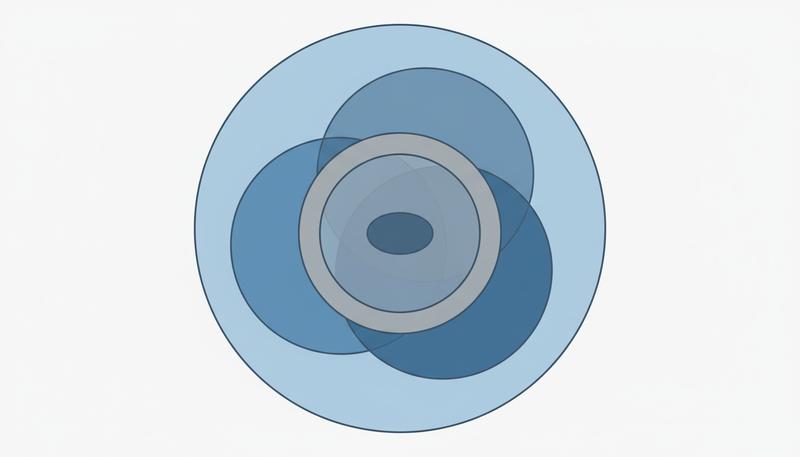
The taxonomy offered by Council for Secular Humanism member John Rafferty captures the nesting structure nicely: "Taxonomically, my family is Freethinker (including atheists, skeptics, agnostics); my genus is Humanist (including the religion-based); and my species is Secular." Secular humanism is the most specific category—it includes the commitments shared by freethinkers and humanists generally, but adds the particular combination of philosophical naturalism, empiricism, secular ethics, and positive meaning-making that constitutes a complete worldview.
The Unique Architecture: Cognitive and Affective in Balance
One way of seeing what is genuinely distinctive about secular humanism—as opposed to its cousins—is to notice the balance it tries to strike between what we might call cognitive and affective commitments.
The cognitive thrust of secular humanism is its naturalistic worldview: the insistence on empirical methods, rational inquiry, scientific literacy, and the rejection of claims that cannot survive critical examination. This is what secular humanists share with atheists, agnostics, freethinkers, and skeptics. It is real, important, and non-negotiable.
But secular humanism's affective thrust—its positive ethical outlook, its genuine care for human wellbeing, its celebration of human dignity and creative capacity—is equally essential. This is what secular humanists share with religious humanists, liberal religious traditions, and the best of various ethical philosophies. Paul Kurtz identified "knowledge" as the key cognitive virtue and "courage and caring" as the key affective virtues of humanism. Neither stands alone. As one analysis puts it, secular humanists "necessarily disbelieve in God (naturalism) and just as necessarily oppose thuggery and tribalism on principle (an outgrowth of ethics)." For atheists or agnostics, the ethical commitment is adopted for reasons external to their atheism or agnosticism. For secular humanists, both commitments "arise organically within the life stance"—they flow from the same source.
This is the point at which the "atheism with better PR" caricature falls apart completely. A person can be an atheist without caring a whit about human dignity. A person can be deeply committed to human dignity without ever thinking about the existence of gods. What secular humanism claims is that these two commitments are internally connected—that a worldview which takes the empirical picture of human beings seriously (evolved, finite, interdependent, capable of both remarkable good and remarkable evil) naturally generates a commitment to human welfare as the proper goal of ethics. The naturalism and the ethics are not two separate items on a checklist; they are two expressions of a single orientation toward reality.
Clearing Away Misconceptions
Before we move forward, it is worth naming several misconceptions about secular humanism that turn up reliably in public discourse—not to dismiss critics, but because these misreadings generate unproductive arguments that obscure the genuinely interesting debates.
Misconception 1: Secular humanism worships humanity. This is a theological caricature, usually aimed at scoring a rhetorical point. Secular humanism does not claim that human beings are inherently good, perfectly rational, or deserving of uncritical reverence. It does not "present humans as being superior to nature," as Wikipedia's entry on secular humanism notes. What it does claim is that human beings are the appropriate focus of ethical concern, and that human capacities for reason and moral agency make us responsible for the consequences of our choices. That is not worship; it is accountability.
Misconception 2: Without God, secular humanism has no basis for morality. This is the most serious philosophical challenge secular humanism faces, and we will spend significant time on it in Section 10. But the short answer here is that this challenge assumes the conclusion: it begins by assuming that morality must come from divine command and then treats the absence of the divine as a moral vacuum. Secular humanists reject that starting assumption. They argue that human wellbeing, reason, empathy, and the observable consequences of moral choices provide a perfectly adequate—and in important ways superior—foundation for ethics. Whether that argument succeeds is a real question. But it is not answered by asserting the premise it is meant to challenge.
Misconception 3: Secular humanism is a religion. This one comes in two flavors. From religious critics, it is usually meant as a rhetorical move: if secular humanism is itself a religion, then teaching evolution in public schools amounts to teaching secular humanism's religion, and church-state separation arguments dissolve. From secular humanists' own defensive posture, you sometimes hear the overreaction: "We're not a religion at all!" Both responses miss the interesting question, which is what kind of thing secular humanism is. It is a lifestance—it does the same organizational work as a religion (providing cosmology, epistemology, ethics, and meaning) without the supernatural commitments, the institutional claim to revealed truth, or the metaphysics of the sacred. Whether you call that a religion depends on your definition of "religion," but the definitional argument is less interesting than understanding what secular humanism actually is.
Misconception 4: Secular humanism is just the Enlightenment, and the Enlightenment is over. This is a more sophisticated objection, and it contains real force. We will engage it directly in Section 6 and again in Section 14. But the short answer is that secular humanism has never been simply the Enlightenment project—it draws on ancient Greek philosophy, Renaissance thought, and numerous post-Enlightenment intellectual traditions. More importantly, the critique of the Enlightenment (which we should take seriously: its failings were real) does not necessarily undermine secular humanism's core commitments any more than the failures of particular democracies undermine the case for democracy.
The Work Ahead
What we have done in this opening section is essentially map the terrain. We have three historical humanisms that need to be kept distinct; a specific philosophical worldview called secular humanism that is positive, comprehensive, and internally coherent; a useful concept—the lifestance—that captures what a complete worldview must do; four domains (cosmology, epistemology, ethics, meaning) that secular humanism addresses as a mutually reinforcing system; and a clarified landscape of related positions (atheism, agnosticism, freethought, rationalism, skepticism) that helps us see what secular humanism shares with its neighbors and what it adds.
The thesis of this course is that secular humanism is not merely the absence of religion but a complete, coherent, and positive philosophical worldview—one with ancient roots, a rigorous internal architecture, and a living tradition of adaptation. That claim needs to be earned, not asserted. In the sections that follow, we will earn it by tracing the actual intellectual history that produced this worldview, examining each of its philosophical pillars carefully, engaging the strongest objections honestly, and exploring how the abstract commitments translate into a lived human life.
The terminological work we have done here is not just housekeeping. It is the beginning of understanding how this particular tradition thinks—with precision, without defensiveness, and with genuine curiosity about whether its answers hold up. That combination of intellectual rigor and practical urgency—the insistence that getting these questions right actually matters for how we live—is itself, as we will see, deeply humanist.
Only visible to you
Sign in to take notes.