Secular Ethics Without Religion: Living a Good Life
Secular Ethics: How to Be Good Without God
We've established naturalism as the foundation of secular humanism: the view that the natural world, investigated through reason and evidence, is sufficient to explain everything that exists — including human beings, consciousness, and values. But naturalism answers a metaphysical question: what is there? It doesn't yet answer the ethical question: what should we do? How do we get from "this is how nature works" to "this is what we ought to do"? That transition — from the natural world to moral obligation — is precisely where secular ethics begins. And it's precisely where the hardest questions arrive.
Here's the charge that gets leveled at secular humanists more often than almost any other, and it comes in different flavors depending on who's asking. Sometimes it's framed as a philosophical puzzle: "Without God, how do you ground objective moral claims?" Sometimes it's more direct: "If you don't believe in divine judgment, what stops you from doing whatever you want?" And sometimes it arrives with a kind of resignation: "Without religion, morality just becomes personal preference — and then anything goes." These questions deserve serious answers. Not dismissal, not defensiveness, but real philosophical engagement. Because the person asking is pointing at something genuine: morality does need a foundation. The secular humanist project isn't to deny this but to provide a different one — built not on divine command but on human nature, reason, experience, and the hard-won insights of twenty-five centuries of ethical philosophy. This section is about that foundation. It won't pretend that secular ethics is easy — it isn't. But it will show that secular ethics is coherent, rigorous, and in several important respects more philosophically defensible than its theological alternatives.
There's a philosophical puzzle that cuts to the heart of why this matters. Theologians call it the Euthyphro dilemma, named after Plato's dialogue. The question is simple: Is something good because God commands it, or does God command it because it is good? If the former — if things are good simply because God says so — then morality seems arbitrary. God could command genocide or slavery and those things would become good simply by virtue of the command. But if the latter — if God commands things because they are good — then there's a standard of goodness that exists independent of God's will. In that case, what's doing the real moral work is that independent standard, not the divine command. Either way, you can't actually rest morality on divine authority alone. You need something else beneath it.
Once you clear away that confusion, the real question emerges: what does morality rest on? And here the secular tradition offers not one answer but several sophisticated ones that turn out to strengthen rather than contradict each other.
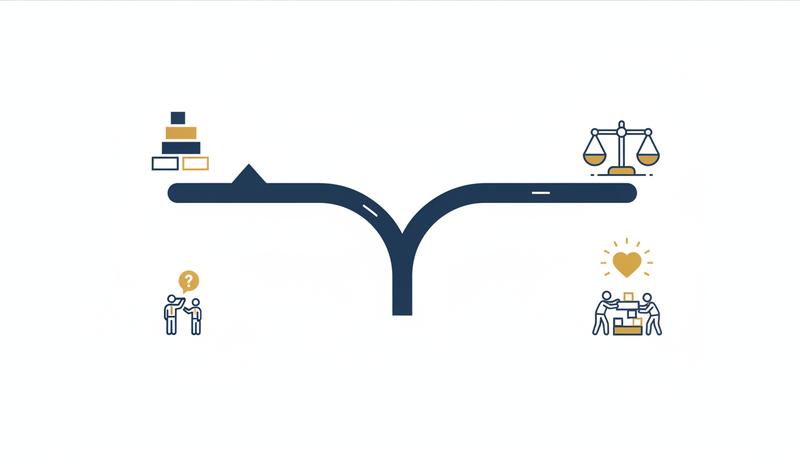
Utilitarian and Consequentialist Ethics: What Matters Is What Happens
The most influential secular ethical tradition in the English-speaking world emerged in the late eighteenth and nineteenth centuries, and it's built on an insight so basic it sounds almost insulting when you first hear it: what makes actions right or wrong is their consequences — specifically, their effects on the well-being of sentient creatures.
Jeremy Bentham, writing at the end of the 1700s, argued that pleasure is good and pain is bad, and therefore the right action is the one that produces the greatest happiness for the greatest number. He even attempted what he called a "felicific calculus" — a method of measuring the intensity, duration, and breadth of pleasures and pains to arrive at a kind of moral arithmetic. The project was ambitious enough to seem absurd and serious enough to be worth taking seriously.
John Stuart Mill came next, and he refined Bentham's hedonism in ways that still matter today. He noticed that not all pleasures are created equal. The pleasures of intellect, friendship, and aesthetic experience are qualitatively superior to merely bodily satisfaction — not just bigger, but different. His argument was almost pragmatic: ask anyone who has experienced both whether they'd trade a life of the mind for uninterrupted physical pleasure, and no competent judge would agree to the exchange. (His critics have pointed out there's something circular about this — we're trusting the judgment of people who've experienced the higher pleasures to tell us those are better — but the intuition behind it holds.)
More importantly, Mill expanded utilitarian ethics into a comprehensive moral and political vision. Utilitarianism lays out the greatest happiness principle. On Liberty grounds individual freedom in utilitarian reasoning: suppress individuality and dissent, and everyone suffers, including those doing the suppressing. The Subjection of Women applies the same logic to gender equality, decades before it became mainstream political argument.
Consequentialism has real strengths as an ethical framework. It forces you to actually look at what your actions do to real beings in the world. It gives you a clear decision procedure, at least theoretically. And it's naturally expansive: if what matters is welfare, then the welfare of any creature that can experience pleasure and pain counts. This logic led Peter Singer and others to extend utilitarian thinking to animal welfare and global poverty in ways that most religious ethics had not.
But the objections are equally serious, and they reveal something genuine. A sufficiently committed utilitarian calculus can seem to justify horrifying things: torturing one innocent person if it would save five; lying habitually if it produces better outcomes; sacrificing individual rights on the altar of collective welfare. These aren't just thought experiments. They point to a real tension between consequential logic and our deepest convictions about human dignity. The twentieth century gave us more than one example of regimes that justified atrocities in the name of collective welfare.
Modern consequentialists have sophisticated responses. Rule utilitarians argue that we should follow rules that, if generally observed, produce the best outcomes rather than calculating case by case. Indirect utilitarians build in second-order considerations about what happens when you undermine trust and rights. But the core tension doesn't disappear, which is why secular humanists typically don't rely on consequentialism alone.
Kantian Deontology: Morality from Reason Itself
Immanuel Kant looked at Enlightenment ethics and was unsatisfied with what he saw. Grounding morality in human feelings or consequences — in happiness, in pleasure — seemed to miss something essential. Morality, he believed, had to be necessary and universal: it had to bind not just humans but any rational being as such. And it couldn't come from God (the Euthyphro problem again) or happiness (which is contingent and varies by person). It had to come from reason itself.
The result was one of the most ambitious ethical systems ever constructed. Kant's Groundwork for the Metaphysics of Morals (1785) argued that the fundamental principle of morality — which he called the categorical imperative — could be derived from the very concept of rational agency. His most famous formulation: "Act only according to that maxim whereby you can at the same time will that it should become a universal law."
The insight is that genuinely immoral actions contain a kind of contradiction. If I lie to gain advantage, I'm counting on a background of trust and truth-telling that I'm simultaneously undermining. If everyone did what I'm doing, the practice itself would collapse. I can't universalize my maxim without contradiction. Therefore it's wrong — not because of consequences I predict, not because God forbids it, but because the action is self-defeating at a logical level.
Kant offered a second formulation that's arguably more important: "Act so that you treat humanity, whether in your own person or in that of another, always as an end and never as a means only." This is the dignity formula, and it's arguably the most consequential single sentence in the history of secular ethics. It grounds a robust conception of human rights — rights not based on being made in God's image, but on something simpler and more universal: the inherent dignity of rational agency. Every person is an end in themselves. To use them purely as instruments for your purposes is to violate something fundamental.
This Kantian insight is central to how secular humanism thinks about human rights. The language about "treating each person as having inherent worth and dignity" — you hear it in the Humanist Manifesto III, and elsewhere in the secular tradition — echoes Kant even when he's not explicitly cited. The secular humanist commitment to human rights isn't sentiment. It has philosophical backbone: the dignity of persons as rational agents, capable of setting and pursuing their own ends.
The objections to Kantian ethics are real. The emphasis on universal principles can make the system too rigid to be livable — Kant himself argued that lying is always wrong even to a murderer at your door asking where your friend is hiding. The requirement that maxims be universalizable doesn't always give clear guidance when multiple maxims compete. And the focus on rational agency potentially excludes beings — infants, people with severe cognitive disabilities, animals — who can't exercise rationality in the relevant way.
Contemporary Kantian philosophers have worked on these problems with varying success. Christine Korsgaard's work extends Kantian autonomy while making room for obligations to animals. Onora O'Neill has developed Kantian ethics into a sophisticated account of global justice. The tradition remains vital.
graph TD
    A[Moral Question: What should I do?] --> B[Consequentialism]
    A --> C[Deontology]
    A --> D[Virtue Ethics]
    A --> E[Contractarianism]
    B --> F[Maximize welfare and well-being]
    C --> G[Act on universalizable principles, respect persons as ends]
    D --> H[Cultivate character traits that constitute human flourishing]
    E --> I[Follow principles rational persons would agree to]
    F --> J[Humanist Synthesis: Empirical, pluralistic, reason + empathy]
    G --> J
    H --> J
    I --> J
Contractarianism: Morality as Rational Agreement
A third major secular tradition locates morality not in consequences or pure reason but in the idea of rational agreement. Imagine people stepping back from their particular interests to ask: what moral rules could we reasonably all accept? That conversation generates moral principles grounded in something powerful — mutual recognition of each other as agents with legitimate interests.
Thomas Hobbes started this tradition in a dark place. Without social agreement, he argued, human life would be "solitary, poor, nasty, brutish, and short" — a war of all against all where nobody benefits. Rational self-interest dictates that we agree to a social contract, surrendering some freedom for security. Morality emerges from that bargain.
John Locke gave the tradition a more optimistic character. Rather than self-interest driving the deal, Locke argued that we have natural rights — to life, liberty, and property — that precede any contract. The contract's purpose is to protect those rights. This Lockean inheritance runs directly into American political philosophy, the Declaration of Independence, and eventually into the secular human rights tradition.
The most philosophically powerful version came from John Rawls in A Theory of Justice (1971). Rawls asked: imagine choosing your society's principles from behind a "veil of ignorance" — not knowing where you'd end up, your wealth, talents, values, or life goals. What principles would rational people choose if they didn't know which position in society they'd occupy?
Rawls argued they'd choose two principles: first, equal basic liberties for all; second, economic inequalities are only permissible if they benefit the least-well-off members of society. The veil of ignorance is a device for achieving impartiality — ensuring moral principles aren't just rationalizations of the powerful's advantages.
Rawlsian contractarianism has become enormously influential in secular ethics and political philosophy. It provides a rigorous basis for commitments to equality, fairness, and social justice without requiring religious premises. It also handles moral disagreement interestingly: if we can't agree on comprehensive doctrines of the good (religious or otherwise), maybe we can agree on principles of justice that allow diverse visions of the good to coexist. This is Rawls's "political liberalism," and it's recognizably a secular humanist aspiration.
The main objection contractarians wrestle with is straightforward: what about people who can't participate in the contract? Future generations, severely disabled people, animals, inhabitants of other countries — they pose real challenges for a framework built around rational agreement. Various extensions of contractarian reasoning have been proposed to address these, with varying degrees of success.
Virtue Ethics: Who Should I Be?
For much of the twentieth century, virtue ethics was relatively sidelined in Anglophone philosophy, overshadowed by utilitarians and Kantians. Its revival is largely due to Elizabeth Anscombe's 1958 essay, which made a striking observation: modern moral philosophy had discarded the theological framework — divine command, natural law — that gave moral language its original meaning, but kept the language anyway. The result was concepts like "morally ought" and "morally required" floating free of any coherent foundation.
Anscombe's suggestion was to return to Aristotle. The really interesting moral question isn't "what should I do?" but "what kind of person should I be?" Ethics is about character — about cultivating virtues like courage, justice, temperance, and practical wisdom that constitute human flourishing (eudaimonia). A virtue isn't a rule to follow; it's a stable disposition of character that enables you to respond well to the varying demands of a human life.
Alasdair MacIntyre's After Virtue (1981) developed this critique further. Modern moral philosophy — including both utilitarianism and Kantianism — had inherited virtue's vocabulary without its substance, MacIntyre argued. The "interminable" moral debates of modern culture are symptoms of philosophical fragmentation that can only be healed by returning to the Aristotelian tradition. (MacIntyre subsequently converted to Catholicism and identified Thomistic natural law as preserving Aristotle's insights — a move drawing on virtue ethics but not essential to it.)
Philippa Foot's Natural Goodness (2001) took a different route, developing a secular naturalist account of virtues. For Foot, what's good and bad for a human being is determined by our nature — by what kind of creature we are. This is naturalistic virtue ethics: the virtues are genuinely good for us because of what we are, not because God commands them or because they maximize utility. We can evaluate a person as good or bad the same way we evaluate a wolf or an oak tree — by asking whether it functions well as the kind of thing it is.
Martha Nussbaum's capabilities approach extends virtue ethics in an explicitly humanist direction. She identifies "central capabilities" — things like life, bodily health, emotional development, practical reason, affiliation, play, and control over one's political environment — that every person must be able to exercise to live a fully human life. This framework has become enormously influential in development ethics and human rights discourse.
Virtue ethics speaks directly to the humanist aspiration. It doesn't ask "what rule am I following?" but "what kind of life am I building?" It focuses on character development, on the social relationships and communities where virtues are cultivated, on the rich texture of a genuinely good life. Unsurprisingly, virtue ethics has the strongest connection to the ancient humanist tradition traced earlier in this course — Aristotle is, in many ways, the first humanist philosopher.
The Evolutionary and Naturalistic Roots of Morality
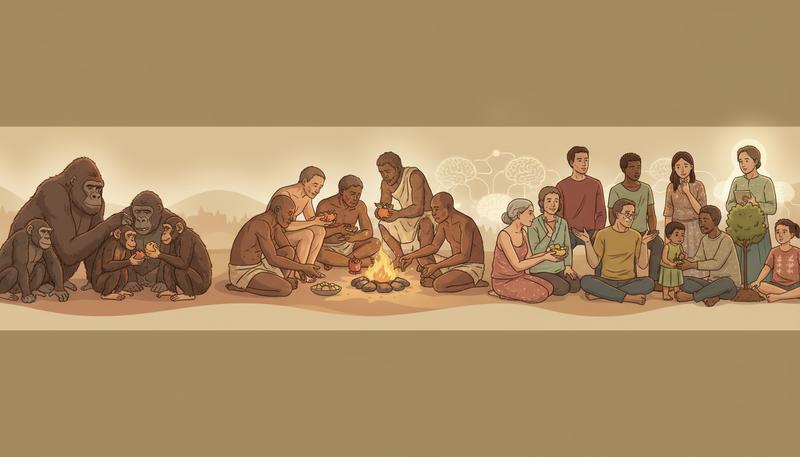
Here's something fascinating that Darwin noticed in The Descent of Man (1871): if moral emotions like sympathy, justice, and loyalty exist in humans, they must have natural causes. Something recognizable as proto-morality — cooperation, reciprocity, care for offspring and group members — shows up in social mammals.
The primatologist Frans de Waal has spent decades documenting this reality. Chimpanzees show empathy, comfort distressed companions, form coalitions, and display something resembling fairness. Capuchin monkeys famously refuse cucumber slices when they see others getting grapes for the same task — an apparent sense of inequity that looks like a basic moral intuition. De Waal's work argues that human morality didn't emerge from nowhere: it has deep evolutionary roots in the social lives of our primate ancestors.
Jonathan Haidt has developed this into a sophisticated moral psychology. His "social intuitionist model" argues that moral judgments are primarily intuitive rather than deliberative: we feel a response first and construct justifications afterward. He identifies several basic moral "foundations" — care/harm, fairness/reciprocity, loyalty/betrayal, authority/subversion, sanctity/degradation — each with evolutionary and developmental histories. His work complicates the Enlightenment picture of morality as primarily a product of reason, and it's generated substantial debate.
What does this mean for secular humanists? It suggests that the basic materials of morality — empathy, fairness, care, reciprocity — aren't contingent cultural inventions or arbitrary divine commands. They're features of what it is to be human, woven into our neurological and social architecture by a long evolutionary process. The philosophers who came later weren't inventing morality from scratch; they were articulating, refining, and sometimes correcting intuitions that already existed.
This doesn't mean evolutionary explanations justify moral beliefs — the is-ought gap remains. The fact that humans evolved toward in-group favoritism doesn't make in-group favoritism right. But it does suggest that the secular humanist who grounds ethics in human nature is on solid ground. The moral sentiments are genuinely there. The philosophical task is to cultivate the best ones, critique the worst, and build from them toward something more consistent and expansive.
The Meta-Ethical Question: Do Moral Facts Actually Exist?
This is where secular ethics gets genuinely difficult, where intellectual honesty requires sitting with uncertainty rather than reaching for reassurance.
The question of meta-ethics — not "what is right?" but "what kind of thing is rightness?" — divides secular philosophers into camps. The central debate is between moral realists and various forms of anti-realism.
Moral realists hold that moral claims can be true or false, that there are moral facts in the world independent of what anyone thinks or feels. When we say "torturing children for fun is wrong," we're not expressing a preference or issuing a command — we're stating something true. Moral realists come in naturalist and non-naturalist varieties. Naturalist moral realists like Richard Boyd and Peter Railton argue that moral facts are natural facts — roughly, facts about well-being, flourishing, or what rational agents would choose. Non-naturalist realists like Derek Parfit argue that moral facts are a genuine but non-natural feature of reality.
Moral anti-realists deny that mind-independent moral facts exist. They subdivide: expressivists argue that moral statements express attitudes rather than describe facts; error theorists argue that moral statements make claims that could be true, but all such claims are false because moral facts don't exist; and relativists argue that moral claims are true or false relative to a framework, culture, or perspective.
Where do secular humanists fall? In practice, humanist ethics tends to operate with what we might call "pragmatic realism" — treating moral claims as if they can be better or worse supported, more or less consistent, more or less adequate to human needs, without firmly committing to strong metaphysical realism or anti-realism. The secular humanist account describes ethics as "objective" and grounded in experience, with moral conclusions subject to "intersubjective affirmation" — a position occupying productive middle ground between relativism and strong realism.
Paul Kurtz's "eupraxsophy" — his term for the secular humanist life stance — emphasizes that ethics can be empirical without being arbitrary. We can evaluate moral practices by their outcomes, their consistency with human needs, their capacity to survive cross-cultural scrutiny, and their alignment with our best reflective judgments. This is science-adjacent without being crudely scientistic: we apply the same rigor, revision, and intersubjective testing to moral questions that we apply to empirical ones.
This doesn't fully resolve the meta-ethical debate, and secular humanists should engage philosophers like Sharon Street (whose evolutionary debunking argument poses a genuine challenge to moral realism), Russ Shafer-Landau (who defends realism), and Simon Blackburn (whose "quasi-realism" tries to preserve the truth-aptness of moral claims without committing to moral facts). These are live, unresolved questions — and the secular humanist tradition is at its best when it acknowledges this rather than pretending the problem away.
Moral Disagreement Across Cultures and History
One of the most common objections to secular ethics is the argument from moral relativism: if there's no God, doesn't everything collapse into "different strokes for different folks"? If ancient Romans thought gladiatorial combat was acceptable and we don't, who's to say we're right?
This objection is philosophically confused in instructive ways.
First, moral disagreement doesn't entail moral relativism. Scientists disagree about whether a particular medical treatment works, about the age of the universe, without us concluding that scientific truth is merely perspective. Disagreement signals difficulty, not the absence of truth.
Second, the actual range of moral disagreement across cultures is often overstated. Empirical research — James Q. Wilson's work, and before him C.S. Lewis's famous appendix to The Abolition of Man — identified a substantial core of cross-cultural moral agreement: prohibitions on murder within the in-group, requirements of basic honesty, obligations to care for children, norms of reciprocity and fairness. Variations concern who counts as in-group members, how principles apply in specific circumstances, and how competing values weigh — not the existence of basic moral norms.
Third, and most importantly, secular humanists can explain moral progress in a way that moral relativism cannot. We believe slavery was wrong even when most people accepted it. We believe female subordination was wrong even when it was culturally universal. We arrive at these judgments through moral reasoning: expanding our circle of concern, applying dignity and autonomy consistently, correcting for the distortions of self-interest and bias. The Humanist Manifesto III captures this: values are "subject to change as our knowledge and understandings advance" — not because morality is arbitrary, but because our moral reasoning improves as our knowledge of human nature, consequences, and affected perspectives grows.
The secular humanist approach to moral disagreement is "empirical rather than dogmatic," as Paul Kurtz put it. We treat ethics like we treat science — with rigor, humility, and genuine openness to being shown wrong. We don't claim to have the final word. We do claim that some answers are better than others, and that we can give reasons for preferring them.
Empathy, Intuition, and the Full Moral Self
It's tempting, especially in the intellectual tradition running from Plato through Kant, to treat ethics as primarily a matter of reason: get the principles right, and moral conduct follows. This significantly underestimates what actually drives moral life.
David Hume made the point classically: "Reason is, and ought only to be the slave of the passions." He meant that reason alone — without emotional engagement — gives you no motivation to act morally at all. Knowing that an action would cause pain is inert information until you care about pain. What makes you care is empathy, sympathy, the imaginative capacity to feel your way into another's experience.
Contemporary moral psychology has accumulated substantial evidence for Hume's insight. Patients with damage to the ventromedial prefrontal cortex — an area crucial for emotional processing — often score normally on tests of moral reasoning but make strikingly poor real-world ethical decisions. The neurologist Antonio Damasio documented this in patients like "Elliot," who after surgery could reason about ethics perfectly well but could no longer be moved to moral action. Moral emotions aren't obstacles to good judgment; they're constitutive of it.
This has implications for how secular humanists think about ethical education and moral community. Developing empathy isn't a soft accompaniment to the hard work of ethical argument — it's foundational. The practices that cultivate empathy — literature, which lets us inhabit other perspectives; face-to-face community, which makes other people vivid and particular; encounter with those different from ourselves — are genuinely moral practices. This connects secular ethics to the humanist traditions of education and the arts in ways that pure philosophical analysis tends to miss.
At the same time, moral intuitions — those strong felt convictions that something is right or wrong, even when we can't fully articulate why — play a crucial evidential role. John Rawls called these "considered judgments" and argued that a satisfactory moral theory must achieve "reflective equilibrium" between general principles and particular judgments. If a principle implies we should torture innocents for aggregate benefit, and our intuition that this is wrong is stronger than our commitment to the principle, we should revise the principle.
This gives secular ethics its flexibility and resilience. We're not locked into defending monstrous conclusions from first principles. We hold both our principles and our intuitions provisionally, testing each against the other, moving toward greater coherence without claiming we've arrived.
Human Rights: Dignity Without Divinity
The modern human rights framework poses an interesting philosophical puzzle. Where do human rights come from? They can't come from God in any universally binding way in a pluralistic world. They can't simply be invented by states, or they lose their status as claims against states. And they seem to require something more than utilitarian calculation — the whole point of rights is protecting individuals even when violating them might aggregate to more overall welfare.
Secular humanists have contributed significantly to thinking through this puzzle. The most influential secular account of human rights draws on the Kantian tradition: rights are grounded in the dignity of persons as rational agents capable of directing their own lives. This is the philosophical basis for Article 1 of the Universal Declaration of Human Rights (1948): "All human beings are born free and equal in dignity and rights." That word "dignity" is doing enormous work, and it's Kantian work.
But dignity can also be grounded more naturalistically, through the capabilities approach. Martha Nussbaum argues that human rights name what is required for a life genuinely worthy of human dignity — for a creature with our nature, with our capacities for love, reason, play, and political participation, to actually exercise those capacities. This is secular in its foundations: it doesn't require being made in a divine image, only a rich account of human nature.
The American Humanist Association's Manifesto III commits to "uphold the equal enjoyment of human rights and civil liberties in an open, secular society" — a commitment that secular humanists have often made before it was fashionable, and have sometimes maintained when it was costly. The association between secularism and human rights is not accidental: a worldview that locates human dignity in persons rather than in their relationship to God has obvious reasons to protect that dignity from institutional power, including religious institutional power.
Practical Secular Ethics: Bioethics, Environment, Justice
Philosophy that doesn't make contact with actual moral decisions isn't doing its job. Secular ethics has been especially productive in three domains where traditional moral frameworks have struggled.
Bioethics emerged as a discipline in the mid-twentieth century largely from secular philosophical sources. Questions about abortion, euthanasia, organ donation, genetic engineering, and medical research allocation don't have obvious answers in traditional religious frameworks — or rather, different religious traditions give different answers, which is precisely why secular approaches became necessary. The principles-based approach developed by Tom Beauchamp and James Childress — autonomy, beneficence, non-maleficence, justice — is broadly secular and humanist: it centers patient autonomy (the Kantian heritage), weighs consequences (the utilitarian heritage), and asks what a just distribution of benefits and burdens looks like (the contractarian heritage).
Environmental ethics presents an interesting challenge for secular humanism. The traditional humanist focus on human well-being and dignity has sometimes been read as anthropocentric — what about non-human nature? Deep ecology, animal liberation, and environmental ethics have pushed secular humanists to extend their frameworks outward. Some, like Peter Singer, extend utilitarian concern to all sentient creatures. Others, following Nussbaum's capabilities approach, argue that some animals have sufficient morally relevant capacities to generate obligations. Still others ground environmental ethics in enlightened human interest: we need a functioning biosphere, and our children and grandchildren have interests the present generation is obligated to consider.
Social justice — how resources, opportunities, and recognition are distributed in a society — is perhaps where secular humanist ethics has been most practically active. The Rawlsian framework provides a rigorous secular basis for commitments to equality and redistribution. The human rights tradition grounds claims against discrimination and for equal treatment. The utilitarian tradition asks hard questions about what policies actually improve welfare for the most people. Together, these frameworks give secular humanists a rich vocabulary for engaging the most pressing political and social questions without appealing to religious authority.
What's characteristic of secular humanist practical ethics is not the specific conclusions it reaches — humanists disagree among themselves on difficult questions like abortion, capital punishment, and euthanasia — but the way it reasons: empirically, with attention to consequences for real people; respectfully, with attention to the dignity and autonomy of those affected; and provisionally, with genuine openness to being shown wrong.
The Secular Ethics Synthesis
If there's a single observation that captures the secular humanist approach to ethics, it's this: we don't need to choose between the great ethical traditions. Each illuminates something the others tend to miss.
Consequentialism reminds us that actual outcomes matter — that good intentions and pure principles aren't enough if they lead to preventable suffering. Kantian deontology reminds us that persons aren't mere vehicles for aggregate welfare — that dignity and autonomy generate genuine constraints on what we may do, even for good ends. Contractarianism reminds us that fairness matters — that moral principles must be justifiable to all those who must live under them, not just to the powerful. Virtue ethics reminds us that ethics is about the whole of a human life, not just discrete decisions — about who we're becoming, not just what we're doing. And evolutionary ethics reminds us that the moral sentiments are not arbitrary: they have roots in what we are, even as they need to be cultivated and extended by reason.
Secular humanism's distinctive position is the organic integration of its cognitive and ethical commitments: its naturalistic understanding of the world and its positive ethical outlook arise together, each supporting the other. It is not ethics bolted onto atheism, but a genuinely integrated philosophical stance in which understanding what the world actually is and caring about what happens in it are inseparable.
This is secular ethics at its best: not the bare claim that you can be good without God, but the developed demonstration that you can be good with all of this — with reason and empathy, with principle and consequence, with the long view of human flourishing and the immediate presence of the person in front of you. It is an ethics for adults who have accepted that the universe offers no guarantees, and who have decided that this makes the work of being good more urgent, not less.
Only visible to you
Sign in to take notes.