The Enlightenment and the Rise of Secular Thought
The Enlightenment: Reason, Science, and the Secular Transformation of Western Thought
The civic humanists of Renaissance Florence had grasped something essential: that a meaningful human life requires both intellectual seriousness and practical engagement with the world. But they were missing something crucial — a reliable method for figuring out what was actually true when tradition, authority, and revelation were all shouting different answers. Then, between 1680 and 1800, something remarkable happened. European intellectual life underwent a transformation that would eventually provide that method, and in doing so, would equip secular humanism with its most powerful philosophical tools.
The shift wasn't subtle. For most of Western history, the question "how do we know something is true?" had a built-in final answer: revelation, scripture, the authority of the Church, the accumulated weight of tradition. The Enlightenment didn't just propose alternative answers. It did something far more radical — it questioned who gets to answer questions at all, and by what right. That shift, from authority and revelation to reason and evidence as the arbiters of truth, is the central drama of the Enlightenment. And it's the single most important intellectual inheritance secular humanism carries.
If Renaissance humanism gave us the rediscovery of human dignity and the recuperation of classical learning, the Enlightenment gave us the tools to act on those insights with actual confidence and rigor: empiricism, the scientific method, religious skepticism, natural rights theory, and the ideal of progress through human effort rather than divine grace. To understand secular humanism as a philosophical system — not just as a mood or an attitude — you have to understand what the Enlightenment accomplished, what it left unfinished, and what problems it created that later secular humanists would spend two more centuries trying to solve.
The medium through which Enlightenment ideas spread mattered as much as the ideas themselves. Knowledge began appearing in French, English, German, Dutch — in the vernacular languages where ordinary people could encounter it. If knowledge belongs to all rational beings, it shouldn't be locked away in scholarly Latin accessible only to clerics and university men.
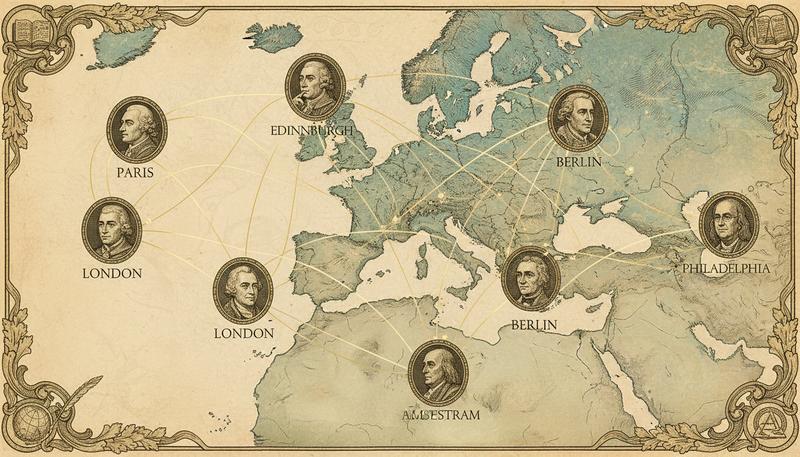
For secular humanism, this institutional dimension matters every bit as much as the ideas themselves. The Enlightenment demonstrated that intellectual life could be organized outside religious structures — that inquiry, community, publication, and even moral formation didn't require the Church as their organizing institution. That demonstration had consequences that would unfold over the next two centuries.
Spinoza: The First Thoroughgoing Naturalist
Of all the Enlightenment's founding figures, Baruch Spinoza might be the most radical — and the most directly ancestral to secular humanism's philosophical core. Writing in Amsterdam in the mid-17th century (his major works appeared in the 1670s, though many circulated in manuscript before that), Spinoza was excommunicated from his Jewish community (Talmud Torah synagogue in Amsterdam) in 1656 at age 24, not age 23. His books made the Catholic Church's Index of Forbidden Books. The charge, essentially, was pantheism shading into atheism — though the truth of his position is more philosophically interesting than either label captures.
Here's his central move: Spinoza identified God with Nature. Not a God who created nature from outside it, or intervenes in it through miracles, or has a plan for it — but God as the single infinite substance of which everything is a mode or expression. Deus sive Natura: God, or Nature. The two terms name the same thing. The naturalist tradition that descends from Spinoza holds that there is exactly one kind of thing — the natural world — and that philosophy's job is to understand it through the same methods that understand anything else, not through a priori revelation or supernatural postulation.
The implications cascaded in every direction. If God is not a person with intentions, there are no miracles — no events that violate the natural order to signal divine displeasure or favor. If God has no plan for human history, then human beings are not fulfilling a divinely appointed destiny. They're finite modes of an impersonal infinite substance, navigating a universe that neither cares about them nor threatens them with supernatural punishment. Spinoza's Ethics (1677) attempts to derive a complete moral philosophy from these premises, using a quasi-geometric method of definitions, axioms, and propositions. The very form of the argument suggests that ethics can be as rigorous and demonstrative as mathematics — without any appeal to divine command.
What makes Spinoza so important for secular humanism specifically is that he doesn't stop at skepticism about the traditional worldview. He doesn't just dismantle the edifice; he builds something in its place. Human beings flourish through understanding, he argues — understanding of nature, of their own passions, of their place in the whole. Virtue is not obedience to divine command but the expression of our rational nature. The free person is guided by reason rather than fear. This is recognizably a humanist ethics — grounded in human capacity rather than external authority — arrived at through rigorous philosophical argument rather than proclamation.
Locke: Toleration, Natural Rights, and the Limits of Religious Authority
If Spinoza is the Enlightenment's most radical metaphysician, John Locke is perhaps its most consequential political philosopher. His Letter Concerning Toleration (1689) and Two Treatises of Government (1689) set the terms for what would become liberal democratic theory — and they both hinge on a specific argument about the proper limits of religious authority over public life.
Locke's argument for toleration is worth understanding carefully because it's not primarily a philosophical argument for religious skepticism. Locke himself was a sincere Christian. Rather, it's an argument about institutional competence and the nature of belief. The civil magistrate has authority over external conduct, Locke argues — over actions that harm others, that disturb the peace, that threaten the civil order. But the magistrate has no authority over belief. Here's why: coerced belief isn't really belief. You can force a person to attend services, mouth liturgical formulas, receive the sacraments. But you cannot force conviction. And if salvation requires genuine faith, as Locke's Protestant Christianity held, then forced religious conformity is not only tyrannical — it's pointless.
The argument cuts deeper than Locke may have intended. Once you've established that civil government has no authority over belief — that the domain of conscience is off-limits to state power — you've created a protected space in which all beliefs, including increasingly heterodox ones, can develop. The Lockean framework of toleration was built for Protestant dissenters seeking relief from Anglican establishment. Within a century it would be invoked by deists, freethinkers, and eventually atheists seeking the same protection.
Locke's natural rights theory does something equally important. By grounding rights in human nature — in the fact that we are rational creatures capable of self-governance — rather than in royal grant or divine dispensation, Locke creates a rights framework that doesn't depend on any particular religious tradition for its validity. Natural rights belong to all human beings as such, discoverable by reason rather than revelation. This move is foundational: secular humanism's commitment to universal human rights traces directly to this kind of reasoning. The argument doesn't require God to underwrite it, even if Locke himself thought God provided its ultimate grounding.
graph TD
    A[Lockean Natural Rights Theory] --> B[Rights grounded in human rational nature]
    B --> C[Discoverable by reason, not revelation]
    C --> D[Universal — apply to all human beings]
    D --> E[Justify religious toleration]
    D --> F[Limit government authority]
    D --> G[Ground democratic consent theory]
    E --> H[Secular constitutional government]
    F --> H
    G --> H
Hume: The Limits of Knowledge and Naturalist Ethics
David Hume may be the Enlightenment's most philosophically rigorous thinker, and certainly the most challenging for anyone who wants to maintain comfortable religious beliefs while also taking argument seriously. Writing in Edinburgh in the middle decades of the 18th century, Hume brought an empiricist epistemology to bear on the traditional foundations of religious belief and found them wanting — systematically, carefully, without apparent animus.
His argument against miracles, presented in An Enquiry Concerning Human Understanding (1748), has a beautiful economy to it. A miracle, by definition, is a violation of the laws of nature. The laws of nature are established by the uniform testimony of human experience — that's what makes them laws. So any report of a miracle is always in tension with the entire accumulated weight of human experience that established the natural order supposedly being violated. How do we assess such a report? By asking: which is more likely — that the laws of nature have been violated, or that the witnesses are mistaken, deceived, or deceiving? Hume's answer, given human fallibility and the notorious unreliability of testimony about extraordinary events, is almost always the latter.
Notice the elegance of this argument: it doesn't require Hume to prove that God doesn't exist or that miracles are metaphysically impossible. It's an epistemological argument — a claim about what we're entitled to believe given the evidence available to us. And that modest framing makes it considerably harder to refute. As the Stanford Encyclopedia's entry on Enlightenment thought notes, Hume's work exemplified the Enlightenment's commitment to subjecting inherited beliefs to rigorous rational scrutiny — including beliefs held so deeply that subjecting them to scrutiny felt like a moral transgression.
Hume's skepticism about causation runs even deeper. His analysis of what we mean when we say one thing causes another — that we observe constant conjunction and feel a psychological expectation of repetition, but that there's no logical necessity underlying the connection — undermines not just miracles but the cosmological argument for God's existence. If causation is an empirical generalization rather than a metaphysical necessity, then the argument that the universe must have a cause (namely God) loses much of its force.
But Hume is equally important for what he built. His Enquiry Concerning the Principles of Morals (1751) argues that the foundation of ethics is not reason alone — contra the Kantian project that would follow — but sentiment: specifically, a natural human sympathy and fellow-feeling that makes us care about the welfare of others. Morality, on Hume's account, is grounded in human nature, in the emotional constitution that makes us social beings, not in divine command or pure rational deduction. This is a recognizably secular and humanist moral framework. The Scottish Enlightenment, in which Hume participated alongside Adam Smith and Adam Ferguson, developed a tradition of moral philosophy that asked: what can we know about ethics starting from human beings as they actually are, rather than from theological premises?
Voltaire and the Philosophes: Wit as Philosophical Weapon
Where Hume was careful and systematic, Voltaire was brilliant and savage. François-Marie Arouet — he adopted the pen name Voltaire — was the most prominent figure of the French Enlightenment, a writer of extraordinary range who used wit, irony, and devastating ridicule as philosophical instruments. His target was what the French called l'infâme — "the infamous thing" — by which he meant not religion as such but fanaticism, superstition, and above all the use of religious authority to oppress people and suppress inquiry.
Candide (1759), his short satirical novel, is a sustained philosophical argument wearing the costume of adventure fiction. Its protagonist travels through a world of massacre, inquisition, earthquake, and slavery while his tutor assures him, with Leibnizian cheerfulness, that everything is for the best in the best of all possible worlds. The effect is corrosive: if this is the best God's providence can arrange, the theodicy — the defense of divine goodness in the face of evil — is exposed as absurd. Voltaire doesn't refute theodicy through abstract argument; he makes it ridiculous, which may be more effective.
Voltaire's positive vision was deism: the belief in a rational creator-God who established natural laws but does not intervene in history, does not perform miracles, does not endorse any particular church or scripture. This was a transitional position — more skeptical than orthodox Christianity, less thoroughgoing than the atheism of some of his contemporaries — but it served an important function. Deism stripped religion of its capacity for arbitrary authority. A God who established rational laws and then stepped back cannot be invoked to justify burning heretics, suppressing scientific discoveries, or torturing confessions out of accused witches. The deist God is a God who has, in effect, handed the world over to human reason.
The philosophes as a group — including Diderot, d'Alembert, Montesquieu, Condorcet, and Helvétius — represented an intellectual culture with remarkable self-consciousness about its project. They knew they were doing something new. They wrote for a public, not just for an academy. They were advocates as well as analysts. And they understood that changing what people believe requires changing the structures through which belief is formed — the institutions of education, censorship, and cultural authority that the Church had controlled.
The Encyclopédie: Systematizing Human Knowledge on Human Terms
The most ambitious single project of the French Enlightenment was the Encyclopédie, ou Dictionnaire raisonné des sciences, des arts et des métiers — the Encyclopaedia, or Systematic Dictionary of the Sciences, Arts, and Trades — edited by Diderot and d'Alembert and published in 28 volumes between 1751 and 1772. It was, among other things, an act of philosophical defiance.
Traditional encyclopedias organized knowledge theologically — beginning with God, whose creation everything else fell under. The Encyclopédie organized knowledge by the faculties of the human mind: memory, reason, and imagination. This isn't just a different organizational scheme; it's a different claim about where knowledge comes from and what its proper center is. The center is not God's revelation but human cognitive capacity. Everything that can be known is known by human beings, through human faculties, and the Encyclopédie aims to make that knowledge — all of it — available to as wide an educated public as possible.
The project was radical in its inclusiveness. Articles appeared on theology alongside articles on carpentry, midwifery, printing, navigation, and agriculture. Skilled artisans were interviewed and their knowledge treated with the same seriousness as abstract philosophical speculation. This democratic valuation of practical, technical knowledge was itself a philosophical statement: the cobbler who knows how leather behaves in rain is in possession of genuine knowledge, as real as anything derived from theological reflection.
Diderot, the project's intellectual engine, was philosophically one of the most interesting figures of the Enlightenment. His private views — expressed in philosophical dialogues and essays he was careful not to publish in his lifetime — moved well beyond deism toward something like materialist atheism. In his Letter on the Blind (1749), which got him briefly imprisoned, he argued that blind people's conceptions of God differ from those of sighted people, suggesting that our ideas of divinity are conditioned by our sensory experience — a quietly devastating point about the supposed universality and transcendence of religious knowledge.
Kant: The Critique of Metaphysics and the Grounding of Ethics in Autonomy
Immanuel Kant represents the Enlightenment's most ambitious and most paradoxical achievement. Writing in Königsberg in the 1780s and 1790s, he attempted to simultaneously defend reason against Humean skepticism, establish the limits of what reason can know, and ground ethics on a basis that required neither theological premises nor empirical observation. The result was a philosophical system of enormous complexity that has shaped — and continues to shape — virtually every subsequent debate in epistemology and moral philosophy.
Kant's famous answer to the question "What is Enlightenment?" (1784) captures something essential about the movement's spirit: Sapere aude — dare to know. "Enlightenment is man's emergence from his self-incurred immaturity. Immaturity is the inability to use one's own understanding without the guidance of another." The authority being questioned is not just religious authority but any external authority that substitutes for one's own rational judgment. The Enlightenment demand is that each person take responsibility for their own thinking — which is, in effect, a philosophical statement about human dignity and rational autonomy.
Kant's Critique of Pure Reason (1781) undertook a systematic investigation of what human reason can and cannot know. His conclusion was double-edged in ways that both religious and secular thinkers have struggled with ever since. On one hand, Kant argued that the traditional metaphysical proofs of God's existence — the ontological, cosmological, and teleological arguments — fail. Pure reason cannot demonstrate the existence of God, the immortality of the soul, or the freedom of the will. These are, in Kant's terminology, ideas of pure reason that exceed what experience can confirm or deny.
On the other hand, Kant didn't conclude that God, freedom, and immortality are simply false or meaningless. He argued that they are legitimate postulates of practical reason — not provable truths but rational requirements for moral life, what we must assume if morality is to make sense. This move has struck many secular readers as a theological rope trick: having established that you can't know these things through theoretical reason, he rehabilitates them through a back door marked "practical reason." The secular humanist tradition has generally followed Hume rather than Kant here, declining to postulate what cannot be known simply because moral life would be tidier if it were true.
What Kant gave secular humanism unconditionally, however, was his moral philosophy — specifically, the categorical imperative and its grounding in rational autonomy. The core insight is that morality cannot depend on anything contingent — not consequences, not desires, not divine commands — because any of these can vary. Genuine moral obligation must be unconditional. And unconditional obligation, Kant argues, can only come from reason itself. Act only on maxims you could will to be universal laws. Treat rational beings always as ends in themselves, never merely as means.
The secular payoff of this framework is immense: ethics grounded entirely in rational autonomy requires no supernatural support. It doesn't matter whether God exists; what matters is that rational beings have a dignity that demands respect. This is precisely the move secular humanism makes. The rights of persons are not gifts from God to be revoked if God is doubted; they are grounded in the rational nature that all persons share, discoverable by reason, defensible by argument.
graph LR
    A[Kant's Ethical Framework] --> B[Morality must be unconditional]
    B --> C[Can't be grounded in consequences]
    B --> D[Can't be grounded in divine command]
    B --> E[Can't be grounded in desires]
    C --> F[Must come from Reason alone]
    D --> F
    E --> F
    F --> G[Categorical Imperative]
    G --> H[Universal Law Formula]
    G --> I[Humanity Formula]
    I --> J[Dignity: treat persons as ends]
    J --> K[Secular ethics without supernatural premise]
The Scottish Enlightenment: Moral Philosophy Without Theology
The Scottish Enlightenment deserves recognition as a distinct tradition within the broader movement — one that was, in some ways, more practically influential on the shape of modern secular thought than the more celebrated French philosophes. Figures like Francis Hutcheson, Adam Smith, Adam Ferguson, and above all David Hume developed a tradition of social and moral inquiry that was rigorously empirical, genuinely humanistic, and — by the standards of the time — remarkably non-theological in its methods.
Hutcheson, who taught at Glasgow and influenced a generation of Scottish moral philosophers, argued that human beings possess a "moral sense" — an internal faculty that allows us to perceive the moral quality of actions directly, much as we perceive color through vision. This is a naturalistic moral psychology: ethics is grounded in how humans actually are constituted, not in divine command or abstract reason. Adam Smith's Theory of Moral Sentiments (1759) developed a related idea through the concept of the impartial spectator — our moral judgments are formed by imagining how a well-informed, disinterested observer would view our actions. Smith's moral philosophy is a social and psychological account of how conscience develops in beings who live together and care about each other's approval.
What strikes you about the Scottish moral philosophers is how completely they manage to do moral philosophy — seriously, rigorously, with real insight — without placing theological premises at the foundation. They are Christians, by and large, but their Christianity operates in a separate compartment from their philosophical work. The moral life they describe is recognizable as a human moral life — one in which sympathy, justice, self-interest rightly understood, and the cultivation of character all play roles — without requiring any particular theological framework to sustain it. This is a template for secular moral philosophy, even if the Scottish moralists wouldn't have described it that way.
The American and French Revolutions: Enlightenment Philosophy Made Political
The Enlightenment was not merely an academic conversation. Its ideas were explosive, and in the last two decades of the 18th century, they detonated.
The American Declaration of Independence (1776) reads, in its preamble, like a précis of Lockean natural rights theory: "We hold these truths to be self-evident, that all men are created equal, that they are endowed by their Creator with certain unalienable Rights, that among these are Life, Liberty and the pursuit of Happiness." The appeal to a Creator is there, but it functions very differently from traditional Christian political theology. The Creator is the author of natural rights, not the sovereign whose will kings must execute. Rights are "self-evident" — accessible to reason without theological argument. And the authority of government derives not from divine appointment but from the consent of the governed.
Jefferson, Madison, Franklin, and the other Founders were philosophically sophisticated men, deeply influenced by Locke, by the Scottish Enlightenment, and by classical republican thought. Several of them, including Jefferson and Franklin, were deists rather than Christians in any orthodox sense. The constitution they produced included, in the First Amendment, the separation of church and state — the first time in history that a major nation had explicitly and constitutionally placed religious authority outside the domain of civil government. That separation is the political enactment of an Enlightenment philosophical principle: that the authority of reason and the authority of revelation are different kinds of authority, operating in different domains, and that confusing them leads to both bad government and corrupted religion.
The French Revolution (1789) made the same Enlightenment ideals available on a more radical, and more volatile, stage. Liberté, Égalité, Fraternité — the revolutionary slogan — was an Enlightenment program compressed into three words. The Declaration of the Rights of Man and of the Citizen (1789) asserted universal natural rights in explicitly secular terms. The Revolution confiscated Church property, abolished monasteries, attempted (disastrously) to replace the Christian calendar with a rational one, and eventually instituted the Cult of Reason — a short-lived official secular religion, presided over by Reason personified as a goddess in Notre Dame cathedral. This episode is worth dwelling on, because it illustrates something important: the Enlightenment's secular impulse, when pursued to its logical extreme without attention to the social functions that religion serves, produced not a stable secular culture but a chaotic vacuum that the revolutionary state tried, grotesquely, to fill by inventing a new religion.
The lesson was not lost on later secular thinkers. The problem with the French Revolution's secularism was not that it was secular but that it was coercive — it tried to legislate belief rather than creating the conditions for free inquiry. True to its own principles, a fully consistent Enlightenment secularism would protect freedom of conscience even for the religious, which is precisely what the American First Amendment attempted.
What the Enlightenment Left Secular Humanism
The Enlightenment bequeathed secular humanism a rich and somewhat disorganized estate. Let's be precise about what actually got inherited.
Empiricism and the scientific method. The commitment to testing beliefs against experience — to treating observation and experiment, not authority or revelation, as the final court of appeal — is the Enlightenment's most enduring methodological contribution. Secular humanism's naturalism (which the next section will examine in depth) is the philosophical formalization of this commitment. As the Internet Encyclopedia of Philosophy explains in its treatment of naturalism, the naturalist tradition that descends from the Enlightenment "seeks to show that philosophical problems as traditionally conceived are ill-formulated and can be solved or displaced by appropriately naturalistic methods" — a direct heir of the Enlightenment's application of scientific thinking to philosophical questions.
Human rights as a secular category. Natural rights theory — the idea that human beings have rights by virtue of their humanity, discoverable through reason and applicable universally — is an Enlightenment creation. It's available to secular humanists precisely because it doesn't depend on any particular religious tradition for its warrant. This matters enormously: it means that the defense of human rights doesn't have to wait for religious consensus, and it can be maintained even in the face of religious traditions that have historically opposed it.
Religious toleration and the separation of church and state. The Enlightenment invented, or at least systematized, the argument that political authority has no business policing belief — that the domain of conscience must be protected from coercion. This is the philosophical foundation of secular governance, and it remains as important as ever in a world where religious majoritarianism still threatens minority belief in many contexts.
Ethics grounded in human nature and reason. Both the Humean tradition (ethics grounded in natural sympathy and fellow-feeling) and the Kantian tradition (ethics grounded in rational autonomy) offer complete moral frameworks that require no theological premises. Secular humanism draws on both, and the tension between them — sentiment versus reason, character versus principle — is one of the productive internal tensions that keeps humanist ethics alive rather than scholastic.
The ideal of progress. The Enlightenment believed that the human situation could be improved — that poverty, disease, ignorance, and injustice were not inevitable features of the human condition but problems that could be diagnosed and solved. This is secular humanism's characteristic optimism, and it's worth noting that it's an optimism with receipts: the two and a half centuries since the Enlightenment have seen dramatic declines in disease, childhood mortality, extreme poverty, and violence (even if the distribution of those gains remains grossly unequal). The case for the ideal of progress is not blind faith but a running argument from evidence.
What the Enlightenment did not fully resolve — and this is an honest reckoning — was the question of meaning. It successfully demonstrated that the traditional religious answers to questions of ultimate meaning were intellectually unsustainable. It failed to offer equally compelling secular alternatives. The 19th century would be haunted by this failure — Nietzsche's "God is dead" is not a celebration but a diagnosis of a cultural crisis — and secular humanism's engagement with questions of meaning and mortality (which will occupy a full section later in this course) represents its attempt to complete the unfinished Enlightenment project.
Honest Complications
The Enlightenment is not a simple triumph story, and secular humanism should not treat it as one. Three complications deserve mention.
First, the Enlightenment was produced almost entirely by educated European men, and its "universal" claims were in practice often exclusive. The philosophes who celebrated universal reason generally didn't extend their arguments to enslaved Africans or colonized peoples. Jefferson wrote "all men are created equal" and owned enslaved people. The gap between the universality of Enlightenment principles and the selectivity of their application is not a minor footnote; it's a structural problem that secular humanism has to engage with honestly, which later sections will do.
Second, the Enlightenment's confidence in reason and progress produced, in its more extreme forms, a kind of rationalist hubris — the conviction that social life could be redesigned from scratch according to rational principles, discarding everything traditional simply because it was traditional. The French Revolutionary Terror is one result of this hubris. The insight that traditions can embody accumulated practical wisdom — that you shouldn't tear them down faster than you can build replacements — is one the Enlightenment often missed, and one that the conservative tradition (Burke, de Maistre) articulated with uncomfortable force.
Third, the Enlightenment's treatment of emotion and religion was often dismissive in ways that created problems. Hume was the exception — his naturalist moral psychology took sentiment seriously. But much Enlightenment rhetoric treated religious belief as simply error, superstition to be swept away by the light of reason, ignoring the ways in which religion serves genuine psychological and social functions. Later secular thinkers would need to be more sophisticated about what they were proposing to replace.
None of these complications invalidates the Enlightenment project. They complicate it — which is what mature philosophical engagement with a tradition actually looks like. The Enlightenment's core commitments — to reason, evidence, human dignity, tolerance, and the possibility of progress — remain defensible and important. But defending them honestly requires acknowledging the ways in which the original project was incomplete, selectively applied, and sometimes pursued with its own brand of dogmatism.
What the next century — the 19th — would do is try to turn these philosophical commitments into a social movement, to build institutions that could carry Enlightenment ideals forward in the absence of the religious institutions they were displacing. That is the story of freethought, secularism, and the slow emergence of secular humanism as an organized philosophy rather than a set of ideas held by unusually brave or lucky individuals. It would prove considerably harder than the philosophes imagined.
Only visible to you
Sign in to take notes.