Humanist Manifestos History and Evolution 1933 to 2003
By the end of the Victorian era, freethinkers had accomplished something genuinely remarkable: they'd built a living philosophical tradition complete with institutions, media outlets, and a genuine cultural identity. But there's a problem that comes with any philosophy that grows into a movement. At some point, you have to actually say what you stand for — clearly enough that people can quote you, critique you, and build on what you've started. That's where manifestos come in.
There's a particular kind of bravery involved in writing one, especially when you're following in the footsteps of people who've already paid a real price for these commitments. You're putting your name — along with others' names — next to numbered propositions. You're inviting people to take shots at you. You're binding yourself and your co-signatories to claims that future generations will read with the advantage of hindsight and, almost certainly, with some skepticism. The humanist movement of the twentieth century would eventually write three of them — 1933, 1973, and 2003 — plus a major supplementary declaration in 1980. In doing so, they accomplished something the Victorians couldn't: they gave their hard-won tradition an explicit, organized, and testable form.
Here's what's most revealing about this pattern: the willingness to commit, then revise, then commit again. While religious creeds tend to lock in and stay locked (the Nicene Creed is essentially unchanged since the fourth century), the humanist manifestos are deliberately provisional. Each one implicitly admits the previous one got some things wrong. Each one bears the marks of its historical moment — sometimes illuminating, sometimes uncomfortable. Together, they function less like a catechism and more like a longitudinal study: a record of how a community of thinkers updated their beliefs in response to new evidence, new catastrophes, and new political realities.
The First Manifesto (1933): Religion Without God
The opening move of Humanist Manifesto I was genuinely odd. The signatories decided to call humanism a "religion." Not metaphorically. They meant it as a straightforward description. "Religious humanism" — that was how they identified themselves.
This was not accidental, and it wasn't mere rhetorical camouflage. Many of the signatories — a significant number of them Unitarian and Universalist ministers — genuinely believed the word "religion" could be reclaimed and redirected. They wanted the emotional warmth, the communal structure, the ethical seriousness of religious life, but without the metaphysics. In a sense, they were attempting a philosophical renovation of religion itself: keep the building, gut the supernatural interior.
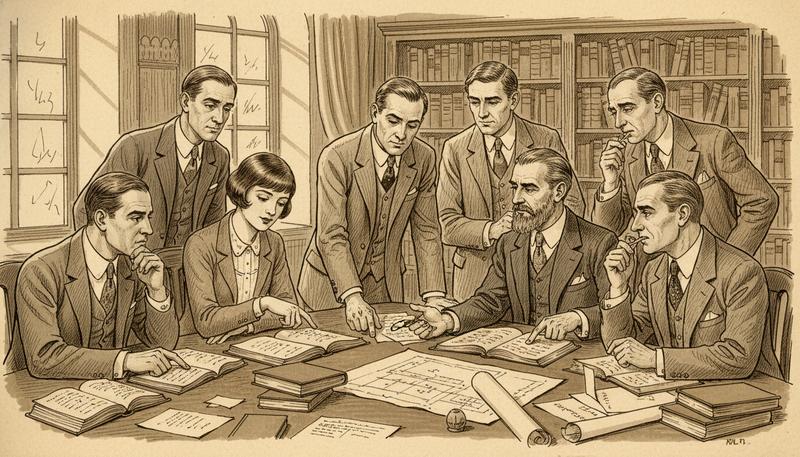
For its time, the 1933 document's actual positions were genuinely radical. It stated flatly that "the universe is self-existing and not created" — a clean rejection of theism. It embraced evolutionary science without qualification. It insisted that "the distinction between the sacred and the secular can no longer be maintained" and called for economics structured around "the equitable distribution of the means of life." That last part reflected the Depression moment: several signatories had sympathies for socialist economic organization, and those prescriptions would eventually prove more embarrassing than anything in the metaphysics.
The full text of Humanist Manifesto I reveals a document that is both philosophically serious and historically situated in ways that later revisions would need to address.
Why the Religious Language — and Why It Became a Problem
Calling humanism a "religion" was strategic, pastoral, and, ultimately, philosophically unstable. Strategic because it repositioned humanism as a legitimate alternative to Christianity rather than merely its opponent — it claimed the emotional and communal space that religion occupied rather than ceding it. Pastoral because many signatories were actually serving congregations and needed a framework that let them keep their ministerial vocations while abandoning supernatural belief. And philosophically unstable because the word "religion" carries so much baggage that its use guaranteed endless confusion.
The confusion cut both ways. Secular critics of religion found the religious language off-putting and unconvincing — if you reject God and the supernatural, why grab for a word so thoroughly owned by those concepts? Religious traditionalists found the appropriation either insulting or dishonest. Then the Supreme Court's 1961 decision in Torcaso v. Watkins added a legal complication: the opinion mentioned "Secular Humanism" in a footnote (in a list of non-theistic religions) — a characterization that evangelical critics of public education would later weaponize to argue that secular humanism was a "religion" being unconstitutionally promoted in schools. What had started as a philosophical self-description became a legal and political liability.
By the 1960s, the humanist community was visibly fracturing over this question. Some humanists — particularly those in Unitarian circles and the Ethical Culture movement — continued to embrace the "religious humanism" language. Others, influenced by logical positivism, the professionalization of philosophy, and plain discomfort with the term, wanted nothing to do with the word "religion." This tension never formally resolved until 1980, but it haunted every document the movement produced in the meantime.
Humanist Manifesto II (1973): After the Catastrophes
Forty years is a geological epoch in intellectual history. Between 1933 and 1973, the humanist movement had to process the Holocaust, Hiroshima, Stalin's gulags, Mao's Cultural Revolution, McCarthy, Vietnam, and the assassinations of Kennedy and King. The utopian confidence of 1933 — with its faith in social planning, its progressive economics, its assumption that reason and science were reliably on the side of human liberation — suddenly looked like it had been written by people who fundamentally underestimated what the twentieth century was capable of.
Humanist Manifesto II, drafted primarily by Paul Kurtz with Edwin H. Wilson and signed by 114 prominent figures including B.F. Skinner, Betty Friedan, Francis Crick, and Andrei Sakharov, is a substantially different document. It's longer, more careful, more explicitly political, and — most importantly — far more cautious about political and economic prescriptions. Where the 1933 document had entertained collectivist economics, the 1973 version went out of its way to warn against authoritarianism from both left and right.
The most famous line captures the shift perfectly: "No deity will save us; we must save ourselves." This is not the language of religious humanism. It's the language of a movement that has decided to stop hedging its bets.
graph TD
    A[Humanist Manifesto I, 1933] -->|40 years of history| B[Humanist Manifesto II, 1973]
    B -->|7 years, organizational split| C[A Secular Humanist Declaration, 1980]
    C -->|23 years| D[Humanist Manifesto III, 2003]
    A -->|Drops religious framing| B
    B -->|Formalizes 'secular'| C
    C -->|Becomes more concise| D
The 1973 Manifesto is organized around seventeen theses covering the nature of the universe, ethics, individual freedom, democratic society, world community, and humanity. Several of its positions reflected hard-won lessons from mid-century catastrophes. Proposition ten explicitly defends "the right to birth control, abortion, and divorce." Proposition fifteen calls for a world community and opposes nationalism "when it runs counter to international justice." Proposition seventeen condemns "the increasing invasion of privacy, by whatever means, in both totalitarian and democratic societies."
That last one matters. The 1933 document had been written in an era when it seemed plausible that centralized planning might be genuinely benign. The 1973 version had learned that power — including secular, rational power — could be catastrophically abusive. This wasn't just historical updating. It was a genuine philosophical revision that reflected a deeper understanding of the relationship between political freedom and human dignity, purchased at an enormous human cost.
The Holocaust posed a particular intellectual challenge to humanism. The Nazis weren't obviously religious actors — they appealed to pseudoscientific racism, romantic nationalism, and mythology. If reason and science could be mobilized for genocide, what exactly did it mean to put faith in reason and science? The 1973 Manifesto doesn't fully grapple with this question (it mostly treats Nazi catastrophe as a failure of democracy and freedom rather than as a challenge to humanist confidence in rational progress), but the heightened emphasis on human rights and democratic accountability reflects an implicit awareness that earlier optimism had been naive.
The document made another important practical move: it dropped the claim that humanism was itself a religion. The word "religious" doesn't disappear entirely — some signatories still identified as religious humanists — but the framing shifted considerably. Humanism became a "philosophical, religious, and moral point of view" — a hedged formulation that acknowledged the ongoing internal debate without settling it.
Paul Kurtz: The Philosopher-Organizer
No single figure is more central to the institutional development of secular humanism in the second half of the twentieth century than Paul Kurtz (1925–2012), and understanding his career is essential for understanding why the movement produced the documents it did and why it eventually fractured over them.
Kurtz was, in the best sense, a philosophical entrepreneur. Trained at Columbia under Sidney Hook (himself a student of Dewey), he combined genuine philosophical seriousness with an unusual capacity for institution-building and media work. He edited The Humanist magazine, served as the primary drafter of Manifesto II, and then — frustrated with what he saw as intellectual insufficiency in the American Humanist Association — founded his own organizations.
In 1976, Kurtz co-founded the Committee for the Scientific Investigation of Claims of the Paranormal (CSICOP, later CSI), which published Skeptical Inquirer and became the hub of the modern skeptics movement. In 1980, he founded the Council for Democratic and Secular Humanism (CODESH, later renamed the Council for Secular Humanism), which published Free Inquiry magazine. In 1991, both organizations were brought under the Center for Inquiry umbrella, which remains one of the most active humanist and skeptical organizations in the world.
Kurtz was also the primary author of the 1980 document that formalized the "secular" designation — and this is where his philosophical instincts and organizational ambitions converged in ways that would shape the movement for decades.
Kurtz's philosophical project can be summarized in a single word he coined: eupraxsophy — from Greek roots meaning "good," "practice," and "wisdom." A eupraxsophy is, as the Council for Secular Humanism describes, "a body of principles suitable for orienting a complete human life." Kurtz wanted secular humanism to be exactly this: not just a set of negative claims (no God, no supernatural) but a positive, comprehensive philosophy offering guidance across the full range of human concerns. This ambition — secular humanism as a complete life stance rather than merely an intellectual position — drove his organizational work and his frustration with organizations he thought too intellectually cautious.
A Secular Humanist Declaration (1980): Naming the Thing
The 1980 A Secular Humanist Declaration, drafted by Kurtz and published through his newly formed Council for Democratic and Secular Humanism, is in some ways the most consequential document in this history, even though it's the least read today. It's the document that formally crystallized "secular humanism" as a distinct designation — separating it explicitly from religious humanism and establishing a clear identity.
The Declaration is organized around ten commitments: free inquiry, separation of church and state, the ideal of freedom, ethics based on critical intelligence, moral education, religious skepticism, reason, science and technology, evolution, and education. It's notable for emphasizing not just the negative rejection of religious authority but the positive embrace of skeptical inquiry as a method and democratic freedom as a political requirement.
The timing was deliberate. The late 1970s saw the emergence of the religious right as a political force — Jerry Falwell's Moral Majority launched in 1979, and Ronald Reagan's presidential campaign was explicitly building on evangelical Christian political mobilization. Secular humanists were increasingly being named as enemies in this discourse. Falwell and others routinely accused "secular humanism" of being a pernicious ideology undermining American values — which paradoxically gave secular humanists a public identity they hadn't entirely sought.
Kurtz's response was characteristic: if you're going to be named, define yourself. The 1980 Declaration was partly defensive (we are not what our critics say we are) and partly affirmative (we are this, and we claim it proudly).
The document also formalized the organizational split that had been developing since the 1960s. The American Humanist Association remained associated with a broader humanist identity that included religious humanists. Kurtz's Council for Secular Humanism positioned itself for those who wanted a rigorously secular, explicitly non-religious humanist philosophy. This institutional differentiation would persist — sometimes productively, sometimes generating unnecessary friction — for decades.

The American Humanist Association vs. the Council for Secular Humanism
The organizational history here matters not for its administrative drama but for what it reveals philosophically. The two organizations were not simply competing for members — they represented genuinely different answers to what humanism actually is.
The AHA, founded in 1941, maintained a coalition broad enough to include religious humanists — Unitarians, Quakers, Ethical Culturists — alongside secular members. The Humanist reflected this inclusive approach. The AHA's 1973 Manifesto was drafted by Kurtz, but the Association's institutional culture remained more accommodating of religious language and religious-adjacent practices than Kurtz found intellectually satisfying.
Kurtz wanted sharper distinctions. He wanted secular humanism to be explicitly naturalistic, explicitly non-religious, and explicitly committed to scientific skepticism as a methodology — not just for questions about God but for questions about the paranormal, alternative medicine, pseudoscience, and other areas where he thought intellectual rigor was being abandoned. This was a philosophical position as much as an organizational preference: Kurtz believed you couldn't coherently claim to be a humanist while leaving open the possibility of supernatural or pseudoscientific claims.
The tension between these positions reflects a genuine philosophical question: Is secular humanism primarily defined by what it rejects (supernaturalism, religious authority) or by what it affirms (reason, science, human dignity, democratic freedom)? Kurtz thought the negative and positive commitments were inseparable — that you couldn't properly affirm reason and science while remaining agnostic about the supernatural. The AHA's broader coalition implicitly suggested these affirmative commitments could be shared even by those who declined the negative ones.
This debate, which never produced a clear resolution, reveals something true about secular humanism: it's a philosophical family with genuine internal diversity, not a monolithic ideology. The presence of multiple organizations, sometimes in tension, is evidence of intellectual vitality rather than organizational failure.
Humanists International and the Global Dimension
The story of the humanist manifestos has been told almost entirely as an American story, which needs correction. The humanist movement was international from the start, and the global dimension adds crucial context to the American debates.
Humanists International (originally the International Humanist and Ethical Union, or IHEU) was founded in Amsterdam in 1952, with Julian Huxley — the evolutionary biologist and first Director-General of UNESCO — as a founding figure. Humanists International now represents over 100 member organizations in more than 40 countries, spanning Europe, Africa, Asia, and the Americas.
The international organization's approach to terminology has generally differed from the American one. IHEU long maintained that unmodified "Humanism" (capitalized) was preferable to "secular humanism" — partly because the "secular" qualifier carries connotations specific to the American church-state context that don't translate cleanly elsewhere, and partly because many European humanist organizations operate in political contexts where the religious-secular boundary is drawn differently than in the United States.
In 2002, the IHEU General Assembly adopted the Amsterdam Declaration, which serves as the global humanist movement's defining statement. The Declaration identifies seven key elements of Humanism: that it is ethical, rational, supports democracy and human rights, insists that personal liberty be combined with social responsibility, is non-theistic, and is committed to finding meaning in life without the supernatural. The Amsterdam Declaration explicitly used capitalized "Humanism" without qualifiers — a deliberate choice reflecting the IHEU's preference for a unified humanist identity over proliferating hyphenated subspecies.
This linguistic disagreement is philosophically substantive. Those who prefer "secular humanism" argue the qualifier is necessary to distinguish the non-religious variety from religious humanism, and that clarity matters. Those who prefer unmodified "Humanism" argue that adding "secular" privileges secularism over humanism and unnecessarily narrows the movement's self-understanding. As Wikipedia notes, the term "secular humanism" is most prevalent in the United States and is sometimes considered essentially an Americanism.
Humanist Manifesto III (2003): Less Prophecy, More Principle
If Manifesto I was utopian and Manifesto II was chastened, Manifesto III — published by the American Humanist Association in 2003 and titled simply Humanism and Its Aspirations — reads as something closer to a philosophical mission statement than a political program. It's much shorter than its predecessors, organized around six core commitments, and deliberately avoids the detailed policy prescriptions that dated the earlier documents.
The 2003 Manifesto was signed by notable figures including Kurt Vonnegut, Oliver Stone, Eugenie Scott, and James Randi. The brevity itself is a philosophical choice: the drafters had watched two previous manifestos age poorly in their specifics and concluded that durability required less ambition, not more.
The six commitments of Manifesto III are:
- Knowledge of the world is derived by observation, experimentation, and rational analysis — a clear embrace of scientific epistemology
- Humans are an integral part of nature, the result of unguided evolutionary change
- Ethical values are derived from human need and interest as tested by experience
- Life's fulfillment emerges from individual participation in the service of humane ideals
- Humans are social by nature and find meaning in relationships
- Working to benefit society maximizes individual happiness
The document emphasizes human dignity, democratic values, and the interconnection of individual flourishing and social responsibility. It also makes explicit commitment to global ethics and planetary stewardship — reflecting the environmental concerns that had become central to progressive thought by 2003.
What the 2003 Manifesto deliberately omits is as significant as what it includes. It says nothing about economics, nothing about specific political policies, nothing that would pin it to the political arguments of its particular moment the way 1933's flirtation with collectivism or 1973's explicit defense of abortion rights had. This restraint is arguably a philosophical virtue — it focuses on what is genuinely foundational — but it also reflects a movement that had learned, sometimes painfully, that specific policy commitments become embarrassments much faster than core principles do.
What the Manifestos Reveal About Humanism as a Living Tradition
Reading the three manifestos in sequence, what strikes me most is not what changed but what persisted. Across seventy years, four generations of signatories, and extraordinary historical upheaval, certain commitments remained constant: the naturalistic worldview, the conviction that ethics is a human enterprise rather than divine command, the importance of reason and scientific method, the centrality of human dignity, and the connection between philosophical integrity and democratic freedom.
What changed — the religious framing, the economic prescriptions, the political specifics — turned out to be historically contingent clothing draped over a more durable philosophical core. This is actually rather encouraging for a tradition that prides itself on empirical honesty: the revisions demonstrate that humanists were genuinely updating their views in response to evidence and experience, not merely rationalizing fixed positions.
This is precisely what you'd expect from a philosophy committed to the scientific method as a model for inquiry. Science doesn't get things right on the first try — it builds a picture gradually, revising in response to new data, retaining what proves robust, discarding what doesn't. The manifesto tradition represents secular humanism trying to do something similar with its own philosophical commitments: treating its own worldview as revisable in principle, even while maintaining that some core commitments are well-established enough to act on.
graph LR
    A[Core Commitments: Constant] --> B[Naturalism]
    A --> C[Reason & Science]
    A --> D[Human Dignity]
    A --> E[Democratic Freedom]
    F[Contingent Elements: Revised] --> G[Religious language]
    F --> H[Economic prescriptions]
    F --> I[Political specifics]
    F --> J[Institutional affiliations]
The post-Holocaust revision is particularly instructive. The 1973 Manifesto's increased emphasis on human rights and explicit warnings against authoritarianism were not cosmetic updates — they represented genuine philosophical reckoning with the limits of progressive optimism. The twentieth century had demonstrated that belief in reason and science was not sufficient protection against catastrophic political evil. Humanists absorbed this lesson and revised accordingly. That they absorbed it imperfectly — that the 1973 document still doesn't fully confront how secular ideologies themselves enabled atrocities — is a legitimate criticism, but the attempt at revision is more impressive than the defensive rigidity that characterizes many ideological traditions when confronted with disconfirming historical evidence.
The Ongoing Debate: Does Secular Humanism Need a Manifesto?
There's a reasonable case against the manifesto tradition, and it deserves honest engagement. Manifestos tend to date. They attract signatories with varied motivations, producing documents that satisfy no one completely. They can make a philosophical tradition look like a political movement or, worse, like a cult. They encourage the perception that secular humanism is an "ism" in the ideological sense — a fixed doctrine that adherents subscribe to — rather than a philosophical orientation characterized by inquiry and revision.
Paul Kurtz himself became increasingly uncomfortable with the manifesto format in his later years. He worried that documents produced by committee would inevitably sacrifice philosophical precision for the sake of consensus, producing language vague enough to offend no one and inspire no one either. His preferred alternative was something like the eupraxsophy model: a comprehensive philosophical framework developed through careful argument, not signed declarations.
There's also the practical problem that manifestos attract critics more reliably than they attract adherents. Every specific claim in a manifesto becomes a target. The 1933 document's economic prescriptions were used to link humanism to communism. The 1973 document's defense of abortion rights was used to link humanism to the culture wars. Manifestos make it easy for opponents to cherry-pick unflattering passages and ignore context.
And yet there's something important the manifesto tradition gets right. Philosophy doesn't live only in academic journals and university seminars. It lives in communities of people trying to articulate shared values, organize collective action, and make sense of their lives in public, together. The manifesto format — however imperfect — attempts philosophy in a way that is accountable, legible, and community-forming. It says: here is what we think, in plain language, for anyone to read and criticize. That's more honest, in a way, than the careful hedging of purely academic philosophy.
The Council for Secular Humanism's own description of what secular humanism is reflects this dual aspiration: to be philosophically rigorous and humanly accessible, to offer a comprehensive orientation to life rather than merely abstract positions. Whether a manifesto is the best vehicle for that aspiration is a fair question. That the aspiration itself is worth having — that a philosophy for human living should be expressible in terms that human beings can actually use — seems beyond serious doubt.
The three manifestos, read in sequence, tell the story of a philosophical tradition attempting something genuinely difficult: trying to be honest about what it knows, humble about what it doesn't, and courageous enough to commit publicly to positions that will inevitably require future revision. In an intellectual culture that often rewards either dogmatic certainty or nihilistic irony, that combination of commitment and humility is rarer and more valuable than it might appear.
The documents are imperfect. They bear the marks of their moments. They reflect the blind spots as well as the insights of their authors. But they are genuinely philosophical documents — attempts to think through hard questions in public, with consequences — and they deserve to be read as such.
Only visible to you
Sign in to take notes.