Secular Humanism in the 21st Century: Challenges and Future
Secular Humanism in the 21st Century: Challenges, Renewal, and the Road Ahead
Here's the thing about progress: it's real, but it's not automatic. We've traced secular humanism from ancient Athens through the Enlightenment, watched it coalesce into organized movements, and seen it articulate increasingly sophisticated philosophical foundations. By almost every measurable standard, the world has moved in directions humanists long advocated for — more literacy, more scientific knowledge available to more people, more democratic governance, expanding human rights. And yet, something unexpected happened. That late-twentieth-century confidence that the victory was essentially won? It turned out to be premature.
Secular humanism in the early twenty-first century finds itself under pressure in new and disorienting ways. Not just from the expected quarter — traditional religious critics — but from algorithmic disinformation, authoritarian movements wrapped in populist language, institutional distrust that targets science the way it targets everything else, and a cultural moment where the very possibility of shared reason feels increasingly fragile. This is precisely the kind of moment that reveals whether a philosophy is alive or just historical.
But here's what we learned in the previous section that matters right now: secular humanism's strength was never invulnerability. It's the capacity to identify genuine problems — in its genealogy, its understanding of community, how it grounds dignity, even its basic assumptions about knowledge — and then actually change in response. The question this final section wrestles with is whether the tradition we've traced from Socratic Athens to the present has the resources to meet what we're actually facing. My answer is yes. But only if secular humanism turns on itself the same honest reckoning it's learned to give to its critics, and does the real work — philosophical and practical — to address what it's missed and who it's left out.
Religious Authoritarianism and the Return of Theocratic Politics
Start with the political dimension, because it's the most immediately urgent. Religious nationalism is on the rise across multiple continents — not as a fringe phenomenon but as a governing principle in democracies and near-democracies that were supposed to be moving toward secularization. India's Hindu nationalism, Poland's Catholic resurgence, Myanmar's Buddhist extremism, the Taliban's return to Afghanistan, Hungary's Christian nationalism, evangelical dominionism within American politics — the list is long and getting longer. Humanists International, the global federation of humanist organizations operating in over forty countries, has tracked this trend with something close to alarm. Their annual reports read like dispatches from an ongoing emergency: documented attacks on freedom of conscience, blasphemy prosecutions, systematic legal persecution of humanists, atheists, religious minorities across continents.
What makes this particularly insidious is that it's not anti-humanism dressed in religious language. It's the explicit targeting of humanism itself — the universalism that has always been central to the humanist project. The principle that human dignity doesn't depend on tribal belonging, religious affiliation, or ethnic origin. When that universalism becomes the target, the stakes are obvious.
What secular humanism offers as a counterweight isn't anti-religion — the tradition has always been careful to distinguish between religious belief as such and theocratic power. It's a principled defense of the institutional arrangements that protect everyone's freedom: separation of powers, rule of law, freedom of conscience, human rights grounded in the dignity of persons rather than in any particular deity's will. This is the argument that Locke first developed, the Enlightenment refined, and that remains as necessary now as it's ever been.
There's something people sometimes miss about this: the argument isn't that secular people are morally superior to religious people. That would be empirically false and philosophically self-defeating. The argument is that a genuinely pluralistic society — one with multiple faith traditions coexisting — cannot organize itself politically around any one tradition's theological commitments without systematically wronging everyone outside it. That's not anti-religious. That's just recognizing how power actually works.
Post-Truth and the Epistemological Crisis
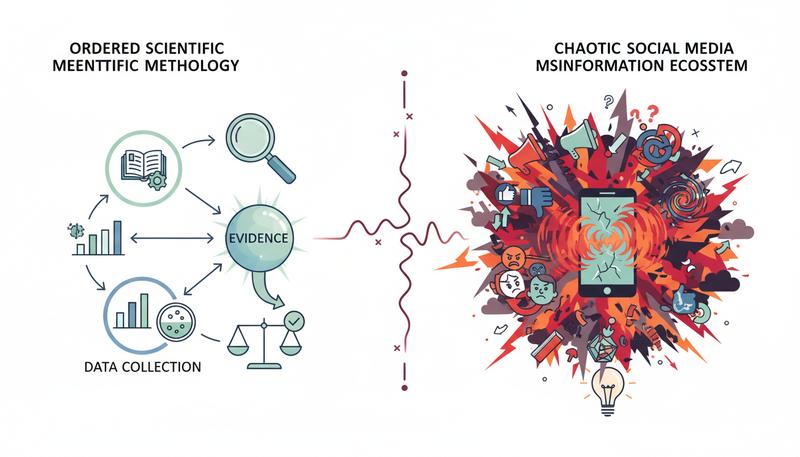
If theocratic nationalism represents the political challenge, the post-truth information environment is the epistemological one. Secular humanism, at its core, has always been a bet on epistemology: the conviction that reliable knowledge comes from reason, evidence, and scientific method — not revelation, tradition, or authority.
The twenty-first century has made holding that conviction much harder.
Take what's happened with social media's attention economy combined with deliberately engineered disinformation and a deep, structural crisis of institutional trust. The result? Scientific consensus on topics from vaccine safety to climate change to election integrity gets publicly contested as though there are two equally valid sides. The measles vaccine and autism controversy becomes presented with apparent parity to the evidence that there is no connection. Philosophically, we call this false equivalence. Emotionally, it feels more like vertigo — a world where the actual tools for figuring out what's true (peer review, expert consensus, empirical evidence) have themselves become objects of suspicion. The very institutions designed to get us closer to truth are now seen as obstacles to truth.
Humanists have sometimes made this worse without realizing it. We've been very good at debunking, at pointing out where people are wrong. But being told you're wrong — however accurately — doesn't automatically make you open to evidence next time. The psychological research on belief change is pretty clear: correction works best when it comes from within a trusted community, when it offers an alternative narrative rather than just negation, and when it doesn't implicitly threaten someone's identity or social belonging. These are things secular humanism, which hasn't always been the warmest of traditions, needs to take seriously.
What humanist epistemology actually offers, at its best, is more than "trust the scientists." It's a method and a set of intellectual virtues: rigor, humility, willingness to change your mind when evidence demands it, comfort with uncertainty, and genuine appreciation for the difference between provisional conclusions and settled facts. When the Council for Secular Humanism describes humanism as grounded in "impartial review by multiple observers," that's essentially a lay description of intersubjective verification — the same principle that makes peer review work. Making that principle not just intellectually defensible but emotionally compelling, culturally attractive, and accessible to people who didn't spend their twenties in graduate school? That's the communication challenge of this generation.
Climate Change: The Ultimate Humanist Test Case
Climate change is a philosophical emergency in a way that's worth unpacking. It's a problem that demands exactly the cognitive and ethical capacities secular humanism has always claimed humans possess: the ability to reason across vast timescales about causes and consequences, to take seriously the interests of people not yet born, to sacrifice short-term comfort for longer-term flourishing, and to act collectively on the basis of scientific knowledge rather than what you can feel in your immediate experience.
The humanist case for urgent climate action isn't primarily about nature worship or environmental mysticism, though humanists can and do develop a profound respect for the natural world on purely naturalistic grounds. It's about intergenerational justice — a concept with deep roots in humanist ethics. Take the consequentialist ethical framework seriously: it judges moral choices by their results. The results of continued fossil fuel dependence — rising seas, intensifying storms, agricultural collapse, mass displacement, vanishing species — constitute an ethical catastrophe being inflicted on billions of future people who have no say in the decisions we're making now. Derek Parfit spent decades developing the philosophical tools for thinking rigorously about obligations to generations that don't yet exist. That's secular humanism applied at the deepest temporal scale.
This is also where the humanist commitment to science becomes most consequential politically. Climate denial isn't just a scientific error. At its most organized, it's a deliberate epistemological campaign funded by industries with real economic incentives to delay action. Responding to that requires more than better science communication. It requires defending the institutions and practices themselves — peer review, scientific consensus, regulatory agencies based on expert knowledge — through which societies turn scientific findings into policy. If you care about the future of human civilization, as humanists claim to, you can't treat climate change as someone else's problem.
Here's the uncomfortable internal question though: the humanist tradition emerged in times and places that were, at best, indifferent to ecological limits. That Baconian vision of "the relief of man's estate" through mastery of nature, which animated a lot of Enlightenment optimism about science, carried a certain hubris that hasn't aged well. A secular humanism for the twenty-first century needs to integrate an ecological conscience — not by abandoning the commitment to human flourishing, but by recognizing something obvious: human flourishing on a degraded planet is a contradiction.
Artificial Intelligence and the Question of Human Dignity
Nothing on the technological horizon right now forces humanist philosophical questions more sharply than artificial intelligence. The development of large language models, autonomous systems, and increasingly powerful AI tools creates a direct confrontation with some of the deepest questions humanist thought has ever had to face: What makes human beings distinctive? What grounds dignity? Who counts morally, and on what basis?
Secular humanism has always grounded human dignity not in a soul granted by divine fiat but in capacities — reason, self-awareness, moral agency, the ability to love and suffer and create meaning. In principle, this is more flexible than theological accounts. It can, in theory, be extended to any being that actually possesses those capacities, regardless of what it's made of. But it also raises genuinely unsettling questions in the AI context: if a sufficiently sophisticated system can reason, model itself, and respond to the world in ways that functionally resemble self-awareness, what follows? Most philosophers serious about this question are honestly uncertain, which is the right answer.
What secular humanism can contribute more immediately is a set of principled commitments about how these technologies should be deployed in relation to human beings. We're not in speculative territory here. The erosion of meaningful consent through algorithmic surveillance, the automated reproduction of historical biases in hiring and lending and criminal justice, the displacement of workers without any social safety net underneath them, the concentration of AI capabilities in the hands of a few corporations with zero democratic accountability — these aren't science fiction. They're happening now. Humanism's insistence that every individual has dignity and deserves to be treated as an end rather than a means — the Kantian formulation, which humanists don't have to accept wholesale to find it useful — applies directly to how AI systems should be designed, audited, and governed.
graph TD
    A[AI as Humanist Challenge] --> B[Dignity & Moral Status]
    A --> C[Economic Displacement]
    A --> D[Epistemic Manipulation]
    A --> E[Democratic Accountability]
    B --> F[Who counts morally?]
    C --> G[Right to meaningful work]
    D --> H[Algorithmic disinformation]
    E --> I[Corporate vs. public control]
    F --> J[Humanist response: capacity-based dignity]
    G --> J
    H --> J
    I --> J
The best humanist response to AI is neither technophobic nor naively techno-utopian. Secular humanism has always celebrated human ingenuity and the expansion of human capability through knowledge and tools. But it has also — in its more self-aware moments — recognized that capability without wisdom, power without accountability, and efficiency without justice are not obviously good things. The challenge of AI is building governance structures and ethical frameworks adequate to a technology that's developing faster than our institutional capacity to regulate it. That's a humanist challenge in the most direct sense.
The New Atheism: A Reckoning
Any honest account of secular humanism in the early twenty-first century has to contend with the New Atheism — that publishing and public intellectual phenomenon from roughly 2004 to 2012 featuring Richard Dawkins, Christopher Hitchens, Sam Harris, and Daniel Dennett. The God Delusion, God Is Not Great, The End of Faith, Breaking the Spell — combative, confident, often brilliantly written arguments for atheism and against religion that dominated bestseller lists and actually reached audiences that academic humanism never could.
The relationship between New Atheism and secular humanism is genuinely complicated, and it deserves more honesty than either the cheerleading or the dismissal usually provides.
At its best, New Atheism did something real: it made public non-belief socially acceptable, at least in Anglophone countries. It pushed back against the reflexive deference to religious authority that had made certain questions seem taboo. It brought genuine philosophical sophistication to questions that had too often been treated as purely personal. Dennett's Breaking the Spell was serious naturalistic study of religion. Dawkins brought real expertise to evolutionary biology's defense against creationism. Hitchens's demolition of religious hypocrisy and theocratic politics was often devastating and sometimes exactly right.
But at its worst — and there was a worst — New Atheism embodied precisely the failure modes that have historically made secular humanism its own enemy: an epistemically overconfident dismissiveness toward religious experience that matched the faith it mocked for arrogance. A cultural parochialism that read "religion" primarily as evangelical Christianity while being oddly protective of one tradition and vicious toward another. And most damagingly for the tradition itself, a demographic insularity that in some cases slid into anti-Muslim bigotry, making the whole thing look less like universal humanism and more like Western cultural supremacy in rationalist costume.
The honest assessment: New Atheism was an ally of secular humanism epistemologically. It often was a liability ethically and politically. It demonstrated — yet again — that skepticism about God doesn't automatically produce justice, humility, or concern for the marginalized. As the Council for Secular Humanism has articulated, atheism is just a position on whether God exists. It's not a comprehensive life stance. The New Atheists were atheists, many of them brilliantly. Not all of them were humanists in the fuller sense. The difference matters.
The legacy is a need for secular humanism to be clearer about what it's for, not just what it opposes. A philosophy that's primarily recognizable by its denials will always get defined by its enemies.
Humanism and Social Justice: An Unfinished Reckoning
One challenge to humanist credibility is New Atheism's limitations. A deeper, more uncomfortable one is the tradition's actual historical relationship to race, gender, and colonialism. Section 12 engaged with this as an objection. Here the question is what a renewed twenty-first-century humanism actually does about it.
On paper, the humanist tradition has long been committed to human equality across race, gender, and sexual orientation. Secular humanism's core claim — that humans are capable of ethics and morality without supernatural authority, and that ethics must be examined and revised based on actual consequences for actual people — logically grounds robust commitments to racial equity, gender equality, and LGBTQ+ rights. If dignity is grounded in capacity rather than divine designation, there's no principled humanist argument for racism, sexism, or heterosexism. The American Humanist Association has, in fact, taken strong positions on all these issues.
But the institutional reality of organized humanism — like organized atheism, organized skepticism, and much of progressive secular culture — has been predominantly white, predominantly male, predominantly middle-class, predominantly based in the global North. The people who wrote the manifestos, founded the organizations, and defined what counts as the canon were never a representative sample of humanity. This has consequences beyond image. It shaped which questions get asked and which don't, whose experiences count as paradigmatic, what "reason" looks like in practice.
A secular humanism worth the name in the twenty-first century needs more than position papers on racial equity issued from organizations that look like a 1950s faculty lounge. It needs to genuinely grapple with how historical structures of domination — slavery, colonialism, patriarchy — were often supported by the same Enlightenment science and progressive thought that produced humanist values. It needs to listen to voices historically excluded from the conversation. Those voices don't just add "diversity" in a cosmetic sense. They bring different insights, different priorities, different philosophical resources.
This isn't a capitulation to anti-rationalism or rejection of the Enlightenment. It's what genuine intellectual humility — which humanists have always claimed as a virtue — actually requires.

The Nones: A Demographic Opportunity and a Philosophical Challenge
One of the most discussed religious trends of the past two decades is the rise of the religiously unaffiliated — the "nones" — in the United States, Europe, and the developed world generally. American surveys consistently show roughly 28-30% of adults now identify as religiously unaffiliated, a figure that's roughly doubled since the early 2000s. Among adults under thirty, it's even higher.
This looks, at first, like good news for organized secular humanism. A larger population of non-religious people should mean a larger potential constituency. Except it hasn't. Organized secular humanism hasn't experienced anything like a corresponding growth in membership or real cultural influence. The "nones" aren't, mostly, secular humanists in any organized sense. Most are better described as "spiritual but not religious," indifferent rather than thoughtful about metaphysical questions, or simply post-religious without having adopted any alternative framework.
That gap — between demographic trends and organized humanism's stagnation — reveals something important. The difficulty isn't primarily philosophical. The arguments hold up. It's communal and cultural. Religion provides its adherents not just metaphysical claims but community, ritual, rites of passage, mutual support during crisis, a shared narrative that locates you within something larger, a ready-made social world. When the "nones" leave organized religion, they're not leaving because they've read Hume and been convinced. They're leaving because the specific community no longer serves them. But they remain human beings with human needs for belonging, meaning, ceremony.
If secular humanism is going to speak to this demographic, it needs to be more than a philosophy. It needs what Section 11 examined: a practice — actual communities, ceremonies, real relationships that meet human needs. The Sunday Assembly movement, Ethical Culture societies, humanist celebrants conducting namings and weddings and funerals, local humanist chapters that function as genuine mutual aid communities rather than just lecture series — these are the institutional forms through which secular humanism could actually become, for many people, not just intellectually compelling but existentially sustaining.
This is genuinely difficult. Religious communities have spent millennia developing their practices and infrastructure. Secular humanist communities are starting almost from zero. But the raw material is there: a large and growing population of thoughtful non-religious people searching for connection and meaning.
Humanists International: The Global Movement Beyond the Anglophone World
Any account of secular humanism that treats it as primarily American or British misses most of the actual story. Humanists International, founded by Julian Huxley and Jaap van Praag and now representing over one hundred organizations in more than forty countries, has worked to build a genuinely global humanist movement that reflects human diversity rather than Anglophone priorities.
This matters philosophically as well as politically. The humanist claim that reason, human dignity, and ethical concern are genuinely universal — not Western impositions but capacities shared by every human being — only holds credibility if the movement making it actually reflects human universality. Humanist organizations in Uganda, India, Pakistan, Nigeria, Bangladesh operate in conditions radically different from those faced by humanists in Norway or the United States. They confront blasphemy laws, state persecution, social ostracism, physical violence in ways that their counterparts in liberal democracies rarely experience. Their courage is genuine, and their understanding of what humanism means and what it costs is something the Anglophone movement has a lot to learn.
The Amsterdam Declaration of 2002, adopted by Humanists International, attempted to articulate a globally applicable humanist philosophy — one moving beyond the specific contexts of American freethought or British rationalism toward something more genuinely universal. Whether it fully succeeded is debatable. The voice still reads, in places, like a document written by educated professionals in the global North. But the aspiration is right, and the infrastructure — a genuine international federation — exists.
What a 21st-Century Secular Humanism Needs
Let me be direct about what I think is actually required if secular humanism is to be a living philosophy rather than a historical artifact.
More diversity, genuinely pursued. Not diversity as a checkbox exercise but as a philosophical commitment — recognizing that a philosophy of human flourishing designed by and for one demographic slice of humanity is, to that extent, a failure of its own stated principles. This means organizations that reflect humanity's full range, intellectual traditions that take seriously philosophical resources from outside the Western canon, genuine humility about which questions get assumed to be central.
More community, more practice. Philosophy without practice is just theory. Secular humanism has invested too much institutional energy in publications, debates, position papers, not enough in the actual social infrastructure through which people live and support each other. The Sunday Assembly's slogan — "All the church, none of the religion" — is a bit flippant, but it points at something real. People need places to go, people to call when they're struggling, rituals to mark life's passages, communities to belong to. A secular humanism that can't provide these things is offering theory when people also need a home.
More positive vision. Secular humanism's history is, partly, a history of defining itself in opposition — to religion, superstition, authoritarianism. That opposition has often been justified and necessary. But a philosophy legible primarily by what it rejects will always be reactive. The great humanist documents — the Manifestos, the Amsterdam Declaration, Humanist Manifesto III — have all tried to articulate positive visions of human flourishing. The twenty-first century's task is making those visions vivid, culturally resonant, and emotionally compelling, not just logically coherent.
More engagement with hard cases. The objections in Section 12 — the grounding problem, the charge of hubris, whether humanism can sustain itself without religion's institutional depth — aren't definitively answered by what we offered there. A contemporary humanism needs to keep these questions open, genuinely engage with critics rather than dismiss them, and model the intellectual honesty it preaches.
graph LR
    A[21st-Century Secular Humanism] --> B[Diversity & Inclusion]
    A --> C[Community & Practice]
    A --> D[Positive Vision]
    A --> E[Intellectual Honesty]
    B --> F[Global representation]
    B --> G[Non-Western philosophical resources]
    C --> H[Ceremony and ritual]
    C --> I[Mutual aid and belonging]
    D --> J[Vivid ethics of flourishing]
    D --> K[Engagement with meaning]
    E --> L[Genuine self-critique]
    E --> M[Open to hard questions]
Returning to the Thesis: Why It Still Matters
We began this course with a claim: secular humanism isn't the mere absence of religion but a complete, coherent, positive philosophical worldview with ancient roots, a rigorous internal architecture, and a living tradition of adaptation. We traced that architecture from Socrates through the Stoics, through Renaissance humanism, through the Enlightenment's transformation of reason into a political project, through the freethought movement and the humanist manifestos, through the philosophical foundations connecting naturalism to ethics to meaning.
That claim deserves restating now, because the world's condition makes it more urgent, not less.
Think about what secular humanism actually offers: a method for acquiring reliable knowledge about reality (scientific naturalism); an ethics grounded in actual consequences for actual human beings rather than divine commands or metaphysical abstractions; a commitment to everyone's dignity regardless of group membership; a politics defending the institutions through which people with different beliefs can coexist in freedom; a set of resources for finding genuine meaning and purpose in a finite life without supernatural consolation.
These aren't small things. They're actually the things the twenty-first century's major crises most urgently require. You can't address climate change without the epistemological commitments — scientific method, respect for evidence, willingness to act on consensus — that humanism has always defended. You can't address rising authoritarianism without the political philosophy — universal dignity, separation of powers, minority protection — that Enlightenment humanism worked out, imperfectly but genuinely. You can't build the kind of just, diverse, pluralistic communities the twenty-first century requires without an ethical framework grounding human dignity in something more universal than tribal belonging or divine election.
None of this means secular humanism has all the answers. It doesn't. It means secular humanism has the right questions — and more importantly, the right approach to questions: rigorous, humble, empirical, genuinely committed to the well-being of real human beings.
When the Council for Secular Humanism describes humanism as touching "every aspect of life including issues of values, meaning, and identity," they captured something essential. This comprehensiveness isn't overreach. It's a feature. Human life is comprehensive. It involves metaphysical questions about what kind of universe we inhabit, ethical questions about how to treat each other, political questions about organizing collective life, aesthetic questions about beauty and expression, existential questions about facing mortality and finding purpose. A philosophy addressing only some of these isn't a complete life stance. Secular humanism, at its best, addresses all of them — doing so without invoking any authority outside human reason, human experience, and the natural world.
The Examined Life Revisited
Socrates, condemned to death for asking too many questions, told his jury that "the unexamined life is not worth living for a human being." We started there. Let's end there.
That Socratic invitation lives at the heart of secular humanism in ways no manifesto fully captures. It's not an invitation to reach particular conclusions. It's an invitation to a particular practice: taking your own beliefs seriously enough to scrutinize them, taking other people seriously enough to genuinely engage with their arguments, taking reality seriously enough to follow evidence wherever it leads, taking human life seriously enough to ask what it's for.
That's harder than it sounds. It requires genuine intellectual courage — willingness to revise your beliefs, to say "I was wrong," to sit with uncertainty rather than cover it with comfortable certainties, religious or secular. It requires the kind of emotional honesty that doesn't flinch from mortality's full weight, from suffering, from the apparent indifference of the cosmos. And it requires — this is perhaps the most demanding part — extending that same serious engagement to other people: their suffering, their dignity, their own attempts to live well.
As the tradition's defenders have long insisted, secular humanism is distinguished from simple atheism or skepticism by a dual commitment: the cognitive commitment to naturalism and evidence, and the affective commitment to real human beings' well-being. Neither alone is sufficient. Together, they constitute something genuinely deserving the name of a complete philosophy.
We live in a world — with its algorithmic manipulation, resurgent authoritarianism, ecological crisis, staggering inequalities, and staggering scientific wonders and human creativity — that didn't ask permission before becoming complicated. It never does. What we have is an inheritance from a long line of people who faced their own versions of complexity and confusion and worked out, on the basis of reason, experience, and genuine care for one another, how to live well and treat each other justly.
That tradition isn't perfect. It's excluded too many people, been too confident in the wrong places, sometimes mistaken educated Europeans' prejudices for universal reason. But the core of it — the insistence on human dignity, the commitment to evidence, the refusal to outsource ethical responsibility to any authority beyond our own reasoning and compassion — isn't just defensible. It's among the most important intellectual inheritances we have.
The examined life is still the one worth living. Secular humanism, at its best, is the ongoing practice of examining it together — honestly, rigorously, with genuine warmth for the extraordinary, fragile, meaning-seeking creatures we happen to be.
Only visible to you
Sign in to take notes.