Humanism and Classical Learning in the Renaissance
The transition from ancient philosophy to the modern world was not automatic or inevitable. For over a thousand years, the humanistic tradition we traced in the previous section went largely underground, displaced by frameworks of thought that had no place for Epicurean naturalism, Stoic cosmopolitanism, or Cicero's vision of human dignity rooted in reason and rhetoric alone. But intellectual traditions, once established, do not simply disappear. They wait. And they resurface when conditions allow and when individuals with the right sensibilities come seeking them.
The Renaissance is the period where this recovery became systematic, institutional, and culturally transformative. It is also where the word "humanism" itself first found its home — in curricula, in canonical texts, in a characteristic intellectual posture that would define an entire era. What makes the Renaissance crucial to understanding secular humanism is not that it invented something entirely new, but that it consciously revived what had been lost, and in doing so, prepared the ground for the secular philosophical vision that would emerge in the Enlightenment and beyond. The humanists of this period were, in many cases, devout Christians; yet in their hunger to recover Cicero, Lucretius, and the ancients, they were recovering the very tradition that secular humanism would later claim as its own intellectual ancestry.
There is a story — almost certainly apocryphal but too good to abandon entirely — that when Petrarch climbed Mount Ventoux in 1336, he reached the summit, looked out over the vast landscape of Provence, and then opened Augustine's Confessions to a passage about men who go abroad to admire high mountains while neglecting to know themselves. He immediately descended. The story captures something real about the man who is conventionally, and not wrongly, called the first humanist: a person caught between two worlds, genuinely medieval in his Christianity and his piety, yet seized by a new hunger for the human, the earthly, the particular — a hunger he had learned, above all, from the Romans.
Petrarch had a problem with the dominant intellectual method of his time. The Scholastics, those medieval philosophers who dominated the universities, had constructed an elaborate system of argument and counterargument, of logical precision and metaphysical abstraction. Their question was always: how can we prove X using the rules of logic? Petrarch asked a different question: so what? What good was knowing the nature of animals if one did not know the nature of humanity? What was the point of elaborate syllogistic reasoning if it produced no wisdom about how to live? His alternative was not systematic philosophy but eloquentia — the kind of persuasive, morally engaged writing he found in Cicero and Seneca, writing that aimed not merely to demonstrate truths but to transform the reader.
This is a distinction worth dwelling on. Petrarch was not anti-intellectual. He was one of the most voracious readers of his age, and his Africa, a Latin epic on Scipio Africanus, was a serious literary ambition. But he believed that the purpose of learning was human formation — making people wiser, more virtuous, more fully alive to their condition — and that the Scholastic tradition had lost sight of this purpose in the thicket of its own technicalities. The studia humanitatis, as the curriculum that grew from his influence came to be called, was in part a pedagogical reform as much as a philosophical one.

The Studia Humanitatis: A Curriculum of Human Formation
The phrase studia humanitatis — literally "studies of humanity" — had classical roots in Cicero and Aulus Gellius, where it carried the sense of learning befitting a cultivated human being. When Italian scholars revived the term in the fourteenth century, they gave it a specific institutional meaning: a curriculum centered on grammar, rhetoric, history, poetry, and moral philosophy.
The studia humanitatis was not merely a list of subjects but a vision of education. The exclusion of logic — the backbone of Scholastic education — was deliberate and polemical. By stepping back from pure logical argumentation, humanists were saying something important: that knowing how to think is less urgent than knowing how to live. The inclusion of moral philosophy placed ethics at the center of learning: not the abstract metaphysical ethics of Aristotle's commentators, but the practical, rhetorically charged moral reflection of Cicero's De Officiis or Seneca's letters. History provided models of human greatness and failure that no abstract argument could match. Poetry cultivated the imagination and emotional range that mere argument could not reach. Grammar and rhetoric were not mere technical skills but the foundations of effective human communication and civic life.
The social context of this curriculum is important. The umanisti — the practitioners of the studia humanitatis, from which our word "humanist" ultimately derives — were not primarily university professors, though some held university chairs. They were teachers at schools for the sons of merchants and civic leaders, secretaries and chancellors to city governments and princes, court intellectuals whose practical function was to draft persuasive documents, write political histories, and deliver ceremonial orations. Their work was civic in the most direct sense: they served the civitas.
This gave Renaissance humanism a practical orientation that distinguished it from purely contemplative philosophical traditions. The ideal was not the philosopher withdrawn to his study but the vir civilis — the civic man, learned and eloquent, whose knowledge was placed in service of the community. We will return to this civic dimension in the next section, but it is worth noting here that the humanist curriculum was designed to produce exactly this kind of person: someone formed by the best that ancient thought had to offer, and capable of putting that formation to public use.
graph TD
    A[Studia Humanitatis] --> B[Grammar]
    A --> C[Rhetoric]
    A --> D[History]
    A --> E[Poetry]
    A --> F[Moral Philosophy]
    B --> G[Reading & Writing Classical Latin and Greek]
    C --> H[Persuasion, Oration, Civic Discourse]
    D --> I[Models of Virtue and Vice]
    E --> J[Imagination, Emotional Formation]
    F --> K[How to Live Well and Act Justly]
    G & H & I & J & K --> L[The Vir Civilis: Educated, Eloquent, Civic Person]
Florence and the Spread of Humanist Learning
If Petrarch was the founding figure, Florence was the incubator. The city's extraordinary concentration of wealth, political energy, and intellectual ambition in the late fourteenth and fifteenth centuries created an almost uniquely fertile environment for the humanist project.
Giovanni Boccaccio, Petrarch's younger contemporary and correspondent, shared his mentor's passion for classical antiquity and added a crucial dimension: vernacular literature. His Decameron was, among other things, a demonstration that the Italian language could carry serious literary weight — a claim that had implications for the humanist project of making classical learning widely accessible. Boccaccio also pursued classical scholarship with real rigor, producing a biographical dictionary of famous ancient women (De mulieribus claris) and working to recover and transmit classical texts. He is said to have arranged for Leontius Pilatus to teach Greek at Florence — an early step in the recovery of a tradition that Latin humanists had initially known only at second hand.
Leonardo Bruni, who served as Chancellor of Florence from 1427 to 1444, represents the fully formed humanist-civic type. A brilliant Latinist and Greek scholar, Bruni produced the first great humanist history, his History of the Florentine People, which deliberately modeled itself on Livy and Thucydides rather than on medieval chronicle. He translated Aristotle, Plato, and Plutarch into polished Latin, making these texts available to a wider audience. And he was a vigorous public intellectual who used humanist learning in explicit service of Florentine civic identity — arguing, for instance, that Florence's republican tradition was the direct heir of Roman Republican virtue.
The Medici family, beginning with Cosimo de' Medici's patronage from the 1430s onward, transformed Florence into the acknowledged capital of humanist learning. Cosimo sponsored Marsilio Ficino to translate the complete works of Plato into Latin — a massive scholarly undertaking that made the Platonic corpus fully accessible to Western European readers for essentially the first time. Ficino's Platonic Academy was less a formal institution than an informal circle of scholars, but it generated the synthesis of Platonism and Christianity — called theologia platonica — that would shape Italian Renaissance thought for decades.
Pico and the Oration on the Dignity of Man
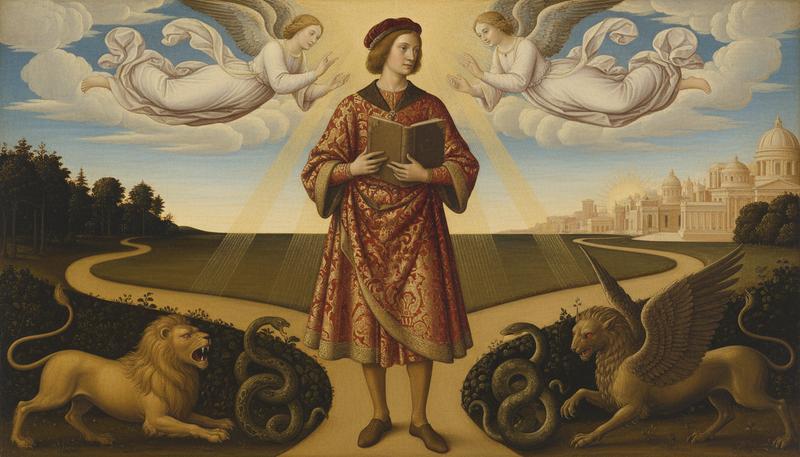
No text is more frequently cited as the defining statement of Renaissance humanism than the Oration on the Dignity of Man by Giovanni Pico della Mirandola. And almost everything commonly said about it requires some qualification — which makes engaging with it carefully all the more worthwhile.
Giovanni Pico was born in 1463 to a noble Italian family near Modena, and his intellectual biography is a kind of compressed tour through the competing strains of fifteenth-century thought. He studied canon law at Bologna, philosophy at Padua under an Averroist Aristotelian, then came under the spell of Ficino's Platonism in Florence. He read Hebrew and studied Kabbalah — unusual even by the eclectic standards of the day. He was, by any measure, a prodigy: by his late twenties he had assembled nine hundred philosophical theses drawn from dozens of traditions — ancient Greek, medieval Christian, Islamic, and Jewish — and proposed to defend all of them in a grand public debate in Rome in 1487.
The speech we know as the Oration on the Dignity of Man was written as the introduction to this debate. Pico never actually delivered it — the Pope intervened, condemned thirteen of the nine hundred theses, and the debate never happened. Pico fled to France, was briefly imprisoned, and eventually died in Florence in 1494, possibly poisoned, at the age of thirty-one. The title "Oration on the Dignity of Man" was not Pico's own — he left the speech untitled, and it was only published after his death.
So what does this speech actually argue? Its famous opening passage presents God addressing the newly created human being:
"We have made you neither of heavenly nor of earthly stuff, neither mortal nor immortal, so that with free choice and dignity you may mold and fashion yourself into whatever form you prefer... You can degenerate to the lower forms of life, which are brutish. You can, by your own choice, rise to the higher forms, which are divine."
This is the passage that has made the Oration a foundational text for modern humanists. Human beings, unlike angels who have a fixed divine nature and animals who have a fixed animal nature, are defined by their radical openness — by the capacity to fashion themselves into whatever they choose to become. There is no fixed human essence, only human possibility.
It is a genuinely remarkable philosophical claim, and it does anticipate later humanist and existentialist themes in ways that are not merely superficial. But several qualifications are necessary if we are to understand it honestly rather than anachronistically.
First, Pico's framework was thoroughly theological. The point of human self-fashioning, in the Oration, is to ascend toward God — to choose the angelic over the bestial, to pursue contemplative union with the divine. This is not a secular philosophy of self-actualization. It is a Christian Neoplatonic mysticism in which human freedom is freedom to choose the sacred path.
Second, the Oration is less typical of Renaissance humanism than its canonical status suggests. Pico was, by the assessment of scholarly specialists, remarkably original and idiosyncratic — genuinely unlike his contemporaries in the radicalism of his eclectic synthesis and his esoteric philosophical commitments. He was more philosopher than umanista; more interested in the technical reconciliation of Plato and Aristotle than in the civic rhetoric that characterized the Florentine humanist mainstream.
Third, the specific passage about human dignity and self-fashioning is not, in context, the main argument of the Oration. It serves as a preamble to justify the philosophical enterprise of debating nine hundred theses from divergent traditions — an exercise Pico understood as itself a form of the contemplative ascent he was advocating.
None of this diminishes the Oration's importance. It remains one of the most beautiful and intellectually significant texts of the Renaissance, and its image of the self-fashioning human being has been genuinely influential in shaping humanist self-understanding. But we should appreciate it for what it actually was — a Christian Neoplatonic vision of human freedom oriented toward God — rather than as a premature secular manifesto.
The Crucial Distinction: Renaissance Humanism Was Largely Christian
Here is the point that any honest treatment of this history must confront directly: Renaissance humanism was not secular humanism in period costume. The vast majority of Renaissance humanists were devout Christians who understood their project as the renewal and purification of Christianity, not its replacement.
This was not merely nominal Christianity — the kind of nominal faith one might expect from people living in a society where nonbelief was dangerous. Petrarch was a genuinely pious Augustinian. Ficino was ordained as a priest in 1473 and was sincere in his Christian Platonism. Pico, despite his eclectic philosophy, turned in the last years of his short life toward the severe Dominican preacher Savonarola. Even the civic humanists of the Florentine tradition, whose work sometimes reads as thoroughly secular, operated within a Christian moral universe.
The humanists' quarrel with Scholasticism was not a quarrel with Christianity. It was a quarrel about how to be Christian — specifically, about whether the arid logical machinery of the Schoolmen was the best way to cultivate genuine Christian wisdom and virtue. The humanist answer was that returning ad fontes — to the original sources, meaning both classical literature and the original Greek texts of the New Testament — would produce a more authentic and morally vital Christianity than the elaborate commentarial traditions of the universities.
Why does this matter for a course on secular humanism? Because getting the distinction wrong leads to a distorted intellectual history in both directions. If you simply identify Renaissance humanism with secular humanism, you flatten a complex historical reality and produce an anachronistic narrative. But if you conclude from the Christian character of Renaissance humanism that it contributed nothing to secular humanism's development, you miss the real intellectual bridges — and they are substantial.
What Renaissance Humanism Contributed to Its Secular Successor
The bridges are several, and each deserves attention.
The posture of human dignity. Whatever its theological scaffolding, the Renaissance humanist insistence on human dignity, human capacity, and the value of human life in the present world represented a genuine reorientation of emphasis. Medieval thought — this is a generalization, but a useful one — tended to understand earthly life as a vale of tears, valuable primarily as preparation for the eternal life to come. Renaissance humanism, without denying the afterlife, shifted attention to the capacities and achievements of human beings in this world: their art, their eloquence, their history, their political achievements. The great humanist genre of de dignitate hominis literature — of which Pico's Oration is only the most famous example — asserted the nobility of the human creature against traditions that emphasized human degradation and sinfulness. When later secular humanists insisted on the value and dignity of human life without reference to God, they were drawing on a tradition of thought that Renaissance humanism had helped establish, even if they were dropping its Christian framing.
The authority of classical reason. By insisting that ancient Greek and Roman philosophers — pagans, not Christians — had achieved genuine moral wisdom that remained directly relevant, Renaissance humanists implicitly granted secular reason an authority it had not clearly held in medieval thought. This was not a simple move; they typically argued that classical wisdom was a kind of natural preparation for Christian truth, or that Platonic philosophy was nearly identical with Christian mystical theology. But by taking Cicero's ethics, Stoic moral philosophy, and Platonic metaphysics seriously on their own terms, they created space for the eventual argument that secular reason could be not merely preparatory but sufficient.
The value of philology. The humanist insistence on returning to original texts, reading them in their original languages, and understanding them in their historical context was a methodological revolution with enormous long-term consequences. When Lorenzo Valla used humanist philological methods to demonstrate that the Donation of Constantine — a document purportedly transferring authority over the Western Roman Empire to the Papacy — was a medieval forgery, he was deploying the tools of classical scholarship against ecclesiastical authority. The same methods, applied to the Bible itself, would eventually contribute to the kind of historical-critical reading that secular humanists practice. The habit of asking "what did this text actually say, in its original context?" is a humanist habit with direct Renaissance roots.
The dignity of earthly learning. Perhaps most practically, Renaissance humanism established that a life devoted to learning and letters was not merely a preparatory phase or a consolation but was itself noble. The umanista who spent his life reading, teaching, writing history, and serving the civic community was living a fully human life, not a fallen one. This valorization of the intellectual and civic life as intrinsically worthwhile — not merely as a means to salvation — created a cultural template for the secular intellectual tradition.
Erasmus and the Northern Renaissance
The humanist movement was not confined to Italy. In the late fifteenth and early sixteenth centuries, it spread across the Alps into France, England, Germany, and the Netherlands, where it took forms shaped by the different political and religious contexts of Northern Europe.
Desiderius Erasmus of Rotterdam — born around 1466, perhaps the greatest classical scholar of his age — represents what historians call Christian humanism in its most fully realized form. Erasmus was a humanist's humanist: his Adages collected classical wisdom from hundreds of ancient sources; his Colloquies used the dialogue form to make humanist learning vivid and accessible; his edition of the Greek New Testament, published in 1516, applied the most rigorous philological methods to the text that mattered most.
Erasmus was also one of the most brilliant satirists of his age. The Praise of Folly (1511) deployed humanist wit and classical learning against the corruptions of the Church — the venality of priests, the obscurantism of theologians, the superstition of popular piety — with a devastating irony that owed as much to Lucian as to any Christian source. Yet Erasmus remained, throughout his life, a Catholic who was appalled by Luther's break with Rome. When the Reformation forced a choice, Erasmus declined to follow Luther — partly from temperament, partly from a genuine belief that reform within the Church was possible, and partly because he found Luther's certainties as theologically overbearing as those of the Scholastics he had spent his career mocking.
This choice has sometimes been read as a failure of nerve, but it reflects something genuine in the humanist temperament: a preference for irony over polemic, for patient learning over revolutionary assertion, for the complexity of tradition over the clarity of rupture. The Erasmian humanist is skeptical of enthusiasm in all its forms — and that skepticism is itself part of what secular humanism inherited.
Erasmus's great contribution to the long humanist tradition was methodological and cultural. He demonstrated that the tools of classical scholarship — linguistic precision, historical context, critical reading — could be turned on religious texts and traditions without destroying faith, but could instead produce a more honest, more spiritually serious form of it. The same tools, deployed without the same theological commitments, would eventually produce something quite different: but the tools themselves were Erasmus's legacy.
The Printing Press and the Democratization of Learning
No account of Renaissance humanism can ignore the technology that transformed it from an elite scholarly project into a genuinely popular cultural movement: the printing press.
Johannes Gutenberg's movable-type press, developed in the 1440s and 1450s, created a revolution in the production and distribution of texts that was arguably as transformative as the internet. Before printing, the humanist project was limited to those with access to manuscripts — an expensive, fragile, and geographically restricted medium. After printing, texts could be produced in large editions at relatively low cost and distributed across enormous distances.
The consequences for humanism were enormous. Aldus Manutius, the Venetian printer who founded the Aldine Press in the 1490s, made it his mission to publish the Greek and Latin classics in affordable, portable editions — the pocket-sized Aldine texts were a genuine innovation in the democratization of learning. Within decades of Gutenberg, humanist texts were circulating across Europe in quantities that manuscript culture could never have achieved.
The printing press also accelerated the feedback loop between humanist scholarship and the reading public. When Erasmus published The Praise of Folly in 1511, it was a bestseller — going through multiple editions across Europe within months. The humanist conversation was no longer confined to chancelleries, courts, and universities; it was being conducted in the homes of educated merchants, lawyers, and minor clergy. This expansion of the reading public created the conditions for the religious and political upheavals of the Reformation and, eventually, for the Enlightenment that would follow.
Here's a crucial lesson for how intellectual movements actually change the world: the ideas mattered enormously, but the infrastructure that allowed those ideas to spread mattered equally. The printing press was to Renaissance humanism what the blog and the podcast have been to secular humanism's twenty-first century revival — a technology that transformed a conversation among specialists into something approaching a mass movement. When you can suddenly get a book into hundreds or thousands of hands instead of dozens, the conversation changes. It scales. It becomes unavoidable.
Continuities and Ruptures
The Renaissance produced a rich, complex, and internally diverse humanist tradition. By the time we reach the early sixteenth century — with Erasmus at the peak of his influence, More writing Utopia, Machiavelli completing The Prince, and Luther nailing his theses to the door at Wittenberg — the world that Renaissance humanism helped create was on the verge of shattering into something new.
What mattered for the long run was not any single text or figure but a set of intellectual habits and postures that Renaissance humanism established and that would survive the religious upheavals of the sixteenth century, the scientific revolution of the seventeenth, and the Enlightenment of the eighteenth, eventually arriving — transformed, secularized, and philosophically systematized — at the modern humanist tradition.
Those habits include: taking human beings seriously as the proper objects of intellectual attention; trusting that classical reason offers genuine moral wisdom; believing that education is a form of human development, not merely a transmission of dogma; insisting on returning to primary sources and reading them carefully in historical context; and valuing eloquence — the ability to articulate one's understanding of the human condition — as a virtue in its own right.
None of these commitments require the abandonment of religion. The Renaissance humanists mostly did not abandon it, and several of its greatest figures were deeply pious. But each of these commitments could survive — and did survive — the stripping away of the theological framework that had originally supported them. That is the intellectual bridge from Petrarch to the Enlightenment, from the studia humanitatis to the secular humanism of the twentieth century: not a march of progress, but a gradual migration of ideas from one context to another, in which certain core commitments proved durable enough to be carried across the divide.
The Renaissance did not invent secular humanism. But it taught the West how to take humanity seriously — and that lesson, once learned, proved remarkably hard to unlearn.
Only visible to you
Sign in to take notes.