The Rise of Freethought and Secularism in the 1800s
The 19th century is where the Enlightenment's grand philosophical promises actually crashed into the messiness of real life. Turns out it's considerably harder to transform abstract commitments to reason and human dignity into living institutions that can sustain those values across an entire society than the philosophes had imagined. The people who tried — John Stuart Mill, Charles Darwin, Robert Ingersoll, George Eliot, George Jacob Holyoake, and Auguste Comte — weren't simply passing down ideas from Locke and Voltaire like some intellectual relay race. They were grappling with new conditions, new data, and new moral crises that forced the humanist tradition to reckon with questions the Enlightenment had mostly dodged. Darwin made it reckon with biology. Mill made it reckon with women and the limits of state power over the individual. Eliot showed what secular moral seriousness actually looks like in a human life. Ingersoll made it reckon with democracy and popular persuasion. And Comte — well, Comte is the tradition's most expensive lesson in what happens when secular thinking tries to become a religion. By 1900, the philosophical inheritance of Enlightenment naturalism had been filtered through evolutionary biology, packed lecture halls, Victorian novels, and the lived demands of working people insisting on dignity without theological justification. It wasn't called "secular humanism" yet, but everyone knew what they were looking at — and for the first time, it had institutions, journals, speakers, and organizational muscle.
Mill and the Architecture of Liberty
John Stuart Mill's On Liberty opens with a principle so simple and so radical that we can miss its radicalism on first reading:
"the only purpose for which power can be rightfully exercised over any member of a civilised community, against his will, is to prevent harm to others."
This is as secular as philosophy gets. It anchors the legitimacy of any moral constraint entirely within human welfare and human relationships. Divine command? Irrelevant. Sacred custom? Irrelevant. What the majority feels? Not the point. The only question that matters is whether someone else suffers harm. That's it. That's the entire foundation.
What often gets overlooked is how thoroughly Mill grounded intellectual freedom specifically. The second chapter of On Liberty remains one of the finest defenses of free thought in the language, and its foundation is unmistakably humanist: we are fallible creatures; history is largely a catalog of confident orthodoxies that turned out to be wrong; the only way truth gets a real chance to survive is when it faces open challenge. Mill wrote it with characteristic force: "If all mankind minus one were of one opinion, mankind would be no more justified in silencing that one person than he, if he had the power, would be justified in silencing mankind." He wasn't being relativistic — he believed some views were actually better than others. Rather, he was building his defense of free speech on something like epistemic humility: recognizing that human judgment is limited and that knowledge grows only under conditions of genuine contest.
Mill's Utilitarianism (1863) added another layer to the emerging secular ethical framework. Utilitarianism itself wasn't new — Jeremy Bentham had developed it in the late 1700s — but Mill's version was more subtle, more alive to the qualitative differences among pleasures, and more genuinely troubled by the worry that reducing morality to a calculus of happiness might actually degrade human dignity. His famous distinction between higher and lower pleasures — "better to be Socrates dissatisfied than a fool satisfied" — was his way of trying to smuggle aspiration back into a purely this-worldly ethics. Did he fully succeed? That's a real philosophical question. But the fact that he tried matters enormously: it shows the secular tradition wrestling openly with the deepest fear critics leveled at it — that without God, morality collapses into comfortable hedonism.
Mill was also, crucially, a feminist. And this wasn't separate from his secularism; it was a direct extension of it. His The Subjection of Women (1869), developed with his partner Harriet Taylor Mill, argued that women's subordination was a relic of exactly the same unthinking traditionalism that secular liberalism opposed everywhere else. The logic was structural: if you believe individuals should be free from inherited religious authority, you cannot consistently endorse inherited patriarchal authority. The epistemological move applies equally to rejecting theocracy and rejecting male dominion. We'll come back to this connection when we trace the link between feminism and the freethought movement, but the point here is that Mill saw them as the same fight.
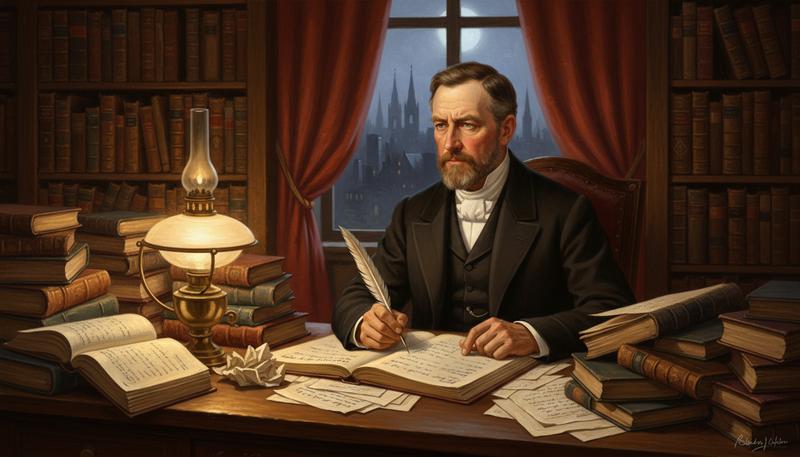
Darwin and the Revolution in Human Self-Understanding
Charles Darwin didn't wake up wanting to blow up theology. By all accounts, he was a methodical, even cautious man who sat on his theory for twenty years before publishing it — partly temperament, partly genuine anxiety about the suffering it would cause believers, including his own wife. But On the Origin of Species (1859) and then The Descent of Man (1871) rewired the entire humanist understanding of what it means to be human.
The claim was simple and devastating: humans aren't a separate creation dropped into the world by divine command. We're part of nature. We're related by descent to every living thing on the planet. Human reason, human morality, human capacity for love and art and thought — these aren't imports from outside the natural order. They're natural phenomena, products of the same indifferent process of variation and selection that built the eye of a trilobite and the wing of a bat.
This obviously threatened a certain strand of humanist thinking — the line running from Pico della Mirandola's celebration of human dignity through Enlightenment reverence for Reason as something quasi-divine that lifted us above the animal world. If that special status was an illusion, what happened to human dignity? The best of the humanist tradition didn't retreat from this question. The evolutionary understanding of human nature actually deepened some humanist commitments while forcing a radical revision of others.
What Darwin strengthened was naturalism — the conviction that scientific methods and scientific findings are the right tools for understanding reality, including human reality. The naturalist approach to philosophical problems that Darwin exemplified became foundational to secular humanism: if you want to understand human nature, you study biology, psychology, and social history, not scripture or speculation about essences. Darwin didn't just propose a theory; he modeled a way of knowing that the humanist tradition adopted as central to its identity.
What he forced humanists to discard was any lingering notion that humans occupied some special ontological tier separate from the rest of biological existence. After The Descent of Man, it wasn't philosophically defensible to claim that human reason or moral capacity existed in a different category from animal nature. They were part of it — more elaborate, more complex, more powerful, but not fundamentally different. This was uncomfortable. It was also, oddly, liberating: it meant human moral life could be studied and understood using the same empirical methods we used for everything else.
graph TD
    A[Darwin's Theory of Evolution] --> B[Humans are part of nature, not lords over it]
    A --> C[Moral and rational capacities have natural origins]
    B --> D[Naturalism strengthened as philosophical foundation]
    C --> D
    D --> E[Ethics can be studied empirically]
    D --> F[Human dignity redefined: not from divine creation, but from capacity for reason and feeling]
    E --> G[Modern secular humanist ethics]
    F --> G
Thomas Henry Huxley — "Darwin's bulldog," in the phrase that stuck — worked out the philosophical implications of evolution as rigorously as Darwin did the biology. Huxley coined "agnostic" in 1869, and he chose the term deliberately. It expressed an epistemological position (we cannot know whether God exists) rather than an ontological claim (God does not exist). This was a distinctly humanist move: intellectual honesty means acknowledging what we don't and cannot know. The agnostic doesn't claim certainty in either direction. Huxley insisted this was a rigorous intellectual stance, not a comfortable middle ground, and it became one of secular humanism's defining positions.
The relationship between Darwinism and human dignity usually gets handled carelessly. Critics of secular humanism argue — still argue — that if humans are just the products of natural selection, there's no rational basis for treating them as possessing any special worth or deserving respect. This is a serious objection, and we'll face it directly in the chapter on objections. For now, it's worth noting that most humanist thinkers in the Darwinian era didn't try to resurrect pre-Darwinian exceptionalism. Instead, they reconceived dignity as a relational and functional property: humans deserve respect because they are beings who suffer, who reason, who love and can be loved, whose projects and relationships genuinely matter to them. The source of dignity isn't metaphysical status; it's the actual character of human experience. Whether that reconception fully works is a legitimate philosophical question — but it's the right one to ask.
George Jacob Holyoake and the Invention of 'Secularism'
The word "secularism" didn't always exist. It was invented — deliberately, strategically, as a conscious organizational move — by a British working-class radical named George Jacob Holyoake in 1851. Understanding why he needed the word tells you everything about what the nineteenth-century movement was trying to do.
Holyoake had been imprisoned in 1842 for blasphemy — the last person to serve time in Britain for that particular offense. He had followed Robert Owen's cooperative socialism and been active in the Chartist movement. By 1851, he'd reached a conclusion: the freethought movement, which consisted mostly of atheists, deists, and religious skeptics, was limiting itself by focusing on the negative — on what people didn't believe. The working people he was trying to organize didn't need another critique of religion. They needed a positive alternative, a framework for organizing society around human needs and this-worldly concerns.
"Secularism," as Holyoake defined it, was that positive alternative. Crucially, it was not synonymous with atheism. He was explicit: secularism bracketed theological questions entirely. It concerned itself with what could be known through experience and reason in this life, regardless of what one believed about the next. This was a genuinely important move. It meant secularism could be a shared platform for people with radically different theological views — atheists, agnostics, liberal Protestants, Unitarians — all agreeing that human welfare in this world should be the primary concern of social organization, without having to solve the unsolvable question of whether God exists.
The practical consequences were substantial. Secularism, as Holyoake conceived it, became a platform for opposing state establishment of religion, for public education independent of church control, for repealing laws that required religious oaths for public office, and for recognizing civil marriage and nonreligious burial. These were urgent political battles in mid-Victorian Britain, and the secular societies that emerged after 1851 — most prominently Charles Bradlaugh's National Secular Society (1866) — organized around them.
Bradlaugh himself deserves attention as the figure who embodied Victorian secularism's combative, populist dimension. A self-taught working-class man who became the first openly atheist Member of Parliament, he fought for six years — 1880 to 1886 — for the right to take his seat without swearing a religious oath. The Affirmation Act was passed in 1886 (not 1888), allowing parliamentarians to affirm rather than swear, it was a direct result of his stubborn public campaign. It's one of the clearest examples in history of a secular humanist argument winning in the legislative arena through sheer determination and persuasive power.
Robert Ingersoll: The Great Agnostic and American Popular Freethought
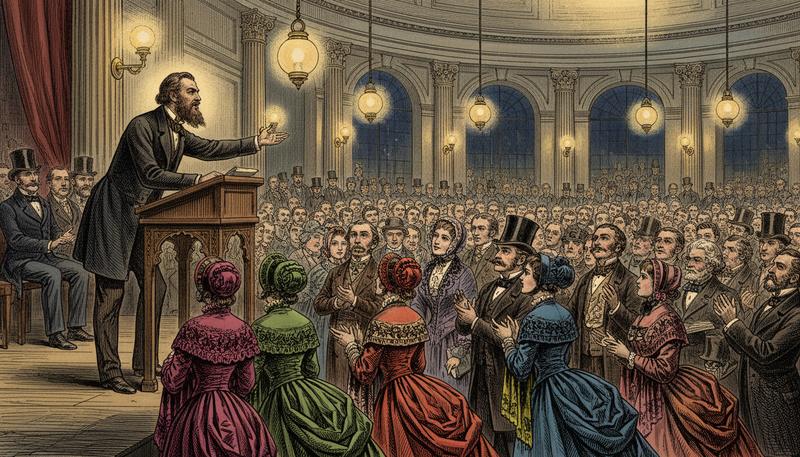
If Holyoake was the architect of British secularism, Robert Green Ingersoll was its American equivalent — but with more volume, more humor, and considerably more theatrical flair. Ingersoll was probably the most famous public speaker in late nineteenth-century America. People paid Broadway-level prices to fill lecture halls for hours listening to him dismantle orthodox Christianity and argue for a secular, scientifically grounded approach to human life.
Ingersoll's career teaches something crucial about how philosophical ideas actually become movements. Books don't do it alone. Movements emerge when charismatic people translate ideas into forms that speak to ordinary people's actual experiences of injustice, grief, and longing. Ingersoll was a master of this translation. He'd been a Civil War soldier, a lawyer, a Republican politician before he became America's most prominent freethinker, and he brought all that lived experience to the lecture stage. He knew how to make an audience laugh, make them cry, and make them think — often in the space of a single sentence.
He attacked the cruelties of orthodox theology — eternal damnation, scriptural absolutism, the treatment of women as spiritual inferiors — and his arguments were basically Enlightenment deism filtered through American democratic sentiment. But what set him apart from mere polemic was his genuine affection for the people he was criticizing. He didn't hate Christians; he thought they'd been failed by their theology and wanted them to be free. "The Mistakes of Moses" wasn't a screed but a careful, often wryly warm examination of the biblical text. "What Is Religion?" offered something constructive: a vision of human life organized around love, reason, and the pursuit of happiness in this world.
One Ingersoll passage captures the spirit better than any analysis:
"Happiness is the only good. The time to be happy is now. The place to be happy is here. The way to be happy is to make others so."
It's not sophisticated philosophy. But it's a clear statement of secular humanist values in a language that working people without philosophy degrees could embrace and live. Ingersoll's popularity — at its height in the 1870s and 1880s — shows that the hunger for a secular, humanistic way of living was far broader in Victorian America than the official culture admitted.
His politics reveal the same pattern. He was a committed abolitionist and a vocal advocate for women's rights, seeing both as expressions of the same commitment to human dignity that animated his religious skepticism. The connection was explicit in his thinking: if every human being has inherent worth regardless of race or sex, then slavery and the legal subordination of women are indefensible. These weren't separate causes joined by political convenience. They were expressions of a single underlying commitment.
George Eliot: Secular Humanism as Lived Moral Imagination
Mary Ann Evans, writing as George Eliot, is one of the great novelists in English and one of the most philosophically rigorous figures the secular humanist tradition has produced. She's also chronically underrepresented in accounts of that tradition — perhaps because she wrote novels instead of manifestos, or perhaps because the tradition has been more comfortable celebrating male orators than female thinkers.
Eliot's entry into secular humanism came through translation — literally. In 1854 she published a translation of Ludwig Feuerbach's Das Wesen des Christentums (The Essence of Christianity), arguably the most radical and most humanistically serious Christian critique of the nineteenth century. Feuerbach's core argument: Christianity is a form of alienated self-knowledge. When human beings project their highest qualities — love, wisdom, justice — onto a divine being and then worship those projected qualities, they're essentially worshipping an idealized mirror of themselves while failing to recognize and cultivate those same qualities in actual human life. God is humanity's perfect image, and we've forgotten to look at ourselves.
Eliot found this argument liberating, not nihilistic. If what theology called "divine love" was really a projection of humanity's highest forms of love, then the answer wasn't cynicism. It was redirection: take those qualities seriously in the human world, in human relationships, in the actual messy life of actual people. This is exactly what her novels do. Middlemarch, The Mill on the Floss, Silas Marner, Daniel Deronda — they're all, in different ways, explorations of what moral seriousness looks like without the structure of orthodox belief. Her characters who lose faith aren't punished by the narrative for doing so. They're challenged to find new ground for the moral commitments they keep.
Eliot also lived her humanism publicly in ways that cost her. Her long partnership with the philosopher George Henry Lewes — a man who couldn't legally divorce his estranged wife — was a scandal in Victorian England. She accepted the social exclusion rather than compromise her private moral judgment to conform to public religious convention. She was doing what Mill argued theoretically: treating her own conscience, informed by reason and sympathy, as a more reliable guide to right conduct than inherited social authority.
What Eliot gave the humanist tradition was something no philosopher writing in the first person can easily provide: a vivid fictional demonstration of what secular moral seriousness actually is. Philosophy can tell you that human solidarity is a sufficient ethical foundation. Eliot shows you what solidarity looks and feels like in a specific person's life — shows you its cost, its texture from the inside, and why it might just be enough. That's a different kind of argument, and in some ways more persuasive.
Auguste Comte and the Religion of Humanity: A Cautionary Tale
No account of nineteenth-century secular humanism is complete without grappling with Auguste Comte — not because he's central to the tradition, but because he's its most instructive cautionary tale.
Comte, the French philosopher who developed positivism, argued that human intellectual history moves through three stages: theological (phenomena explained by supernatural beings), metaphysical (explained by abstract forces), and positive or scientific (explained by empirical observation and law). By this scheme, the theological stage was simply humanity's childhood, destined to be left behind as we matured.
Up to this point, recognizably humanist — it influenced Mill and others significantly. Then Comte did something extraordinary. Having argued that traditional religion was intellectually obsolete, he designed a replacement: the Religion of Humanity. It had calendars. It had saints — now historical benefactors of humanity rather than supernatural mediators. It had rituals. It had a priesthood (sociologists, naturally). It had hierarchical structure. Many observers noticed it bore a suspicious resemblance to the Catholic Church Comte claimed to have transcended.
The parallels were intentional. Comte understood something crucial: religion doesn't function through intellectual argument alone. It binds communities together, structures time, provides emotional support in crisis, and motivates sacrifice for collective goods. His Religion of Humanity was an attempt to capture those functions while swapping out the supernatural content for humanistic content.
Eliot was drawn to Comte's ideas — she read him seriously and was influenced by his social thought. But most secular humanists, then and since, have recognized that his solution missed something important. Building an elaborate institutional replacement for something you've defined as intellectually empty is philosophically odd. And it doesn't work. Designing a church from memory isn't the same as meeting the actual human needs that churches meet. If traditional religion is humanity's childhood, the Religion of Humanity is what you get when an intellectual tries to recreate childhood from blueprints — all the right furniture but missing something essential.
The Comtean cautionary tale remains live today. Whenever secular humanists debate whether they need "rituals" or "communities" or "ceremonies" — and they do debate these things, often anxiously — they're navigating the space Comte tried to chart and largely failed to map. The question is real, even if his answer was wrong.
The Freethought Movement: Organizations, Periodicals, and Popular Culture
The philosophical arguments of Mill, Darwin, Eliot, and Holyoake didn't float in the abstract. They were carried by institutions — by networks of freethought societies, secular clubs, radical newspapers, and public lecture circuits that formed the social infrastructure of the movement.
In Britain, radical popular freethought had deep roots. Richard Carlile in the 1820s had spent years in prison for publishing deistic and republican material. By the middle of the century, this tradition had matured into a network of secular societies in industrial cities — Manchester, Birmingham, Bradford, Sheffield — that combined freethought advocacy with support for working-class causes: cooperative economics, trade unionism, educational reform. Bradlaugh's National Secular Society (1866) coordinated this network and gave it a national voice.
The periodical press was essential infrastructure. Holyoake's The Reasoner (1846–1861) was one of the Victorian era's most important secular journals, providing a space for debate about secularism, positivism, and freethought in language accessible to educated working-class readers. Later, The Freethinker, founded by G. W. Foote in 1881 and still publishing today, took a more combative stance — Foote served a prison sentence for blasphemy in 1883, following in Holyoake's footsteps as a martyr to free expression.
America organized differently. The National Liberal League (1876) and its successor the American Secular Union advocated for church-state separation and against the "Christian nation" framing that some politicians were beginning to push. Ingersoll was associated with these organizations, though more as a celebrity voice than an organizational operator. The freethought press was robust: The Truth Seeker, founded in 1873, became the most prominent freethought journal in America, publishing until 2000.
graph LR
    A[Freethought Press] --> D[Public Debate and Awareness]
    B[Secular Societies] --> D
    C[Public Lectures] --> D
    D --> E[Legislative Campaigns]
    D --> F[Educational Reform Advocacy]
    D --> G[Support for Women's Rights]
    E --> H[Affirmation Act 1888 UK]
    F --> H
    G --> I[Connection to Feminist Movement]
What strikes you about this infrastructure, looking back from now, is how deliberately non-elite it was. The secular clubs and mutual improvement societies of industrial Britain were deliberately organized for people who hadn't attended university, who worked with their hands, who felt condescended to by polite upper-class society. At this level, freethought was inseparable from class politics: critiquing religious authority and critiquing class authority often felt like the same fight, directed at the same establishment.
Feminism and Freethought: The Structural Connection
The link between nineteenth-century feminism and the freethought/secularist tradition is one of the most important and least celebrated aspects of this history. It wasn't incidental. It wasn't merely strategic. It was structural.
The logic goes like this: traditional religious authority was the primary justification for women's subordination in the nineteenth century. The Pauline injunctions — women should be silent in church, should submit to their husbands, sinned first and deepest — were woven into law and social practice. A woman who questioned scripture's authority over her life was making the same epistemological move as any freethinker who questioned scripture's authority over public life: she was asserting that her own reason and experience were a more reliable guide to right conduct than inherited textual authority.
Many of the most prominent nineteenth-century feminists made this connection explicit. Elizabeth Cady Stanton, one of the architects of American women's rights, was also a committed freethinker who published The Woman's Bible (1895–1898) — a systematic feminist critique of the biblical texts used to justify women's subordination. She saw the two projects as one: you cannot liberate women politically and legally while leaving intact the religious framework that defines their subordination as divinely ordained.
Frances Wright — Scottish-born American radical, one of the earliest public advocates for women's rights in the U.S. — was also a committed secularist and associate of Robert Owen. She lectured publicly, which was itself shocking for a woman in the 1820s, and she lectured on freethought, abolition, and women's education together as a single package of reforms grounded in the same commitment to human reason over tradition.
George Eliot, as noted, embodied this structural connection: her rejection of religious convention in her personal life was the same move as her intellectual rejection of received authority in her work. And Harriet Taylor Mill, whose intellectual partnership with John Stuart Mill produced some of the century's most important feminist arguments, was herself a freethinker whose critique of women's social position rested on the same naturalistic, empirical approach to human affairs that animated Mill's philosophy generally.
The connection continued into the early twentieth century. Many women who organized suffrage campaigns were affiliated with freethought societies or secular organizations, and many freethinkers were committed suffragists. The two movements didn't always move in lockstep — there were religious feminists and secular anti-feminists, in both theory and practice — but the structural affinity between rejecting divinely ordained authority over the mind and rejecting divinely ordained authority over women's bodies and lives was too powerful to be accidental.
From Philosophy to Movement: The Shape of the Century
By 1900, the freethought and secularist traditions had accomplished something genuinely remarkable. They had taken the abstract philosophical commitments of Enlightenment rationalism — reason and evidence over tradition and authority, this-worldly human welfare as the sole basis for ethics, the fundamental equality of persons regardless of inherited status — and translated them into:
- A recognizable popular identity (freethinker, secularist, agnostic, humanist)
- A set of organized institutions (secular societies, freethought clubs, liberal leagues)
- A media ecosystem (journals, lecture circuits, pamphlets)
- A set of concrete political demands (separation of church and state, educational reform, women's rights, the right to affirm rather than swear)
- A rigorous philosophical foundation updated for the post-Darwinian world
This wasn't yet "secular humanism" in the organized, manifesto-drafting sense it would become in the twentieth century. The term itself wouldn't crystallize until the 1930s. But all the intellectual and institutional raw materials for that crystallization were present by 1900. Darwin had provided an account of human nature. Mill had provided an ethics. Holyoake and Bradlaugh had provided a political program. Eliot had provided a moral imagination. Ingersoll had provided a popular voice. And Comte — bless him — had provided the tradition's first vivid lesson in what not to do.
The nineteenth century also handed secular humanism one of its most durable self-understandings: not as religion-minus, not as atheism-plus, but as a positive commitment to human welfare grounded in the best available knowledge about human nature and the natural world. This is the understanding that would carry through the Humanist Manifestos of the twentieth century, through the philosophical work of Dewey and Russell, and ultimately into the living secular humanist tradition as it exists today. The organized humanist movement that emerged in the twentieth century, with its international organizations and formal declarations, was built on foundations that Victorian freethinkers had laid — often at genuine personal cost.
The word "movement" matters. A philosophy becomes a movement when ordinary people put something real on the line for it — their reputations, their legal standing, their relationships, their social belonging. The Victorian freethinkers did exactly that. Holyoake went to prison for it. Bradlaugh fought for his parliamentary seat for six years for it. Eliot gave up her place in respectable society for it. Ingersoll sacrificed a political career that very likely would have taken him to the highest offices in America — he had presidential potential before his public atheism became known. These weren't armchair philosophers. They were people who found something in the humanist tradition worth the cost of holding it publicly, and by holding it publicly, they made it available to others.
That's what a philosophy-become-movement looks like. And that's the legacy the nineteenth century handed down to the secular humanism of the twentieth.
Only visible to you
Sign in to take notes.