Before It's Too Late: The Complete Guide to Recording Your Family's Oral History
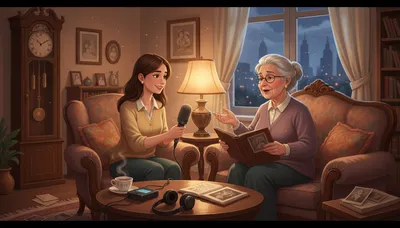
A step-by-step course teaching anyone — regardless of technical experience — how to capture the stories of family members before those stories are lost forever. From the first awkward question to the final archived file, this course walks you through every stage of a meaningful oral history project. No journalism degree, no fancy equipment, and no prior experience required.
Sign up free to unlock:
- Track your progress across courses
- Request & vote on new courses
- Highlight text, take notes & bookmark
- Get personalized recommendations
- Build your public learning profile
Already have an account? Log in
Course Content
Sources & References
This course draws from the following sources. Visit them for additional depth.
- 🔗
- 🔗
- 🔗
- 🔗
- 🔗guides.bpl.org — Equipment ↗webpage
- 🔗
- 🔗
- 🔗
- 🔗
- 🔗
- 🔗
- 🔗
- 🔗
- 🔗
- 🔗
- 🔗
Students Also Studied
 mixed
mixedThe History of Espionage: Intelligence, Tradecraft, and the Secret Struggles That Shaped the Modern World
From ancient scouts and Renaissance codebreakers to Cold War mole hunts and the age of cyber intelligence, this course traces how espionage evolved from a primitive art into a decisive instrument of state power. You'll learn the actual tradecraft spies use, the organizations that refined it, and the individuals — brilliant, treacherous, and sometimes both — who made or broke empires.
 mixed
mixedThe Oral Tradition: Storytelling, Memory, and Culture Before Writing
A deep exploration of how human societies encoded knowledge, history, law, and identity through spoken word, song, and ritual before the invention of writing — and what these traditions reveal about memory, community, and the nature of narrative itself. From Aboriginal songlines to Homeric epics to West African griots, this course examines oral tradition as the original technology of the human mind.
 mixed
mixedThe Anthropology of Everyday Life: How Culture Shapes What We Think Is Normal
A deep, engaging journey through cultural anthropology that reveals how ritual, kinship, taboo, language, and symbol-making invisibly structure what every society calls "normal." Using classic and contemporary anthropological frameworks — from Franz Boas to Mary Douglas to Clifford Geertz — this course helps you develop a genuine anthropological lens to apply to your own daily life and assumptions.
Want a course that doesn't exist yet? Request one →