How to Record Difficult Family Stories Safely
Navigating Difficult Stories: A Trauma-Informed Approach to Family Oral History
You've built the ethical container. You've secured genuine informed consent. You've established that your narrator knows they control their story, that they can pause or stop at any time, and that you're not extracting information — you're collaborating. Now comes the moment when that container actually gets tested, and it will happen in ways you won't see coming.
There's a moment that happens in almost every family oral history interview. You've asked a question that seemed perfectly innocent — about a childhood home, a first job, a sibling who moved away — and suddenly the room shifts. Your grandmother's voice drops to a different register. Your father looks somewhere past your shoulder at a memory you can't see. The story that surfaces isn't the one you expected, and it's carrying weight you didn't anticipate. This doesn't happen because you did something wrong. It's not a failure of your consent process. It happens because human lives aren't organized by theme, and memory doesn't file trauma separately from joy. The story of your great-aunt's beautiful garden in Poland leads to what happened to that garden. The story of your grandfather's "adventure" coming to America turns out to be a story about running for his life.
Family oral history goes to unexpected emotional places because family life is unexpected emotional places. And here's what matters: because you've done the ethical groundwork — because your narrator genuinely understands what they're participating in, and knows they have agency — you're actually in the strongest possible position to hold these conversations with care. This section is about building on that foundation. It's about preparing yourself, emotionally and practically, for the difficult stories that ethical, honest oral history will almost inevitably surface.
Trauma in Family Stories
Before we talk about how to navigate difficult stories, it helps to understand what terrain you might actually be walking through. "Trauma" is a word that gets used everywhere, and in family oral history, you may encounter several distinct types that require somewhat different handling.
Historical and collective trauma refers to events that affected entire communities or generations: the Holocaust, the Armenian Genocide, the Transatlantic Slave Trade, the internment of Japanese Americans, the Irish Famine, the Cultural Revolution, colonial displacement of Indigenous peoples. When your narrator is a survivor of these events — or a descendant still carrying their reverberations — you are doing more than family history. You are sitting at the edge of living memory for events the world must not forget. The stakes are high. The care required is proportional.
Intergenerational trauma operates differently. Research in epigenetics and psychology suggests that trauma can be transmitted across generations — not just through stories families tell or patterns of behavior, but potentially through biological mechanisms we're still learning to understand. You may be interviewing someone who carries wounds they can't entirely explain, wounds that originated with parents or grandparents who survived things they could never fully articulate. These narrators sometimes speak about family history with a kind of free-floating grief that doesn't attach to their own memories. When you hear that, pay attention to it.
Personal trauma includes the losses and injuries of an individual life: the death of a child, surviving domestic violence, sexual assault, a mental health crisis, addiction, imprisonment, profound professional failure, the slow devastation of a long illness. These stories are often the most closely guarded, and they have a way of surfacing unpredictably in the middle of what seemed like a much lighter conversation.
The National Public Housing Museum's guidance on trauma-informed care in oral history identifies types of trauma ranging from acute to chronic, complex to systemic, and notes that "there is substantial overlap with how trauma is defined. Individuals may find that their traumatic experiences fit into several of these definitions or none at all." This is important: your job is not to diagnose or categorize. Your job is to be present.
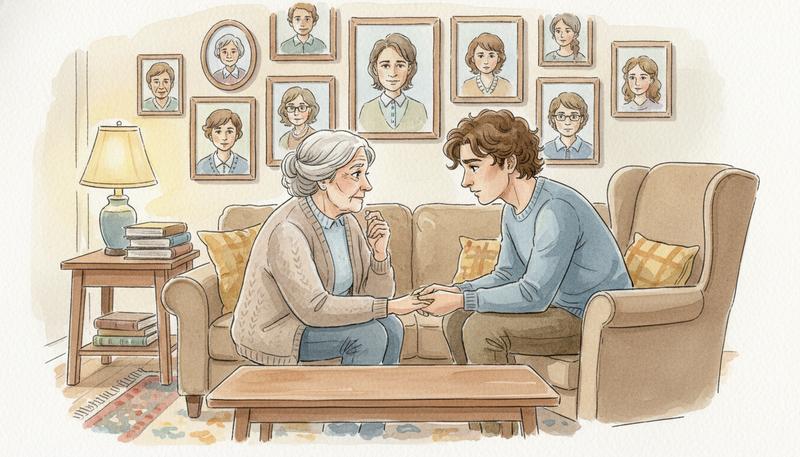
Before the Interview: Creating Safety
The most important trauma-informed work happens before you press record.
Environmental safety gets overlooked more often than it should. Narrators who have experienced trauma can be surprisingly sensitive to their physical surroundings — not always consciously, but in ways that show up as tension, distraction, or withdrawal. Guidance for oral history narrators explicitly recommends adjusting the environment to create comfort: seating, lighting, spacing, and whether the interview happens in-person or virtual.
Before your interview, ask yourself: Is this a space where your narrator already feels safe? For many people, that's their own home — their kitchen, their living room, surrounded by their things. Usually, that's ideal. A hospital room, a nursing facility common area, a stranger's office — these present more friction. If you can't control where the interview takes place, you can still control small things: sitting at the same level rather than across a table, adjusting harsh lighting, turning off televisions and background noise, making sure there's water within reach.
Relational safety builds in the pre-interview conversation. And this isn't small talk. This is the work of establishing trust, clarifying that the narrator controls what they share and what they don't, and naming that the interview may touch on difficult things. You don't have to be clinical about it. You can say something as simple as: "Some of what we might talk about today could bring up hard memories. I want you to know we can take breaks anytime, skip anything you don't want to discuss, or stop entirely if you need to. I'm not here to push you anywhere you don't want to go."
This kind of explicit permission-giving isn't just kind — it's structurally important. When narrators know they have an exit, they often feel safer going deeper.
Identifying potential triggers beforehand matters when the relationship permits it. If you know your narrator lost a child, or survived a particular event, or has never spoken about a certain period of their life, you don't have to walk into that territory blind. You can mention, before the formal interview begins, that you know some topics may be sensitive, and ask if there's anything they'd prefer to approach carefully or avoid entirely. This respects their agency without placing the burden on them to raise it in the moment.
The Difference Between Going There and Going Too Far
This is the central navigational challenge of family oral history: how do you hold space for difficult stories without becoming a bulldozer?
The short answer is that you learn to read signals. The longer answer requires understanding what those signals actually look like.
Signs that a narrator is moving toward a difficult story but wants to continue:
- A pause or a longer silence than usual
- Eyes that go somewhere interior — not distressed, but accessing something
- A shift to a more careful, slower cadence of speech
- Reaching for a particular word or phrase, as if trying to name something precisely
- Saying something like "That's a hard one" and then continuing
Signs that a narrator is becoming distressed and may need space:
- Visible agitation — wringing hands, accelerated breathing, voice rising
- Crying accompanied by a frozen or shutting-down quality (as opposed to tears that come with continued speech, which often means they're fine to continue)
- A sudden, flat affect — a kind of emotional shutdown or dissociation
- Requests to stop, change the subject, or go get something from another room
- Physical withdrawal — leaning back, turning away, getting up
Signs that you've pushed too far:
- A narrator who was previously engaged becomes monosyllabic or evasive
- They say they're fine when their body says something else entirely
- The energy in the room shifts from open to closed
- They begin redirecting you — "let's talk about something else" — repeatedly
The distinction that matters is not whether tears are present. Tears aren't, by themselves, a sign that something has gone wrong. Many narrators cry during oral history interviews and feel, afterward, grateful for the chance to do so. The real question is whether the emotion seems to be moving through them or trapping them — whether they seem present in the conversation or flooded by it.
graph TD
    A[Narrator approaches difficult memory] --> B{Read the signals}
    B --> C[Engaged, continues speaking]
    B --> D[Slows down, accesses memory]
    B --> E[Shows distress signals]
    C --> F[Hold space, gentle follow-up]
    D --> F
    E --> G{Assess severity}
    G --> H[Mild: offer pause or choice]
    G --> I[Significant: name what you see, slow down]
    G --> J[Acute: stop, ground, care for narrator]
    H --> F
    I --> F
    J --> K[Do not continue interview]
Trauma-Informed Language in the Moment
How you talk during a difficult passage matters enormously. Some phrases open; others close. Here's a practical guide for what actually works.
When a difficult story is emerging and you want to hold space for it:
- "Take your time."
- "We don't have to rush."
- "I'm here."
- Silence — which is itself a form of holding space, and which most interviewers use far too rarely
When you want to give the narrator explicit permission to stop or redirect:
- "You don't have to go into more detail if you don't want to."
- "We can move on whenever you're ready, or we can stay here — whatever feels right to you."
- "Is this okay to talk about?"
When you want to acknowledge what they've shared without projecting emotions onto them:
- "Thank you for telling me that."
- "That sounds like it was really hard."
- "I can hear how much that meant to you." (Or "how much that cost you.")
What to avoid:
- "I know exactly how you feel." (You don't. Even if you've lived through something similar, their experience is theirs.)
- "At least..." (Any "at least" following a painful story is a minimization.)
- "You should feel proud of how strong you were." (Imposing a framework they may not feel.)
- "Let's not dwell on this." (This signals that their pain is inconvenient.)
- Filling silences immediately with your own discomfort. The silence belongs to them.
The general principle is simple: your job is to witness, not to fix, reframe, or manage. People who have survived terrible things don't need you to make it better. They often just need someone to sit with them in the reality of what happened.
When a Narrator Becomes Distressed
Despite all your preparation, there will be moments when someone becomes genuinely distressed during an interview. Here is a clear-eyed guide to what to do.
Step one: Stop. Put down your questions.
Not forever — just for now. Your protocol, your question list, your recording schedule — none of it matters more than the person in front of you. The interview can be paused or ended. The relationship cannot be damaged without consequence.
Step two: Name what you're observing, gently.
"I can see this is bringing up a lot. Do you want to take a break?"
This does two things: it acknowledges what's happening without catastrophizing, and it returns agency to the narrator. You're not telling them they're in crisis. You're simply noticing, and offering a door.
Step three: Ground the room.
If someone is in acute distress — hyperventilating, deeply crying, dissociating — grounding techniques help. Offer water. Suggest taking a few slow breaths together. If the environment allows, stepping outside briefly can help. The physical act of noticing immediate surroundings — "What can you see right now? What can you hear?" — is a simple, evidence-based way to bring someone back from an overwhelming internal state.
Step four: Let them lead the reset.
Don't rush to resume. Let the narrator set the pace for what comes next. "Would you like to stop for today, or is there something lighter we could talk about?" is a valid path forward. Some narrators, after a difficult moment, want very much to continue — telling the hard story is part of why they showed up. Others need to end the session and return another day. Both are completely fine.
Step five: Follow up afterward.
A text or phone call the next day — "I've been thinking about you and our conversation. How are you feeling?" — is an act of basic human decency, and it matters. The National Public Housing Museum's trauma-informed care guidelines explicitly emphasize providing additional resources when needed. If your narrator is visibly struggling with what surfaced, and if the relationship warrants it, a gentle mention of counseling resources isn't inappropriate. "I know our conversation stirred up a lot — I want to make sure you have support if you need it" is something a caring family member says, not just an oral historian.
The Healing Dimension of Telling
Here is something that practitioners encounter again and again, and it deserves to be said plainly: telling difficult stories often heals.
Not always. Not automatically. Not if the teller isn't ready, or if the listener isn't truly present, or if the story gets treated as information to be extracted rather than a lived experience to be witnessed. But when the conditions are right — trust, genuine attention, the narrator's own readiness — putting painful things into words can do real work.
There's substantial research on this. James Pennebaker's foundational work on expressive writing showed that articulating traumatic experiences in narrative form is associated with measurable improvements in mental and physical health. Narrative therapy builds an entire clinical approach around the idea that the stories we tell about ourselves shape how we experience ourselves — and that retelling stories, especially in the presence of a compassionate witness, can loosen the grip of old pain.
The National Public Housing Museum's framework puts it plainly: "Storytelling is a fundamental part of healing. Holding intentional space to reflect on and unpack past traumatic experiences cultivates empathy and compassion, decreases stigma and shame, and is a vehicle for healing and growth." They add something important that gets overlooked: "Long term healing from trauma is possible."
None of this means you are your narrator's therapist. You are not. The role of interviewer and the role of healer are distinct, and crossing that line creates problems — for your narrator, for your relationship, and for the integrity of what you're recording. But you can be someone who makes healing more possible simply by being genuinely present, genuinely willing to hear the hard thing, and genuinely caring about the person telling it.
Many narrators report, after difficult oral history interviews, that they feel lighter — that something that had no container finally has one. The story that lived only inside them now lives somewhere else too. For some people, that is a profound relief.
When You Are Part of the Story
There's a particular kind of complexity that shows up in family oral history that professional oral historians rarely encounter: you are not a neutral party.
You're not a journalist with a stranger. You're someone's grandchild, or child, or niece, or cousin. The stories your narrator tells may be about your family. They may be about you, your parents, events you were present for or grew up hearing about in distorted versions. They may reveal things about people you love — or people you love to hate — that are genuinely hard to sit with.
Your grandmother tells you that the marriage you always envied was secretly unhappy. Your father, who you thought of as a strong man, describes being profoundly frightened as a child. Your aunt reveals that a family elder you revered did something harmful. Your mother describes experiences of racism or abuse that she protected you from knowing about, and the rage and grief you feel in response is real and immediate and sitting right there in the room.
In these moments, your instincts may pull you toward several unhelpful responses:
- Interrupting to defend someone. Don't. Their story is theirs to tell. You can process your feelings separately.
- Asking leading questions shaped by your own need to understand. Be careful. "But why didn't you just leave?" is not a neutral question when you're listening to your mother describe a difficult marriage.
- Shutting down emotionally to get through it. This tends to show on your face and in your body, and narrators feel it.
- Sharing too much of your own reaction during the interview itself. The interview is about them. Your response deserves its own space, later.
The more self-aware you can be about your own emotional landscape before you begin — what stories you're hoping to hear, what stories you're afraid of, what you already believe about this person and their past — the better equipped you'll be to stay present rather than reactive.
It's completely valid to cry during a family oral history interview, by the way. It can even be a gift to your narrator — a signal that you heard them, that what they shared landed. Just don't let your emotions hijack the session. A quick "I'm sorry, give me a moment" is fine. Ten minutes of processing your own feelings while your narrator waits is not.
Interviewer Self-Care: After the Session
No one talks enough about what oral history work does to the person doing the recording.
When you spend an hour or two listening to someone describe profound suffering — a crossing that claimed family members, a war that destroyed everything, a childhood marked by violence — that experience goes somewhere in you. If you're interviewing your own family, it carries even more weight, because these aren't strangers' stories. They're the water you swam in. They're part of how you became who you are.
Secondary traumatic stress — sometimes called compassion fatigue — is a real phenomenon. It's the emotional and psychological cost of sustained, empathic exposure to others' trauma. It can show up as intrusive thoughts, dreams, numbness, or a kind of hollow feeling after intense interviews. It doesn't mean you're weak. It means you were genuinely present.
A few practices that help:
Give yourself transition time. Don't schedule a difficult interview immediately before a work meeting or a social obligation where you'll need to perform normalcy. Build in time to decompress — a walk, a quiet hour, whatever helps you return to yourself.
Write notes that include your own reactions. The reflective notes you take after an interview (which we'll cover in Section 10) should include not just what was said but how it landed for you. Externalizing your response — putting it somewhere outside your head — is its own form of grounding.
Talk to someone. If you heard something that stays with you, find a trusted person to share it with. This doesn't have to be a therapist (though that's not a bad idea if you're doing intensive work). It can be a partner, a friend, another family member who understands the context.
Notice what you're carrying. If you find yourself wanting to call your mother after an interview that touched on something from her childhood, that's your instinct toward connection and care working correctly. Follow it.
Respect your own limits. If a particular line of inquiry is too close to something in your own history — if interviewing your grandmother about her escape from violence is triggering your own experiences of violence — it's okay to bring in another family member to do that portion of the interview, or to wait until you're in a better place emotionally. No oral history project is worth your own destabilization.
The Smithsonian Folklife and Oral History Interviewing Guide notes that oral history relationships connect us "to the past, grounding us firmly in the present, giving us a sense of identity and roots, belonging and purpose." That's beautiful and true — and it also describes a process that can be emotionally significant for the interviewer, not just the narrator. Treat that significance with appropriate care.
When to Stop Entirely
Most difficult moments in oral history interviews are manageable with patience and care. But there are circumstances when the most ethical, caring thing you can do is end the session.
Stop if your narrator is showing signs of acute psychological distress — if they are dissociating, having a panic attack, weeping inconsolably without any sign of wanting to continue, or expressing hopelessness or despair that goes beyond the normal emotional range of difficult storytelling.
Stop if continuing would require you to push past an explicit "no." If your narrator has said, directly or indirectly, that they don't want to go further with a topic, and you find yourself looking for ways to get there anyway — whether out of curiosity, a sense of historical urgency, or family dynamics — stop. The recording is not worth more than their trust.
Stop if the interview is reopening wounds that have not healed. There's a difference between a narrator who processes grief through telling — who cries, continues, reflects, and seems engaged — and a narrator who is being retraumatized. If someone is getting worse as the interview continues rather than moving through something, that's a signal to close the session with care.
Stop if you, the interviewer, are not okay. If you've heard something that has fundamentally destabilized you — something about your family or your own history that you can't sit with in the moment — it is completely legitimate to say "I think I need to take a break" or "I'd like to continue this another day when I've had time to sit with what you've shared." Narrators, in my experience, often feel deep relief when interviewers show this kind of honesty. It humanizes the interaction in a way that makes the whole project feel more trustworthy.
Stopping is not failure. An oral history project that takes three sessions instead of one because you paused to care for the people involved is a more ethical project, and almost certainly a richer one. The story will be there. The relationship is what makes the story worth telling.
A Note on What You're Actually Doing
Let me step back for a moment and name what trauma-informed oral history practice actually is, at its core.
It is not a clinical protocol. It is not a set of scripts you memorize or a checklist you move through. It is fundamentally a way of being with another person that says: Your dignity matters more than my recording. Your wellbeing matters more than my project. You are not a source of information. You are a person who is trusting me with the most important things they know.
When you approach family oral history from that orientation — when you sit across the kitchen table from a grandparent or parent or uncle and you are genuinely, fully present; when you've thought carefully about what they might carry; when you've prepared a space that feels safe and given them control over what they share; when you're ready to slow down, hold silences, and follow their lead wherever they go — you are doing something that is simultaneously pragmatic and profound.
You are making it more likely that the difficult stories get told. You are making it more likely that telling them feels safe, even healing. You are creating conditions under which the whole truth — not just the cheerful, presentable parts — has a chance to be preserved for the people who will need it after you're gone.
That's not therapy. That's not journalism. That's a member of a family saying: I see you. I'm ready to hear you. Tell me everything.
That is, in the end, what this whole project is about.
Only visible to you
Sign in to take notes.