Legal and Ethical Issues When Recording Family Interviews
Now that you've scoped your project and identified the stories you're actually looking for — the ones beneath the surface, underneath the polished family legends — there's a critical conversation that needs to happen before you ever press record. It's a moment that catches a lot of first-time family oral historians off guard. You've set up your recorder, your grandmother is settled into her favorite chair, and you're ready to begin — and then it occurs to you: Did I actually ask her if this is okay? Does she understand what I'm going to do with this? Does she know that the deeper, more vulnerable stories you're hoping to capture will be recorded, transcribed, and potentially preserved for decades?
Most people wave that thought away. She's family. Of course she's okay with it. She's been talking to me her whole life. But here's the thing: being willing to chat over dinner is not the same as consenting to have her words recorded, archived, and potentially shared with cousins or preserved for future generations. Those are fundamentally different acts, and conflating them — even with the best intentions — is one of the most common ethical missteps in family oral history. This section is about building the ethical foundation your entire project deserves. Not because ethics are a box to check before you get to the interesting part, but because the respect you show your narrator in these early conversations will shape everything that follows: the trust they extend to you, the depth of what they share, and whether this project is something they feel genuinely proud to have been part of.
Here's something that catches people off guard: when you sit down with your narrator before the interview and explain clearly what you're doing and why, what you'll do with the recording, and what they have the right to control — something remarkable happens. People relax. They trust you more. They open up in ways that wouldn't have happened if you'd just shoved a recorder in front of them and started asking questions. The ethics conversation, done well, isn't a bureaucratic obstacle. It's relationship-building. It's the first act of the interview itself.
Informed Consent vs. Implied Consent
Implied consent is the assumption that someone's participation means they've agreed to everything. It's what happens when you just start recording and assume that because Grandpa sat down and started talking, he's consented to whatever comes next. This is ethically problematic and, in some contexts, legally so.
Informed consent means that before recording begins, the narrator understands — in plain terms they actually comprehend — the following:
- What this project is and why you're doing it
- What the recording will capture (audio? video? both?)
- Who will have access to the recording — just you? other family members? a digital archive? the general public someday?
- What you plan to do with it — share it at a family reunion, deposit it with a historical society, build a website, create a book?
- That they have the right to say no, or to say yes to some things and no to others
- That they can stop at any time, ask you to turn off the recorder, or ask you to delete specific portions
- That there will be documentation of this agreement
The Montana State University Library's guide on oral history release forms makes a helpful distinction: "Informed consent does not cover or deal with copyright." This is a point most people miss entirely. Consent and copyright are two separate things, handled by two separate documents, and you need both. More on that shortly.
A good informed consent process doesn't have to be formal or stiff. In a family context, it often sounds like a conversation you're already having:
"Before we start, I want to make sure you understand exactly what I'm planning to do with this. I want to record our conversation — probably an hour or two — and I'm thinking I'll keep a copy for myself, share it with your kids and grandkids, and eventually, if you're okay with it, see if the county historical society would want a copy. You can tell me no to any of that. And if there's anything you tell me that you don't want included, just let me know and I won't use it. Does all of that sound okay to you?"
That's it. That's the spirit of informed consent. You can formalize it afterward in writing, but the conversation itself is where the real consent lives.
One practical note: some oral historians like to capture verbal consent at the very beginning of the recording itself. Before diving into your first question, you simply ask: "Do I have your permission to record this interview?" and capture their "yes" on tape. The MSU Library guide notes that asking the narrator at the beginning of a recorded interview, "Do I have your permission to record this interview?" can be a helpful way to document their consent. It takes five seconds and protects both of you.
What Narrators Have the Right to Control
This is perhaps the most important part for family oral historians to understand, because it runs counter to an instinct many of us have: the feeling that once we've captured a story, it's ours.
It isn't. The story belongs to the person who lived it.
Here are the rights your narrator holds over their own oral history:
The right to review. Before anything is shared or published — especially if you're creating a transcript — the narrator should have the opportunity to read or listen back and say "yes, that represents me fairly." The Oral History Association recommends providing narrators an opportunity to approve the oral history prior to public release wherever possible. In a family context, this might look like emailing your aunt a link to the audio file before you share it in the family group chat, or reading back a passage and asking, "Is this how you remember it?"
The right to revision. Narrators can ask you to change things — to omit a name, clarify a misremembered date, or cut a section they feel reveals something too personal. This doesn't mean you have to gut the whole recording, and it doesn't mean they're trying to sanitize history. It means they're a human being who said something they now want to reconsider. Respect that.
The right to restriction. A narrator might tell you: "You can keep that recording, but please don't share it with anyone until after I'm gone" — or "not until my sister passes." This is a legitimate request, and you should honor it in writing, specifying a date or condition under which restricted material becomes accessible. Libraries and archives do this routinely with sealed collections.
The right to withdrawal. Before a recording is deposited somewhere or widely distributed, a narrator can withdraw their consent entirely — ask you to delete it, not share it, or return the original materials. Once you've deposited recordings with an archive that has provided public access, withdrawal becomes complicated and may not be fully possible. But in family oral history, you usually have enough control over the materials that withdrawal is feasible if someone has genuine second thoughts.
These rights don't mean narrators can retroactively rewrite what they said. They mean narrators are partners in the creation of something that will represent them, possibly long after they're gone, and they deserve an ongoing voice in how that happens.
Two Documents You Need: Consent Form and Copyright Release
This is where a lot of people's eyes glaze over, so let's make it quick and clear.
You need two different agreements, serving two different purposes. Some projects combine them into a single document — which is fine — but it's important to understand why each one exists.
graph TD
    A[Narrator Agreement] --> B[Informed Consent Form]
    A --> C[Copyright Release Form]
    B --> D[Documents: willingness to participate, understanding of the project, rights to review/revise/restrict]
    C --> E[Documents: who legally owns the recording and transcript, what uses are permitted, any restrictions]
    D --> F[Protects narrator's dignity and autonomy]
    E --> G[Protects interviewer's ability to share and preserve the work]
The Consent Form documents that the narrator understands the project and has voluntarily agreed to participate. It's about autonomy and transparency. It should explain what the project is, how the recording will be used, and what the narrator's rights are. It's essentially a written record of the conversation you already had. It does not transfer any intellectual property.
The Copyright Release (also called a deed of gift or a release form) is about intellectual property. In oral history, copyright law is counterintuitive: as the Montana State University Library guide explains, a release form "establishes the intellectual property rights to the oral history" and determines "how the recording can be used and by whom."
Here's the copyright reality in plain English: when your grandfather tells you a story, he owns the copyright to his words — his spontaneous speech is his intellectual creation. You, as the person who set up the interview and pressed record, own certain rights to the recording itself as a produced artifact. But neither of you can fully use the material without some agreement in place. The copyright release clarifies who has what rights, and grants the permissions needed for the recording to be shared, archived, or published.
For a purely personal family project — recordings you'll share only within the family, never deposit with an archive or publish — the copyright formalities matter less. But the moment you plan to do anything with these recordings beyond keeping them on your own hard drive, a signed release form protects everyone.
Common options for copyright releases include:
- Full transfer of copyright to you (or an archive): The narrator hands over all rights. This is often used for institutional archives.
- Nonexclusive license: The narrator keeps their copyright but grants you permission to use the recording for specified purposes. This is often the most comfortable for family projects.
- Creative Commons license: The narrator releases the recording under a specific Creative Commons license that determines how others can use it. Good if you want the recording to be genuinely public.
For most family oral history projects, a nonexclusive license — "I keep my copyright, but I give you permission to share this within the family and deposit it with [named repository]" — is the right fit.
How to Present the Forms Without Making It Feel Like a Deposition
Here's the practical anxiety most people have: Won't pulling out paperwork make this feel weird? Will my uncle think I don't trust him? Will my grandmother feel like she's signing legal documents before she's allowed to talk about her childhood?
The answer is: only if you make it feel that way.
The key is to introduce the forms as part of the same conversation you've already been having — the one about what you're doing and why. Not as a sudden shift into legal formality, but as a natural conclusion to that discussion.
A script that works:
"I put together a simple form that captures everything we just talked about — it explains what the project is, confirms that you're okay with being recorded, and covers who can listen to this down the road. I want you to read it over, and if anything doesn't match what you expected, tell me and we'll change it. There's no right answer here — this is just so we both know we're on the same page."
Then hand them the form and stop talking. Give them time to actually read it. Don't hover anxiously. Don't pre-explain every line. Just let them read.
MSU Library recommends that "the interviewer should walk them through the form and explain how it outlines the narrator's rights." This is different from explaining what they should sign. You're clarifying their rights, not steering them toward a particular answer.
Timing matters, too. Present the forms before the interview, not after. Asking someone to sign something after you've just spent two hours together, after they've trusted you with private memories, can feel coercive even if you don't mean it that way. The signature before the interview is clean, clear, and mutual. The signature after the interview can feel like they've already given you everything and now you're formalizing their surrender.
If your narrator is uncomfortable with paperwork — if the forms feel bureaucratic and off-putting, especially with older family members who associate "signing things" with legal trouble or hospitals — you have options. You can:
- Use the verbal consent captured at the start of the recording as your primary documentation
- Follow up with a simple email or letter summarizing what you discussed and asking them to confirm in a reply
- Create a plain-language, one-page form that looks nothing like a legal document
The goal is documentation, not performance. The goal is that both of you genuinely understand and agree.
Sample Consent Language That Actually Sounds Human
Here is a plain-language consent and release form you can adapt for your family oral history project. It deliberately avoids legalese while still covering the necessary ground.
Family Oral History Interview Agreement
Project: [Your project name, e.g., "The Martinez Family History Project"]
Interviewer: [Your name]
Narrator: [Narrator's name]
Date: _______________
What this is: I am recording a personal history interview with you for the purpose of [preserving our family's story / creating a family archive / donating to [name of archive] / etc.]. This interview may be audio recorded, video recorded, or both.
How it might be used: I plan to [share this with family members / create a written transcript / deposit it with [name of archive] / eventually make it publicly accessible]. I will not use this recording in any way we haven't discussed without asking you first.
Your rights:
- You can choose not to answer any question.
- You can ask me to stop recording at any time.
- You can ask me to delete specific portions of the recording.
- Before I share this widely, I will give you the chance to review it and request changes.
- You may restrict certain portions — for example, asking that something not be shared until a certain date or event.
- Until this recording is deposited in a permanent archive, you may withdraw your consent.
About your words: The words you speak in this interview are yours. By signing below, you are giving me permission to use this recording for the purposes described above. You are not giving up ownership of your story — you are sharing it.
Narrator signature: _________________________ Date: _______
Interviewer signature: _________________________ Date: _______
Any specific restrictions or notes: ___________________________
This isn't a legal document designed to stand up in court. It's a human document designed to make an agreement explicit and mutual. For most family oral history projects, that's exactly what you need.
Navigating Confidentiality: Secrets, Living Relatives, and Reputations
Every family has them. Stories that involve people who are still alive. Details that, if shared, could embarrass, hurt, or expose someone. Old wounds that never quite healed. Events that happened but were never spoken of openly.
Your narrator may volunteer these stories freely, not quite thinking through the implications. Or they may dance around them, dropping hints. Or they may look at you steadily and say, "There's something I want to tell you, but I'm not sure I should."
Your job, as the ethical interviewer, is not to extract sensitive information against someone's better judgment. It's not to press for the salacious detail. And it's not to promise that you'll "keep it between us" and then write it all down in a permanent record.
Here are the principles that should guide you:
Distinguish between things said for the record and things said off the record. You can establish with your narrator that anything they want to share privately — things they want you to know but not preserve — can be said "off the record," meaning the recorder goes off. Some of the most important context you'll gather comes in those off-record moments. Honor them absolutely.
Think about third parties. If your grandmother tells you something damaging about a living relative — a sibling, a child, a cousin — that person hasn't consented to being discussed and has no opportunity to respond. This doesn't mean you can't capture the story; it means you should think carefully about how widely it's shared and whether it should be restricted in your archive.
Consider a time restriction on sensitive material. If your narrator shares something they want preserved but not shared during their lifetime (or during the lifetime of someone named in the story), you can note in your agreement that this portion of the recording is sealed until a specified date or condition. Libraries and archives use this mechanism all the time.
Protect reputations proportionately. Historical accuracy matters, and sanitizing family history into a fairy tale serves no one. But there's a difference between preserving an honest account of a family member's struggles with addiction (which future generations might find both humanizing and useful) and preserving an accusation that can't be substantiated and could damage someone's reputation. Use judgment.
The test worth applying to any sensitive content: If the person being described heard this recording, would they feel their privacy had been respected, even if what was said was unflattering? It's an imperfect test, but it's a useful one.
Special Considerations for Cognitive Decline and Diminished Capacity
This is where the ethics get both more important and more tender.
If the narrator you most need to interview — the one carrying stories no one else can tell — is also the one whose memory is failing, whose cognition has changed, whose understanding of what they're agreeing to may be incomplete, you're in ethically complex territory. And you're not alone. This is one of the most common challenges family oral historians face.
Some principles to guide you:
Capacity exists on a spectrum and fluctuates. Someone with early dementia may have perfectly clear recall of events from 50 years ago and full understanding of what they're agreeing to on a good morning, while being confused about the same things on a different afternoon. Interview on the good days. Take notes about the person's capacity at the time of the interview.
Simplify the consent conversation. You don't need someone to understand the nuances of Creative Commons licensing to give meaningful consent. You need them to understand: "I'm going to record you talking about your life. Is that okay?" That's genuine consent. Build in frequent check-ins: "Are you still comfortable? Do you want to keep going?"
Involve a trusted advocate. If there's genuine concern about a person's ability to give informed consent, a family member they trust — not you, since you have a stake in the interview happening — should be present and should confirm that the narrator is comfortable proceeding. Document this.
Prioritize dignity over completeness. If a narrator becomes distressed, confused, or frightened during an interview, you stop. Full stop. Not after you finish this thought, not after one more question. You stop, you turn off the recorder, and you take care of the person. Their dignity is worth infinitely more than any recording.
Recognize when someone can't meaningfully consent. If a person is in advanced cognitive decline and genuinely cannot understand what they're agreeing to, ethical oral history practice says you should not record them as a formal narrator whose testimony will be treated as reliable first-person account. You can absolutely visit, spend time, listen — and capture what you remember in your own notes afterward. But recording someone as though they've consented when they can't fully do so crosses a line.
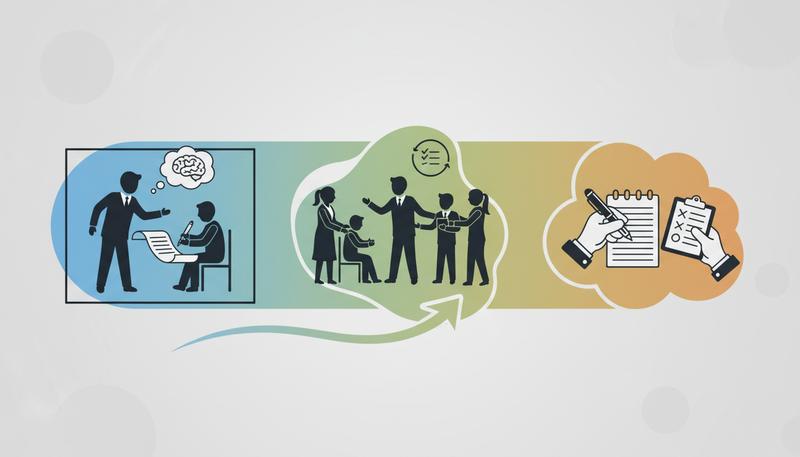
The Deeper Point: Ethics as Relationship
It would be easy to read all of this and feel like ethics is a list of hoops to jump through before you get to the real work. It isn't.
The ethical approach to oral history — the transparency, the genuine consent, the respect for your narrator's right to control their own story — is itself an expression of what this whole project is for. You are not extracting information from your family members like a journalist looking for a story. You are collaborating with them to create a record of their lives that they can feel proud of. The ethics are the relationship.
When your grandmother knows that you asked her permission, that you explained what you'd do with her words, that she can tell you to turn off the recorder anytime, that you won't share anything without giving her a chance to review it first — she will tell you things she would never have told you otherwise. The ethical container you create is what makes the depth possible.
The Oral History Association's guidelines frame this well: the process of engaging narrators and securing informed consent is "important in establishing rapport between interviewer and narrator and allowing for clear communication." Rapport. That's the word. Not compliance, not legal protection — rapport. The forms and the conversations and the explicit permissions are how you build the trust that makes the real conversation possible.
That's not bureaucracy. That's love, made operational.
Only visible to you
Sign in to take notes.