How to Conduct a Family Oral History Interview
In the Room: How to Conduct the Interview Itself
You've prepared meticulously. The room is ready, the equipment is tested, consent is secured. But now — sitting across from your grandmother, your uncle, or the neighbor who watched the neighborhood transform over sixty years — the recorder is running, and none of that preparation matters as much as what happens next.
This is the threshold between planning and presence. Everything you've done until now has been in service of this moment, but the moment itself requires something different than checklists and intention. It requires you to step back and make room for genuine listening. The best interviews aren't won by the best questions. They're won when the narrator feels truly heard — when someone, often for the first time in their lives, has made space for their whole story. Your job in the room isn't to manage a script or execute a plan. It's to be fully present enough that your narrator can be fully present too.
This section walks you through what that presence actually looks like, moment by moment — starting with the first thing you do before you even ask your first question.
Active Listening: The Underpinning of Everything
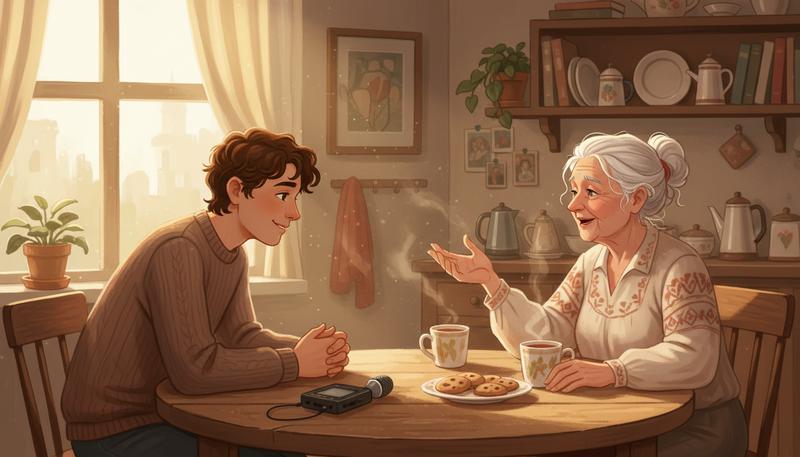
Before the questions begin, something more fundamental happens. You listen. Not the way you half-listen to your phone while checking email. Real listening — the kind that another human being can feel.
Here's what active listening looks like in practice:
Make eye contact, but not laser-beam eye contact. You want to be present and engaged, not staring. Think of the soft, relaxed attention you give to a friend telling you a story over dinner. Glance at your notes occasionally — that's natural — but return to their face. When narrators look up from their own thoughts, they need to see that you're still there.
Nod, but don't perform nodding. Small, genuine nods signal "I'm with you." Exaggerated, rhythmic bobbing signals impatience or an urge to move on. If you catch yourself nodding in a pattern rather than in response to something specific, stop.
Lean slightly forward. This is subtle but real. Sitting slightly forward communicates engagement. Sitting back, arms crossed, signals evaluation or distance. You don't have to perch on the edge of your chair — just an incline of the torso, toward the story.
Keep your hands visible and still. Fidgeting with a pen, phone, or ring pulls your narrator's attention (and your own). Put your hands in your lap, or on the table, and let them rest.
Suppress your own reactions until they finish. This is the hard one. When something surprising or moving comes up, our instinct is to exclaim — "Oh wow!" or "No way!" or to jump in with a follow-up question. In casual conversation this is fine. In an interview, it interrupts the narrator's train of thought at exactly the wrong moment. Let them complete the sentence. Let them complete the thought. Then respond.
KQED's guide to interviewing family members like an oral historian quotes oral historian Roger Eardley-Pryor on the importance of seeing your interviewees as collaborators — and collaboration requires that kind of attentive, unhurried presence. You can't collaborate with someone you're rushing past.
Following the Narrator vs. Following Your Questions
You prepared a question list. Probably a good one. Now comes the hardest instruction in this whole course: hold it loosely.
Here's the mistake that happens all the time with well-prepared interviewers: they get so committed to their list that they stop actually listening to the person in front of them. The narrator finishes a story about leaving their home country, and instead of following that thread — What were you thinking on the boat? What did you bring with you? Was there a moment you thought about turning back? — the interviewer glances at their notes and asks, "So, let's talk about your first job."
The narrator just offered you a door. You walked past it.
Your question list is a skeleton, not a script. It's what you fall back on if the conversation loses momentum or if you've covered something substantial and genuinely need direction. But in a flowing interview, many of your best questions will emerge organically from what's just been said — the detail that seems small but is clearly significant, the word choice that hints at complicated feelings, the moment your narrator pauses and looks somewhere else.
Think of your questions in two categories:
- Anchor questions — the big, important topics you need to cover before the session ends. You'll return to these if you need to.
- Responsive questions — the follow-ups that emerge from what's actually being said. These are often the questions that produce your most memorable material.
Trust the responsive questions. They're the ones that say: I heard what you just said, and I want to know more. Narrators feel that kind of attention.
graph TD
    A[Narrator begins speaking] --> B{Does their story open a new thread?}
    B -->|Yes| C[Follow the thread with responsive questions]
    B -->|No| D{Have anchor topics been covered?}
    D -->|Yes| E[Move naturally to next anchor topic]
    D -->|No| F[Bridge back to uncovered anchor topic]
    C --> G{Thread exhausted?}
    G -->|Yes| D
    G -->|No| C
Productive Tangents vs. Derailing Digressions
Not all departures from your outline are equal — and here's the nuance that trips up beginners.
Some "tangents" are actually the interview handing you something better than you planned. Your narrator starts answering a question about their mother and slides into a long story about the church they attended as children. Suddenly you're hearing about community, belonging, faith, immigration, and family all woven together in a single memory. That's not a tangent. That's richness. Follow it.
Other tangents are genuine departures — a narrator who loops back to the same grievance repeatedly, who drifts into extended commentary on current events with no connection to their personal history, or who loses the thread so completely that the conversation isn't generating useful material anymore.
The question to ask yourself is: Is this going somewhere? Not "is this where I planned to go?" but "is there genuine content here that illuminates their experience?" If yes, follow it. If no, redirect gently.
Redirection, done well, doesn't feel rude. It actually signals that you're taking the interview seriously — that their time matters. The softest version sounds like:
"I want to make sure we get to talk about [topic] before we run out of time — would it be okay if we came back to that?"
Or:
"That's really interesting — I'd love to hear more about that in a moment. But going back to what you were saying about [specific detail they mentioned earlier]..."
Notice what both do: they don't dismiss what the narrator just said. They acknowledge it. They signal that it has value. Then they steer.
The Smithsonian oral history program's Six R's framework includes "Restraint" as a core principle — and this is exactly what restraint means in practice. Not restraining your narrator, but restraining your own urge to either chase every tangent or rigidly stick to your list.
The Art of the Pause
This is the technique that separates competent interviewers from great ones. And it costs you nothing except the willingness to be briefly uncomfortable.
When your narrator finishes an answer, wait.
Not forever. Not awkwardly long. But three to five seconds longer than feels natural. Because what often happens in that silence is one of two things:
-
Your narrator keeps going. They were pausing to gather a thought, and in the quiet, they find it — the detail they almost left out, the qualification they needed to make, the memory they were circling around. Some of the most valuable content in an entire oral history interview comes after what sounds like the end of an answer.
-
You think of a better follow-up question. The pause gives you a moment to actually process what was said rather than immediately reaching for the next item on your list.
We're culturally trained to fill silence. Silences feel like failures, like gaps, like problems to be solved. In an interview context, they're often the opposite. They're invitations.
The Smithsonian's guidance on good oral history emphasizes "listening closely without interrupting" as a core practice — and the pause is the physical expression of that principle. You're not just refraining from talking; you're making room.
If this feels unnatural to you, practice it first. Have a low-stakes conversation with a friend and try extending your pauses by a few seconds. Notice how strange it feels initially, and then notice what actually happens after that awkwardness passes.
When You Don't Understand Something
At some point in almost every interview, a narrator will say something you don't quite follow — a name you didn't catch, a place reference you don't recognize, a word in another language, a reference to a person or event you have no context for.
Your instinct might be to nod along and figure it out later. Don't do it.
The interview is your best and only opportunity to get clarification. Later, when you're listening to the recording alone, you won't have the ability to ask. And names, places, and specific details are exactly what makes an oral history record useful — both to your family and to anyone who might research it later.
The trick is asking without breaking the flow. There are two good moments:
In the moment, briefly, if the detail matters for what follows. Something like: "Sorry — can you say that name again? I want to make sure I have it right." This is always appropriate. It also signals that you're paying close attention, which most people find gratifying.
At the end of a natural section. If the narrator is in full flow and stopping them would interrupt something important, make a quick note and return to it: "Going back to something you mentioned a few minutes ago — you referenced someone named [name]. Can you tell me a bit more about who they were?"
Don't be embarrassed to ask for clarification. Your narrator has lived with this material for decades. What's obvious to them may be entirely opaque to you — and getting details wrong in your transcription or your notes serves neither of you.
Handling Emotion: Tears, Anger, Laughter, and Long Silences
Emotions will arise in the room. Plan for this.
An interviewer who panics at the first sign of tears — who rushes to offer tissues, to change the subject, to reassure — is well-meaning but inadvertently sends the message that the emotion is a problem to be managed. It isn't. It's often the truest, most important thing happening.
Here's a practical framework for different kinds of emotional moments:
Tears. Let them come. A box of tissues placed nearby (not thrust at the narrator) is a kindness. Wait. When your narrator is ready to continue, a soft "take your time" is enough. If they seem stuck, you might gently ask: "Would you like to keep going, or would you like a short break?" Give them the choice. But don't automatically redirect away from the topic that produced the tears — that topic is often exactly what the interview most needs to explore.
Anger. Sometimes narrators become angry — at historical injustice, at specific people, at their own inability to fully articulate something. This anger is legitimate. Don't try to neutralize it or calm it down. Acknowledge it: "That sounds incredibly frustrating." Let them sit in it if they need to. The goal isn't a comfortable interview. The goal is an honest one.
Laughter. This is easy to mishandle in the other direction. When a narrator finds humor in their story — and many do, even about difficult things — lean into it. Laugh with them. Don't treat moments of levity as a distraction from the "serious" work. Humor is often how people have survived. It's part of the story.
Long silences. These are different from the short pauses described above. A long silence — ten, twenty, thirty seconds — often means your narrator is somewhere else, inside a memory or a feeling that's difficult to put into words. Don't rush them. Don't fill it. Just wait. When they return, a quiet "take your time" or your continued, patient presence is the right response.
The Smithsonian's oral history guidelines describe the role of the interviewer as creating a situation "in which the interviewee is able to reflect widely, to recall fully, and to associate freely" — and emotional safety is the ground that makes that possible. You're not there to produce a clean, tidy recording. You're there to hold space for the full human complexity of someone's life.
Keeping Track of Time Without Making Anyone Feel Rushed
Most oral history sessions work best in the sixty- to ninety-minute range. Beyond that, narrators tire — their recall becomes less precise, their energy flags, and the interview starts to produce diminishing returns. (There are exceptions: some narrators are energized by the attention and could go for hours. Read the room.)
You need to track time, but the way you do it matters. Glancing repeatedly at your watch or phone signals to your narrator that you're thinking about something other than them. Here's how to handle it:
- Set a gentle timer on your phone and put the phone face-down. You'll feel the vibration when time is running short, without having to look.
- At the 45-minute mark, mentally assess. What anchor topics have you covered? What's still essential? This is when you start prioritizing, steering away from extended tangents and moving toward anything you haven't yet touched.
- At the 75-minute mark, begin thinking about your close. You should be wrapping up, not starting new major topics.
If a narrator is clearly fatigued before the time is up, close early. A tired narrator gives you less useful material. Ending on a high note — when they still feel good about the conversation — leaves the door open for a second session.
The Smithsonian's principle of "Retreat" speaks directly to this: close each session before fatigue sets in, and plan sessions so they conclude at natural resting points. It's not just considerate — it produces better recordings.
Circling Back: Returning to What Got Glossed Over
Some things get mentioned and then pass by before you can explore them. A narrator says "there was a period I'd rather not get into" and moves on. Or they refer to a person in a way that suggests enormous significance, but the moment passed before you could ask. Or they said something in the first twenty minutes that you didn't quite understand the importance of until thirty minutes later.
Circling back is a skill, and it's an important one.
The cleanest way to do it is the explicit callback: "I want to go back to something you mentioned earlier — you said [specific thing]. I'd love to hear more about that if you're willing."
The specificity matters here. "Earlier you mentioned something about your father" is vague and puts the narrator in the position of figuring out what you mean. "Earlier you said there was a period after the factory closed when things got very hard — I was hoping we could talk a bit more about that time" tells them exactly where you're pointing.
For topics the narrator deflected from, approach gently and give them genuine choice. You might say: "I noticed you mentioned [topic] but moved on — I wanted to check in about whether that's something you'd be willing to talk more about. It's completely up to you." Sometimes the answer is no, and that's legitimate. Sometimes the act of being explicitly invited back to something difficult is exactly what allows a narrator to go there.
The Closing Ritual
Don't just stop. Close intentionally.
A well-closed interview has a few key components:
The deflationary question. This is borrowed from professional oral history practice — ask something that allows the narrator to step back from the emotional intensity of the conversation and reflect from a higher vantage. Classic versions include:
- "Looking back on everything we've talked about, what do you think has mattered most?"
- "What do you hope the people who hear this will understand?"
- "Is there anything you wish I had asked that I didn't?"
That last one is particularly powerful. It gives the narrator agency. It invites them to fill in whatever feels most important to them — and often they will, and it's often something you never would have thought to ask.
The statement of gratitude. Not a quick "thanks, that was great," but something that acknowledges what actually happened in the room. "I want to say how much I appreciate you sharing all of this with me. Some of it clearly wasn't easy, and I'm really grateful you trusted me with it."
If you mean it — and you probably will — say so.
The formal close on the recording. Before you stop the recorder, capture a verbal close: "This concludes the interview with [name], conducted on [date]." This mirrors the opening slate and creates a clear endpoint in the archive.
Then stop the recording.
After the Recording Stops: The Off-the-Record Conversation
Here's something that catches beginners off guard: some of the most interesting things your narrator says will come after you turn off the recorder.
The end of the formal interview often releases something. The narrator relaxes. The pressure of "being recorded" lifts. And in that relaxation, stories emerge — the thing they weren't sure they should say, the detail they forgot, the context they assumed you knew. Occasionally this off-the-record conversation is the most candid of the entire visit.
What do you do with it?
First, be clear in your own mind about its status. You turned off the recorder. This conversation is off the record. Don't secretly restart the recording or take casual notes as if you're documenting it. That's a betrayal of trust, and trust is the foundation of this project.
But — and this is important — as soon as you leave, write down everything you can remember from that conversation. Not to publish or share it without permission, but for your own process notes. Note what was said, your impressions, anything that might inform a future interview or help you understand the larger arc of what you're capturing.
Sometimes what comes up after the recorder stops is so significant that you might gently ask: "Would you be willing to say that on record? I think it's really important." Ask. The narrator can say no. But sometimes they'll say yes, and you can turn the recorder back on, re-slate it briefly, and capture what you almost lost.
Keep notes on your impressions of the whole session — how the narrator seemed, what felt significant, what surprised you, what you wish you had asked differently. These field notes become part of your oral history archive, not just housekeeping.
Putting It All Together: Presence as the Core Skill
If you read this section and felt slightly overwhelmed by the number of things to track — body language, pause timing, emotional response, time management, circling back, closing — take a breath. You don't execute all of these as a mental checklist in real time. They're more like the kind of preparation that an athlete does before a game: you internalize them so that, when the moment comes, they're just part of how you move.
And here's the deepest truth about conducting a good interview: show up and care. Your narrator will feel whether you're genuinely interested in their life or going through the motions. They will feel whether you're listening or waiting for your turn to ask the next question. They will feel whether this conversation matters to you.
It does matter. The stories in that room — the ones about the crossing, the war years, the first apartment, the ordinary Tuesday that turned out to be the last ordinary Tuesday for a long time — are irreplaceable. No document preserves what a recorded voice preserves. No photograph captures what a narrator captures when they say, in their own words, in their own rhythm: here is what it was like to be me, in that place, at that time.
You asked. They came. The recorder is running. Everything else follows from that.
Only visible to you
Sign in to take notes.