Planning Your Family Oral History Project
You feel the urgency now. The clock is ticking, and you know it. Your grandmother won't be around forever. Your grandfather's stories are already becoming harder to reach. You're ready to ask. But then something happens: you sit down to actually plan this project, and a particular kind of paralysis sets in. Where do I start? Who should I talk to first? Should I interview everyone? Should I get all the cousins together? Do I need special equipment? The questions multiply until the whole thing feels so overwhelming that it never actually begins.
This is the moment where many well-intentioned oral history projects stall out — not because the urgency disappeared, but because the scope suddenly feels impossibly large. That's what this section is for. By the end of it, you'll have a realistic scope, a clear sense of who your most important narrators are, and enough of a concrete plan to actually take the first step. Not a perfect plan. Not a comprehensive family archive worthy of the Smithsonian. Just enough of a plan to actually begin — because as we learned in the previous section, a single well-recorded interview beats a perfectly designed twelve-person project that never gets off the ground.
The good news? The decisions you need to make right now are simpler than they feel. And the first one — the one that determines whether this project lives or dies — is surprisingly straightforward to answer.
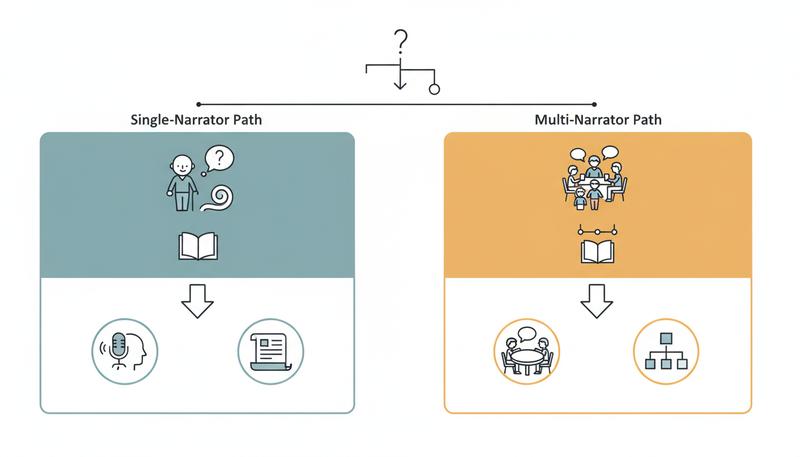
The practical solution: plan for one, remain open to more. Identify your first narrator, commit to conducting and completing that interview, and revisit your scope afterward. You're not closing any doors. You're choosing to open one.
The Urgency Calculus: Who to Interview First
If you have multiple potential narrators — a great-uncle in his late eighties, a parent in their sixties, a cousin who witnessed something extraordinary — you need a framework for prioritizing. The Oral History Association's best practices advise choosing narrators based on the relevance of their experiences, but in family oral history, there's another dimension that professional archivists don't always name plainly: mortality risk.
This sounds harsh. It is also necessary.
Think about your potential narrators through this lens:
Age and health. This is the obvious variable, and it's the one we often avoid looking at directly because it forces us to confront loss. But a narrator in their late eighties or nineties, regardless of how sharp they seem today, is statistically closer to the end of their story. Cognitive changes — which can arrive suddenly — can make interview participation difficult or impossible. Physical illness, even something as mundane as a long hospitalization, can permanently close a window that felt open last month.
The uniqueness of their story. Some family members are the sole keepers of certain knowledge. Maybe your grandmother is the only surviving person who experienced your family's immigration journey firsthand. Maybe your uncle is the only one who knew your grandfather's early years before the family changed its name. When a story exists in exactly one person's memory, the urgency becomes absolute.
Their willingness and current openness. Oral history is a collaborative act. [As UC Berkeley oral historian Roger Eardley-Pryor advises](https://www.kqed.org/news/12042147/how-to-interview-your-family-members-like-an-oral-historian), you should see your narrators as collaborators from the start. Some family members who are willing to talk today may grow more reticent over time, as they age or as family dynamics shift. A current window of openness is worth acting on.
The chain of knowledge they hold. Sometimes the highest-priority narrator isn't the oldest. A middle-generation family member might be the keeper of stories passed down from grandparents who are already gone. Interview them before those second-hand accounts fade further.
Here's a simple way to run the urgency calculus. For each potential narrator, score them on these three factors (1-3, with 3 being highest urgency):
graph TD
    A[Potential Narrator] --> B{Age/Health Risk}
    A --> C{Story Uniqueness}
    A --> D{Current Openness}
    B --> E[Score 1-3]
    C --> F[Score 1-3]
    D --> G[Score 1-3]
    E --> H[Add Scores]
    F --> H
    G --> H
    H --> I[Highest Total = Interview First]
The narrator with the highest combined score gets your first interview. This isn't a cold calculus — it's a loving one. It's how you ensure you don't lose the most irreplaceable before you've captured them.
Life-History Interviews vs. Thematic Interviews
Once you've identified your narrator, you face a second major decision: what kind of interview are you trying to conduct? There are two fundamental approaches, and understanding the difference will shape everything from your questions to how long you'll need.
The life-history interview is exactly what it sounds like: a comprehensive attempt to capture a person's life from beginning to present. These interviews typically start with early childhood and move forward chronologically, covering formative experiences, major life transitions, work, relationships, family, and the narrator's sense of their own meaning-making. They require multiple sessions — typically two to four hours of recording time at minimum, often spread across several meetings — and demand significant preparation.
The life-history approach produces something close to complete when done well. The narrator becomes a full person on the recording, not just a voice talking about one chapter. Listeners in future generations can understand not just what happened but who this person was.
The trade-off is scope. Life-history interviews can feel overwhelming to prepare for, and they ask more of your narrator too — longer sessions, more emotional territory covered, greater stamina required.
Thematic or event-focused interviews are narrower by design. Instead of trying to capture an entire life, you focus on a specific period, event, or domain of experience. Examples:
- "I want to record everything you remember about coming to this country"
- "Tell me about what it was like to run the family business during those years"
- "I want to understand what your childhood was like during the Depression"
- "Let's talk about how you and Grandpa met and your early years together"
Thematic interviews are often more achievable, especially for a first project. They can be completed in a single sitting. They allow you to prepare targeted questions. And here's something that might surprise you: a focused interview often produces richer material than an unfocused one — because both you and your narrator know exactly what territory you're exploring.
The Smithsonian Folklife and Oral History Interviewing Guide notes that folklorists often begin with specific traditions, practices, and knowledge rather than life histories — asking about foodways, celebrations, occupational skills, family customs. These thematic entry points are often easier for narrators to talk about than their lives in the abstract. "Tell me about the holiday foods your mother made" is less daunting than "Tell me about your life."
Which should you choose? If your narrator is elderly and this may be your only extended opportunity, lean toward a broader life-history approach. You may not get another chance, and you want to capture the whole person. If your narrator is younger, healthier, and open to future conversations, a thematic approach lets you start small and return repeatedly. You can build a life history one theme at a time across multiple conversations.
There's also a third approach that many practitioners love: start with one compelling theme and let it bloom outward. Nicole Wong, the Oakland author who documented Mahjong traditions within the Asian diaspora, began with a focused question about game rules and discovered that whole dimensions of family history lived inside the game. A single thematic thread — "how did your family play Mahjong?" — opened into immigration stories, memory, identity, and intergenerational change. You can plan a narrow interview and follow what emerges.
How to Frame the Project to Skeptical Family Members
Here's something that almost nobody talks about in oral history guides: many family members don't immediately want to be interviewed. They deflect. They say "my life isn't interesting." They say "you don't want to hear about that." Some have complicated reasons — painful memories, a sense of shame about certain chapters of their lives, anxiety about how they'll come across on a recording. Others are simply modest. And some have had bad experiences being interrogated by curious relatives and assume this will feel the same.
Your job, before you ever press record, is to frame the project in a way that invites participation without pressure.
Lead with love, not legacy. "I want to preserve your story for future generations" can sound abstract and slightly clinical, like you're treating them as a historical artifact. Compare that to "I've realized I don't know much about your childhood, and I want to hear about it from you before I lose the chance." The second framing is personal, relational, and honest. It says: I want this for me, because I love you and I'm running out of time with you.
Lower the stakes. Many people imagine a formal interview and feel stage fright. Counter that image immediately. Tell them it's a conversation. Tell them there are no right answers. Tell them you're not a journalist and this isn't an interrogation — you're just curious about their life. Maggie MarkdaSilva of Narrative Histories notes that [a common reaction when people learn about family story recording services is "Oh, I am so sorry I didn't find you before it was too late"](https://www.kqed.org/news/12042147/how-to-interview-your-family-members-like-an-oral-historian) — meaning most people, when given the chance, wish they'd done this. Your narrator probably wants this too, even if they're uncertain.
Let them have control. One of the most effective things you can say is: "You don't have to talk about anything you don't want to. If I ask something you'd rather not get into, just tell me and we'll move on." This simple assurance removes enormous resistance. People who fear being pressed into painful territory relax considerably when they understand they hold the power to redirect.
Try a soft start. Rather than beginning with a formal recorded session, propose a casual conversation first — over coffee, during a walk, at a family dinner. Ask one question you're genuinely curious about and listen to what unfolds. This serves two purposes: it warms up the narrator and gives them a taste of what the conversation will feel like, and it gives you invaluable material for preparing your actual questions. Many of the best oral history interviews began as "I just want to show you what this might look like" conversations.
Name the gift explicitly. Some people respond well to being told: "I want to give this to our family." The idea that their stories will outlast them, will be heard by grandchildren not yet born, can be profoundly meaningful. Others are embarrassed by that framing. Know your narrator. If they're the kind of person who would be moved by legacy, speak to that. If they're constitutionally modest, stick with the relational angle: I want this for myself.
The Role of Pre-Interview Research
One of the most common mistakes first-time oral historians make is sitting down with a recorder and expecting the narrator to do all the work. Good interviews require preparation — not to control the conversation, but to enrich it.
The Oral History Association's best practices are unambiguous on this point: interviewers should become familiar with the person, topic, and historical context through research in primary and secondary sources before they conduct the interview.
What does that mean in practice?
Research their era. If your grandmother grew up in the 1940s American South, know something about what life was like in that time and place — segregation, the war economy, rural poverty, what schools looked like. If your grandfather immigrated in the 1970s, understand what was happening in his home country that might have driven that decision. This context lets you ask informed follow-up questions and, crucially, lets you recognize what's significant when you hear it.
Look at photographs, documents, and family records before the interview. Old photos are extraordinary interview preparation. Looking at a picture of your grandfather as a young man working on a farm tells you things that no family story has — the clothes people wore, the physical environment they inhabited, who else was present. Bring those photos to the interview. Many narrators who struggle to find verbal entry points into their memories unlock immediately when they hold an old photograph.
Talk to other family members first. If you're planning to interview your grandmother, have a casual conversation with your mother first. Ask what she knows about her mother's childhood, what questions she's always wondered about, what family stories have circulated. This gives you context and also gives you the questions the whole family is carrying. When you ask your grandmother about something that the whole family has always wondered — and she sees you understand the significance of the question — the interview deepens.
Learn the places. Geographic research sounds like overkill, but it pays off in interviews. If your narrator grew up in a specific town, city, or neighborhood, look it up. Know the geography, the local economy, whether that place still exists or has changed dramatically. When you can say, "So you grew up near the waterfront — what was that neighborhood like back then?", you signal to your narrator that you care enough to have paid attention.
Don't let research become procrastination. The goal is informed curiosity, not encyclopedic knowledge. You want enough context to ask real questions and recognize meaningful answers. You don't need a PhD.
Setting Realistic Expectations: The One Great Interview Standard
Here's a statement worth printing and taping to your wall: One great interview is worth more than twelve mediocre ones.
This is the practitioner's hardest-won wisdom. Oral history projects die from overreach more often than from any other cause. Someone decides to document their entire extended family across four generations, schedules twelve interviews over three months, and by interview number three — when life has intervened and the transcription of interview one is still sitting in a folder unopened — the whole project collapses under its own weight. Six months later, the narrator who was interview number seven has died, and the window is closed forever.
The antidote is radical scope reduction. Ask yourself: if I could only complete one interview — one — who would it be and what would I most want to know? That's your project. That's where you start.
"Don't worry that you don't know what you're doing," Maggie MarkdaSilva of Narrative Histories advises. "Anything you capture is going to be better than nothing." This is liberating. It means the bar for a "successful" oral history project is lower than you think. One person, sitting in a comfortable chair, telling you about their life on a recording that will survive them — that is a complete success. Everything else is bonus.
Practically speaking, here's what a realistic scope looks like for a first-time oral historian:
- One narrator (identified by urgency calculus)
- One to three sessions, totaling two to four hours of recording
- One thematic focus or one life-history arc (not both at once)
- Simple recording setup (more on this in later sections, but a phone on a quiet table is enough to start)
- Timeline of two to six months from project decision to completed interview
That's it. That's the whole project. If you complete it, you've preserved something irreplaceable. If you get momentum and want to do more, wonderful. But the project is a success the moment you finish one great interview.
Family Gatherings as Interview Windows
Family reunions, holiday gatherings, and milestone events create natural opportunities for oral history work that don't require anyone to set up a "formal" interview session. If you approach these gatherings with a little preparation, you can capture significant material in settings that feel completely natural.
A few approaches that work well:
The casual sit-down. After the meal, when energy is slower and people are feeling warm and connected, find your way to the narrator you've been wanting to talk to. Bring your phone, say "I've been wanting to ask you about X" and let the conversation unfold. You're not conducting a formal interview — you're having a conversation that happens to be recorded.
The photo album gambit. Family gatherings often produce old photos — someone brings an album, a box of prints gets passed around. Make yourself available to sit with the narrator who knew those people. "Who is this?" is the simplest oral history question in the world, and photo sessions can unlock memories that nothing else reaches.
The multi-narrator strategy. If you do want to interview more than one person and a gathering provides the opportunity, use a staggered approach. Brief conversations with several people can help you identify who has the richest material, who is most comfortable talking, and who should become your primary narrator for a more formal session.
Film everything, even badly. At family gatherings, don't wait for perfect conditions. A slightly noisy, imperfectly framed video of your great-uncle telling a story at the dinner table is infinitely more valuable than nothing. The goal at a gathering isn't archival quality — it's capture. You can always do a proper interview later; you can't always get another gathering.
One practical note: if you're planning to use gathering moments as oral history opportunities, do some light preparation in advance. Know which two or three questions you most want to ask each potential narrator. Have your recording device charged and ready. The window at a gathering is often short — an aunt who's expansive and relaxed at 3pm might be tired and ready to leave by 5pm. Having your questions ready means you're not fumbling when the moment opens.
Creating a Simple Project Plan (Without Overcomplicating It)
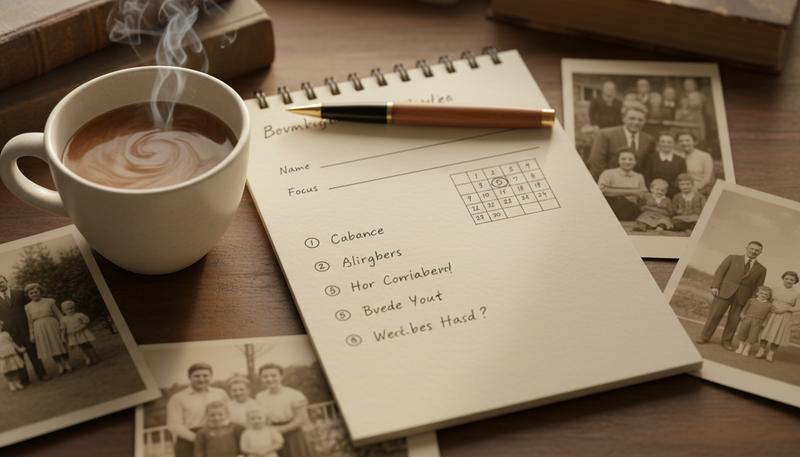
The word "plan" makes some people reach for spreadsheets and project management software. Resist that impulse entirely. For a first oral history project, your plan should fit on one page — or one index card.
Here's what it needs to contain:
Narrator name and relationship. Who you're interviewing.
Priority rationale. One sentence on why this person, why now.
Interview type. Life history or thematic focus? If thematic, name the theme.
Target session count and length. One session of 90 minutes? Two sessions of 60 minutes each?
Proposed dates. Not "sometime in the spring." Actual proposed dates, even if they change.
Three to five anchor questions. The questions you absolutely want to ask, no matter what else happens. (More on question development in Section 6, but start identifying these now.)
Who else you'll talk to first. Two or three family members to consult before the interview, for context and questions.
How you'll record. Even a placeholder is fine: "phone" or "borrow cousin's recorder."
That is your complete project plan. The Oral History Association recommends that oral historians outline a process appropriate for their projects and narrators — but appropriate is doing a lot of work in that sentence. For a first-time family oral historian, appropriate means something simple enough to actually execute.
The hardest part of any project plan isn't writing it — it's treating it as a real commitment rather than an aspiration. When you write down a date, put it in your calendar. When you say you'll call three family members for pre-interview conversations, do it this week. Momentum is fragile at the start of a project. The plan is only as good as the first concrete action it produces.
A Word About the Stories You Think You Already Know
One final thing, before you move to the next section: be suspicious of the stories you think you already know.
Every family has its canonical stories — the ones that get told at every reunion, the ones that have been polished by repetition into almost-myths. Your grandfather's famous story about the blizzard. Your grandmother's account of meeting your grandfather. The immigration story that has been compressed into a five-minute narrative everyone can recite.
These are not the stories you're looking for.
The stories you're looking for live underneath them. They're the ones that never quite made it into the family repertoire — the daily textures, the small humiliations and private joys, the relationships and feelings and doubts that don't fit neatly into a table-ready anecdote. They're what your grandmother really felt when she arrived in a new country. They're the parts of the blizzard story that never get told.
When you scope your project, resist the temptation to treat the canonical stories as sufficient. They're starting points, not destinations. The goal of your project is to get underneath them — to find the full, complicated, deeply human experience beneath the family legend. That's what oral history uniquely can do, and it's why even families who think they already know their stories discover they didn't, not really, until someone sat down and asked.
Only visible to you
Sign in to take notes.