Why Recording Family Oral History Is Urgent
The Clock Is Ticking: Why Oral History Is One of the Most Urgent Things You'll Ever Do
You now understand the stakes. Someone you love is a library — a single building holding only surviving copies of certain irreplaceable things: what it smelled like, how it felt, what was said in moments that never made it into any official record. And there's urgency here. The empty chair comes eventually. The questions you meant to ask don't get asked. This course exists in the space between those two moments — between the realization that this matters and the moment it's too late.
But before we start thinking about equipment or planning interviews, we need to get clear on what we're actually doing. "Oral history" sounds simple enough, but it carries a specific meaning that will shape everything that follows. Let's nail this down — not to make it sound more academic, but because understanding exactly what oral history is will help you recognize what you're creating and why it matters differently than a family story told over dinner.
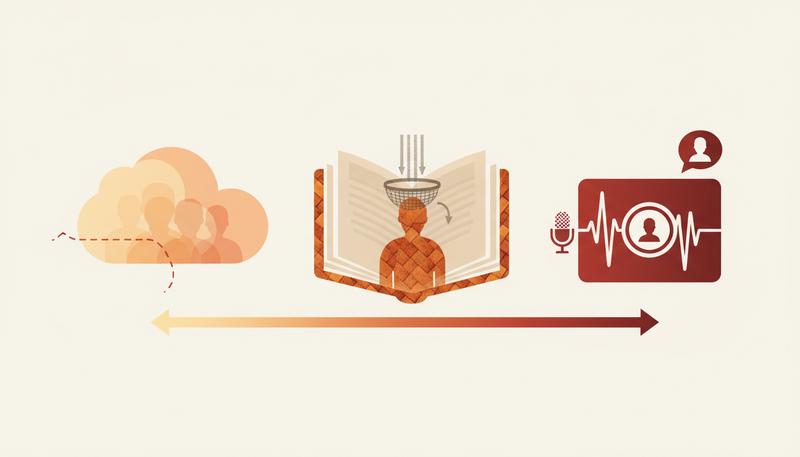
The Smithsonian's guide makes another point that serious oral historians keep hammering on: a proper oral history interview preserves the entire interview in its original form, not the interviewer's interpretation of what was said. This is crucial. When you transcribe or summarize, you're already making choices — emphasizing this detail, letting that one drift away. But the recording holds everything: the thing your narrator almost said before catching herself, the long pause before answering a question about her first marriage, the moment she starts crying while describing something she insists she's made peace with. These aren't just nice color commentary. They're the history.
The Difference Between Remembering and Documenting
Here's a thought experiment. Imagine you know, right now, five things that only you know. Maybe it's the specific sequence of events that led to a decision that changed your family's path. Maybe it's what your parent said to you privately the night before your wedding. Maybe it's what happened on a particular afternoon that no one else witnessed.
When you die, those five things die with you.
This isn't morbid speculation. It's the daily reality of how human history actually works. As the Smithsonian Folklife and Oral History Interviewing Guide describes, the people in our families and communities are "living links in the historical chain, eye witnesses to history, shapers of a vital and indigenous way of life" — and they are, as folklorist Barbara Kirshenblatt-Gimblett writes, "unparalleled in the vividness and authenticity they can bring to the study of local history and culture."
The word that matters there is unparalleled. Not "useful." Not "interesting." Unparalleled. There is no substitute.
Think about what lives in the memories of an older family member: the sensory experience of a world that no longer exists, the political atmosphere of a particular place and decade felt from the inside, the way ordinary people made decisions during extraordinary times. Your grandmother who immigrated didn't experience her journey as a historical event. She experienced it as hunger and hope and the sound of a language she didn't speak yet. That lived texture is recorded nowhere else. It exists only in her.
And here's what most people miss: it's not just the dramatic stories that matter.
The immigration narratives, the displacement stories — yes, those are important. But so is knowing that your great-grandfather was funny, that he told a particular kind of joke, that he had strong opinions about bread. So is understanding what your grandmother's relationship with her own mother was really like — not the polished version, but the actual, complicated truth. These ordinary things are what make people real across time, and they're exactly what disappears first.
A Long Tradition of Legitimate History
Some people come to this work with a hesitation they might not even be able to name: a sense that what their family members have to say isn't really history. That history is what's written in books, what's recorded in archives, what happened to important people in important places.
This hesitation has a name: it's called the bias toward official sources, and oral historians have been working against it for decades.
The modern oral history movement in the United States is generally traced to Columbia University historian Allan Nevins, who in 1948 began systematically recording the recollections of prominent figures as primary historical documents. But the deeper tradition is much older — and much more democratic. Before writing became widespread, as UC Berkeley oral historian Roger Eardley-Pryor notes, "most knowledge was through storytelling" and people "held their stories in their memories and passed them down intergenerationally." Oral tradition wasn't a lesser substitute for written records. It was the record.
The Oral History Association, the professional body that sets standards for this work in the United States, treats recorded oral history interviews as legitimate primary source documents — the equivalent of a letter from the front or an entry in a ship's log. Libraries and archives accept them. Historians cite them. University oral history centers have been collecting them since the mid-twentieth century.
What this means for you: the conversation you're about to have with your uncle about his experience during the civil rights movement, or with your grandmother about what it was like to run a small business in the 1970s, or with your father about the year everything fell apart and then somehow came back together — that conversation has documentary value. It's not just meaningful to your family. It's meaningful to anyone, a century from now, who wants to understand what it felt like to be human in this particular time and place.
Who This Course Is For
This course was written for a specific person.
You may have never held a professional microphone. You may feel uncertain about technology, nervous about asking personal questions, or unsure whether the people you want to interview will actually open up. You may be worried you'll say the wrong thing, ask the wrong question, or fail to capture what matters most.
You may also be acutely aware that time is short — that there's someone in your life whose health is declining, whose memory is beginning to slip, whose window of availability isn't unlimited. That awareness, the one that feels a little like low-grade anxiety every time you think about it, is exactly why you're here.
This course is also for people who aren't in crisis mode — who have a grandparent in good health, or a parent who is sharp and vigorous at seventy-five, but who understand intuitively that "good health" and "plenty of time" aren't the same thing. The best moment to do this work is before urgency forces your hand. The second-best moment is right now, even if urgency already has.
Maggie MarkdaSilva of Narrative Histories captures this precisely: when people hear what her organization does, the most common reaction is, "Oh, I am so sorry I didn't find you before it was too late." That sentence — the past tense, the sorrow — is the whole reason this course exists.
By the end of this course, you will be able to:
- Define a clear scope for your oral history project and identify the right people to interview
- Understand your ethical obligations to the people you record and how to obtain meaningful consent
- Prepare substantive, thoughtful questions that open real conversations rather than closing them
- Set up a recording situation that produces clear, usable audio without professional equipment
- Conduct an interview with warmth, skill, and the kind of follow-up that surfaces unexpected depth
- Process, organize, and transcribe your recordings so they're actually findable and usable
- Preserve your recordings in formats that will survive the next fifty years of technological change
- Share what you've captured in ways that honor your narrator and reach the people who should hear it
That's a lot. But none of it requires a film degree, a journalism background, or any special talent beyond caring enough to show up.
The Six R's: An Orienting Framework
The Smithsonian Oral History Program uses a framework developed by oral historian Martha Ross that organizes the entire practice into six principles. We'll return to each of these throughout the course, but it's worth introducing them here because they'll act as your compass when you feel lost.
graph TD
    A[RESEARCH<br/>Prepare thoroughly] --> B[RAPPORT<br/>Build trust and connection]
    B --> C[RESTRAINT<br/>Listen more than you speak]
    C --> D[RETREAT<br/>Close well, prevent fatigue]
    D --> E[REVIEW<br/>Analyze and improve]
    E --> F[RECORD<br/>Preserve with intention]
    F --> A
The Smithsonian's Six R's framework works like this:
Research means preparing before you ever sit down to record. Knowing the dates, places, and names relevant to your narrator's life isn't just good practice — it's a form of respect. When you can say "so this was around the time of the factory strike in '68?" you signal that you've taken their life seriously enough to learn about the world they inhabited.
Rapport means establishing the kind of trust that allows someone to speak honestly. This begins before the interview itself — in a phone call, a visit, a letter explaining what you're doing and why. People need to understand the purpose of what you're asking, and they need to feel safe saying yes or no or "I'd rather not discuss that."
Restraint is perhaps the hardest skill for enthusiastic interviewers to develop. The instinct is to jump in, add context, share your own memories, finish their sentences. Good oral history practice means staying quiet. Following up on the unexpected thing rather than the prepared question. Leaving silence when silence wants to be filled.
Retreat means ending each session before your narrator runs out of energy. This is practical advice with real emotional stakes: an exhausted person remembers less, becomes guarded, and may be reluctant to sit down with you again. Leave them wanting to tell you more.
Review means listening back to your recordings critically — not just for transcription purposes, but to understand what you did well and what you'd do differently. Every interview makes you a better interviewer.
Record means preserving the interview with real intention: good file organization, multiple backups, proper archival formats. The saddest outcome in oral history work isn't a bad interview. It's a good one that can't be found or can't be played back twenty years later.
We'll spend significant time on each of these throughout the course. For now, let them serve as a map of the territory ahead.
The Internal Resistance — And Why It's Wrong
Let's address the voice in your head directly.
I'm not a filmmaker. I don't have the right equipment. My recordings will be terrible.
Here's the truth: a conversation recorded on a smartphone in a quiet room, by someone who has prepared thoughtful questions and listens well, is infinitely more valuable than a conversation that never happens because the conditions weren't perfect. The bar for "good enough" is genuinely lower than you think, and we'll cover exactly what that looks like in the equipment and setup sections of this course.
They won't want to talk. They'll think I'm strange for asking. They'll say there's nothing interesting about their life.
This resistance is almost universal among people who haven't yet had the experience of actually sitting down and asking. And it's almost always wrong. Nicole Wong, who spent years interviewing her parents about Mahjong and family history, described the process as "a really meaningful way to talk to my parents and to my aunts and uncles in a way that has felt really different." The conversations that emerge when someone is genuinely asked about their life — not interrogated, not put on a talk show, but asked with real curiosity — are often the most meaningful conversations that person has had in years.
Many older people have been waiting, without knowing it, for someone to finally ask.
What if I ask about something painful? What if I open something I can't close?
This is a real concern, and it gets its own dedicated chapter later in this course. The short answer is: the risk of harm is much lower than most people fear, and there are specific practices — drawn from trauma-informed interviewing approaches — that help you navigate difficult territory with care. The vast majority of people who have lived through hard things aren't fragile when it comes to talking about them. They're often relieved.
What if I don't have time? What if it's too late already?
If you're reading this and someone important to you is still alive, it is not too late. Even a single hour of good recording is worth more than nothing — and nothing is what you'll have if you keep waiting.
Maggie MarkdaSilva's words deserve to echo here: "Don't worry that you don't know what you're doing. Anything you capture is going to be better than nothing and be so valuable to you later on, when your parents or grandparents have passed away."
What Is Lost When the Last Person Dies
I want to sit with this for a moment before we move on, because it's the emotional core of everything that follows.
When the last person who remembers something dies, that thing enters a particular kind of absence. It's not like a book being burned, where you can at least feel the loss of something that once existed in tangible form. It's quieter than that. The story simply doesn't exist anymore. There's no gap on the shelf. There's no smoke. It's just gone, and most of the time, no one even knows what was lost.
This happens every single day, in every family, in every culture, in every country on earth.
The twentieth century alone produced more human experience — more displacement, more war, more migration, more radical transformation of daily life — than any previous century in human history. The people who lived through it, who remember the world before antibiotics and commercial aviation and the internet and the end of empires, are in their eighties and nineties now. Their numbers are declining.
This isn't about preserving the distant past. This is about the grandmother who remembers the smell of her mother's kitchen in a country that no longer exists. The grandfather who was the first in his family to go to college and still remembers exactly what he felt when he walked through those gates. The aunt who ran a business alone when no one thought women did that, who never wrote any of it down, who would tell you everything if you asked.
Ask.
That's the whole argument. Every technique in this course, every piece of advice about microphones and release forms and interview structure, exists in service of that single imperative.
The clock is ticking. Let's begin.
Only visible to you
Sign in to take notes.